

Erosion and Runoff Evaluation in
Goodwater Creek Experimental
Watershed using the SWAT-T Model
Sitarrine Thongpussawal, PhD Candidate
C. Gantzer, Professor, University of Missouri
C. Baffaut, Research hydrologist, USDA- ARS
H. Shao, Fellow, University of Guelph, Canada
Soil & Atmospheric Sciences
University of Missouri
Introduction
• Terracing is a conservation practices to reduce
erosion and intercept runoff from steep lands and is
widely used for soil and water conservation (Dorren and
Rey, 2004; Neibling and Thompson, 1992).
• Chow et al. (1999) indicated terracing sloping fields
in combination with grassed waterways and contour
planting in Canada decreased soil loss from an
average of 20 t/ha to less than 1 t/ha, and reduced
25% of the runoff.
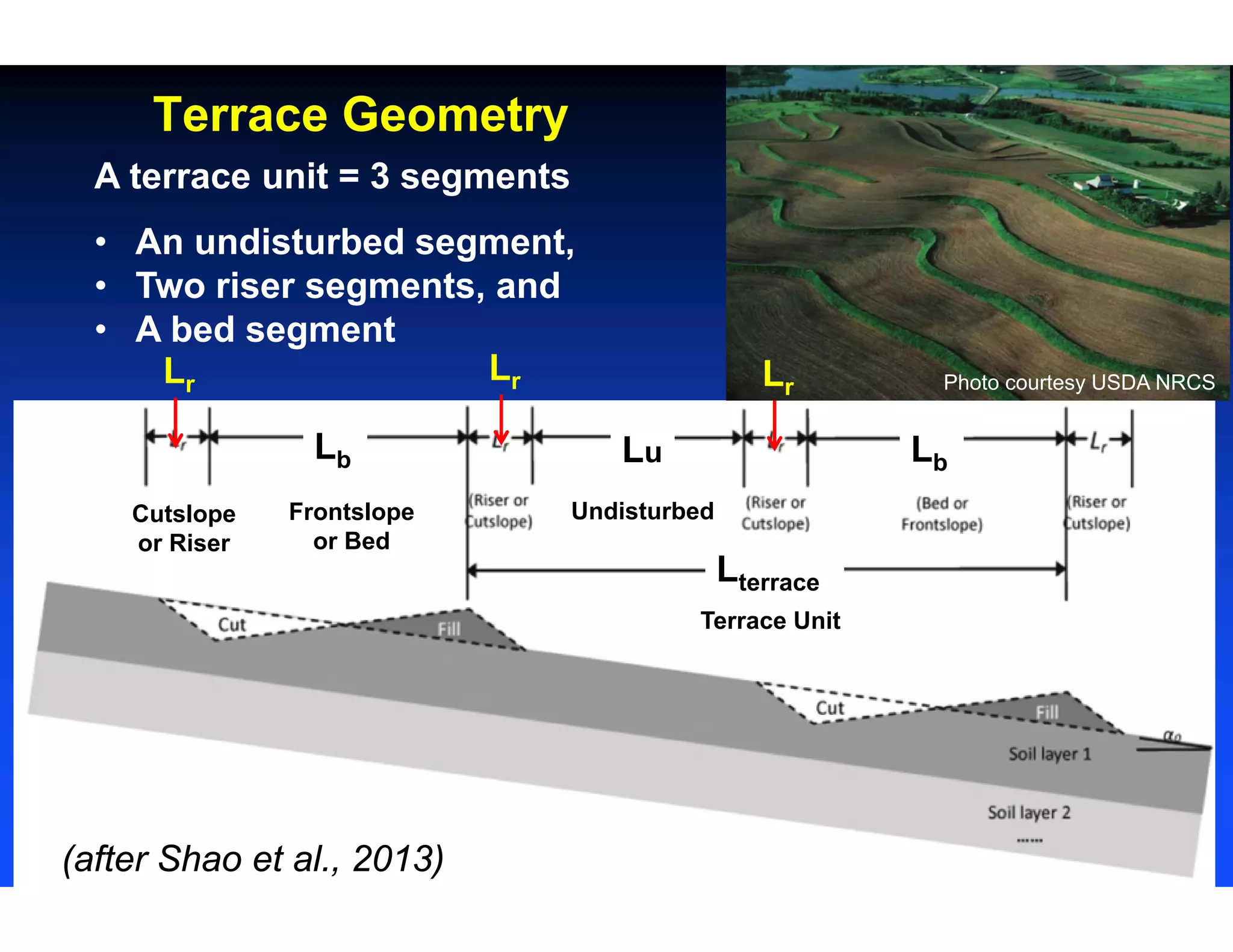
Terrace Geometry
Cutslope
or Riser
Photo courtesy USDA NRCS
(after Shao et al., 2013)
Frontslope
or Bed
Undisturbed
Terrace Unit
LuLb Lb
Lterrace
LrLr Lr
A terrace unit = 3 segments
• An undisturbed segment,
• Two riser segments, and
• A bed segment
What is SWAT-T ?
• “A modified terrace algorithm of Soil and
Water Assessment Tool (SWAT)” developed
by Shao et al. (2013) and incorporated into
SWAT 2009 to simulate the effects of terraces
for difference practices on erosion and runoff
at a watershed scale.
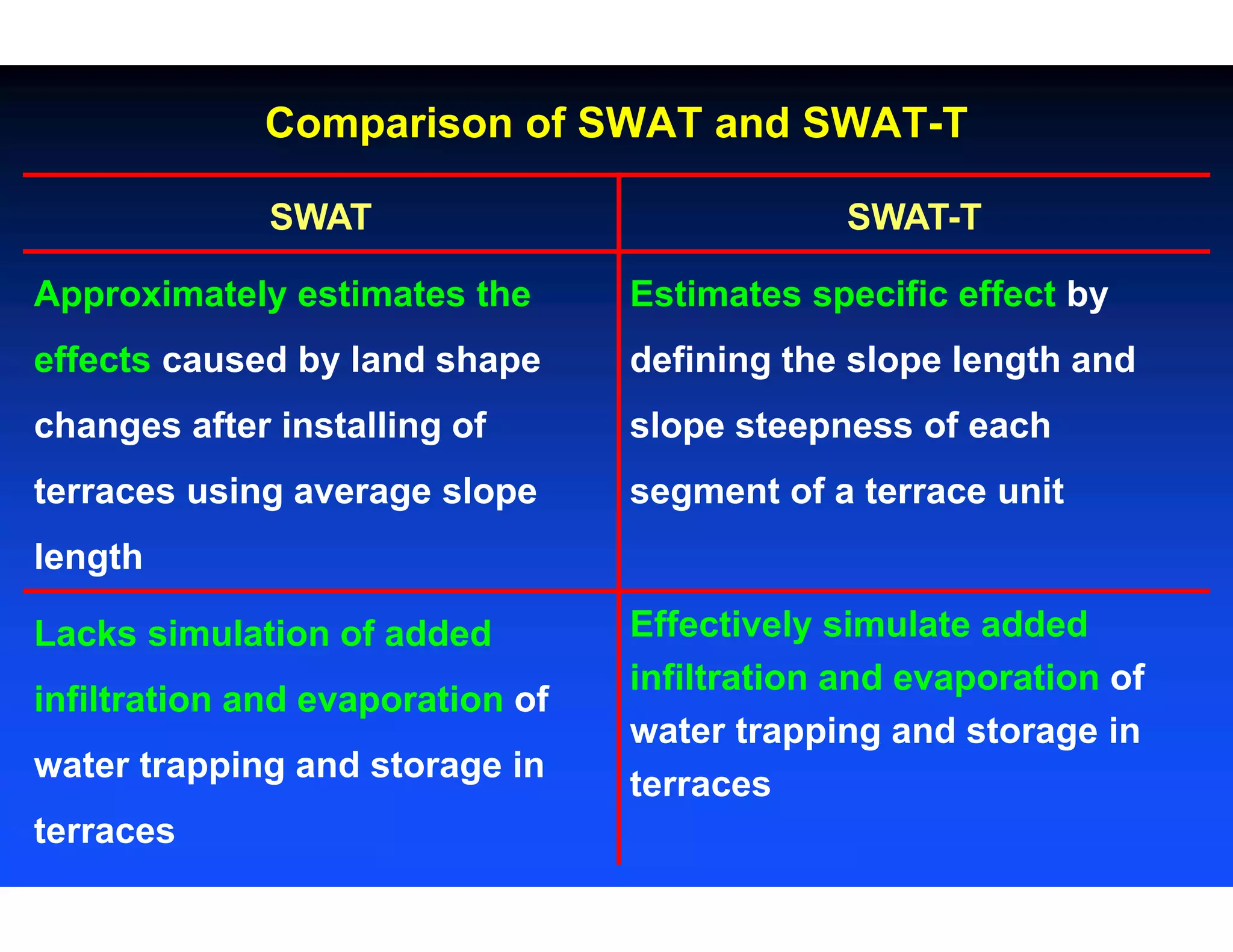
Comparison of SWAT and SWAT-T
SWAT SWAT-T
Approximately estimates the
effects caused by land shape
changes after installing of
terraces using average slope
length
Estimates specific effect by
defining the slope length and
slope steepness of each
segment of a terrace unit
Lacks simulation of added
infiltration and evaporation of
water trapping and storage in
terraces
Effectively simulate added
infiltration and evaporation of
water trapping and storage in
terraces
• SWAT-T model was evaluated for terraced fields
with different crop managements and soils in
Frankling County, Kansas (after Shao et al., 2013).
• The model showed good performance for runoff and
sediment simulation at field-scale (after Moriasi et al., 2007) .
• However, no watershed-scale evaluation has been
undertaken with SWAT-T.
SWAT-T Evaluation
OBJECTIVE
• To evaluate annual and monthly SWAT-T
performance compared to observed
data of Goodwater Creek Experimental
Watershed (GWEC) from 1993-2010.
Materials and
Methods
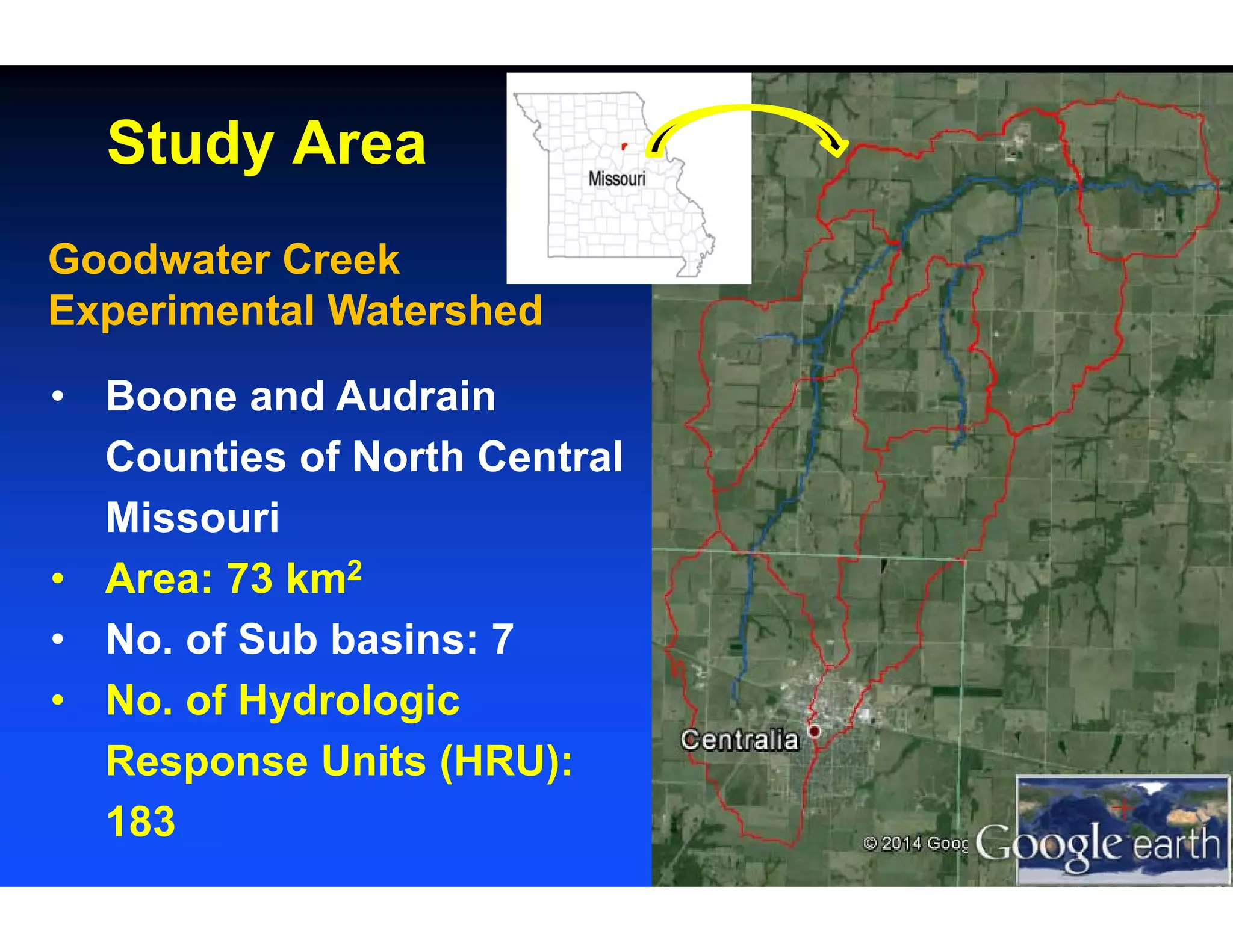
Goodwater Creek
Experimental Watershed
• Boone and Audrain
Counties of North Central
Missouri
• Area: 73 km2
• No. of Sub basins: 7
• No. of Hydrologic
Response Units (HRU):
183
Study Area
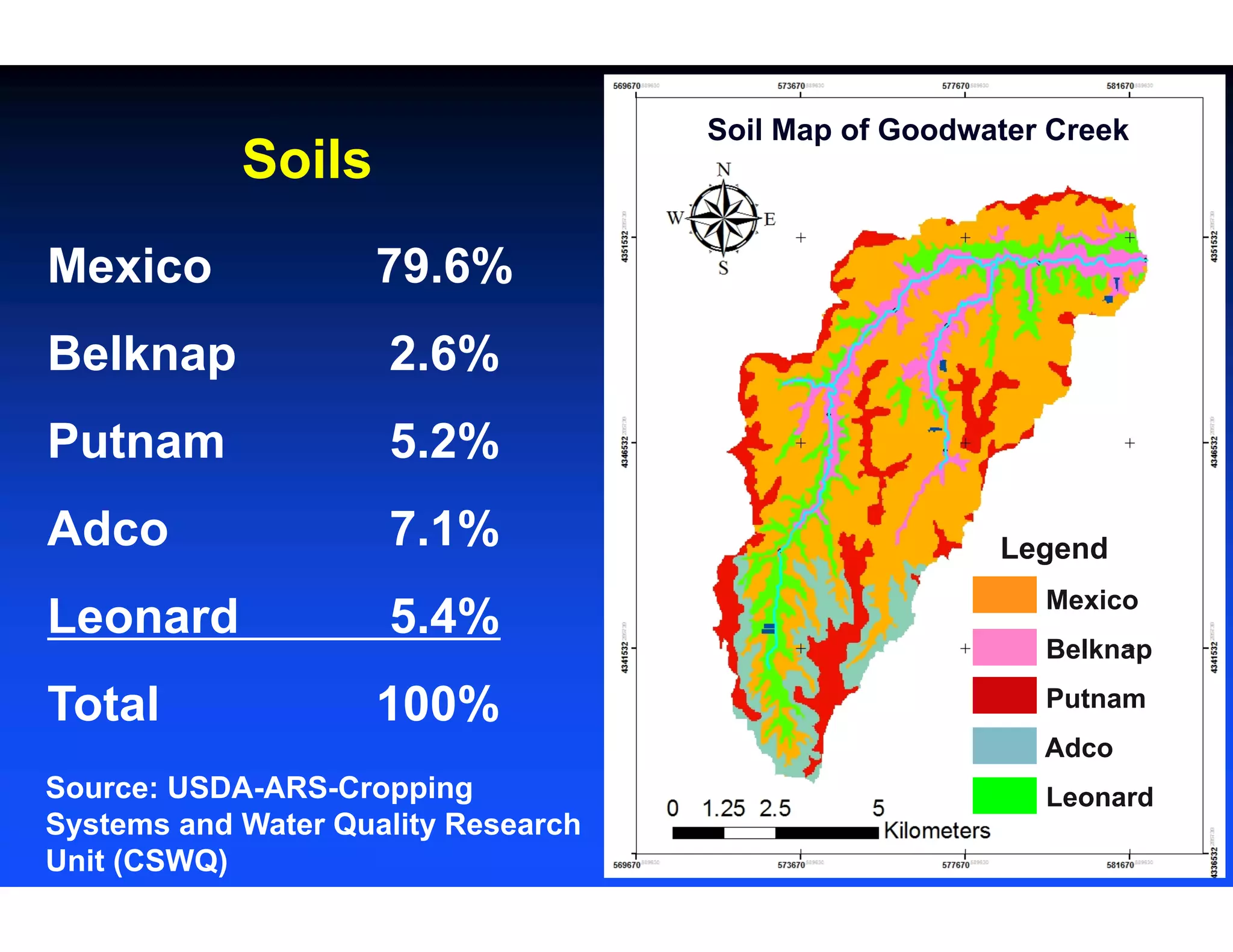
Mexico 79.6%
Belknap 2.6%
Putnam 5.2%
Adco 7.1%
Leonard 5.4%
Total 100%
Soils
Legend
Mexico
Belknap
Putnam
Adco
Leonard
Soil Map of Goodwater Creek
Source: USDA-ARS-Cropping
Systems and Water Quality Research
Unit (CSWQ)
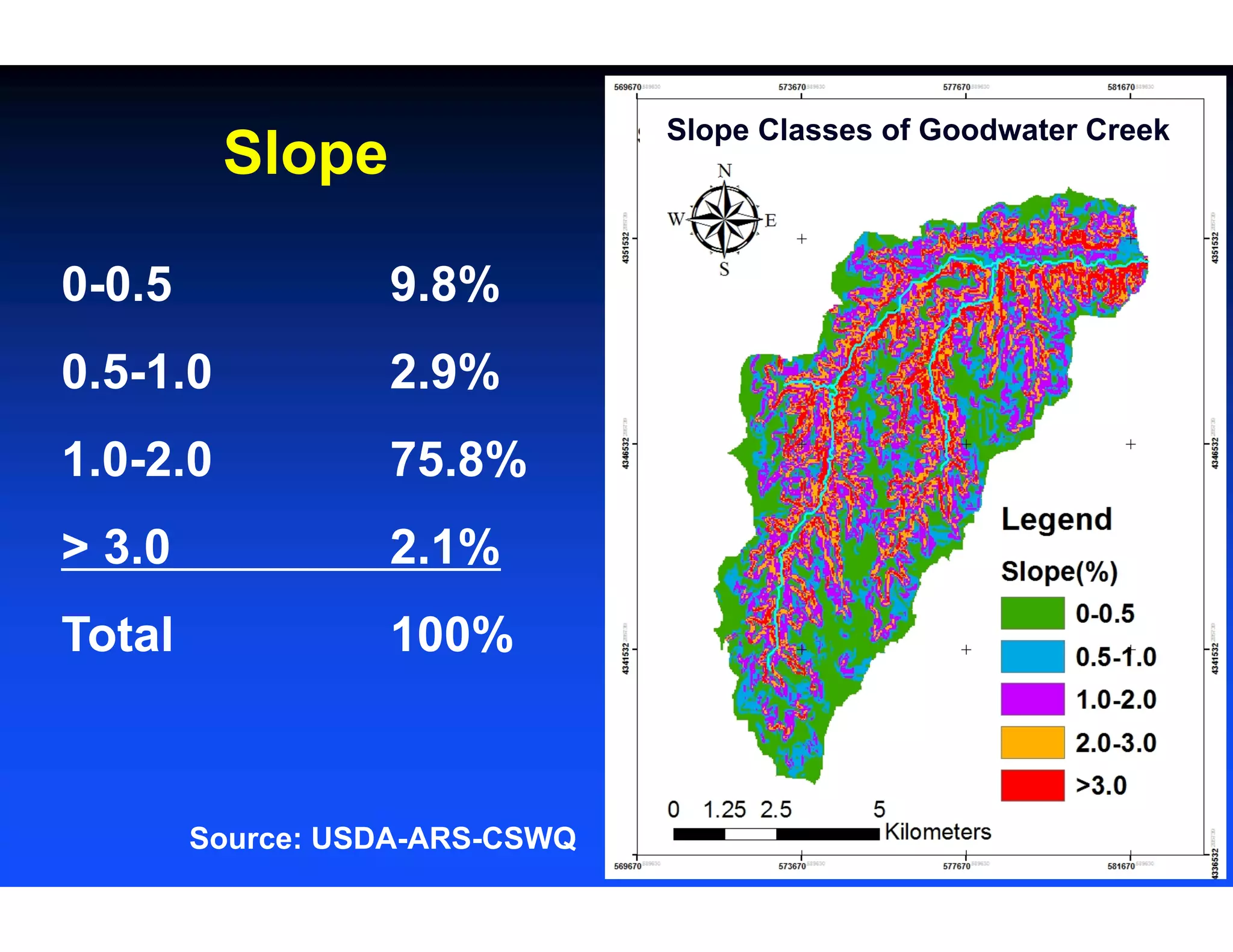
0-0.5 9.8%
0.5-1.0 2.9%
1.0-2.0 75.8%
> 3.0 2.1%
Total 100%
Slope
Slope Classes of Goodwater Creek
Source: USDA-ARS-CSWQ
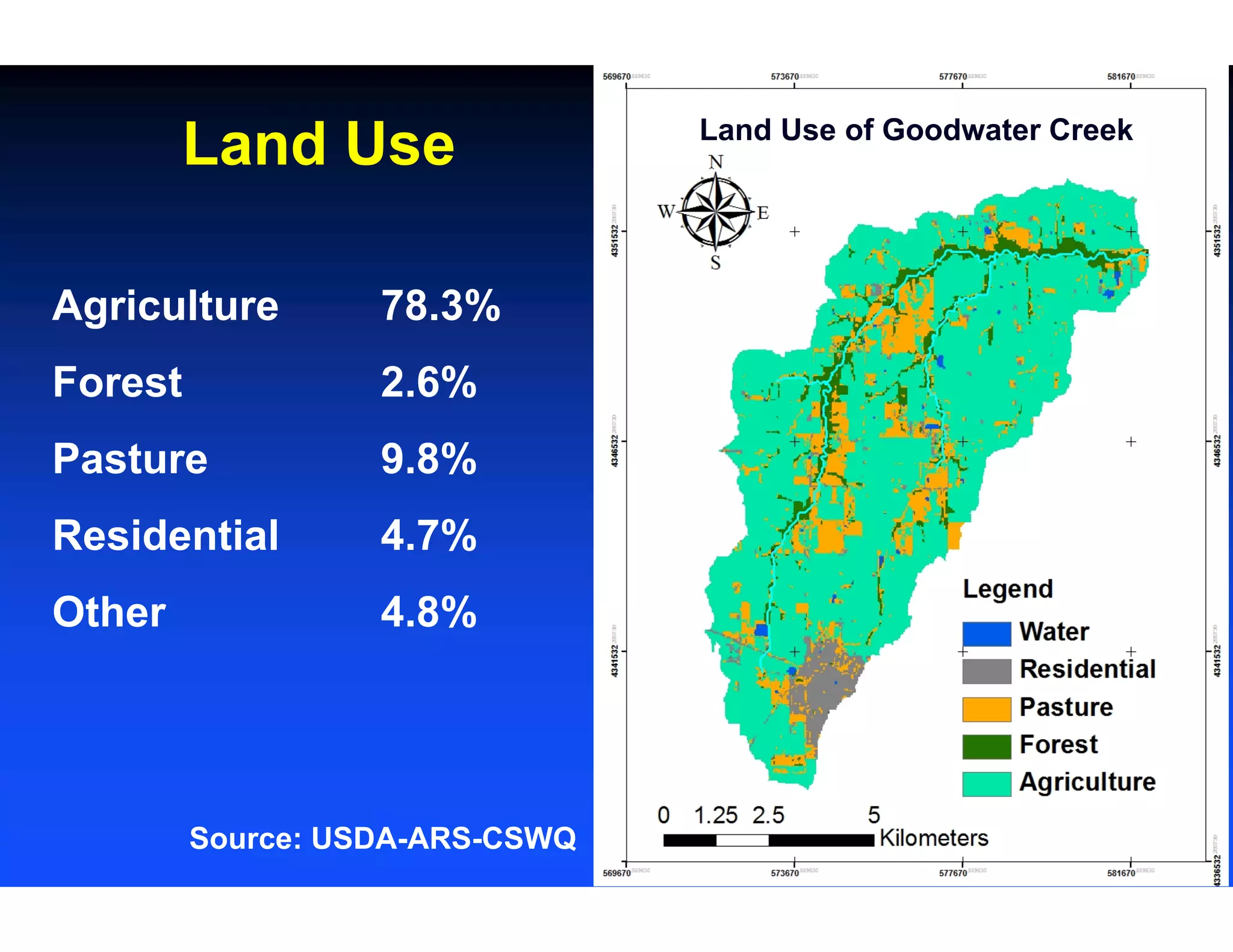
Agriculture 78.3%
Forest 2.6%
Pasture 9.8%
Residential 4.7%
Other 4.8%
Land Use Land Use of Goodwater Creek
Source: USDA-ARS-CSWQ
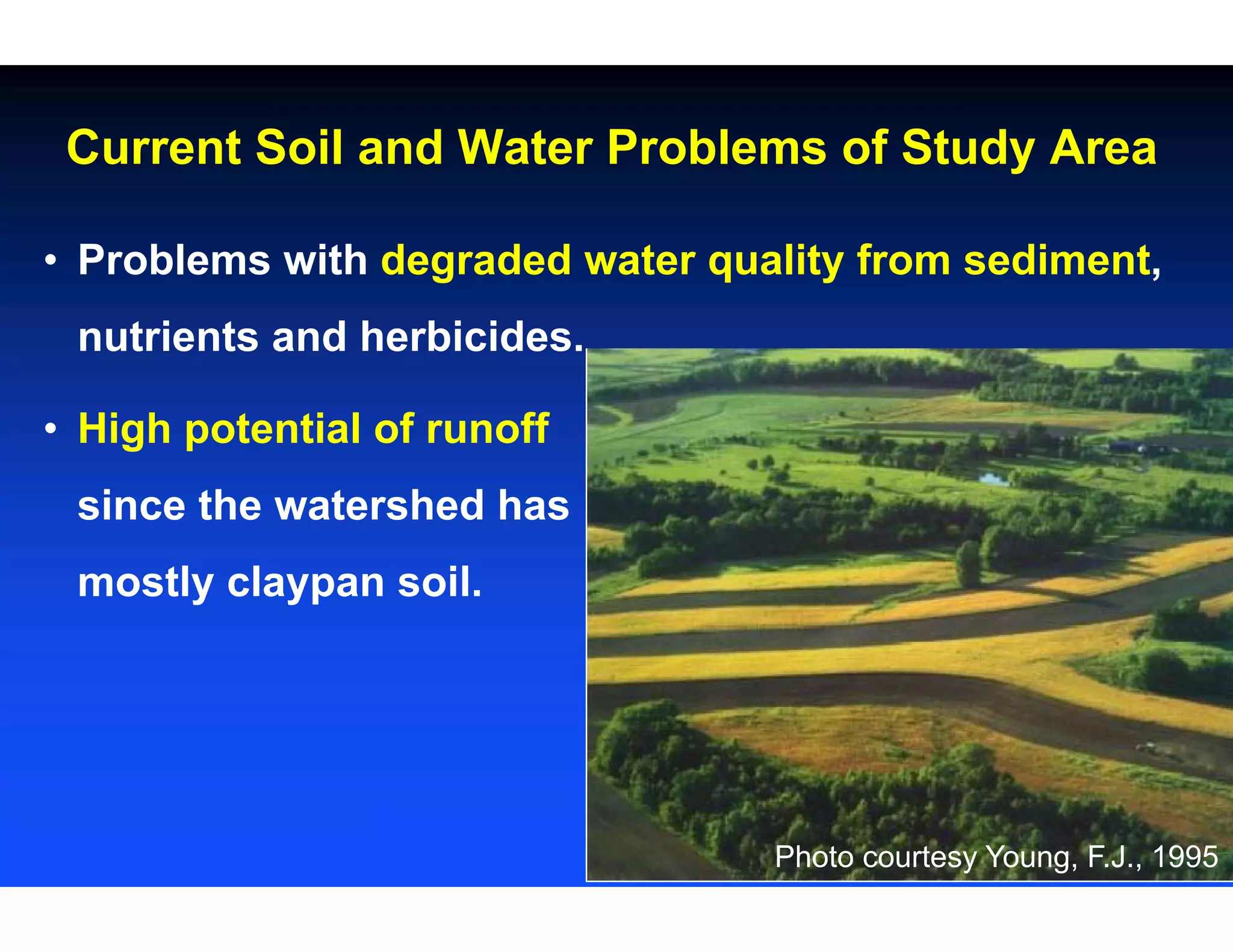
• Problems with degraded water quality from sediment,
nutrients and herbicides.
• High potential of runoff
since the watershed has
mostly claypan soil.
Current Soil and Water Problems of Study Area
Photo courtesy Young, F.J., 1995
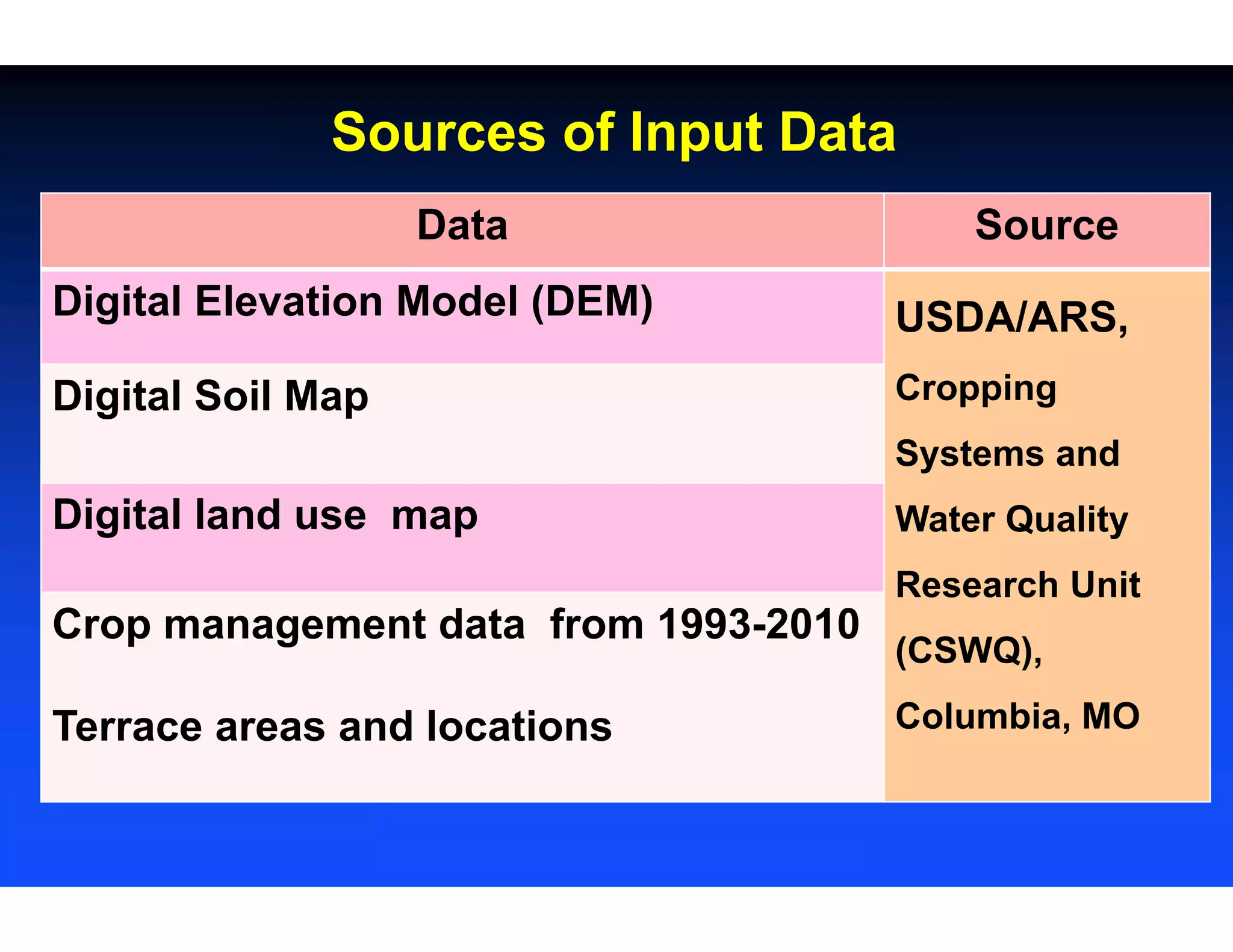
Data Source
Digital Elevation Model (DEM) USDA/ARS,
Cropping
Systems and
Water Quality
Research Unit
(CSWQ),
Columbia, MO
Digital Soil Map
Digital land use map
Crop management data from 1993-2010
Terrace areas and locations
Sources of Input Data
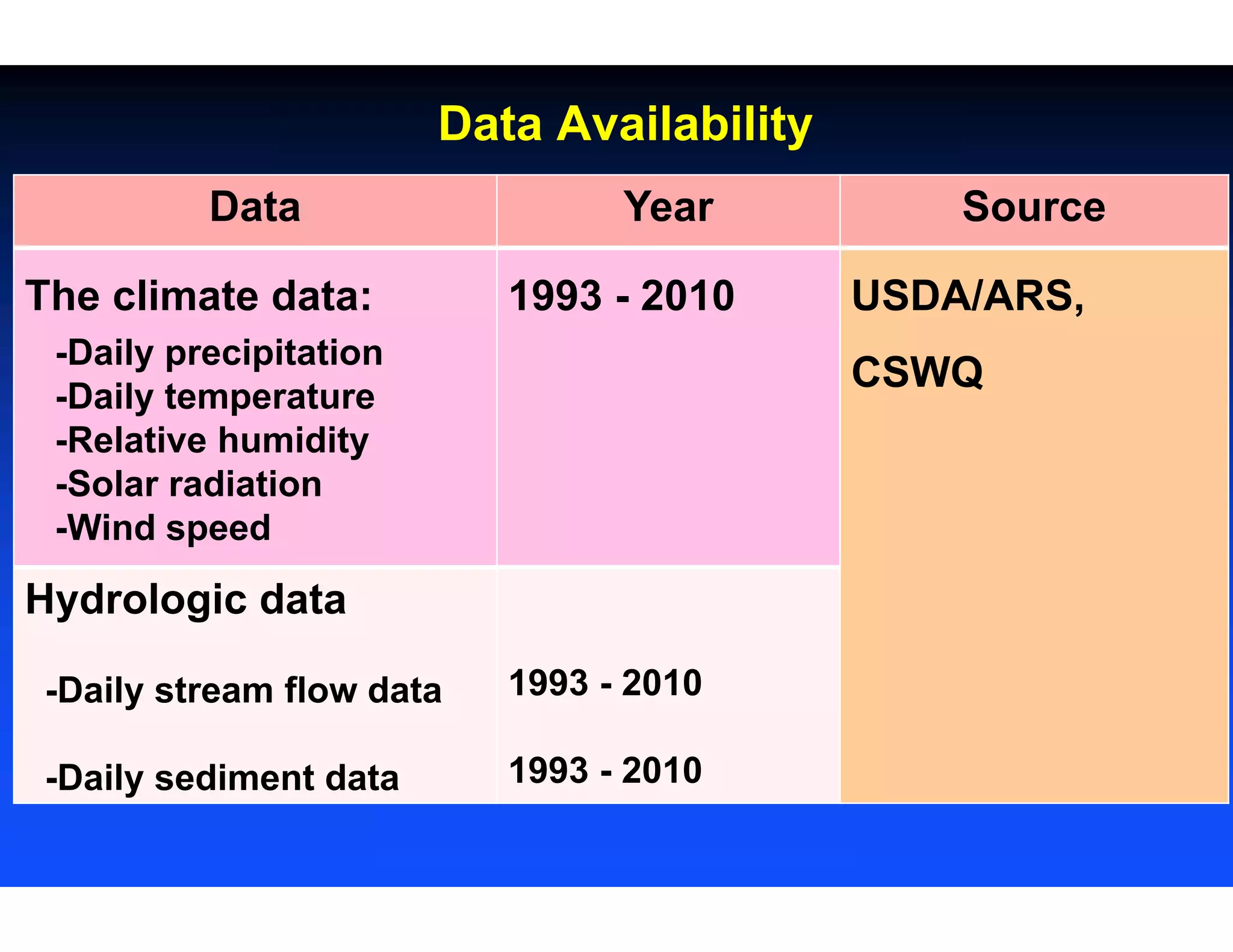
Data Availability
Data Year Source
The climate data:
-Daily precipitation
-Daily temperature
-Relative humidity
-Solar radiation
-Wind speed
1993 - 2010 USDA/ARS,
CSWQ
Hydrologic data
-Daily stream flow data
-Daily sediment data
1993 - 2010
1993 - 2010
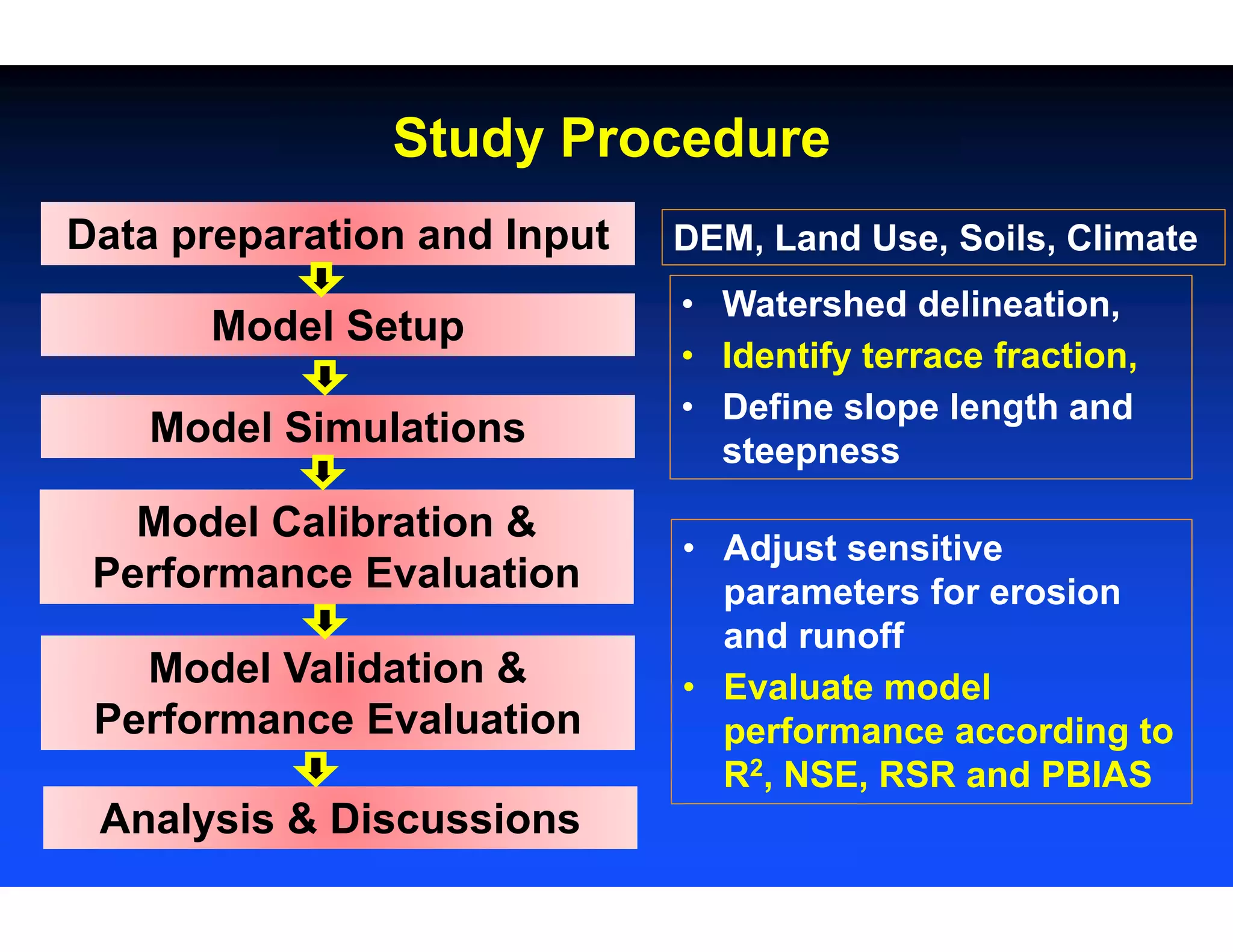
Study Procedure
Data preparation and Input
Model Setup
Model Simulations
Model Calibration &
Performance Evaluation
Model Validation &
Performance Evaluation
Analysis & Discussions
DEM, Land Use, Soils, Climate
• Watershed delineation,
• Identify terrace fraction,
• Define slope length and
steepness
• Adjust sensitive
parameters for erosion
and runoff
• Evaluate model
performance according to
R2, NSE, RSR and PBIAS
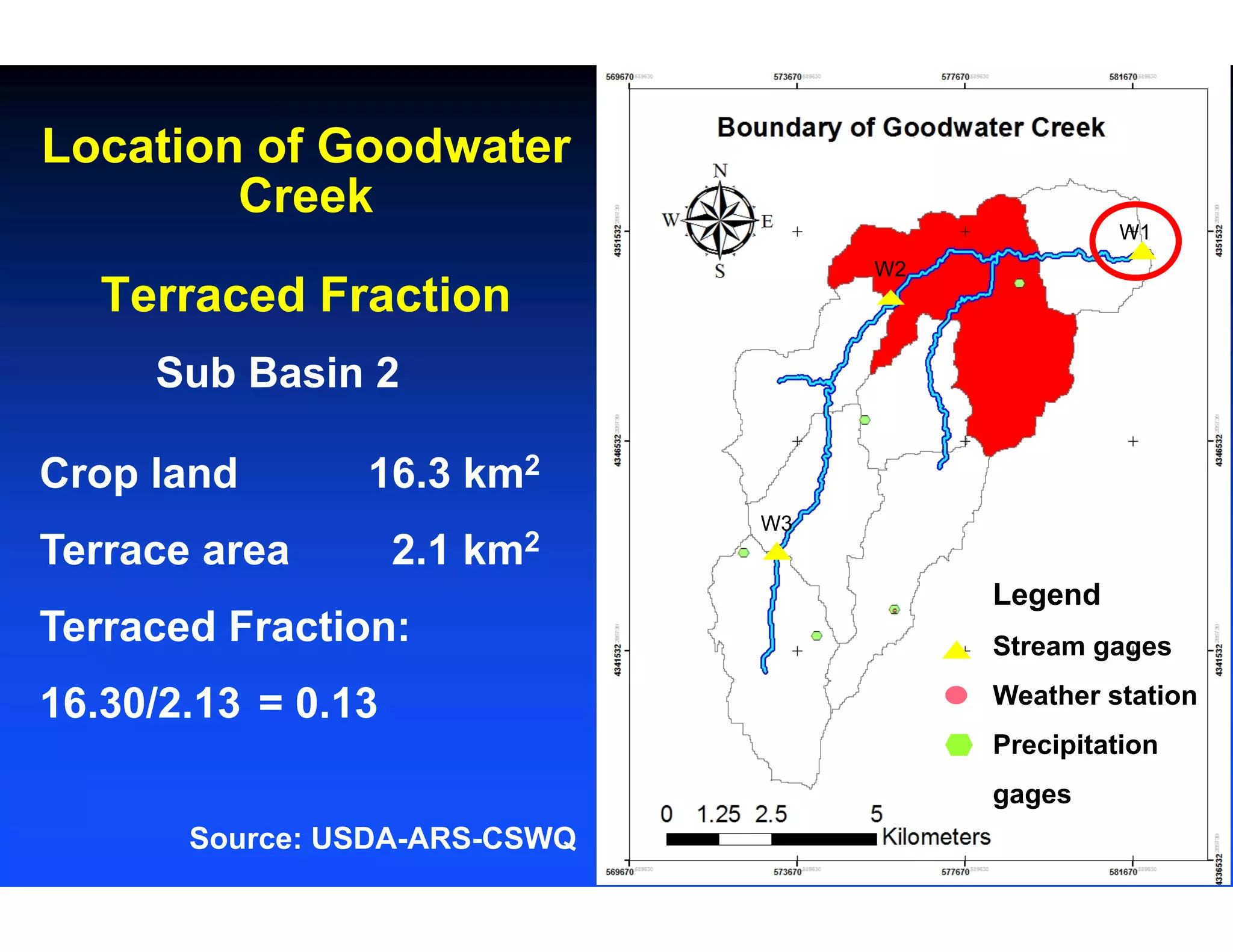
Location of Goodwater
Creek
Terraced Fraction
Sub Basin 2
Crop land 16.3 km2
Terrace area 2.1 km2
Terraced Fraction:
16.30/2.13 = 0.13
Legend
Stream gages
Weather station
Precipitation
gages
W1
W3
W2
Source: USDA-ARS-CSWQ
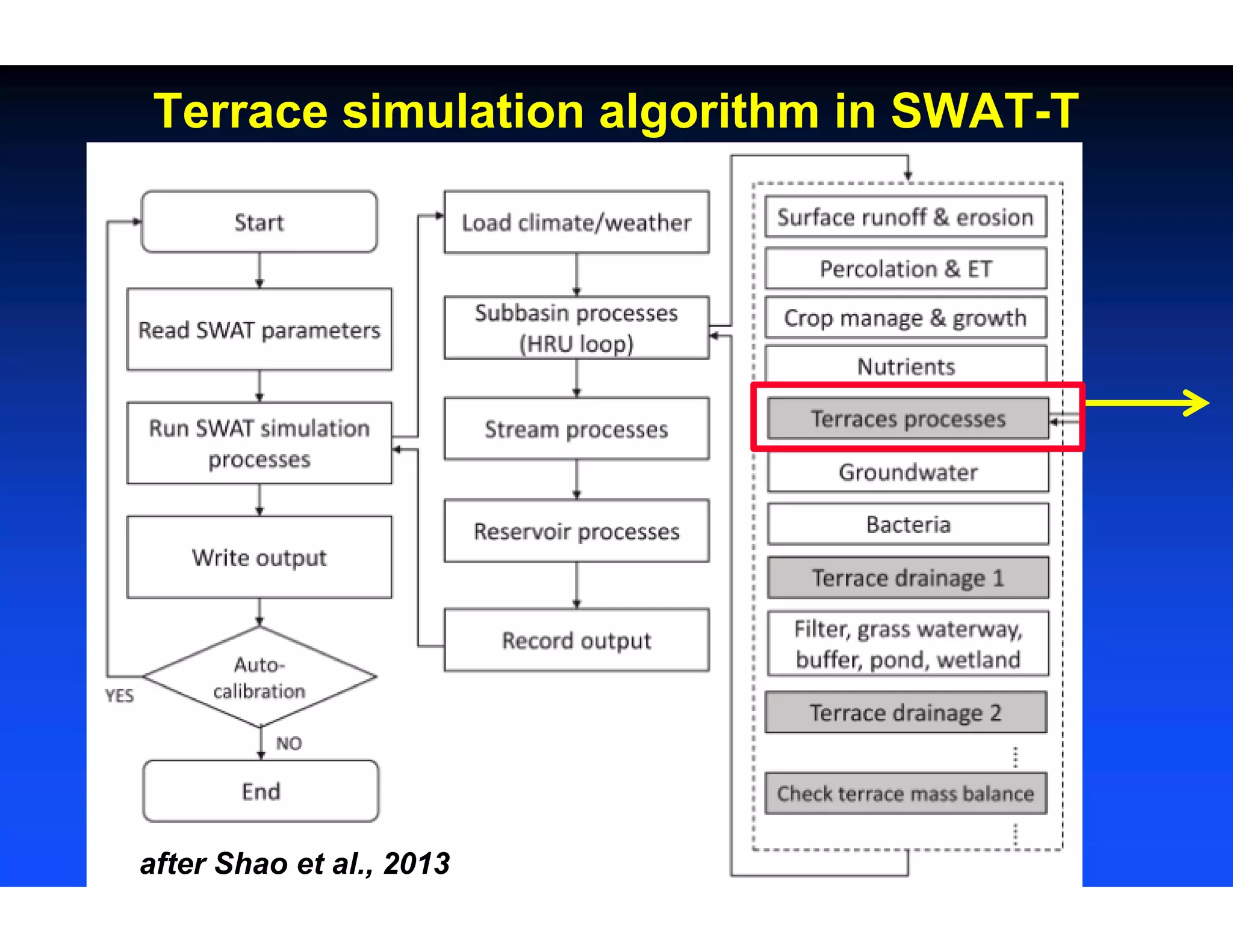
Terrace simulation algorithm in SWAT-T
after Shao et al., 2013
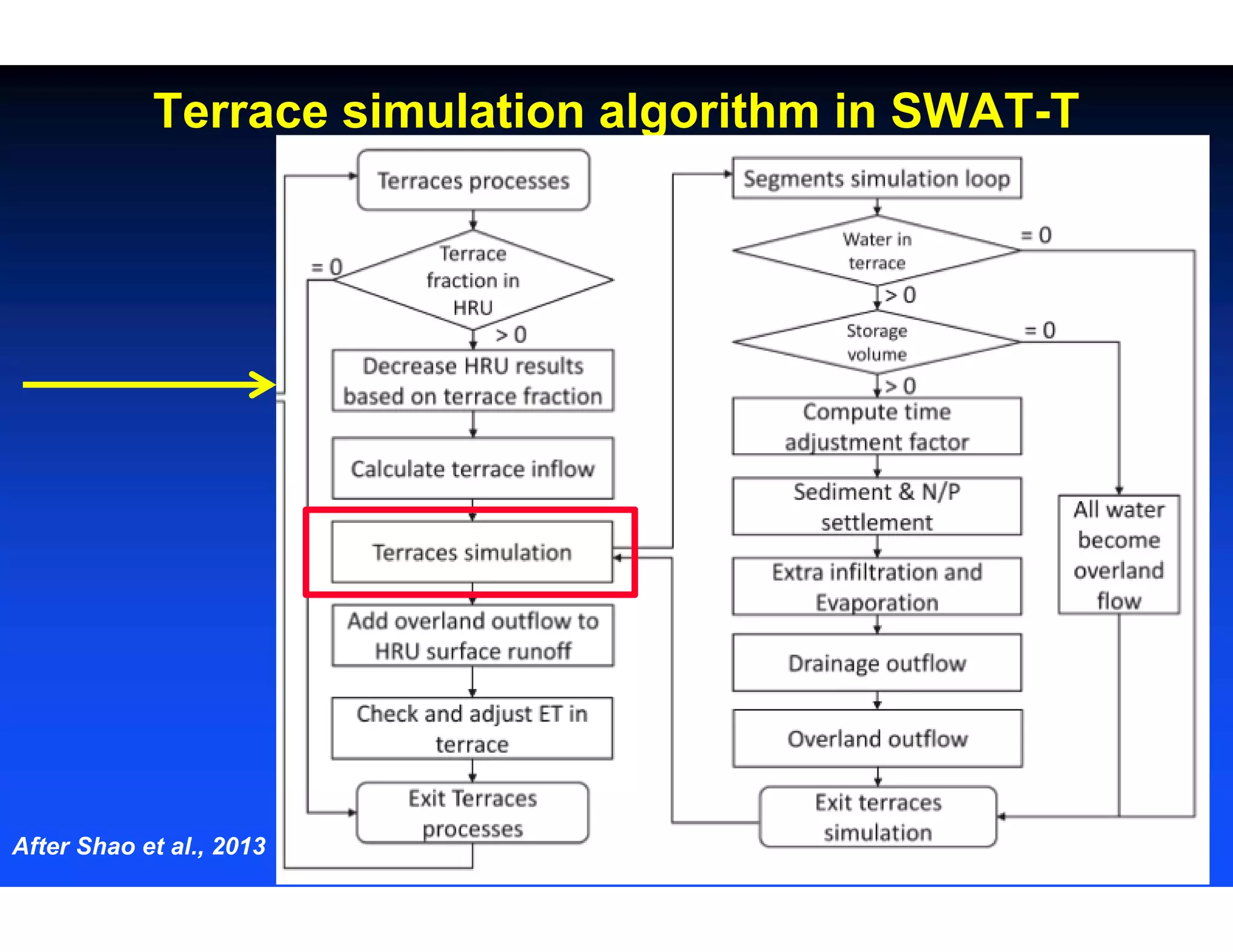
Terrace simulation algorithm in SWAT-T
After Shao et al., 2013
Results of Flow
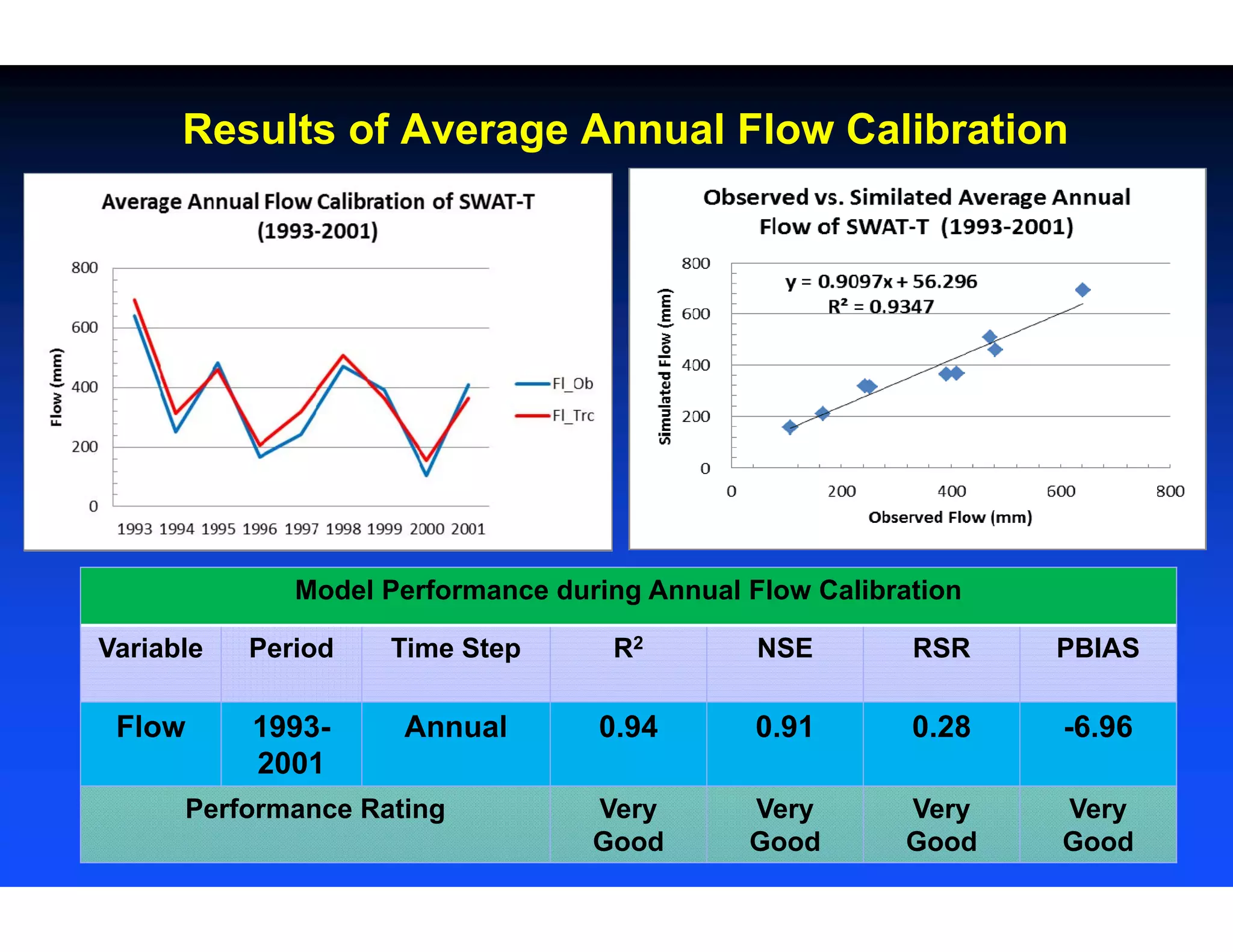
Results of Average Annual Flow Calibration
Model Performance during Annual Flow Calibration
Variable Period Time Step R2 NSE RSR PBIAS
Flow 1993-
2001
Annual 0.94 0.91 0.28 -6.96
Performance Rating Very
Good
Very
Good
Very
Good
Very
Good
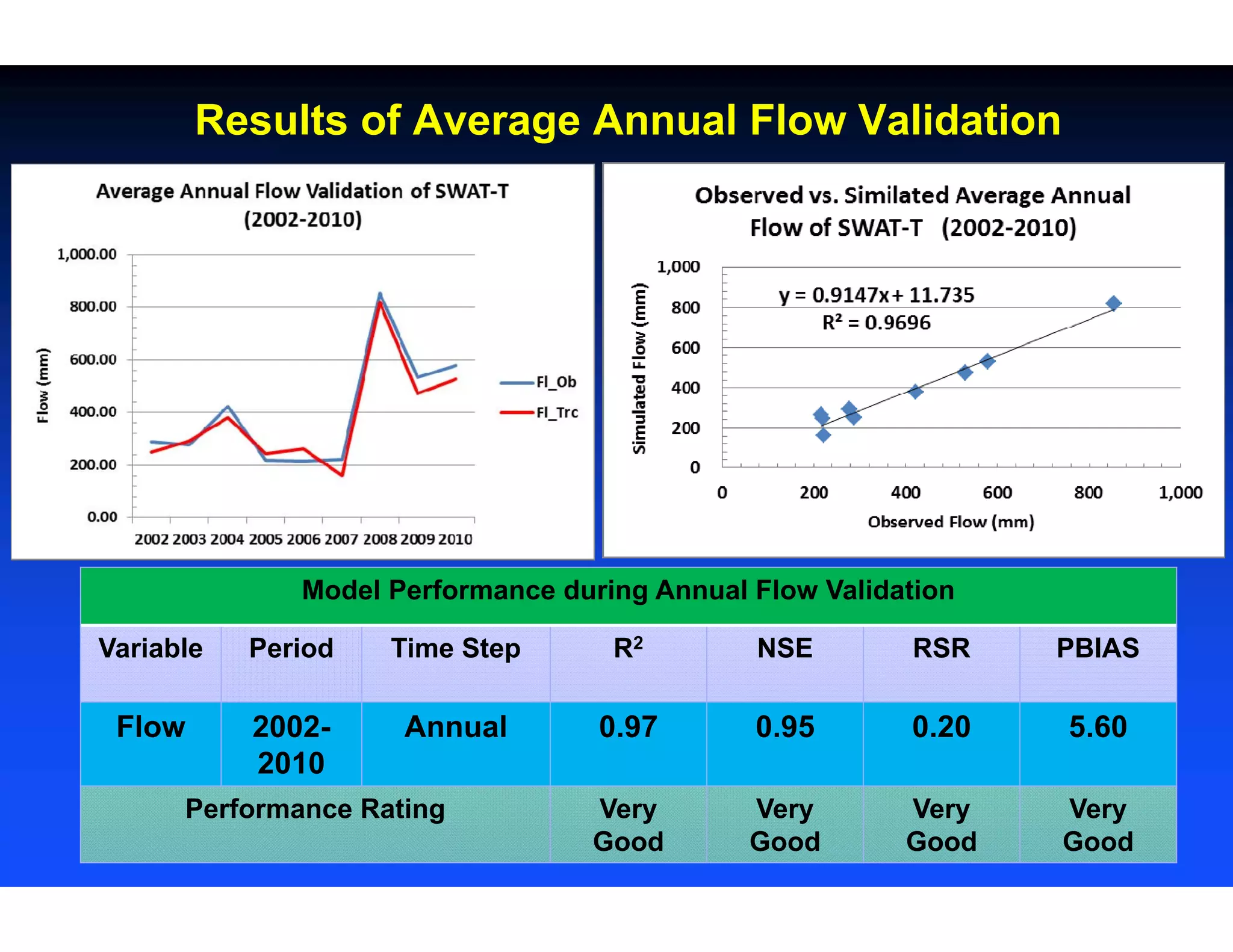
Results of Average Annual Flow Validation
Model Performance during Annual Flow Validation
Variable Period Time Step R2 NSE RSR PBIAS
Flow 2002-
2010
Annual 0.97 0.95 0.20 5.60
Performance Rating Very
Good
Very
Good
Very
Good
Very
Good
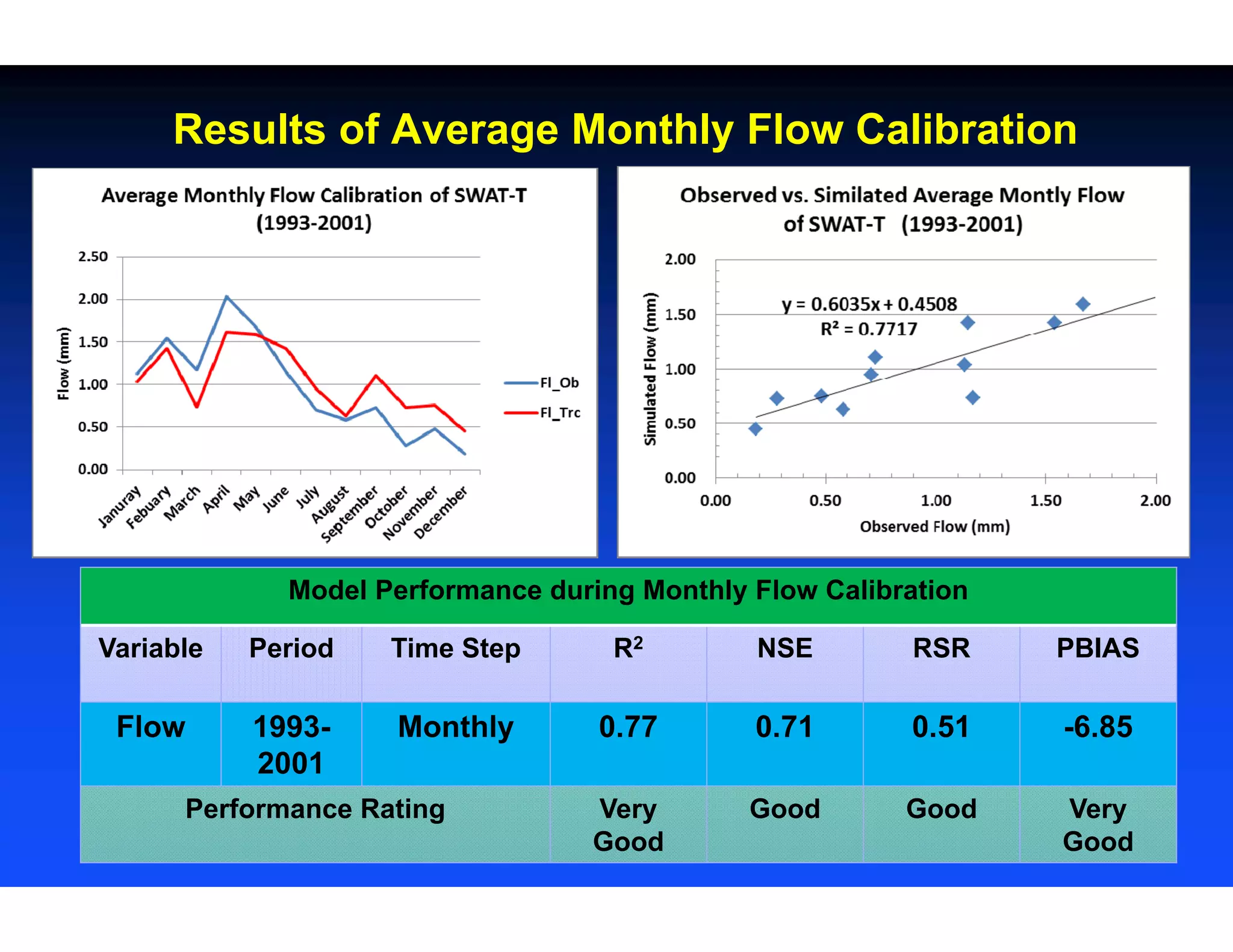
Results of Average Monthly Flow Calibration
Model Performance during Monthly Flow Calibration
Variable Period Time Step R2 NSE RSR PBIAS
Flow 1993-
2001
Monthly 0.77 0.71 0.51 -6.85
Performance Rating Very
Good
Good Good Very
Good
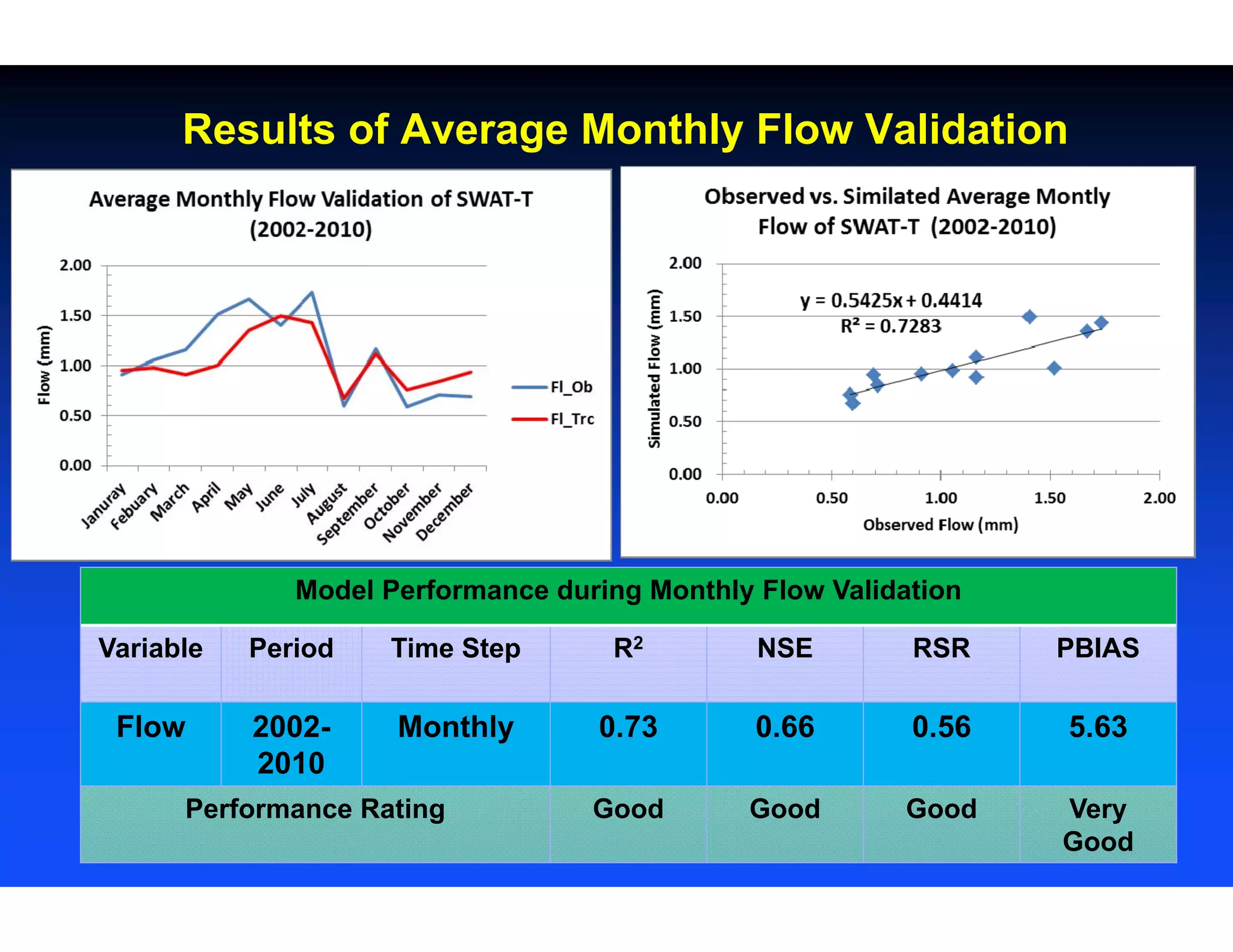
Results of Average Monthly Flow Validation
Model Performance during Monthly Flow Validation
Variable Period Time Step R2 NSE RSR PBIAS
Flow 2002-
2010
Monthly 0.73 0.66 0.56 5.63
Performance Rating Good Good Good Very
Good
Results of Sediment
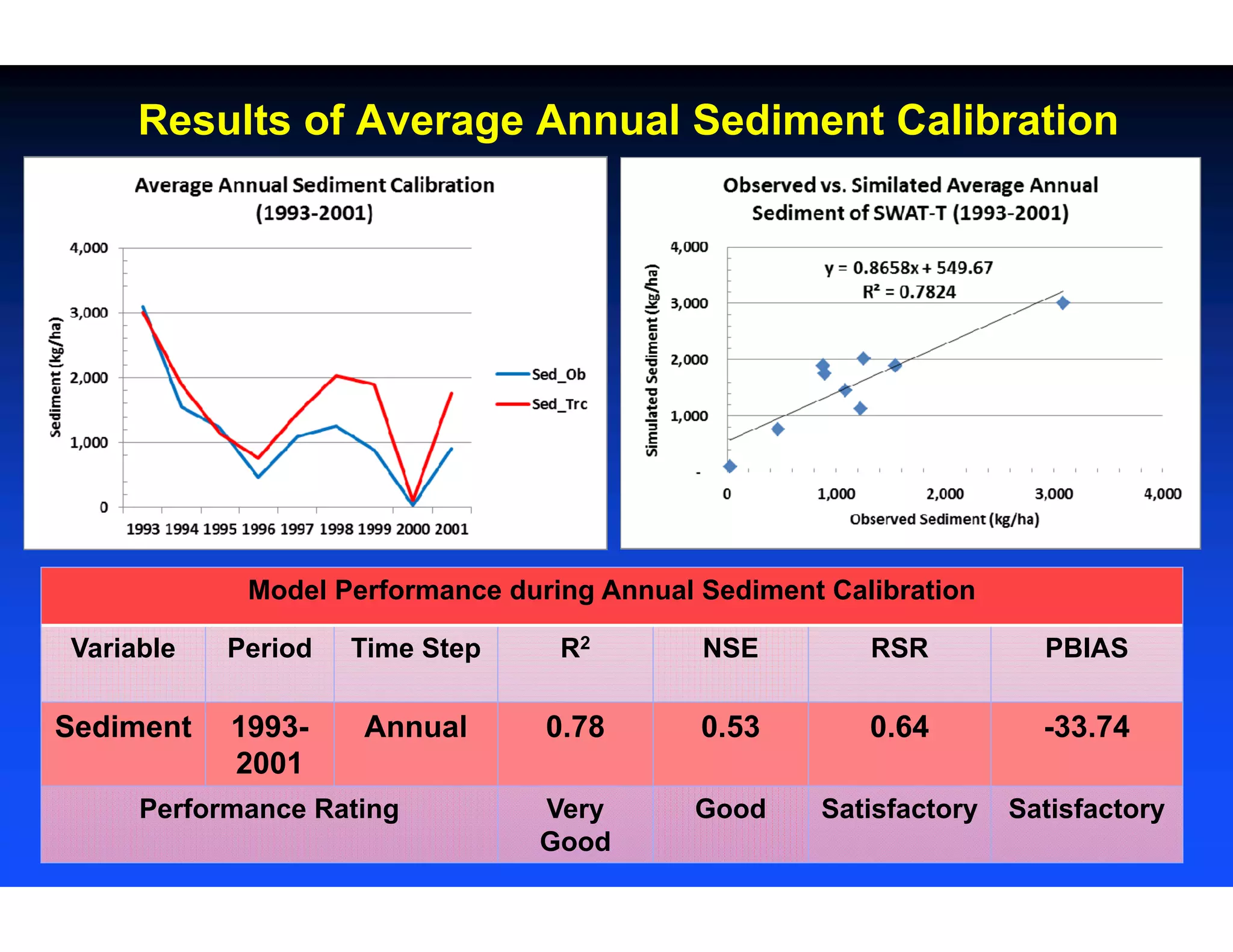
Results of Average Annual Sediment Calibration
Model Performance during Annual Sediment Calibration
Variable Period Time Step R2 NSE RSR PBIAS
Sediment 1993-
2001
Annual 0.78 0.53 0.64 -33.74
Performance Rating Very
Good
Good Satisfactory Satisfactory
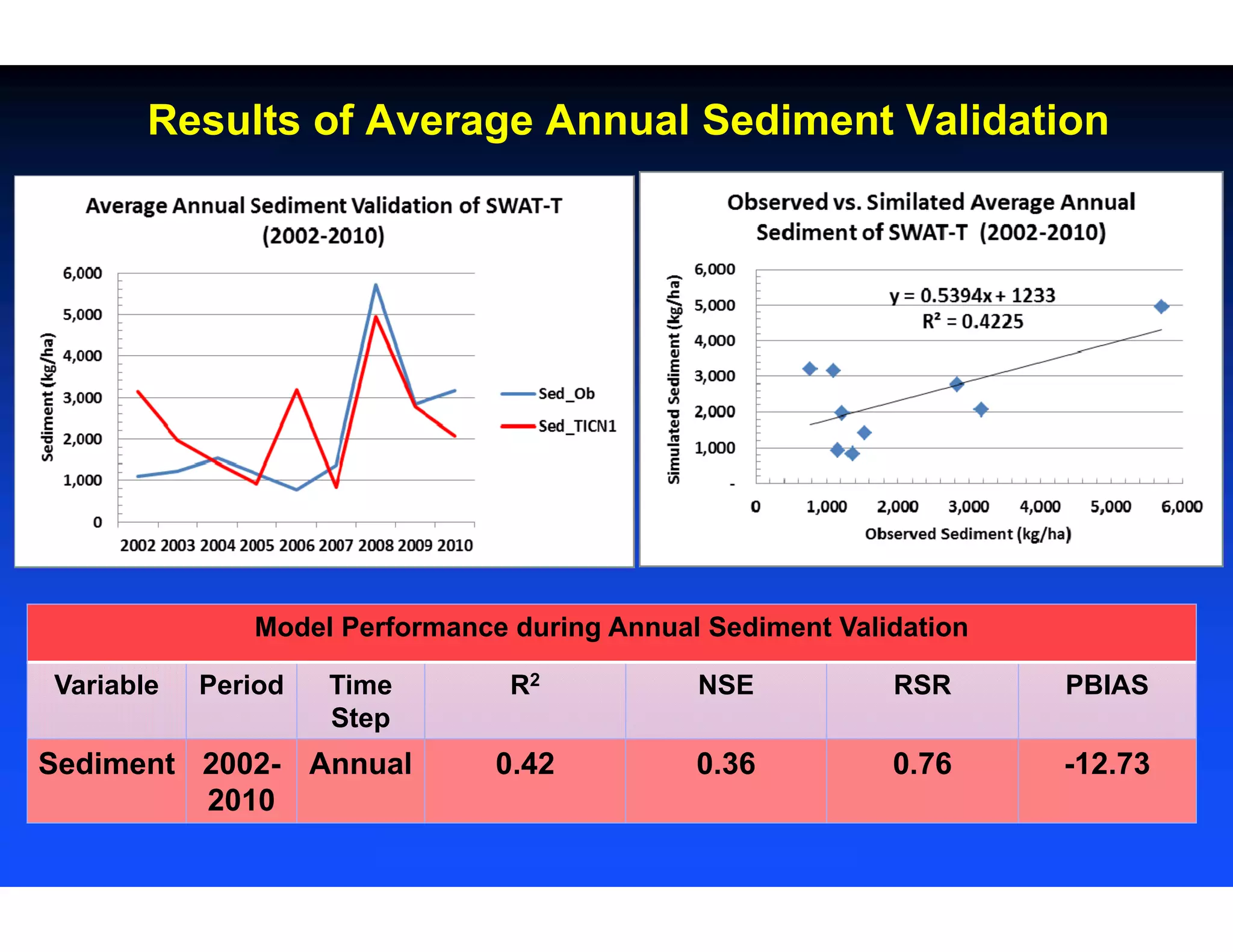
Results of Average Annual Sediment Validation
Model Performance during Annual Sediment Validation
Variable Period Time
Step
R2 NSE RSR PBIAS
Sediment 2002-
2010
Annual 0.42 0.36 0.76 -12.73
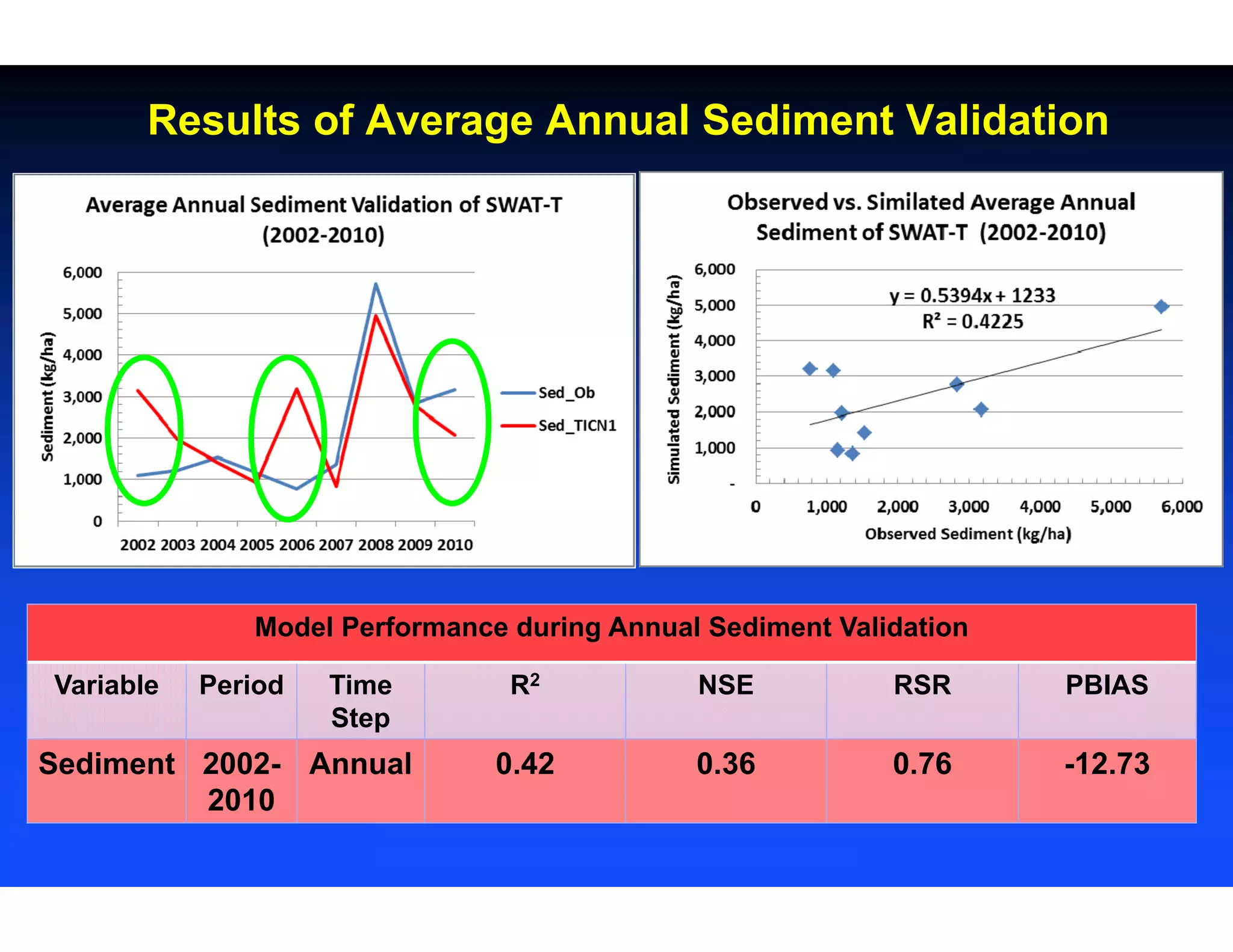
Results of Average Annual Sediment Validation
Model Performance during Annual Sediment Validation
Variable Period Time
Step
R2 NSE RSR PBIAS
Sediment 2002-
2010
Annual 0.42 0.36 0.76 -12.73
Results of Average Monthly Sediment Calibration
Model Performance during Monthly Sediment Calibration
Variable Period Time
Step
R2 NSE RSR PBIAS
Sediment 1993-
2001
Monthly 0.82 0.49 0.60 -33.75
Performance Rating Very Good Satisfactory Satisfactory
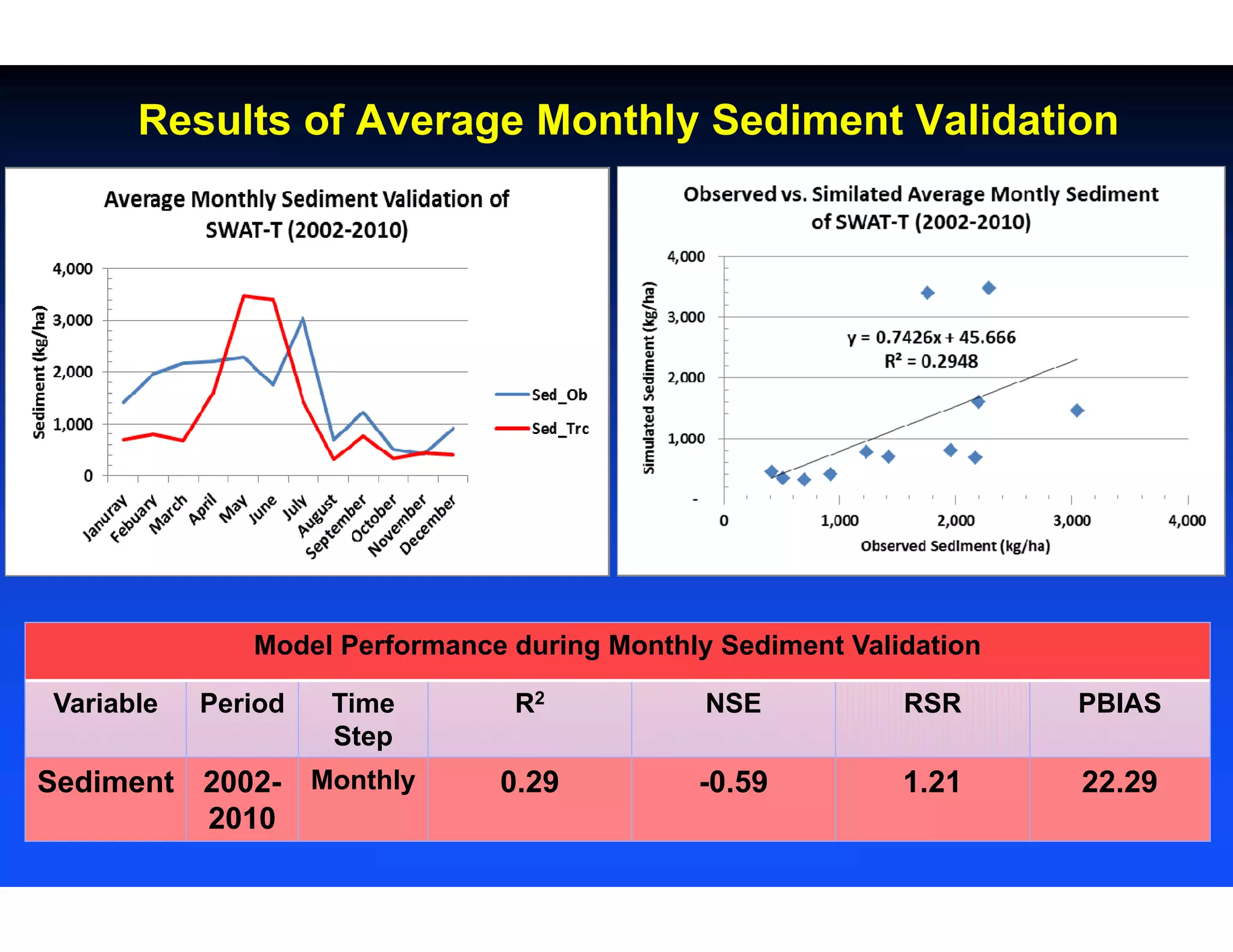
Results of Average Monthly Sediment Validation
Model Performance during Monthly Sediment Validation
Variable Period Time
Step
R2 NSE RSR PBIAS
Sediment 2002-
2010
Monthly 0.29 -0.59 1.21 22.29
Results of Average Monthly Sediment Validation
Model Performance during Monthly Sediment Validation
Variable Period Time
Step
R2 NSE RSR PBIAS
Sediment 2002-
2010
Monthly 0.29 -0.59 1.21 22.29
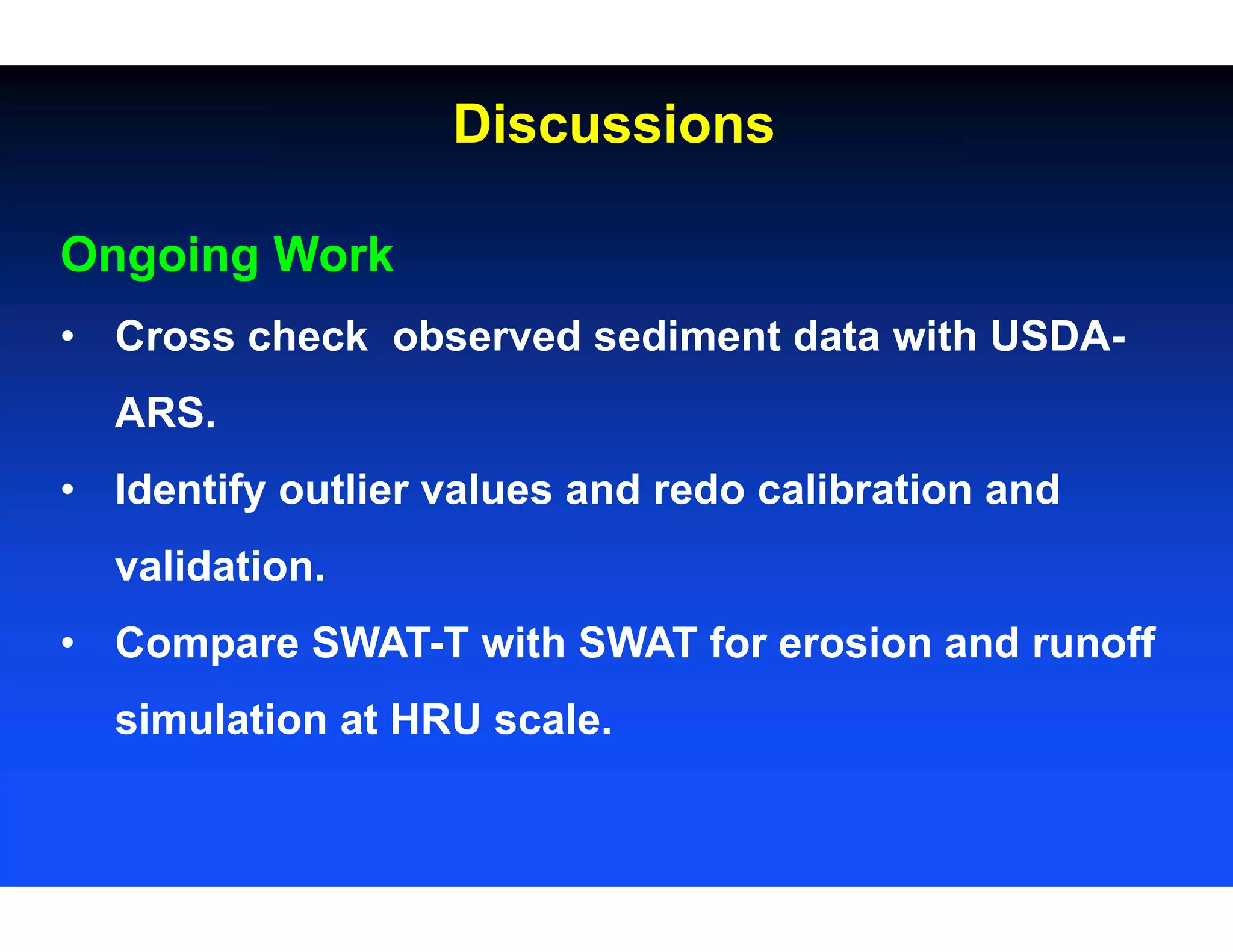
Ongoing Work
• Cross check observed sediment data with USDA-
ARS.
• Identify outlier values and redo calibration and
validation.
• Compare SWAT-T with SWAT for erosion and runoff
simulation at HRU scale.
Discussions
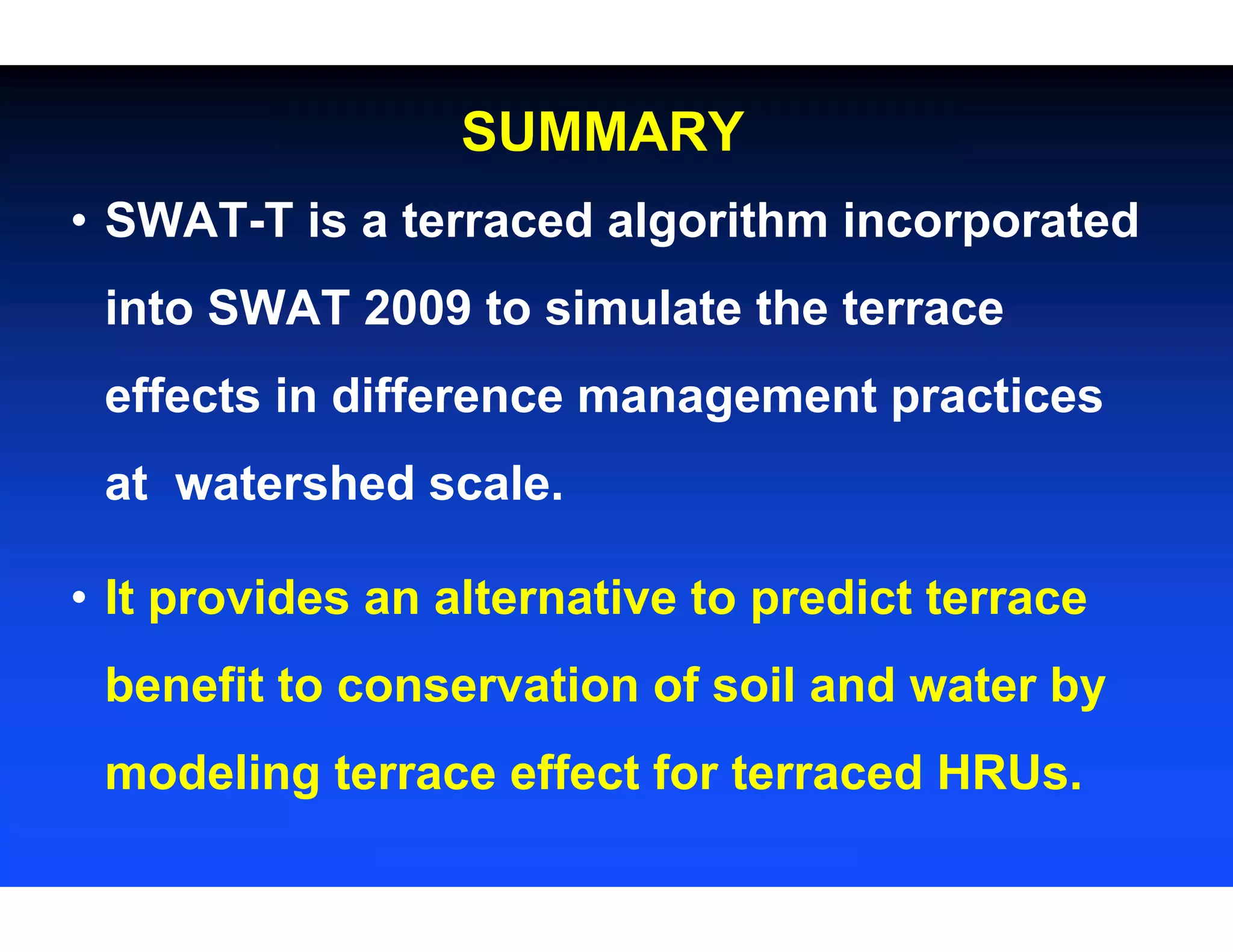
SUMMARY
• SWAT-T is a terraced algorithm incorporated
into SWAT 2009 to simulate the terrace
effects in difference management practices
at watershed scale.
• It provides an alternative to predict terrace
benefit to conservation of soil and water by
modeling terrace effect for terraced HRUs.
Summary
• Results of SWAT-T calibration showed the
feasibility of simulation for erosion and runoff
from terraced fields, but need to improve
validation results.
• Future work, compare SWAT-T with SWAT for
erosion and runoff simulation at HRU scale.
Acknowledgement
Dr. Clark Gantzer University of Missouri
Dr. Claire Baffaut USDA-ARS
Dr. Stephen Anderson University of Missouri
Dr. Hui Shao University of Guelph, Canada
Dr. Fessehaie Ghidey USDA-ARS
Funding and Support:
University of Missouri, Mizzou Advantage
Royal Thai Government/Land Development Department (LDD)
University of Missouri, Agric. Expt. Stn.
USDA-ARS Cropping Systems and Water Quality Unit
Questions
The hillside rice field terraces of Thailand
www.reddit.com
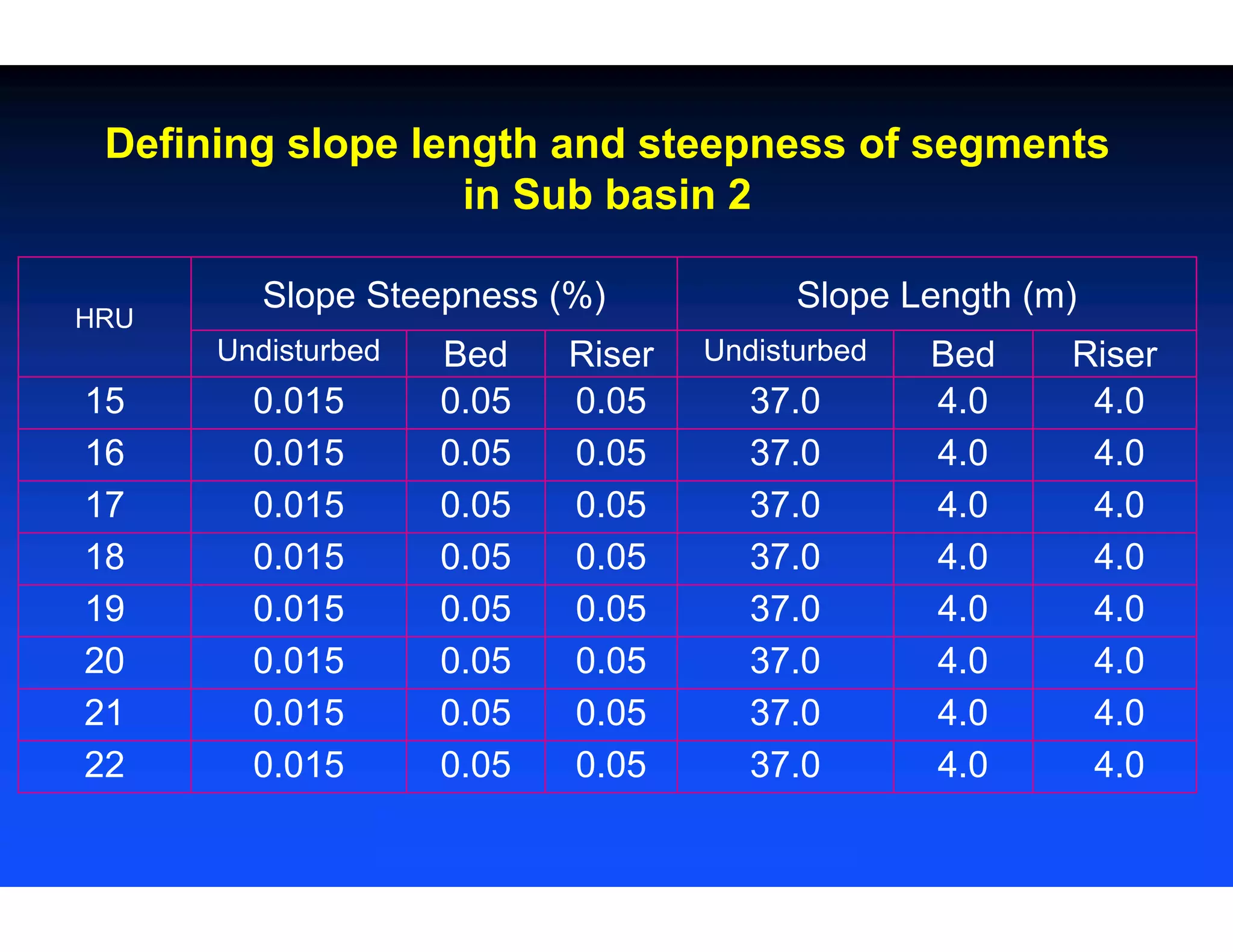
HRU
Slope Steepness (%) Slope Length (m)
Undisturbed Bed Riser Undisturbed Bed Riser
15 0.015 0.05 0.05 37.0 4.0 4.0
16 0.015 0.05 0.05 37.0 4.0 4.0
17 0.015 0.05 0.05 37.0 4.0 4.0
18 0.015 0.05 0.05 37.0 4.0 4.0
19 0.015 0.05 0.05 37.0 4.0 4.0
20 0.015 0.05 0.05 37.0 4.0 4.0
21 0.015 0.05 0.05 37.0 4.0 4.0
22 0.015 0.05 0.05 37.0 4.0 4.0
Defining slope length and steepness of segments
in Sub basin 2
Variable Parameter File Range Default
Value
Calibrated
Value
Flow SFTMP .bsn 1.0 1.5
SMTMP .bsn 0.5 -2.5
SMFMN .bsn 4.5 1.5
SNOCOVMX .bsn 1.0 25
ESCO .bsn, .hru [0,1] 0.95 0.90
SURAG .bsn 4.0 1.0
SHALLIST .gw 0.5 600
ALPHA_BF .gw [0,1] 0.048 0.4
QWQMN .gw [0,1,000] 0.00 150
GW_REVAP .gw [0.02,0.2] 0.02 0.055*
REVAPMN .gw 1.0 125
Default and Calibrated Values of SWAT-T calibration
parameters for Flow
* : Hru 15-22
Variable Parameter File Range Default
Value
Calibrated
Value
Sediment USLP_P .mgt [0,1] 1.0 0.70
USLE_K .sol [-25,25] 0.43 0.28
USLE_C Crop.dat for corn & soybean were adjusted according to
the values given by Alberts et al. 1984
CH_EROD .rte [0,1] 0.0 0.6
CH_COV2 .rte [0,1] 0.0 0.6
ADJ_PKR .bsn 0.0 0.8
PRF .bsn 1.0 0.8
SPCON .bsn [0.0001,0.01] 0.0001 0.0055
SPEXP .bsn [1,2] 1.0 1.25
Default and Calibrated Values of SWAT-T calibration
parameters for Sediment
• A watershed in SWAT is divided into several sub-
basins.
• Sub-basins are further sub-divided into hydrologic
response units (HRUs) that are comprised of
homogeneous soil, land use, and slope.
• The HRUs represent percentages of the sub-basin
area and are not spatially located within a SWAT
simulation (Baffaut et al., 2014; Gassman et al., 2007).
Soil and Water Assessment Tool (SWAT)
• SWAT-T model was tested using annual crop yield
and event runoff and sediment data sets collected
at a six-plot terraced field with different crop
managements and soils in Frankling County,
Kansas (after Shao et al., 2013).
• The runoff simulation was satisfactory (after Moriasi et
al., 2007) with Nash-Sutcliffe model efficiency (NS)
always > 0.6 for both the calibration and validation
simulations
SWAT-T Evaluation
• For the sediment simulation, SWAT-T performed
satisfactory for all calibration of till and no-till plots,
but less satisfactory for the validation of no-till
plots.
• Calibration showed the feasibility of simulating
sediment and runoff from terraced fields using
SWAT-T, but need to do more research with SWAT-
T across a variety of soil and topography condition.
SWAT-T Evaluation
Discussions
• SWAT-T performed well to simulate runoff in both
calibration and validation of annual and monthly time
step with all R2 and NS are higher 0.65.
• In sediment simulation, SWAT-T performed
satisfactory during calibration of annual and monthly
time step, but less consistent during validation.
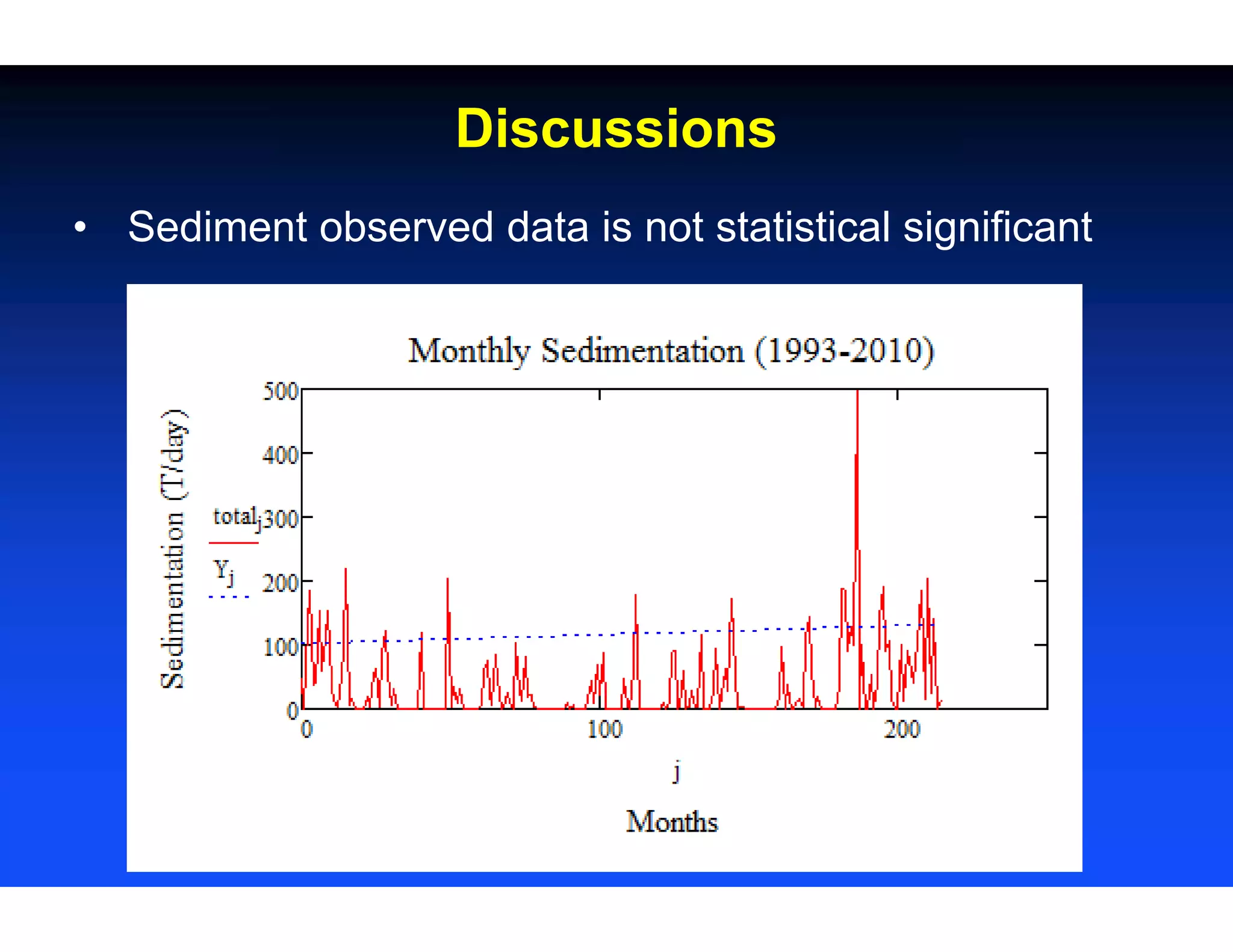
Observed sediment
data
Note:
• Outliers
• Non-linearity
Discussions
• Sediment observed data is not statistical significant
Discussions
Erosion and runoff evaluation

Erosion and runoff evaluation

  • 1.
    Erosion and RunoffEvaluation in Goodwater Creek Experimental Watershed using the SWAT-T Model Sitarrine Thongpussawal, PhD Candidate C. Gantzer, Professor, University of Missouri C. Baffaut, Research hydrologist, USDA- ARS H. Shao, Fellow, University of Guelph, Canada Soil & Atmospheric Sciences University of Missouri
  • 2.
    Introduction • Terracing isa conservation practices to reduce erosion and intercept runoff from steep lands and is widely used for soil and water conservation (Dorren and Rey, 2004; Neibling and Thompson, 1992). • Chow et al. (1999) indicated terracing sloping fields in combination with grassed waterways and contour planting in Canada decreased soil loss from an average of 20 t/ha to less than 1 t/ha, and reduced 25% of the runoff.
  • 3.
    Terrace Geometry Cutslope or Riser Photocourtesy USDA NRCS (after Shao et al., 2013) Frontslope or Bed Undisturbed Terrace Unit LuLb Lb Lterrace LrLr Lr A terrace unit = 3 segments • An undisturbed segment, • Two riser segments, and • A bed segment
  • 4.
    What is SWAT-T? • “A modified terrace algorithm of Soil and Water Assessment Tool (SWAT)” developed by Shao et al. (2013) and incorporated into SWAT 2009 to simulate the effects of terraces for difference practices on erosion and runoff at a watershed scale.
  • 5.
    Comparison of SWATand SWAT-T SWAT SWAT-T Approximately estimates the effects caused by land shape changes after installing of terraces using average slope length Estimates specific effect by defining the slope length and slope steepness of each segment of a terrace unit Lacks simulation of added infiltration and evaporation of water trapping and storage in terraces Effectively simulate added infiltration and evaporation of water trapping and storage in terraces
  • 6.
    • SWAT-T modelwas evaluated for terraced fields with different crop managements and soils in Frankling County, Kansas (after Shao et al., 2013). • The model showed good performance for runoff and sediment simulation at field-scale (after Moriasi et al., 2007) . • However, no watershed-scale evaluation has been undertaken with SWAT-T. SWAT-T Evaluation
  • 7.
    OBJECTIVE • To evaluateannual and monthly SWAT-T performance compared to observed data of Goodwater Creek Experimental Watershed (GWEC) from 1993-2010.
  • 8.
  • 9.
    Goodwater Creek Experimental Watershed •Boone and Audrain Counties of North Central Missouri • Area: 73 km2 • No. of Sub basins: 7 • No. of Hydrologic Response Units (HRU): 183 Study Area
  • 10.
    Mexico 79.6% Belknap 2.6% Putnam5.2% Adco 7.1% Leonard 5.4% Total 100% Soils Legend Mexico Belknap Putnam Adco Leonard Soil Map of Goodwater Creek Source: USDA-ARS-Cropping Systems and Water Quality Research Unit (CSWQ)
  • 11.
    0-0.5 9.8% 0.5-1.0 2.9% 1.0-2.075.8% > 3.0 2.1% Total 100% Slope Slope Classes of Goodwater Creek Source: USDA-ARS-CSWQ
  • 12.
    Agriculture 78.3% Forest 2.6% Pasture9.8% Residential 4.7% Other 4.8% Land Use Land Use of Goodwater Creek Source: USDA-ARS-CSWQ
  • 13.
    • Problems withdegraded water quality from sediment, nutrients and herbicides. • High potential of runoff since the watershed has mostly claypan soil. Current Soil and Water Problems of Study Area Photo courtesy Young, F.J., 1995
  • 14.
    Data Source Digital ElevationModel (DEM) USDA/ARS, Cropping Systems and Water Quality Research Unit (CSWQ), Columbia, MO Digital Soil Map Digital land use map Crop management data from 1993-2010 Terrace areas and locations Sources of Input Data
  • 15.
    Data Availability Data YearSource The climate data: -Daily precipitation -Daily temperature -Relative humidity -Solar radiation -Wind speed 1993 - 2010 USDA/ARS, CSWQ Hydrologic data -Daily stream flow data -Daily sediment data 1993 - 2010 1993 - 2010
  • 16.
    Study Procedure Data preparationand Input Model Setup Model Simulations Model Calibration & Performance Evaluation Model Validation & Performance Evaluation Analysis & Discussions DEM, Land Use, Soils, Climate • Watershed delineation, • Identify terrace fraction, • Define slope length and steepness • Adjust sensitive parameters for erosion and runoff • Evaluate model performance according to R2, NSE, RSR and PBIAS
  • 17.
    Location of Goodwater Creek TerracedFraction Sub Basin 2 Crop land 16.3 km2 Terrace area 2.1 km2 Terraced Fraction: 16.30/2.13 = 0.13 Legend Stream gages Weather station Precipitation gages W1 W3 W2 Source: USDA-ARS-CSWQ
  • 18.
    Terrace simulation algorithmin SWAT-T after Shao et al., 2013
  • 19.
    Terrace simulation algorithmin SWAT-T After Shao et al., 2013
  • 20.
  • 21.
    Results of AverageAnnual Flow Calibration Model Performance during Annual Flow Calibration Variable Period Time Step R2 NSE RSR PBIAS Flow 1993- 2001 Annual 0.94 0.91 0.28 -6.96 Performance Rating Very Good Very Good Very Good Very Good
  • 22.
    Results of AverageAnnual Flow Validation Model Performance during Annual Flow Validation Variable Period Time Step R2 NSE RSR PBIAS Flow 2002- 2010 Annual 0.97 0.95 0.20 5.60 Performance Rating Very Good Very Good Very Good Very Good
  • 23.
    Results of AverageMonthly Flow Calibration Model Performance during Monthly Flow Calibration Variable Period Time Step R2 NSE RSR PBIAS Flow 1993- 2001 Monthly 0.77 0.71 0.51 -6.85 Performance Rating Very Good Good Good Very Good
  • 24.
    Results of AverageMonthly Flow Validation Model Performance during Monthly Flow Validation Variable Period Time Step R2 NSE RSR PBIAS Flow 2002- 2010 Monthly 0.73 0.66 0.56 5.63 Performance Rating Good Good Good Very Good
  • 25.
  • 26.
    Results of AverageAnnual Sediment Calibration Model Performance during Annual Sediment Calibration Variable Period Time Step R2 NSE RSR PBIAS Sediment 1993- 2001 Annual 0.78 0.53 0.64 -33.74 Performance Rating Very Good Good Satisfactory Satisfactory
  • 27.
    Results of AverageAnnual Sediment Validation Model Performance during Annual Sediment Validation Variable Period Time Step R2 NSE RSR PBIAS Sediment 2002- 2010 Annual 0.42 0.36 0.76 -12.73
  • 28.
    Results of AverageAnnual Sediment Validation Model Performance during Annual Sediment Validation Variable Period Time Step R2 NSE RSR PBIAS Sediment 2002- 2010 Annual 0.42 0.36 0.76 -12.73
  • 29.
    Results of AverageMonthly Sediment Calibration Model Performance during Monthly Sediment Calibration Variable Period Time Step R2 NSE RSR PBIAS Sediment 1993- 2001 Monthly 0.82 0.49 0.60 -33.75 Performance Rating Very Good Satisfactory Satisfactory
  • 30.
    Results of AverageMonthly Sediment Validation Model Performance during Monthly Sediment Validation Variable Period Time Step R2 NSE RSR PBIAS Sediment 2002- 2010 Monthly 0.29 -0.59 1.21 22.29
  • 31.
    Results of AverageMonthly Sediment Validation Model Performance during Monthly Sediment Validation Variable Period Time Step R2 NSE RSR PBIAS Sediment 2002- 2010 Monthly 0.29 -0.59 1.21 22.29
  • 32.
    Ongoing Work • Crosscheck observed sediment data with USDA- ARS. • Identify outlier values and redo calibration and validation. • Compare SWAT-T with SWAT for erosion and runoff simulation at HRU scale. Discussions
  • 33.
    SUMMARY • SWAT-T isa terraced algorithm incorporated into SWAT 2009 to simulate the terrace effects in difference management practices at watershed scale. • It provides an alternative to predict terrace benefit to conservation of soil and water by modeling terrace effect for terraced HRUs.
  • 34.
    Summary • Results ofSWAT-T calibration showed the feasibility of simulation for erosion and runoff from terraced fields, but need to improve validation results. • Future work, compare SWAT-T with SWAT for erosion and runoff simulation at HRU scale.
  • 35.
    Acknowledgement Dr. Clark GantzerUniversity of Missouri Dr. Claire Baffaut USDA-ARS Dr. Stephen Anderson University of Missouri Dr. Hui Shao University of Guelph, Canada Dr. Fessehaie Ghidey USDA-ARS Funding and Support: University of Missouri, Mizzou Advantage Royal Thai Government/Land Development Department (LDD) University of Missouri, Agric. Expt. Stn. USDA-ARS Cropping Systems and Water Quality Unit
  • 36.
    Questions The hillside ricefield terraces of Thailand www.reddit.com
  • 37.
    HRU Slope Steepness (%)Slope Length (m) Undisturbed Bed Riser Undisturbed Bed Riser 15 0.015 0.05 0.05 37.0 4.0 4.0 16 0.015 0.05 0.05 37.0 4.0 4.0 17 0.015 0.05 0.05 37.0 4.0 4.0 18 0.015 0.05 0.05 37.0 4.0 4.0 19 0.015 0.05 0.05 37.0 4.0 4.0 20 0.015 0.05 0.05 37.0 4.0 4.0 21 0.015 0.05 0.05 37.0 4.0 4.0 22 0.015 0.05 0.05 37.0 4.0 4.0 Defining slope length and steepness of segments in Sub basin 2
  • 38.
    Variable Parameter FileRange Default Value Calibrated Value Flow SFTMP .bsn 1.0 1.5 SMTMP .bsn 0.5 -2.5 SMFMN .bsn 4.5 1.5 SNOCOVMX .bsn 1.0 25 ESCO .bsn, .hru [0,1] 0.95 0.90 SURAG .bsn 4.0 1.0 SHALLIST .gw 0.5 600 ALPHA_BF .gw [0,1] 0.048 0.4 QWQMN .gw [0,1,000] 0.00 150 GW_REVAP .gw [0.02,0.2] 0.02 0.055* REVAPMN .gw 1.0 125 Default and Calibrated Values of SWAT-T calibration parameters for Flow * : Hru 15-22
  • 39.
    Variable Parameter FileRange Default Value Calibrated Value Sediment USLP_P .mgt [0,1] 1.0 0.70 USLE_K .sol [-25,25] 0.43 0.28 USLE_C Crop.dat for corn & soybean were adjusted according to the values given by Alberts et al. 1984 CH_EROD .rte [0,1] 0.0 0.6 CH_COV2 .rte [0,1] 0.0 0.6 ADJ_PKR .bsn 0.0 0.8 PRF .bsn 1.0 0.8 SPCON .bsn [0.0001,0.01] 0.0001 0.0055 SPEXP .bsn [1,2] 1.0 1.25 Default and Calibrated Values of SWAT-T calibration parameters for Sediment
  • 40.
    • A watershedin SWAT is divided into several sub- basins. • Sub-basins are further sub-divided into hydrologic response units (HRUs) that are comprised of homogeneous soil, land use, and slope. • The HRUs represent percentages of the sub-basin area and are not spatially located within a SWAT simulation (Baffaut et al., 2014; Gassman et al., 2007). Soil and Water Assessment Tool (SWAT)
  • 41.
    • SWAT-T modelwas tested using annual crop yield and event runoff and sediment data sets collected at a six-plot terraced field with different crop managements and soils in Frankling County, Kansas (after Shao et al., 2013). • The runoff simulation was satisfactory (after Moriasi et al., 2007) with Nash-Sutcliffe model efficiency (NS) always > 0.6 for both the calibration and validation simulations SWAT-T Evaluation
  • 42.
    • For thesediment simulation, SWAT-T performed satisfactory for all calibration of till and no-till plots, but less satisfactory for the validation of no-till plots. • Calibration showed the feasibility of simulating sediment and runoff from terraced fields using SWAT-T, but need to do more research with SWAT- T across a variety of soil and topography condition. SWAT-T Evaluation
  • 43.
    Discussions • SWAT-T performedwell to simulate runoff in both calibration and validation of annual and monthly time step with all R2 and NS are higher 0.65. • In sediment simulation, SWAT-T performed satisfactory during calibration of annual and monthly time step, but less consistent during validation.
  • 44.
  • 45.
    • Sediment observeddata is not statistical significant Discussions