PROJECT PRESENTATION
ON
“Demonstrating the use of WEPP model for
estimation of soil loss due to inter-rill erosion”
Advisor : Submitted By :
Prof (Dr.) R.K. ISAAC SHYAM MOHAN CHAUDHARY
13BTAG114
CONTENTS
• INTRODUCTION
• JUSTIFICATION
•• OBJECTIVES
• METHODOLOGY
• RESULTS AND DISCUSSION
• CONCLUSIONS
Introduction
• Soil erosion is a process that causes loss of fertile
topsoil and sedimentation and pollution of surface
water bodies. It is a serious agricultural and
environmental problem in many areas of the
world (Brown and Wolf, 1984)world (Brown and Wolf, 1984)
• The Water Erosion Prediction Project (WEPP) is a
computer program that predicts soil erosion by
water at the field scale. Beginning in 1985, the
WEPP model was initiated by Dr. George
R.Foster with USDA-ARS National Soil Erosion
Research Laboratory.
JUSTIFICATION
• Estimation of soil loss and identification of critical area
for implementation of best management practice is key
to success for any soil conservation program.
• Modeling of soil erosion can provide a quantitative and
consistent approach to estimate soil erosion andconsistent approach to estimate soil erosion and
sediment yield under a wide range of conditions.
• Monitoring and modeling of erosion processes can help
in better understanding of the causes of soil erosion,
making predictions of erosion under a range of possible
conditions and plan the implementation of preventative
and restorative strategies for erosion.
Objectives
• To analyze rainfall events at Chitrakoot.
• To Demonstrate the estimation of average
annual precipitation, runoff, soil loss andannual precipitation, runoff, soil loss and
sediment yield by WEPP model.
Methodology
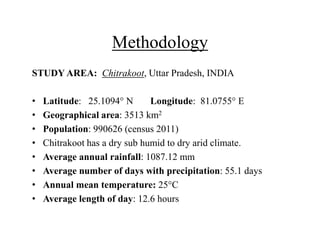
STUDY AREA: Chitrakoot, Uttar Pradesh, INDIA
• Latitude: 25.1094° N Longitude: 81.0755° E
• Geographical area: 3513 km2
• Population: 990626 (census 2011)• Population: 990626 (census 2011)
• Chitrakoot has a dry sub humid to dry arid climate.
• Average annual rainfall: 1087.12 mm
• Average number of days with precipitation: 55.1 days
• Annual mean temperature: 25°C
• Average length of day: 12.6 hours
Data required as input to WEPP model
WEPP model require four inputs:
SLOPE, SOIL, CLIMATE, AND MANAGEMENT.
• The slope can also be referred to topography.
• The soil files may include texture, infiltration and• The soil files may include texture, infiltration and
erodibilities.
• The climate file may include storm precipitation,
duration, daily maximum and minimum temperatures,
wind, solar radiation.
• The management file include the type of vegetation or
cover in that particular area.
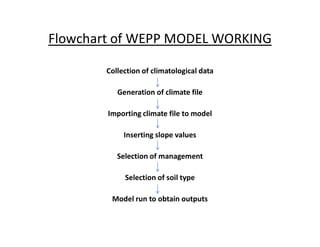
Flowchart of WEPP MODEL WORKING
Collection of climatological data
Generation of climate file
Importing climate file to model
Inserting slope values
Selection of management
Selection of soil type
Model run to obtain outputs
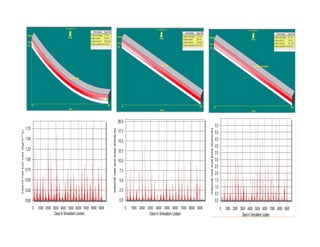
HILLSLOPE SELECTION
HILLSLOPE SELECTED
LENGTH
ESTIMATED
SLOPE
CULTIVATED 360 m 1.7%
FALLOW –
TILLED
230 m 2.2%
MOUNTAIN
AREA
190 m 29.7%
RESULTS AND DISCUSSIONS
STANDARD
DEVIATION
VARIANCE SKEWNESS
JULY 18.96757 359.7687 -0.702
AUGUST 30.31659 919.0956 0.257
SEPTEMBER 20.25882 410.4198 0.502
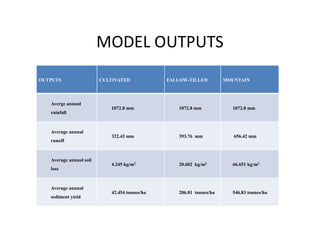
MODEL OUTPUTS
OUTPUTS CULTIVATED FALLOW-TILLED MOUNTAIN
Averge annual
rainfall
1072.8 mm 1072.8 mm 1072.8 mm
Average annual
runoff
322.43 mm 393.76 mm 656.42 mm
Average annual soil
loss
4.245 kg/m2 20.602 kg/m2 66.651 kg/m2
Average annual
sediment yield
42.454 tonnes/ha 206.01 tonnes/ha 546.83 tonnes/ha
CONCLUSIONS
• WEPP model can be used for any watershed in India if
climatological, management, topographic and soil
characteristics are known.
• Results indicate that soil erosion depends largely on
slope of land and vegetation or land cover type, rainfall
and runoff produced for the area.and runoff produced for the area.
• The runoff, soil loss and sediment yield are found to be
maximum for mountaineous hillslope with no
vegetation and average slope of 29.7 % and minimum
for cultivated hillslope with average slope of 1.7 %.
• The maximum variations in maximum daily rainfall
depth over years were found in the month of August.
THANK YOUTHANK YOU

WEPP MODEL

  • 1.
    PROJECT PRESENTATION ON “Demonstrating theuse of WEPP model for estimation of soil loss due to inter-rill erosion” Advisor : Submitted By : Prof (Dr.) R.K. ISAAC SHYAM MOHAN CHAUDHARY 13BTAG114
  • 2.
    CONTENTS • INTRODUCTION • JUSTIFICATION ••OBJECTIVES • METHODOLOGY • RESULTS AND DISCUSSION • CONCLUSIONS
  • 3.
    Introduction • Soil erosionis a process that causes loss of fertile topsoil and sedimentation and pollution of surface water bodies. It is a serious agricultural and environmental problem in many areas of the world (Brown and Wolf, 1984)world (Brown and Wolf, 1984) • The Water Erosion Prediction Project (WEPP) is a computer program that predicts soil erosion by water at the field scale. Beginning in 1985, the WEPP model was initiated by Dr. George R.Foster with USDA-ARS National Soil Erosion Research Laboratory.
  • 4.
    JUSTIFICATION • Estimation ofsoil loss and identification of critical area for implementation of best management practice is key to success for any soil conservation program. • Modeling of soil erosion can provide a quantitative and consistent approach to estimate soil erosion andconsistent approach to estimate soil erosion and sediment yield under a wide range of conditions. • Monitoring and modeling of erosion processes can help in better understanding of the causes of soil erosion, making predictions of erosion under a range of possible conditions and plan the implementation of preventative and restorative strategies for erosion.
  • 5.
    Objectives • To analyzerainfall events at Chitrakoot. • To Demonstrate the estimation of average annual precipitation, runoff, soil loss andannual precipitation, runoff, soil loss and sediment yield by WEPP model.
  • 6.
    Methodology STUDY AREA: Chitrakoot,Uttar Pradesh, INDIA • Latitude: 25.1094° N Longitude: 81.0755° E • Geographical area: 3513 km2 • Population: 990626 (census 2011)• Population: 990626 (census 2011) • Chitrakoot has a dry sub humid to dry arid climate. • Average annual rainfall: 1087.12 mm • Average number of days with precipitation: 55.1 days • Annual mean temperature: 25°C • Average length of day: 12.6 hours
  • 7.
    Data required asinput to WEPP model WEPP model require four inputs: SLOPE, SOIL, CLIMATE, AND MANAGEMENT. • The slope can also be referred to topography. • The soil files may include texture, infiltration and• The soil files may include texture, infiltration and erodibilities. • The climate file may include storm precipitation, duration, daily maximum and minimum temperatures, wind, solar radiation. • The management file include the type of vegetation or cover in that particular area.
  • 8.
    Flowchart of WEPPMODEL WORKING Collection of climatological data Generation of climate file Importing climate file to model Inserting slope values Selection of management Selection of soil type Model run to obtain outputs
  • 9.
    HILLSLOPE SELECTION HILLSLOPE SELECTED LENGTH ESTIMATED SLOPE CULTIVATED360 m 1.7% FALLOW – TILLED 230 m 2.2% MOUNTAIN AREA 190 m 29.7%
  • 10.
    RESULTS AND DISCUSSIONS STANDARD DEVIATION VARIANCESKEWNESS JULY 18.96757 359.7687 -0.702 AUGUST 30.31659 919.0956 0.257 SEPTEMBER 20.25882 410.4198 0.502
  • 11.
    MODEL OUTPUTS OUTPUTS CULTIVATEDFALLOW-TILLED MOUNTAIN Averge annual rainfall 1072.8 mm 1072.8 mm 1072.8 mm Average annual runoff 322.43 mm 393.76 mm 656.42 mm Average annual soil loss 4.245 kg/m2 20.602 kg/m2 66.651 kg/m2 Average annual sediment yield 42.454 tonnes/ha 206.01 tonnes/ha 546.83 tonnes/ha
  • 13.
    CONCLUSIONS • WEPP modelcan be used for any watershed in India if climatological, management, topographic and soil characteristics are known. • Results indicate that soil erosion depends largely on slope of land and vegetation or land cover type, rainfall and runoff produced for the area.and runoff produced for the area. • The runoff, soil loss and sediment yield are found to be maximum for mountaineous hillslope with no vegetation and average slope of 29.7 % and minimum for cultivated hillslope with average slope of 1.7 %. • The maximum variations in maximum daily rainfall depth over years were found in the month of August.
  • 14.