EROSION
EROSION: TRANSPORT OF SEDIMENTS
AND DEPOSITING  THEM ELSEWHERE
 
EROSION IS DRIVEN BY THE FORCE OF GRAVITY
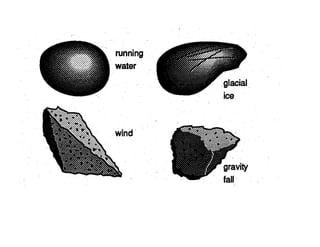
THE AGENTS OF EROSION ARE: RUNNING WATER WIND MOVING ICE (GLACIERS)
Each Agent of Erosion Produces it’s Own Characteristic shape and Texture  in the Sediment :
 
ROUNDS AND SMOOTHES THE ROCK SURFACE ALSO MAKES IT SMALLER
WIND BLOWN SEDIMENTS FROST  AND  PIT   THE ROCK SURFACE
SMALL SEDIMENTS IN THE  GLACIER  POLISHES  &  SMOOTHES   THE ROCK SURFACE LARGE SEDIMENTS  SCRATCH   AND  STRIATE  THE ROCK SURFACE
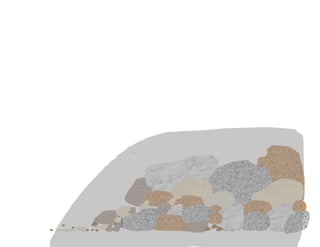
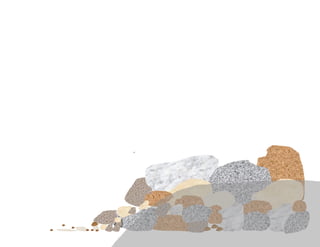
FALLEN ROCKS ARE SHARP  & ANGULAR
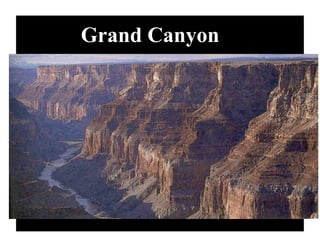
RUNNING WATER   The primary agent of erosion is:
Colorado River
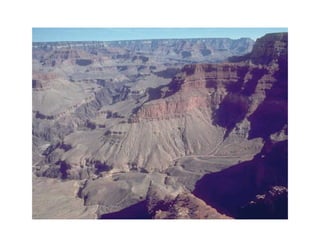
Grand Canyon
Niagra Falls


EROSION BY WATER: PARTICLES ARE CARRIED  IN SEVERAL WAYS DEPENDING ON THEIR SIZE
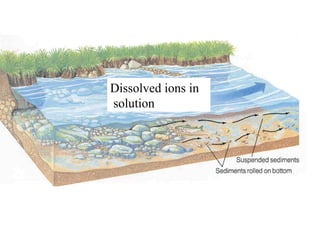
THREE ways streams transport sediment:
SEDIMENTS  IN SOLUTION : DISSOLVED IONS
examples : Salt calcite
Dissolved ions in solution
SEDIMENTS  IN SUSPENSION : COLLOIDS
Can you think of examples : SILT CLAY
 
SEDIMENTS  ROLLED AND  BOUNCED: LARGE SEDIMENTS   dragged along the bottom
 
VELOCITY OF A STREAM  DEPENDS ON: SLOPE  (GRADIENT)   AND DISCHARGE volume of water


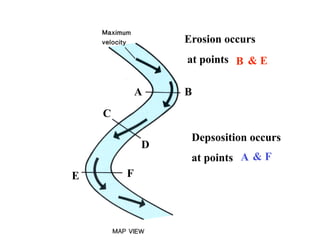
Water moves faster on the outside  of a bend EROSION Water moves slower on the inside  of a bend DEPOSITION LABEL YOUR DIAGRAM (EROSION) & (DEPOSITION) EROSION DEPOSITION
Erosion occurs at points  Depsosition occurs  at points  B & E A & F A B C D F E
B C D E F Maximum erosion  occurs where there is maximum _____________ On a straight path the maximum velocity is in the ___________ below the ____________ center surface velocity
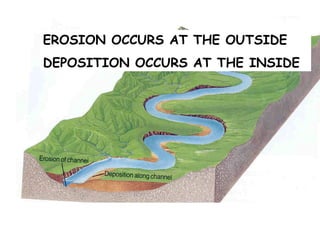
EROSION OCCURS AT THE OUTSIDE  DEPOSITION OCCURS AT THE INSIDE
 
THE MOVEMENT OF THE WATER CAN EVENTUALLY FORM AN OXBOW LAKE
SEDIMENTS LEFT BEHIND BY STREAMS AND WIND ARE   ________ SORTED   dropped off in size order
CALCULATE THE MINIMUM VELOCITY OF A STREAM NEEDED TO CARRY A PEBBLE:
(SEE REF. TABLE PAGE 6)
APPROXIMATELY 50 CM/SEC
WHAT IS THE MINIMUM VELOCITY NEEDED TO CARRY A BOULDER? 200 CM/SEC
SORTING
WIND:
 
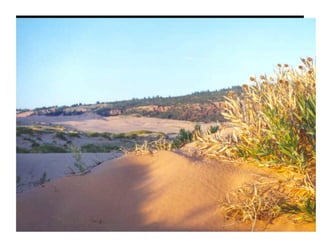
EROSION BY WIND OCCURS PRIMARILY IN: DRY CLIMATES
The particles transported (eroded) by wind are _________ Sorted


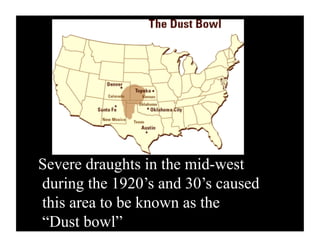
Severe draughts in the mid-west during the 1920’s and 30’s caused this area to be known as the  “Dust bowl”
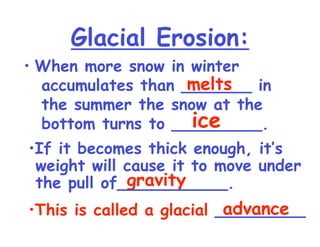
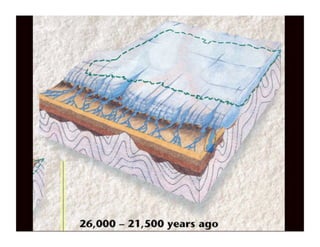
Glacial Erosion: When more snow in winter accumulates than _______ in the summer the snow at the bottom turns to _________.  melts ice gravity advance If it becomes thick enough, it’s  weight will cause it to move under the pull of___________. This is called a glacial  _________


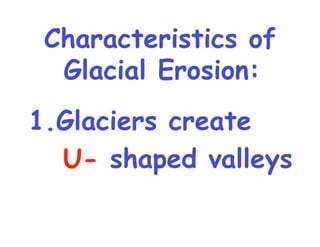
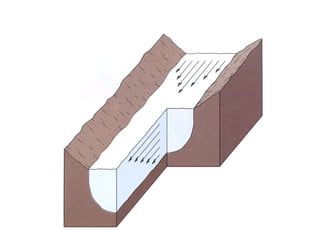
1.Glaciers create   U-  shaped valleys  Characteristics of Glacial Erosion:


escarpment U-shaped valley
 
 
Advancing glacier
Retreating glacier
 
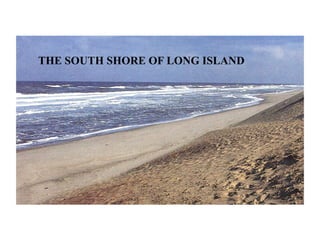
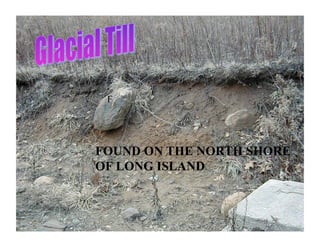
Long Island Sound South Shore North Shore
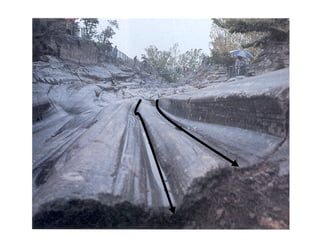
2. Sediments left behind by glaciers are STRIATIONS SHOW THE DIRECTION   OF MOVEMENT OF THE GLACIER polished & striated (scratched)
 
3. SEDIMENTS LEFT BEHIND BY GLACIERS ARE: UNSORTED
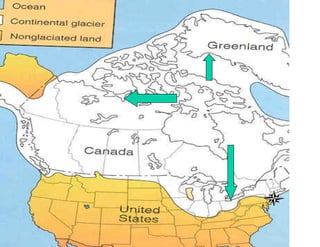
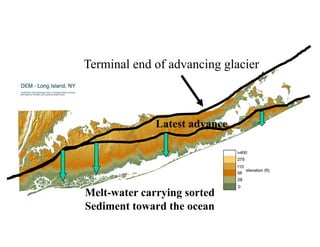
Advancing glacier MORE SNOW FALLS THAN MELTS
Retreating glacier ICE BEGINS TO MELT DUE TO CLIMATE CHANGE


Terminal end of advancing glacier Latest advance Melt-water carrying sorted Sediment toward the ocean
 
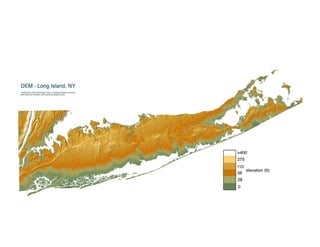
THE SOUTH SHORE OF LONG ISLAND
 
Glacial Till F FOUND ON THE NORTH SHORE OF LONG ISLAND
FASTEST VELOCITY IS AT THE CENTER OF THE VALLEY
Some glacial features include: escarpment U-shaped valley
drumlins outwash plain
Some Glacial Features include : U-shaped valleys Moraines: unsorted sediments Drumlins: elongated moraines kettle lakes: round glacial lake finger lakes: elongated glacial lake outwash plains: deposited by melt-water streams  Erratic: large rock  deposited by a glacier Escarpment: steep cliff Horn: sharp peak Drumlins outwash plain Kettle lakes
River erosion:  notice the V-shaped valleys  and meanders (bending)
 
Valley glacier eroding a U-shape
Glacial features left behind
Glaciers / Rivers
A B C A B C Match the  cross sections below with  the lines on the stream A B C

Erosion

Editor's Notes

  • #25 Merrill Snyder
  • #28 Merrill ES Snyder Feather Hesser
  • #30 Merrill Snyder
  • #39 Merrill earth science Snyder Feather Hesser Glencoe