Erikson’s 8 Ages of Man
(Psychosocial Theory)
1
Erikson’s 8 Ages of Man (Psychosocial Theory)
Otherwise known as:
• Erik Erikson and Lifespan Theory
(Psychosocial Theory)
• The 8 ages of development (the 8 ages of
man)
2
Erikson’s 8 Ages of Man (Psychosocial Theory)
• Erik Erikson (1902-1979) was one of the
writers who developed the psycho-dynamic
approach.
• He received psychoanalytic training from
Freud’s daughter Anna.
• Unlike Freud (who believed that psychological
development was fixed by the end of
adolescence), Erikson suggested that
development is a lifelong process.
3
Erikson’s 8 Ages of Man (Psychosocial Theory)
• We encounter new situations at each stage of
our life
• We have to work out how to respond to them
in order to achieve psychological balance and
health.
4
Erikson’s 8 Ages of Man (Psychosocial Theory)
• The unsuccessful resolution of earlier stages
could produce lasting consequences:
• It would leave unsettled conflicts remaining
to interfere with current psychological
development
• The conflicts are to do with the individual’s
relationship with others – hence the name
psycho-social.
5
Erikson’s 8 Ages of Man (Psychosocial Theory)
• Social factors have a lot of influence on the
way we behave and develop.
• We are influenced by our parents, in our
community by our friends, and at school by
our teachers.
• Consequently, we gather information that will
affect our behaviour.
6
Erikson’s 8 Ages of Man (Psychosocial Theory)
Erikson’s theory is known as the eight
ages of development (eight ages of
man) as:
• he defines eight major life crises which he
says are
• significant in terms of individual growth and
development.
7
Erikson’s 8 Ages of Man (Psychosocial Theory)
• During each stage, there is a life crisis which
we need to work through.
• There are two outcomes, one positive and one
negative, which will have implications for the
development of our identity.
• We will develop a mixture of both outcomes
from each stage, but if the positive outweighs
the negative, then an ego strength will emerge.
• This means we will have a stronger sense of who
we are.
8
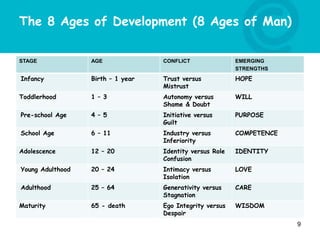
The 8 Ages of Development (8 Ages of Man)
STAGE AGE CONFLICT EMERGING
STRENGTHS
Infancy Birth – 1 year Trust versus
Mistrust
HOPE
Toddlerhood 1 – 3 Autonomy versus
Shame & Doubt
WILL
Pre-school Age 4 – 5 Initiative versus
Guilt
PURPOSE
School Age 6 – 11 Industry versus
Inferiority
COMPETENCE
Adolescence 12 – 20 Identity versus Role
Confusion
IDENTITY
Young Adulthood 20 – 24 Intimacy versus
Isolation
LOVE
Adulthood 25 – 64 Generativity versus
Stagnation
CARE
Maturity 65 - death Ego Integrity versus
Despair
WISDOM
9
Erikson’s 8 Ages of Man (Psychosocial Theory)
• Stages 1 – 4 correspond roughly to the
Freudian stages, up to puberty
• Stage 5 encompasses late adolescence/early
adulthood
• Stage 6 is the so called “prime of life”
• Stage 7 corresponds to middle age
• Stage 8 corresponds to old age
10
Stage 1: Trust v Mistrust (Infancy)
• This is the time when children are most
helpless and therefore dependent on adults.
• It is the quality of the caregiver relationship
that is the foundation for later trust in
others.
• If caregivers are inconsistent or rejecting a
feeling of mistrust will develop.
• If care is loving and consistent, infants will
not be unduly anxious.
11
Stage 1: Trust v Mistrust (Infancy)
• The crisis is over when the child develops
more trust than mistrust.
• However, it could be dangerous for a child to
be too trusting: a little bit of mistrust is
healthy.
• The trusting child is willing to take risks and
will not be overwhelmed by disappointments.
• The virtue of hope develops.
12
Stage 2: Autonomy v Shame
(Toddlerhood)
• Control of behaviour is gained. Skills include
walking, talking, climbing, and becoming ‘toilet
trained’.
• The caregiver has to guide the child’s
behaviour into socially acceptable directions
without damaging the child’s sense of
autonomy.
13
Stage 2: Autonomy v Shame
(Toddlerhood)
• Over protection or strict control will produce
shame and self doubt.
• The development of a sense of autonomy will
allow the virtue of will to develop.
• This refers to the ability to exercise free
choice as well as self-restraint.
14
Stage 3: Initiative v Guilt
(Pre-school age)
• The child becomes capable of more detailed
motor activity
• Language skills improve, imagination develops.
• These skills allow the child to initiate ideas
and actions and to plan future events.
• The child begins to explore what kind of
person they can become. They enjoy role-play
and test limits to find what is permissible and
what is not.
15
Stage 3: Initiative v Guilt
(Pre-school age)
• Initiative is the result of encouragement
• Guilt stems from being ridiculed and feeling
inadequate.
• Developing a sense of initiative allows the
child to find purpose in life.
16
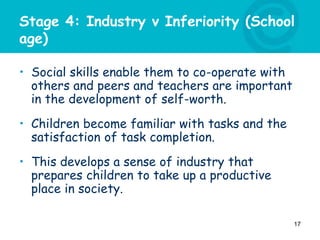
Stage 4: Industry v Inferiority (School
age)
• Social skills enable them to co-operate with
others and peers and teachers are important
in the development of self-worth.
• Children become familiar with tasks and the
satisfaction of task completion.
• This develops a sense of industry that
prepares children to take up a productive
place in society.
17
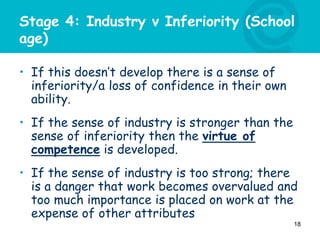
Stage 4: Industry v Inferiority (School
age)
• If this doesn’t develop there is a sense of
inferiority/a loss of confidence in their own
ability.
• If the sense of industry is stronger than the
sense of inferiority then the virtue of
competence is developed.
• If the sense of industry is too strong; there
is a danger that work becomes overvalued and
too much importance is placed on work at the
expense of other attributes
18
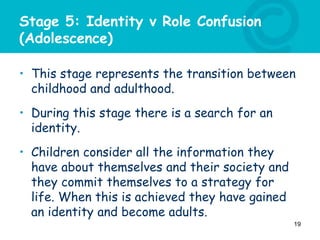
Stage 5: Identity v Role Confusion
(Adolescence)
• This stage represents the transition between
childhood and adulthood.
• During this stage there is a search for an
identity.
• Children consider all the information they
have about themselves and their society and
they commit themselves to a strategy for
life. When this is achieved they have gained
an identity and become adults.
19
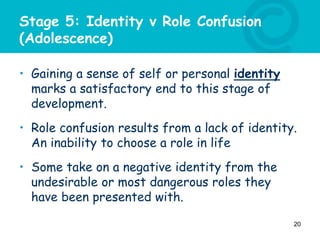
Stage 5: Identity v Role Confusion
(Adolescence)
• Gaining a sense of self or personal identity
marks a satisfactory end to this stage of
development.
• Role confusion results from a lack of identity.
An inability to choose a role in life
• Some take on a negative identity from the
undesirable or most dangerous roles they
have been presented with.
20
Stage 6:Intimacy v Isolation (Young
Adulthood)
• Freud once defined a healthy person as one
who loves and works.
• Erikson agrees and says that only those who
have developed a secure identity can risk
entering into a love relationship with another.
21
Stage 6:Intimacy v Isolation (Young
Adulthood)
• The young adult is ready to commit to
partnership and those with a strong identity
look for intimate relationships with others.
• Those who do not develop a capacity for work
and intimacy withdraw into themselves and
develop a feeling of isolation
22
Stage 7: Generativity v Stagnation
(Adulthood)
• The person who has encountered the right
circumstances to develop a positive identity,
be productive and develop satisfying
relationships will attempt to pass on the
circumstances that caused these things to
the next generation.
• Interacting with children, or producing or
creating things to enhance the lives of others
can do this.
23
Stage 7: Generativity v Stagnation
(Adulthood)
• They develop the virtue of care.
• Those who are unable to invest something of
their own selves in others are socially
impoverished and stagnation results.
24
Stage 8:Ego-Integrity v Despair
(Maturity)
• The person who can look back on a happy and fulfilling
life does not fear death.
• There is a discovery of order and meaning in life and
an acceptance of what has been.
• This stage brings a feeling of completion.
• Those who look back with frustration experience
despair, knowing that it is too late to start again.
• Wisdom is the result of ego integrity.
25
Summary
• We move through the stages as we grow
older, but we may carry unresolved issues
from earlier stages.
• We may be able to work through these
conflicts during experiences later in life, but
it is more difficult to do this.
• Although we have developed a strong sense of
identity in Stage 5 (adolescence),
circumstances later in life may well challenge
this.
26
Summary (continued)
• How we deal with problems/situations later in
life will depend on the ego strengths we have
built up in our earlier stages.
• So, the outcome of every stage has
implications for the development of our
identity and personality.
27

Erikson

  • 1.
    Erikson’s 8 Agesof Man (Psychosocial Theory) 1
  • 2.
    Erikson’s 8 Agesof Man (Psychosocial Theory) Otherwise known as: • Erik Erikson and Lifespan Theory (Psychosocial Theory) • The 8 ages of development (the 8 ages of man) 2
  • 3.
    Erikson’s 8 Agesof Man (Psychosocial Theory) • Erik Erikson (1902-1979) was one of the writers who developed the psycho-dynamic approach. • He received psychoanalytic training from Freud’s daughter Anna. • Unlike Freud (who believed that psychological development was fixed by the end of adolescence), Erikson suggested that development is a lifelong process. 3
  • 4.
    Erikson’s 8 Agesof Man (Psychosocial Theory) • We encounter new situations at each stage of our life • We have to work out how to respond to them in order to achieve psychological balance and health. 4
  • 5.
    Erikson’s 8 Agesof Man (Psychosocial Theory) • The unsuccessful resolution of earlier stages could produce lasting consequences: • It would leave unsettled conflicts remaining to interfere with current psychological development • The conflicts are to do with the individual’s relationship with others – hence the name psycho-social. 5
  • 6.
    Erikson’s 8 Agesof Man (Psychosocial Theory) • Social factors have a lot of influence on the way we behave and develop. • We are influenced by our parents, in our community by our friends, and at school by our teachers. • Consequently, we gather information that will affect our behaviour. 6
  • 7.
    Erikson’s 8 Agesof Man (Psychosocial Theory) Erikson’s theory is known as the eight ages of development (eight ages of man) as: • he defines eight major life crises which he says are • significant in terms of individual growth and development. 7
  • 8.
    Erikson’s 8 Agesof Man (Psychosocial Theory) • During each stage, there is a life crisis which we need to work through. • There are two outcomes, one positive and one negative, which will have implications for the development of our identity. • We will develop a mixture of both outcomes from each stage, but if the positive outweighs the negative, then an ego strength will emerge. • This means we will have a stronger sense of who we are. 8
  • 9.
    The 8 Agesof Development (8 Ages of Man) STAGE AGE CONFLICT EMERGING STRENGTHS Infancy Birth – 1 year Trust versus Mistrust HOPE Toddlerhood 1 – 3 Autonomy versus Shame & Doubt WILL Pre-school Age 4 – 5 Initiative versus Guilt PURPOSE School Age 6 – 11 Industry versus Inferiority COMPETENCE Adolescence 12 – 20 Identity versus Role Confusion IDENTITY Young Adulthood 20 – 24 Intimacy versus Isolation LOVE Adulthood 25 – 64 Generativity versus Stagnation CARE Maturity 65 - death Ego Integrity versus Despair WISDOM 9
  • 10.
    Erikson’s 8 Agesof Man (Psychosocial Theory) • Stages 1 – 4 correspond roughly to the Freudian stages, up to puberty • Stage 5 encompasses late adolescence/early adulthood • Stage 6 is the so called “prime of life” • Stage 7 corresponds to middle age • Stage 8 corresponds to old age 10
  • 11.
    Stage 1: Trustv Mistrust (Infancy) • This is the time when children are most helpless and therefore dependent on adults. • It is the quality of the caregiver relationship that is the foundation for later trust in others. • If caregivers are inconsistent or rejecting a feeling of mistrust will develop. • If care is loving and consistent, infants will not be unduly anxious. 11
  • 12.
    Stage 1: Trustv Mistrust (Infancy) • The crisis is over when the child develops more trust than mistrust. • However, it could be dangerous for a child to be too trusting: a little bit of mistrust is healthy. • The trusting child is willing to take risks and will not be overwhelmed by disappointments. • The virtue of hope develops. 12
  • 13.
    Stage 2: Autonomyv Shame (Toddlerhood) • Control of behaviour is gained. Skills include walking, talking, climbing, and becoming ‘toilet trained’. • The caregiver has to guide the child’s behaviour into socially acceptable directions without damaging the child’s sense of autonomy. 13
  • 14.
    Stage 2: Autonomyv Shame (Toddlerhood) • Over protection or strict control will produce shame and self doubt. • The development of a sense of autonomy will allow the virtue of will to develop. • This refers to the ability to exercise free choice as well as self-restraint. 14
  • 15.
    Stage 3: Initiativev Guilt (Pre-school age) • The child becomes capable of more detailed motor activity • Language skills improve, imagination develops. • These skills allow the child to initiate ideas and actions and to plan future events. • The child begins to explore what kind of person they can become. They enjoy role-play and test limits to find what is permissible and what is not. 15
  • 16.
    Stage 3: Initiativev Guilt (Pre-school age) • Initiative is the result of encouragement • Guilt stems from being ridiculed and feeling inadequate. • Developing a sense of initiative allows the child to find purpose in life. 16
  • 17.
    Stage 4: Industryv Inferiority (School age) • Social skills enable them to co-operate with others and peers and teachers are important in the development of self-worth. • Children become familiar with tasks and the satisfaction of task completion. • This develops a sense of industry that prepares children to take up a productive place in society. 17
  • 18.
    Stage 4: Industryv Inferiority (School age) • If this doesn’t develop there is a sense of inferiority/a loss of confidence in their own ability. • If the sense of industry is stronger than the sense of inferiority then the virtue of competence is developed. • If the sense of industry is too strong; there is a danger that work becomes overvalued and too much importance is placed on work at the expense of other attributes 18
  • 19.
    Stage 5: Identityv Role Confusion (Adolescence) • This stage represents the transition between childhood and adulthood. • During this stage there is a search for an identity. • Children consider all the information they have about themselves and their society and they commit themselves to a strategy for life. When this is achieved they have gained an identity and become adults. 19
  • 20.
    Stage 5: Identityv Role Confusion (Adolescence) • Gaining a sense of self or personal identity marks a satisfactory end to this stage of development. • Role confusion results from a lack of identity. An inability to choose a role in life • Some take on a negative identity from the undesirable or most dangerous roles they have been presented with. 20
  • 21.
    Stage 6:Intimacy vIsolation (Young Adulthood) • Freud once defined a healthy person as one who loves and works. • Erikson agrees and says that only those who have developed a secure identity can risk entering into a love relationship with another. 21
  • 22.
    Stage 6:Intimacy vIsolation (Young Adulthood) • The young adult is ready to commit to partnership and those with a strong identity look for intimate relationships with others. • Those who do not develop a capacity for work and intimacy withdraw into themselves and develop a feeling of isolation 22
  • 23.
    Stage 7: Generativityv Stagnation (Adulthood) • The person who has encountered the right circumstances to develop a positive identity, be productive and develop satisfying relationships will attempt to pass on the circumstances that caused these things to the next generation. • Interacting with children, or producing or creating things to enhance the lives of others can do this. 23
  • 24.
    Stage 7: Generativityv Stagnation (Adulthood) • They develop the virtue of care. • Those who are unable to invest something of their own selves in others are socially impoverished and stagnation results. 24
  • 25.
    Stage 8:Ego-Integrity vDespair (Maturity) • The person who can look back on a happy and fulfilling life does not fear death. • There is a discovery of order and meaning in life and an acceptance of what has been. • This stage brings a feeling of completion. • Those who look back with frustration experience despair, knowing that it is too late to start again. • Wisdom is the result of ego integrity. 25
  • 26.
    Summary • We movethrough the stages as we grow older, but we may carry unresolved issues from earlier stages. • We may be able to work through these conflicts during experiences later in life, but it is more difficult to do this. • Although we have developed a strong sense of identity in Stage 5 (adolescence), circumstances later in life may well challenge this. 26
  • 27.
    Summary (continued) • Howwe deal with problems/situations later in life will depend on the ego strengths we have built up in our earlier stages. • So, the outcome of every stage has implications for the development of our identity and personality. 27