Erik Erikson:
Eight Stages of
Development
Presented B
Ishrat Fa
Contents
Who is Erik Erikson? - Background
Stages of Development 1 – 4 (Rocky)
Stages of Development 5 – 8 (Dan)
Additional Works and Criticisms
1
1
2
2
3
3
4
4
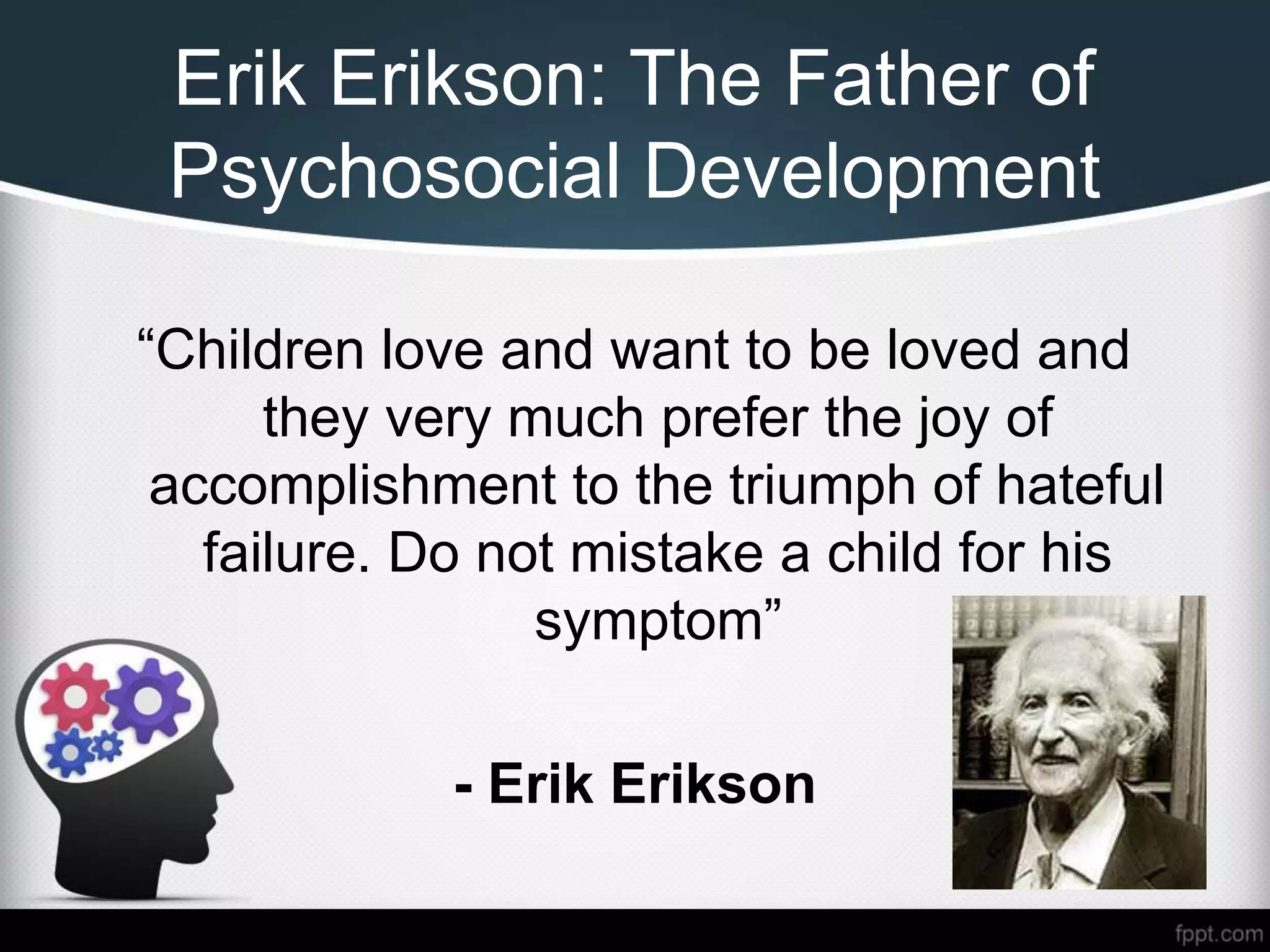
Erik Erikson: The Father of
Psychosocial Development
“Children love and want to be loved and
they very much prefer the joy of
accomplishment to the triumph of hateful
failure. Do not mistake a child for his
symptom”
- Erik Erikson
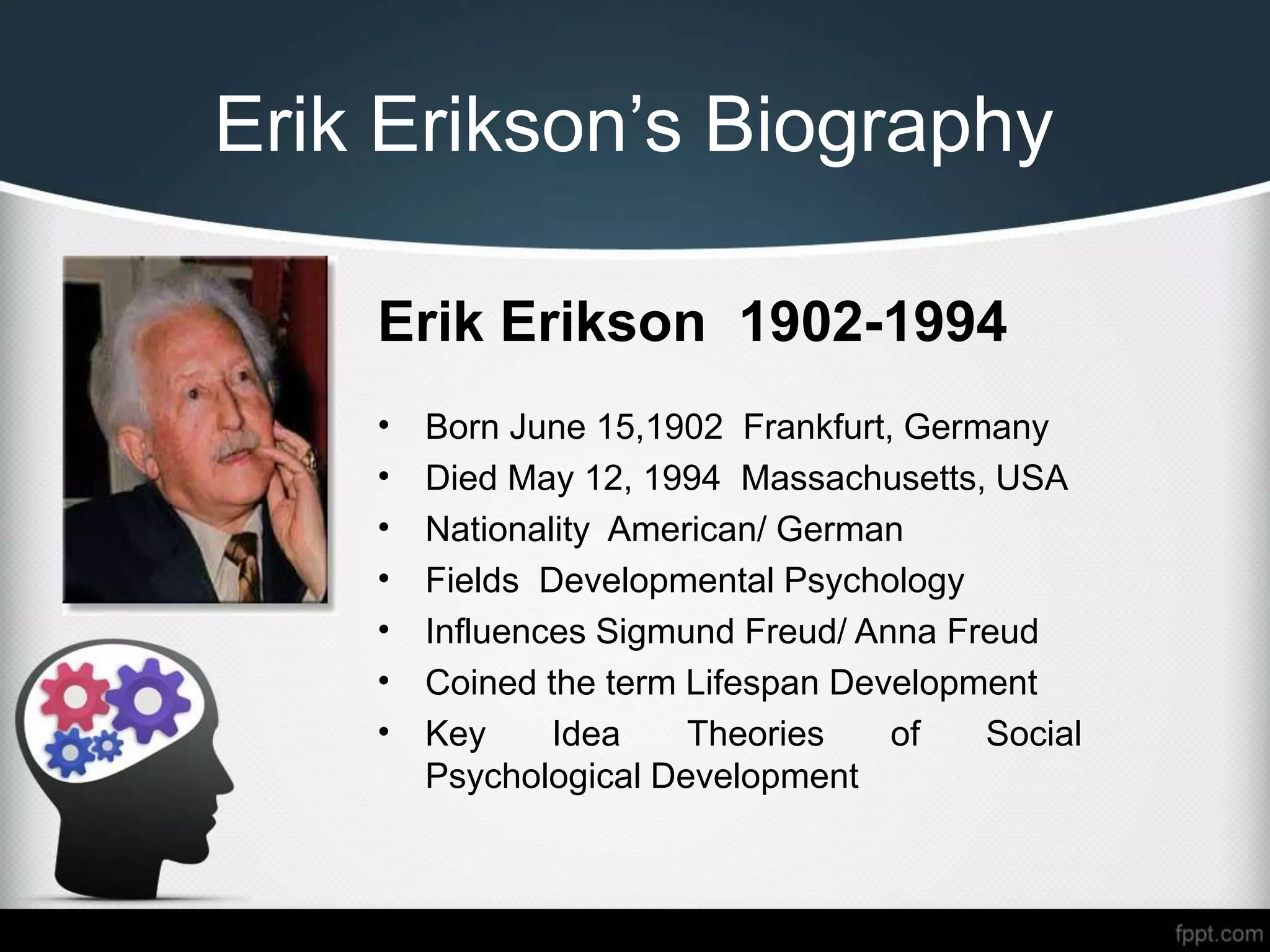
Erik Erikson’s Biography
• Born June 15,1902 Frankfurt, Germany
• Died May 12, 1994 Massachusetts, USA
• Nationality American/ German
• Fields Developmental Psychology
• Influences Sigmund Freud/ Anna Freud
• Coined the term Lifespan Development
• Key Idea Theories of Social
Psychological Development
Erik Erikson 1902-1994
Field of Research
• Erikson’s theory consists of eight stages of development. Each stage is
characterized by a different conflict that must be resolved by the
individual. If a person is unable to resolve a conflict at a particular
stage, they will be confront and struggle with it later in life.
INTRODUCTION
Social development is the sub area of developmental psychology that
focuses on the description of children's development of relationships with others,
their understanding of the meaning of their relationships with others, and their
understanding of others' behaviors, attitudes, and intentions.
Erik Erikson and the
8 Stages of Development
• Best known theories of personality and
development.
• Personality develops in a series of
predetermined stages.
• Psychosocial, and not psychosexual.
• In each stage of development
conflicts acts as turning points in life.
Personality
• Personality consists of all the relatively
stable and distinctive styles of thought,
behavior, and emotional responses that
characterize a person’s adaptations to
surrounding situations
Why Study Personality?
• Identify patterns in the way people
behave.
• Explain the differences between
people.
• How to improve life.
Psychosocial Development
• Refers to the emotional and psychological
changes across the life cycle that occurs
in the context of the individual’s social
environment.
Psychosocial Development
• According to Erikson- Each part of the
personality has a particular time in the life
span when it must develop, if it is going to
develop at all. If it failed to developed on
schedule, the rest of the development is
unfavorably altered. The individual is
then hindered from dealing effectively
with reality.
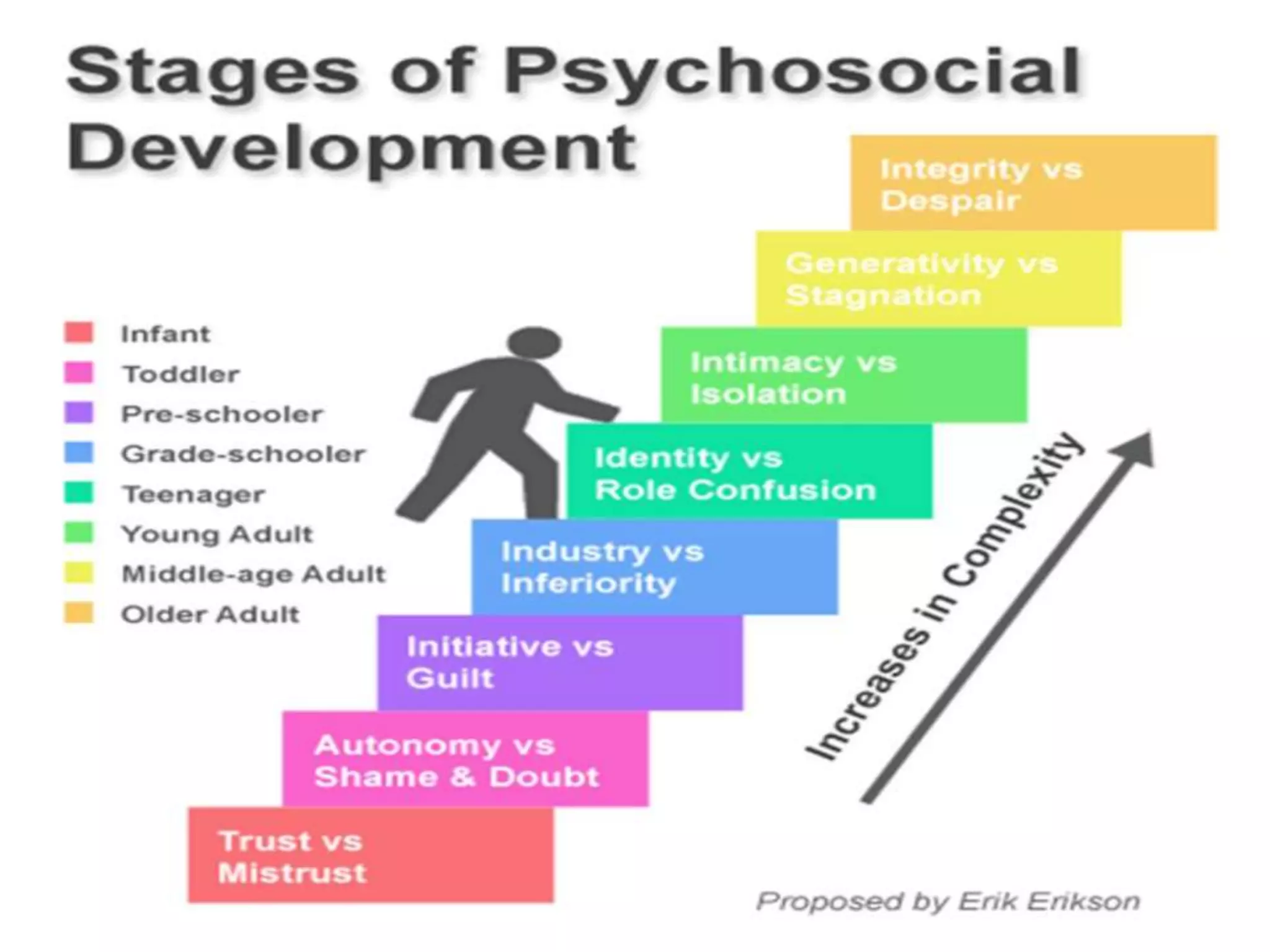
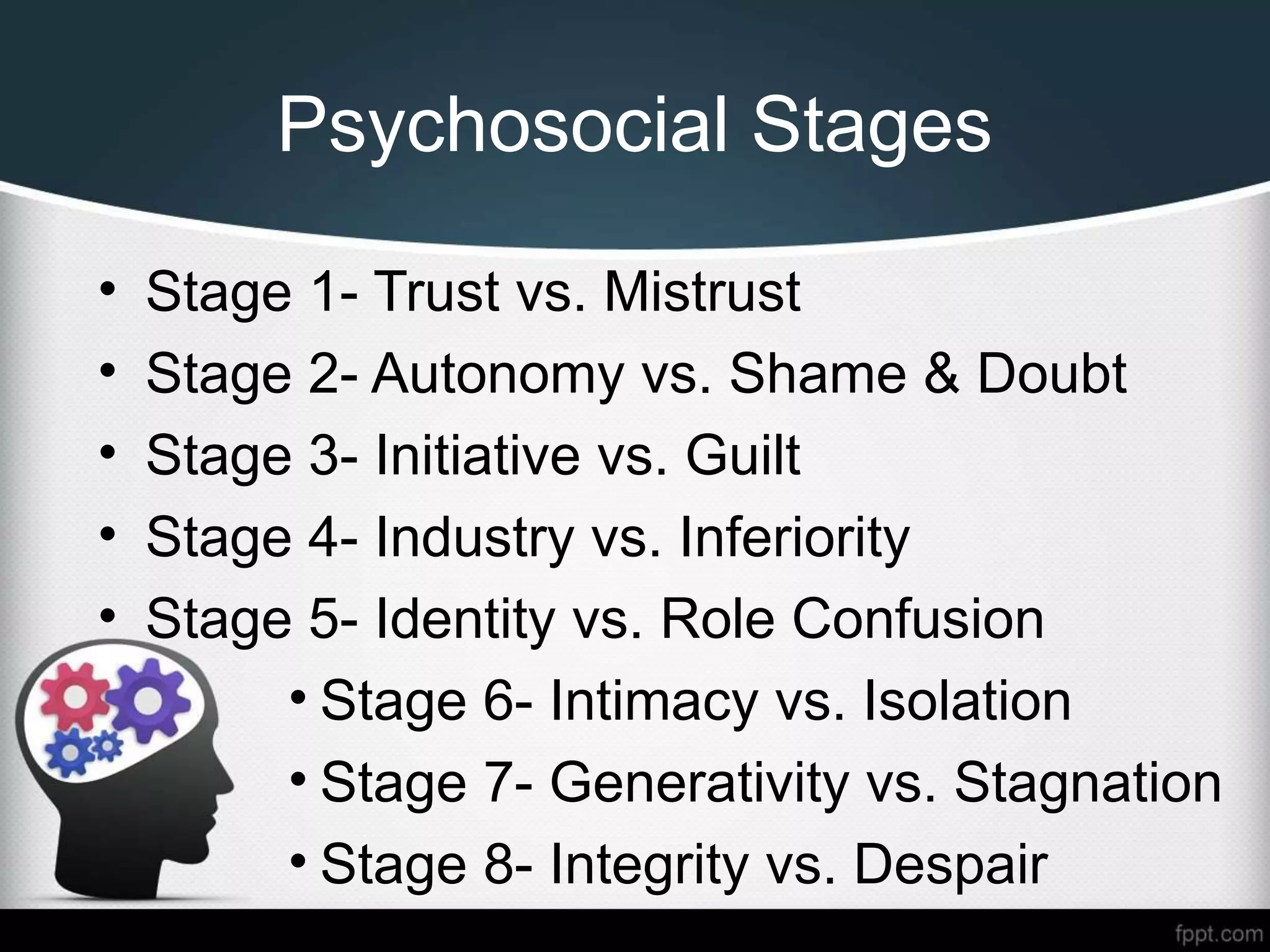
Psychosocial Stages
• Stage 1- Trust vs. Mistrust
• Stage 2- Autonomy vs. Shame & Doubt
• Stage 3- Initiative vs. Guilt
• Stage 4- Industry vs. Inferiority
• Stage 5- Identity vs. Role Confusion
• Stage 6- Intimacy vs. Isolation
• Stage 7- Generativity vs. Stagnation
• Stage 8- Integrity vs. Despair
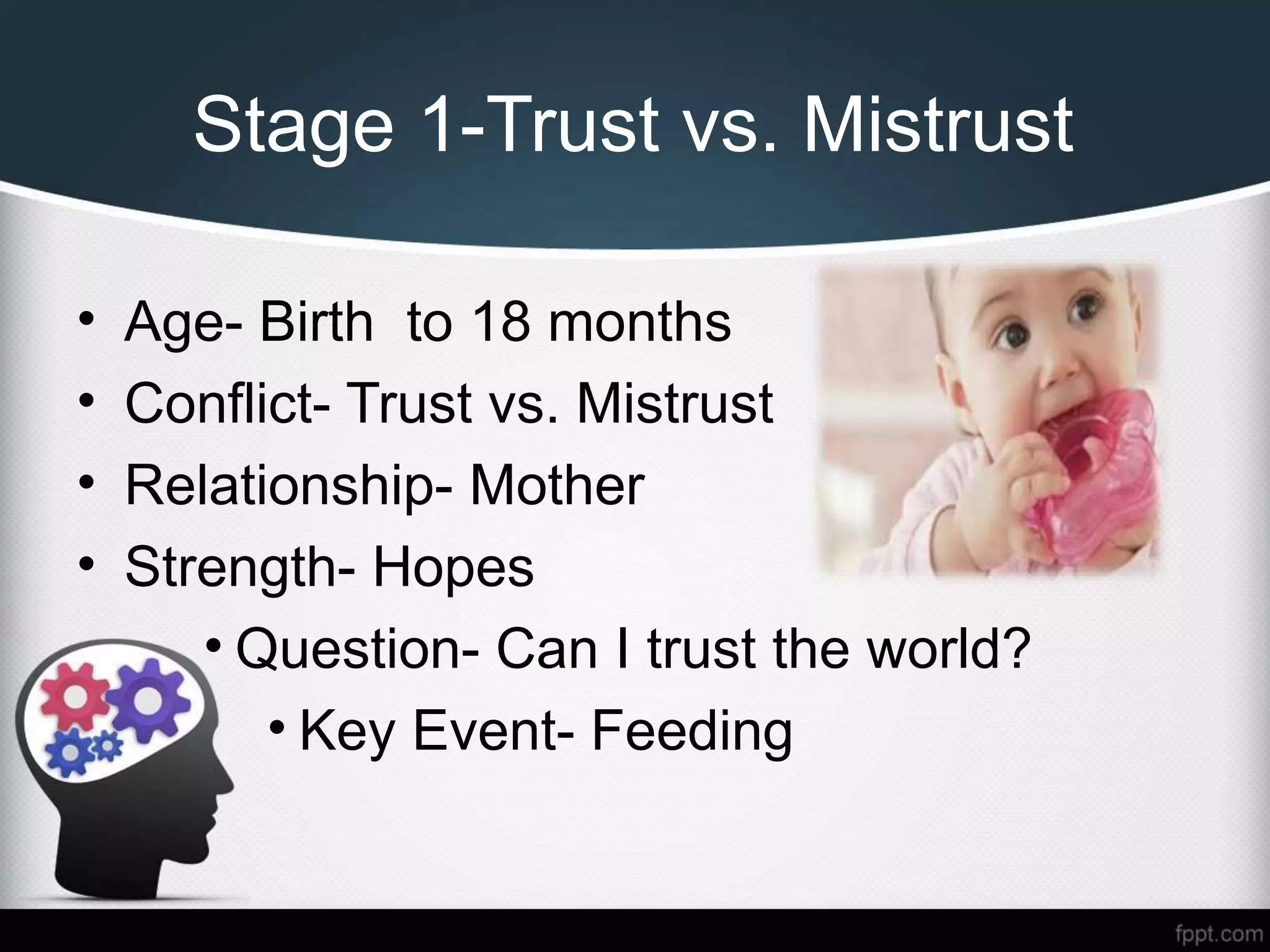
Stage 1-Trust vs. Mistrust
• Age- Birth to 18 months
• Conflict- Trust vs. Mistrust
• Relationship- Mother
• Strength- Hopes
• Question- Can I trust the world?
• Key Event- Feeding
Stage 1-Trust vs. Mistrust
• Children are completely dependent on others
• Trust: Established when babies given
adequate warmth, touching, love, and
physical care-Dependable & Reliable.
• Mistrust: Caused by inadequate or
unpredictable care and by cold,
indifferent, and rejecting parents-
Undependable, Unpredictable &
Dangerous.
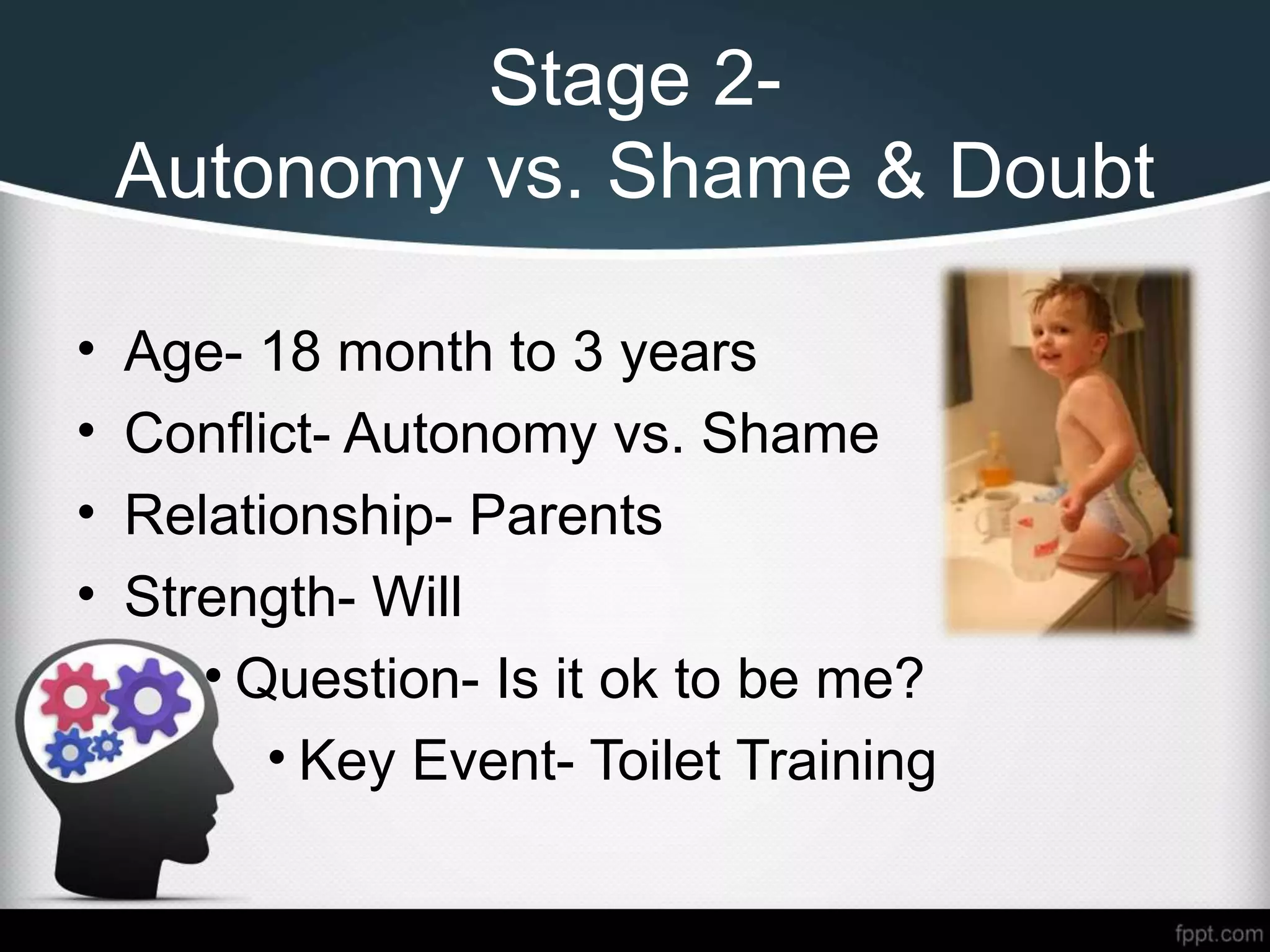
Stage 2-
Autonomy vs. Shame & Doubt
• Age- 18 month to 3 years
• Conflict- Autonomy vs. Shame
• Relationship- Parents
• Strength- Will
• Question- Is it ok to be me?
• Key Event- Toilet Training
Stage 2-
Autonomy vs. Shame & Doubt
• Autonomy: Doing things for themselves
such as body control & making choices.
- Secure and confident self.
• Shame: Overprotective or ridiculing parents
may cause children to doubt abilities
and feel shameful about their
actions- Inadequacy & self doubt.
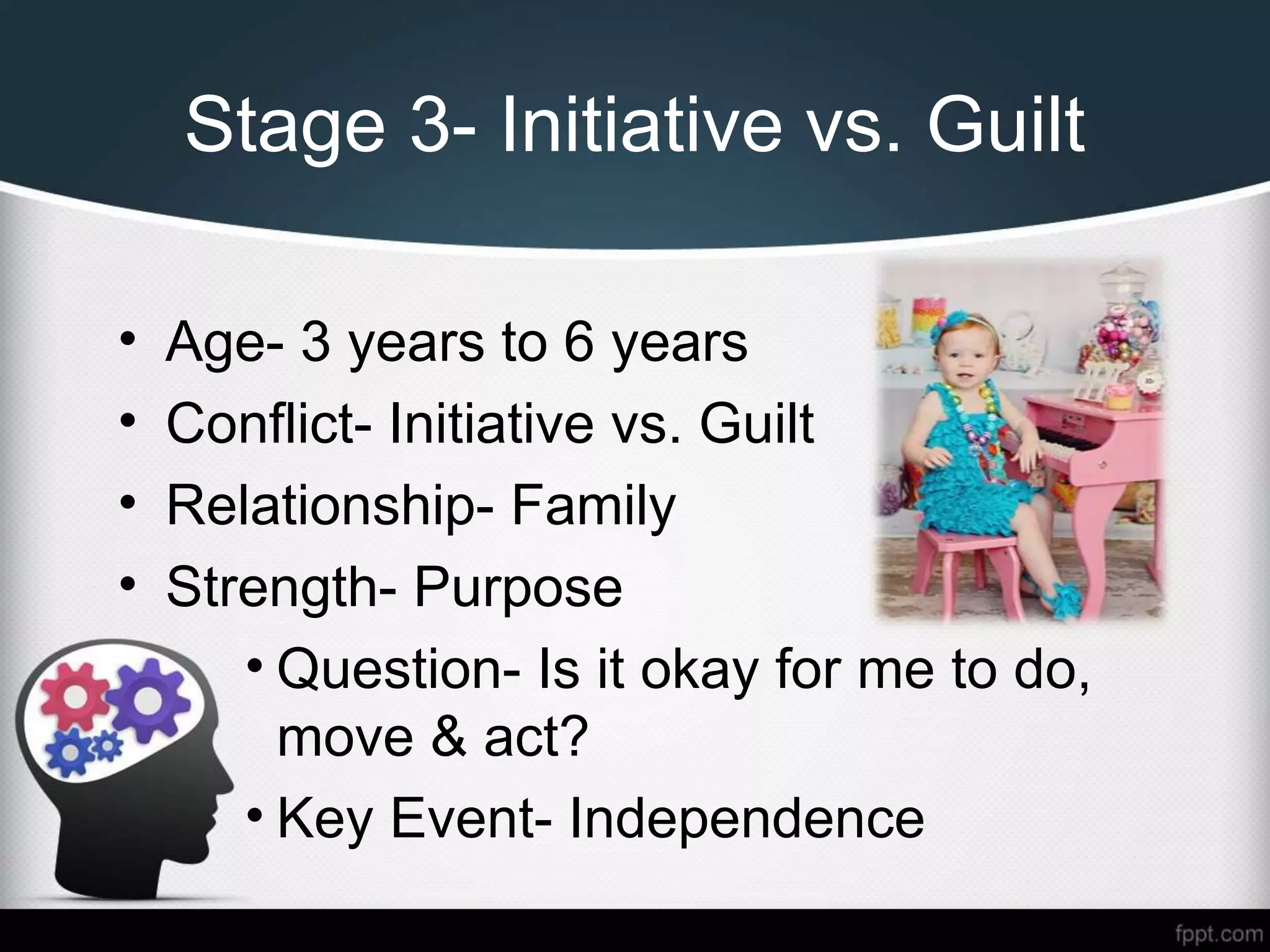
Stage 3- Initiative vs. Guilt
• Age- 3 years to 6 years
• Conflict- Initiative vs. Guilt
• Relationship- Family
• Strength- Purpose
• Question- Is it okay for me to do,
move & act?
• Key Event- Independence
Stage 3- Initiative vs. Guilt
• Initiative: Parents reinforce via giving
children freedom to play, use imagination,
and ask questions- Creative, Constructive.
• Guilt: May occur if parents criticize,
prevent play, or discourage a child’s
questions- Always being wrong, Failed
to explore world.
• Initiative and Guilt should be balanced
in order to have moral judgment.
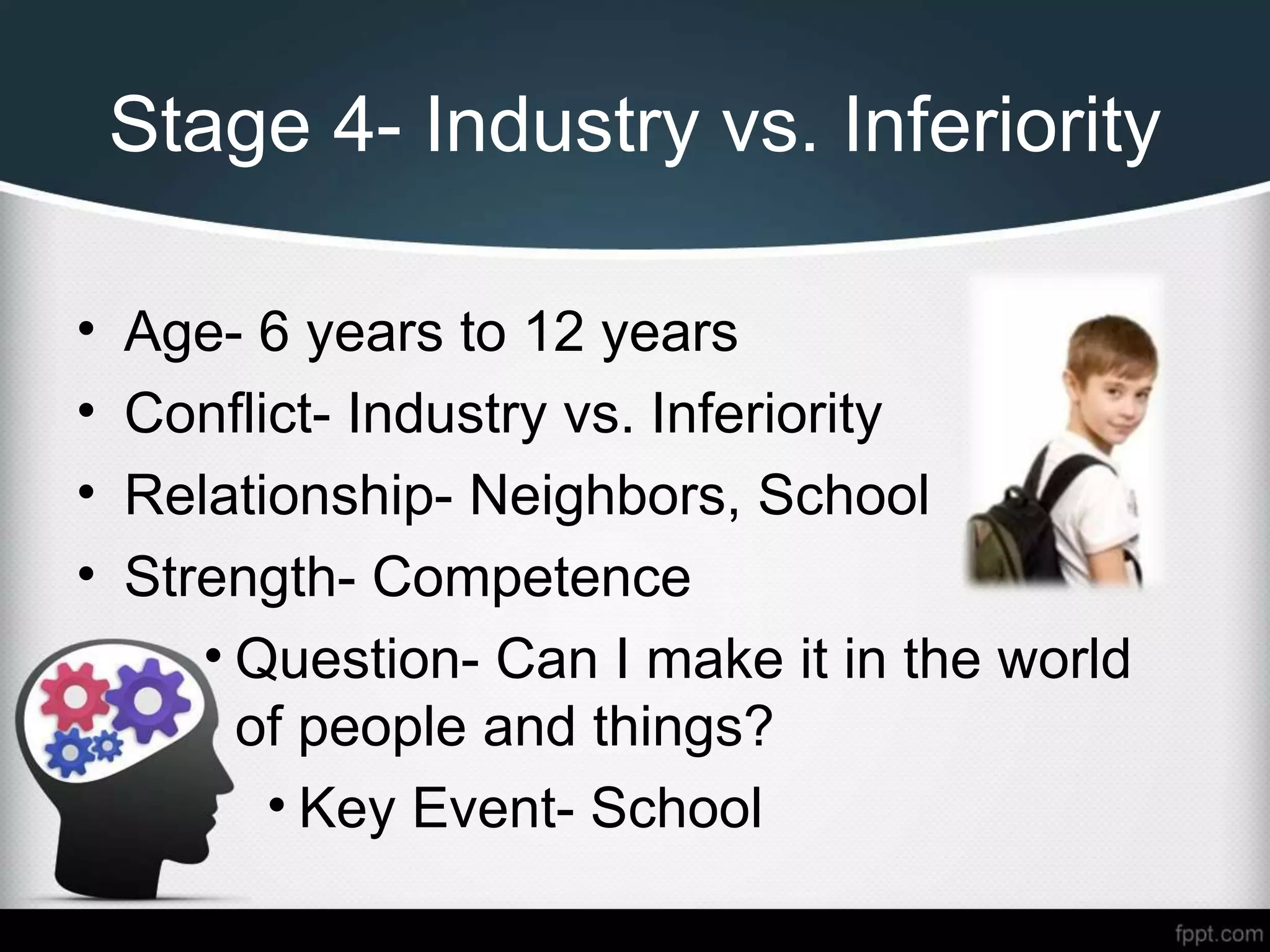
Stage 4- Industry vs. Inferiority
• Age- 6 years to 12 years
• Conflict- Industry vs. Inferiority
• Relationship- Neighbors, School
• Strength- Competence
• Question- Can I make it in the world
of people and things?
• Key Event- School
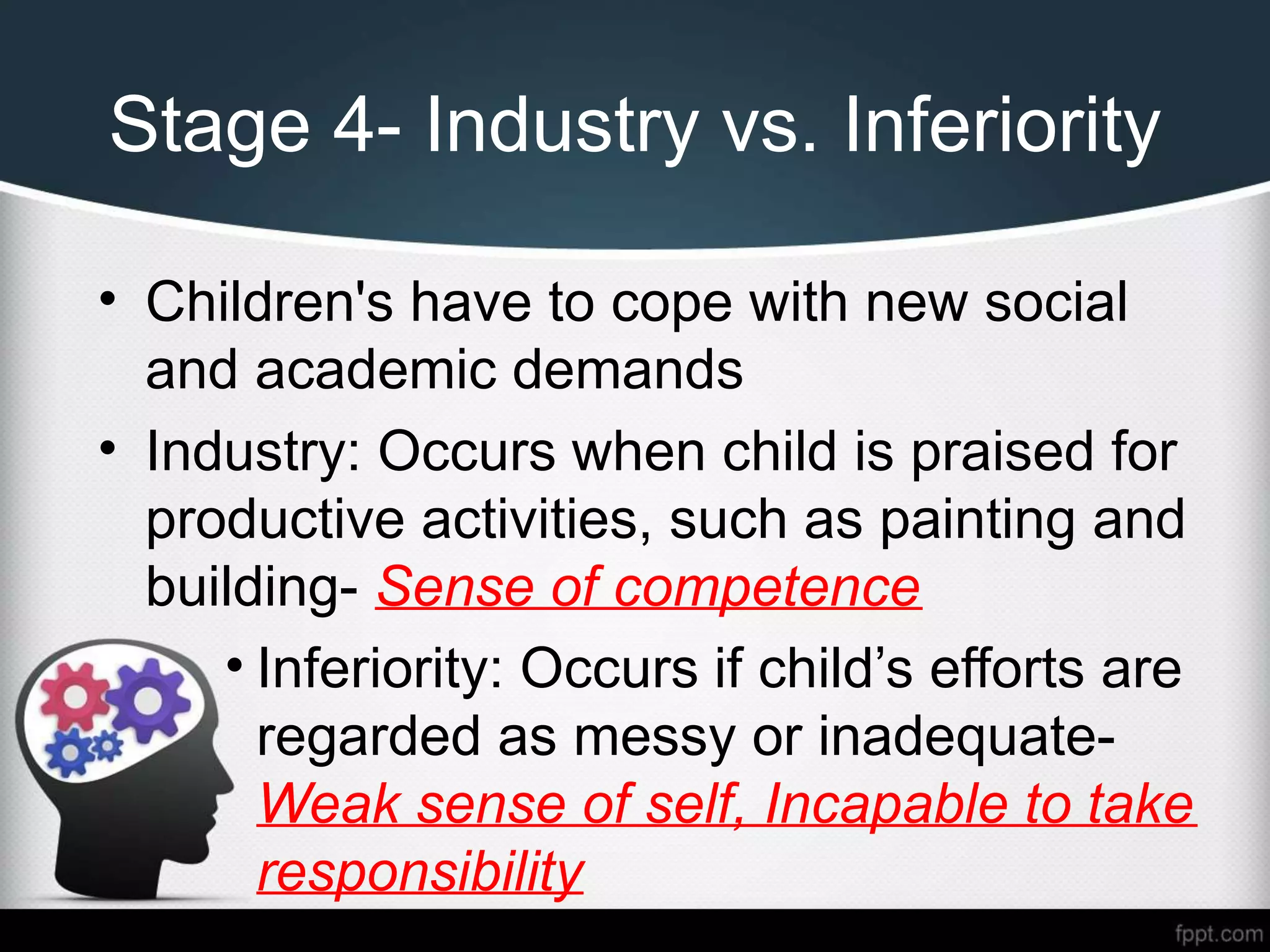
Stage 4- Industry vs. Inferiority
• Children's have to cope with new social
and academic demands
• Industry: Occurs when child is praised for
productive activities, such as painting and
building- Sense of competence
• Inferiority: Occurs if child’s efforts are
regarded as messy or inadequate-
Weak sense of self, Incapable to take
responsibility
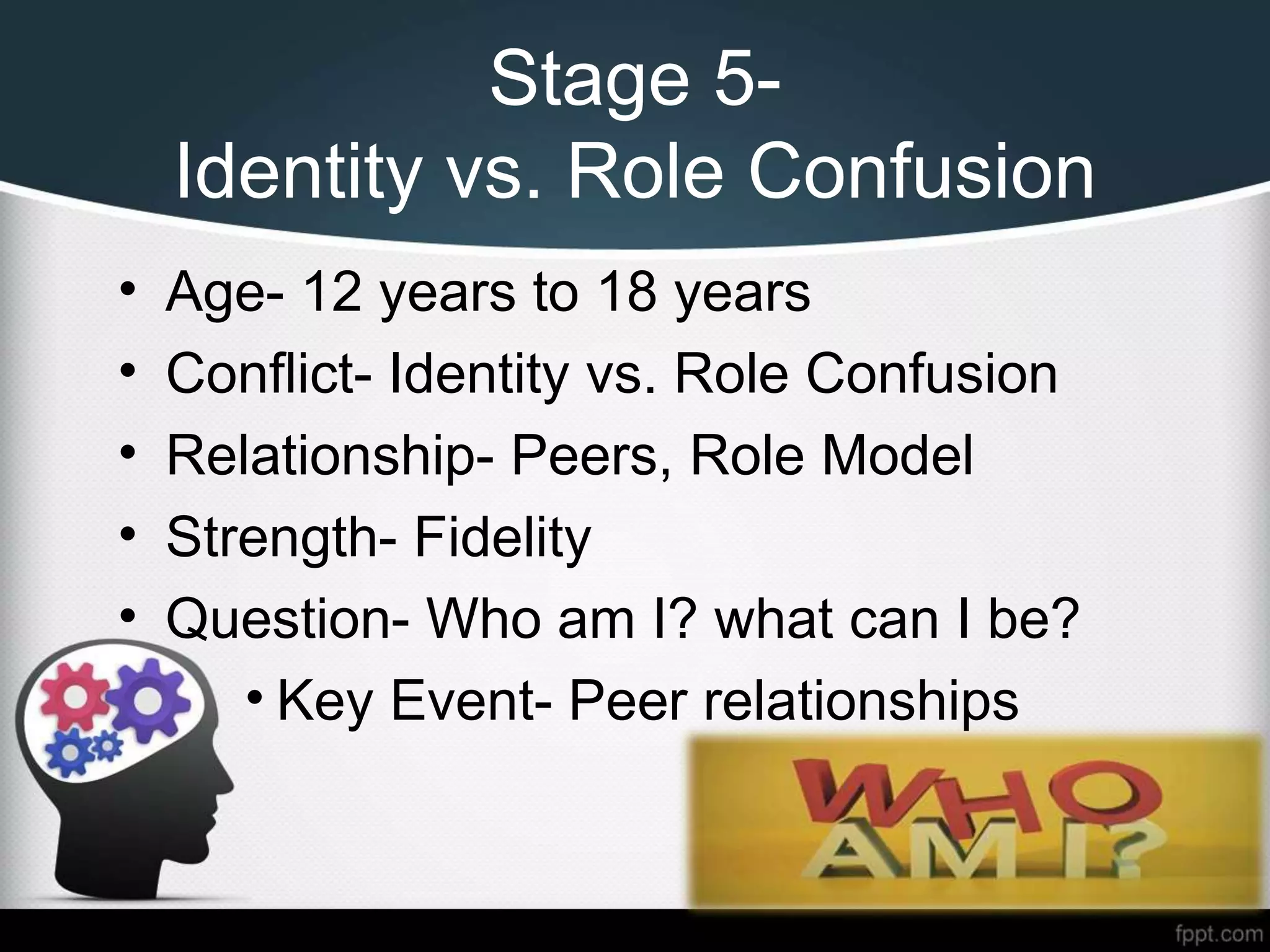
Stage 5-
Identity vs. Role Confusion
• Age- 12 years to 18 years
• Conflict- Identity vs. Role Confusion
• Relationship- Peers, Role Model
• Strength- Fidelity
• Question- Who am I? what can I be?
• Key Event- Peer relationships
Stage 5-
Identity vs. Role Confusion
• Children learn a number of different roles.
• Identity: One’s organization of individual
drives, abilities, beliefs, and experience
into consistent image of self. Who we are.
• Role Confusion: Failure to establish
an individual identity separate from
the family and having no peer
relationships and plans for an
occupation- Ego diffusion
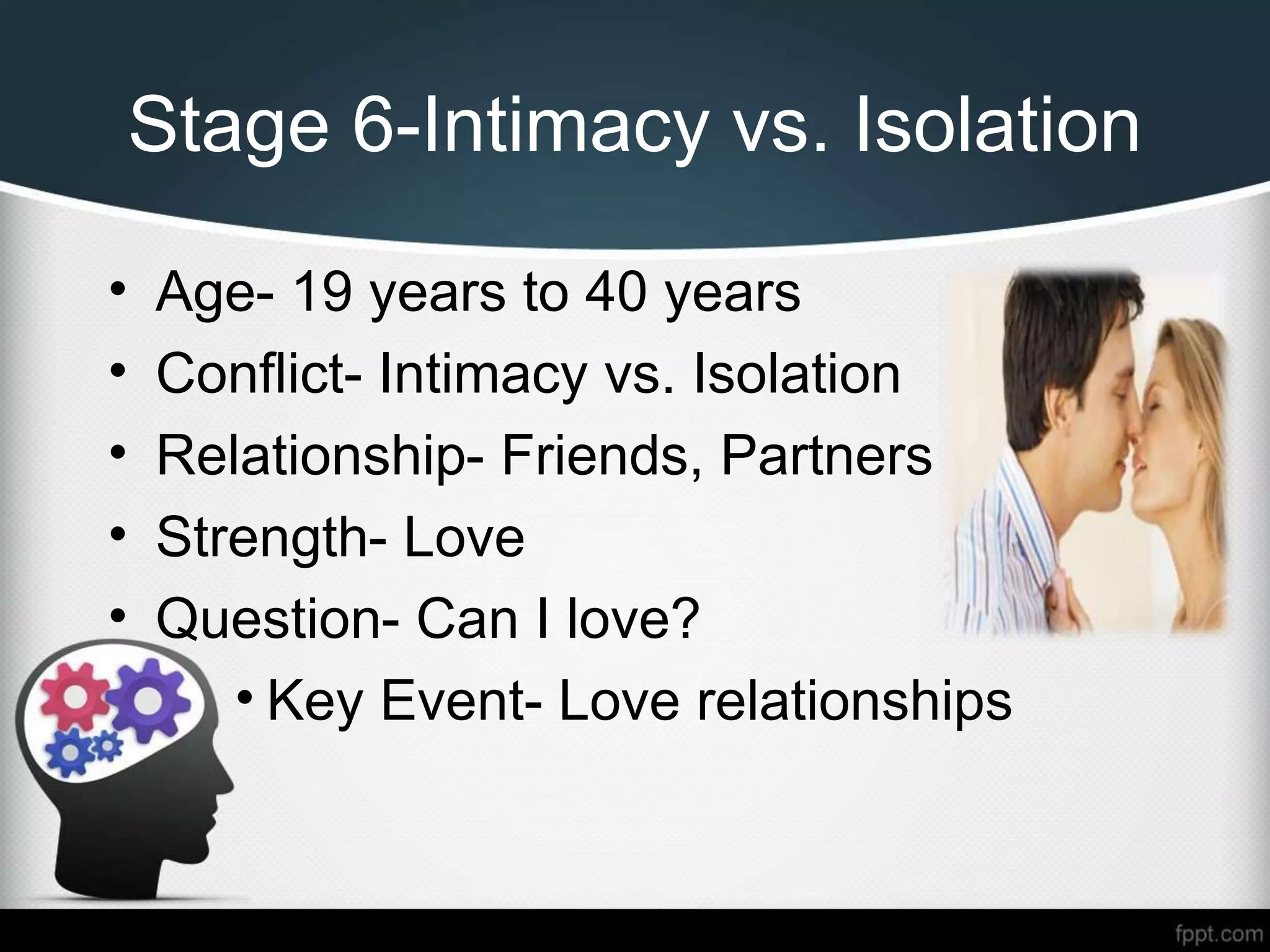
Stage 6-Intimacy vs. Isolation
• Age- 19 years to 40 years
• Conflict- Intimacy vs. Isolation
• Relationship- Friends, Partners
• Strength- Love
• Question- Can I love?
• Key Event- Love relationships
Stage 6-Intimacy vs. Isolation
• Start of families
• Intimacy: Ability to care about others and
to share experiences with them-
Strong relationship
• Isolation: Feeling alone and uncared
for in life- Loneliness
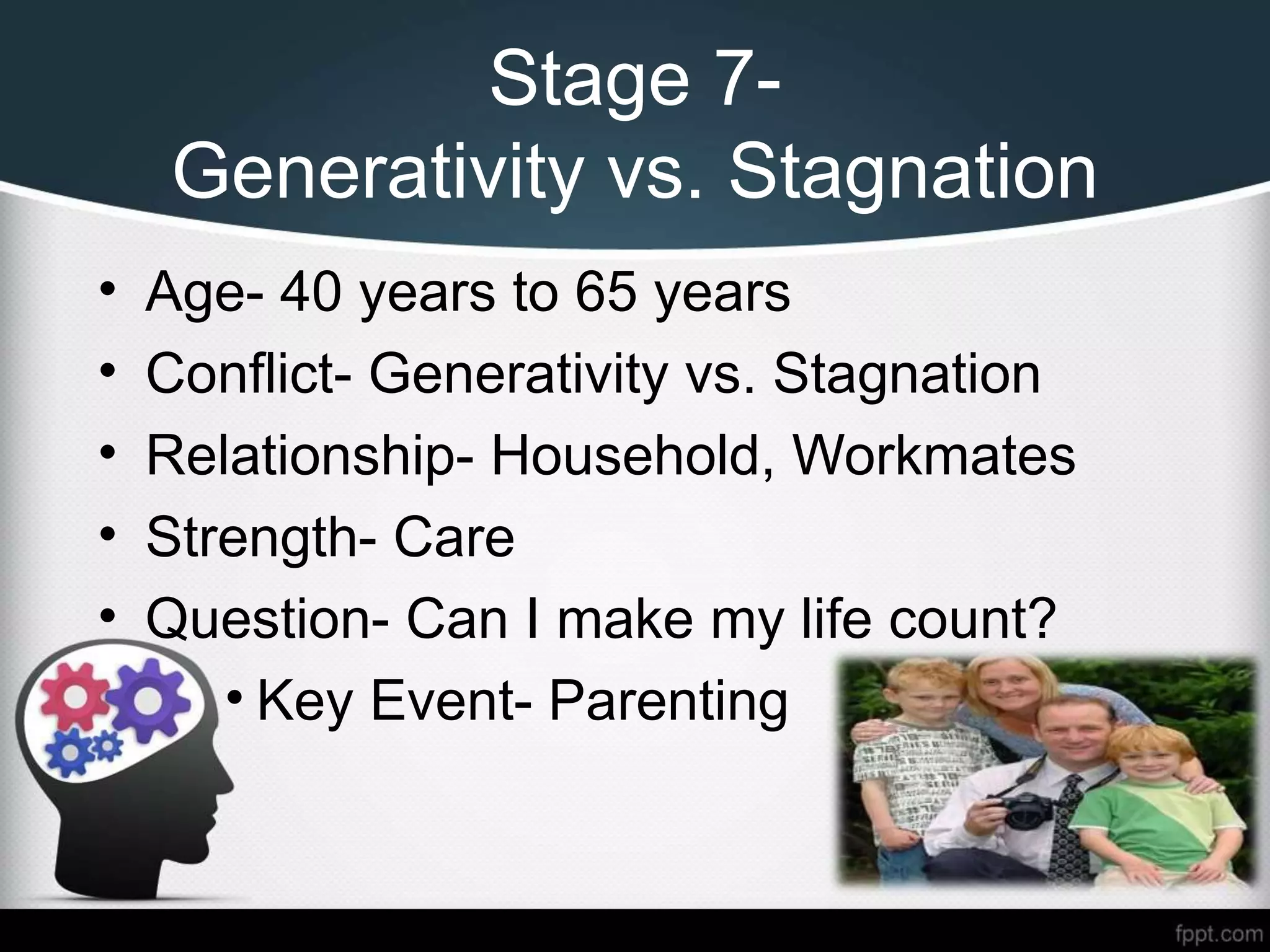
Stage 7-
Generativity vs. Stagnation
• Age- 40 years to 65 years
• Conflict- Generativity vs. Stagnation
• Relationship- Household, Workmates
• Strength- Care
• Question- Can I make my life count?
• Key Event- Parenting
Stage 7-
Generativity vs. Stagnation
• Primary developmental task is one of
contributing to society and helping to
guide future generation.
• Generativity: Interest in guiding the next
generation- Social involvement, Parenting
• Stagnation: When one is only
concerned with one’s own needs and
comforts- Material possession,
Physical well being, Non productive
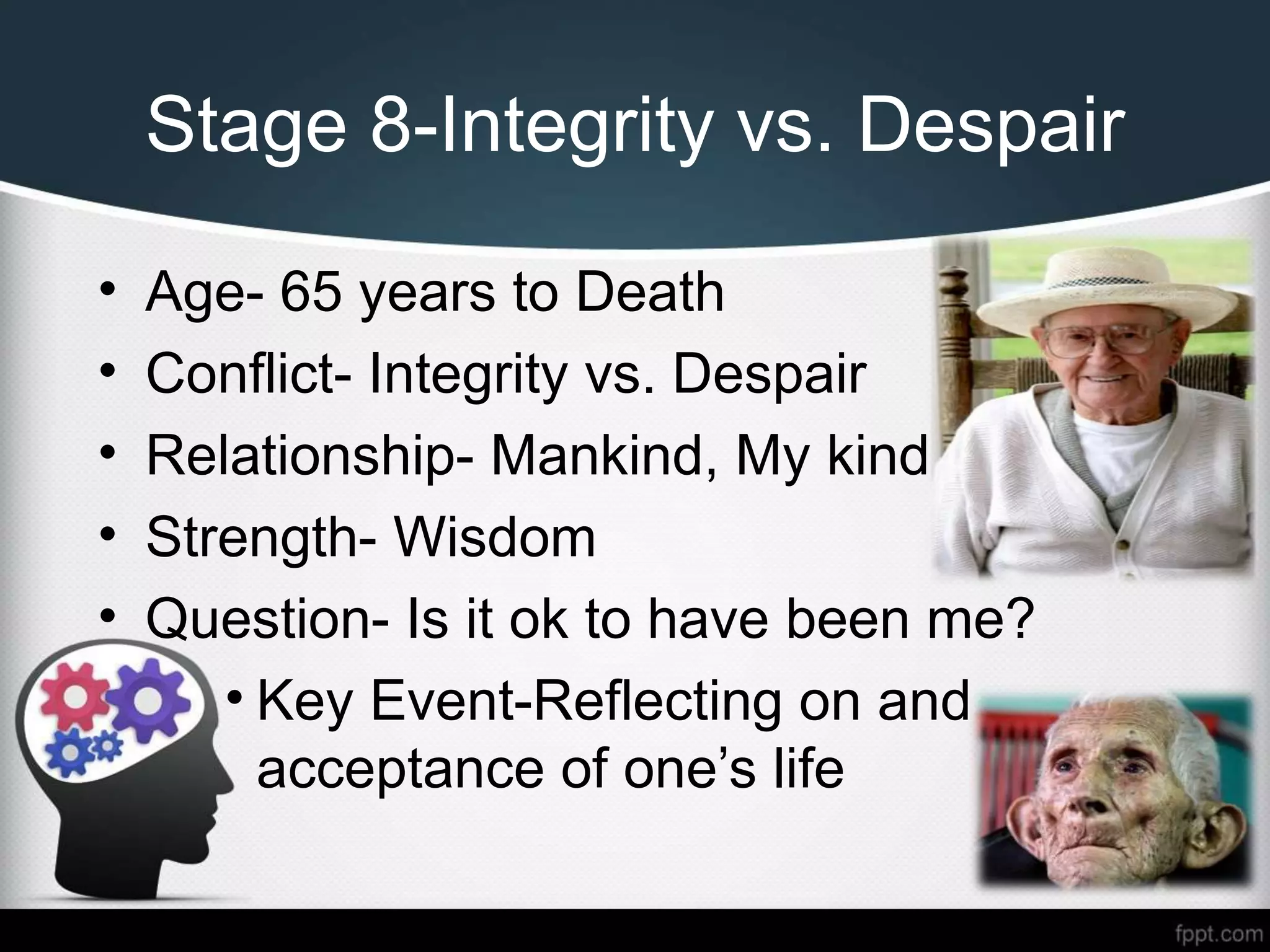
Stage 8-Integrity vs. Despair
• Age- 65 years to Death
• Conflict- Integrity vs. Despair
• Relationship- Mankind, My kind
• Strength- Wisdom
• Question- Is it ok to have been me?
• Key Event-Reflecting on and
acceptance of one’s life
Stage 8-Integrity vs. Despair
• In the last stages of life individuals look
back over their lives and judge them.
• Integrity: Self-respect; developed when
people have lived richly and responsibly-
Feeling of wisdom and meaning
• Despair: Occurs when previous life
events are viewed with regret;
experiences heartache and remorse-
Regret, Bitterness
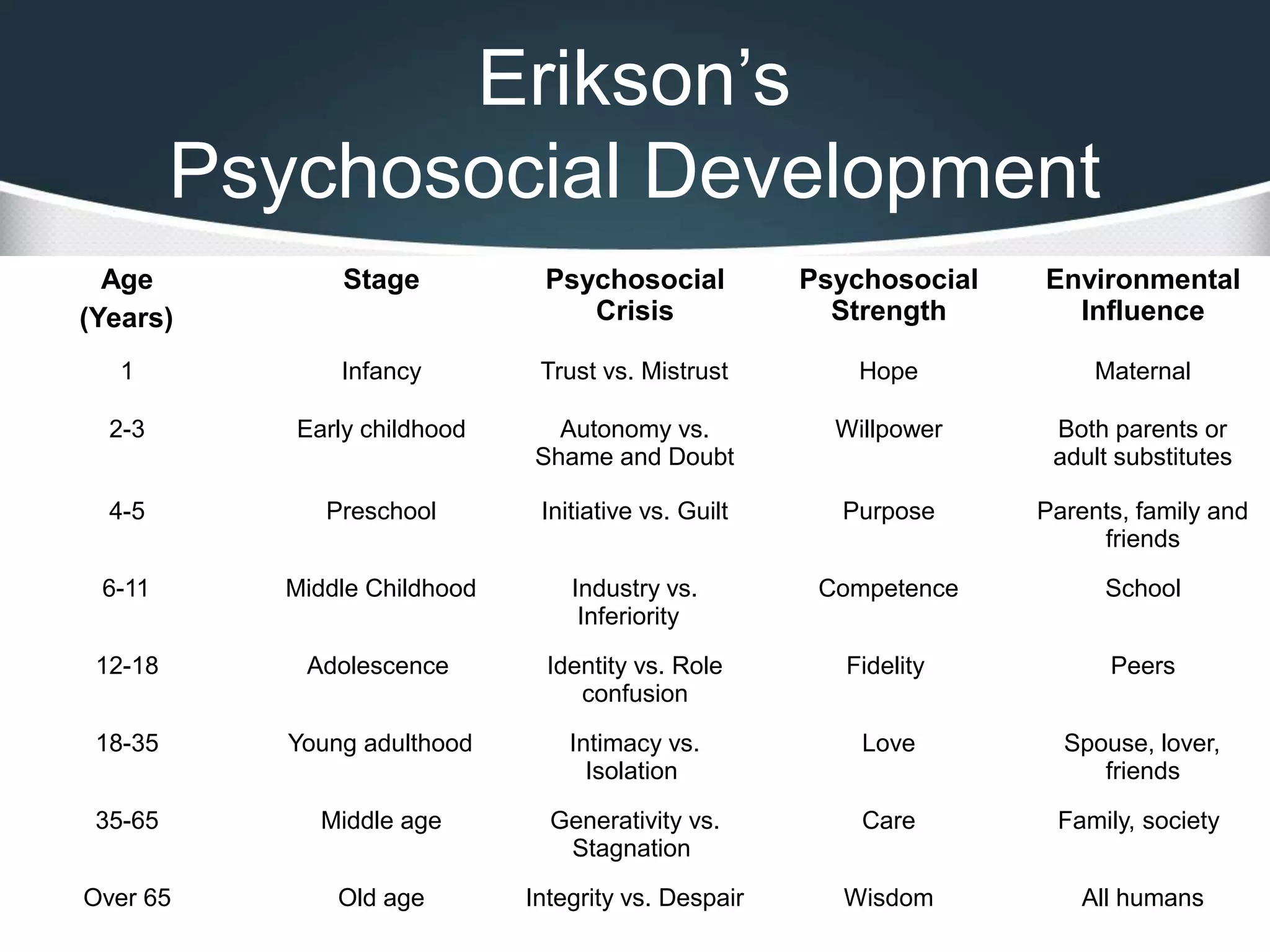
Erikson’s
Psychosocial Development
Age
(Years)
Stage Psychosocial
Crisis
Psychosocial
Strength
Environmental
Influence
1 Infancy Trust vs. Mistrust Hope Maternal
2-3 Early childhood Autonomy vs.
Shame and Doubt
Willpower Both parents or
adult substitutes
4-5 Preschool Initiative vs. Guilt Purpose Parents, family and
friends
6-11 Middle Childhood Industry vs.
Inferiority
Competence School
12-18 Adolescence Identity vs. Role
confusion
Fidelity Peers
18-35 Young adulthood Intimacy vs.
Isolation
Love Spouse, lover,
friends
35-65 Middle age Generativity vs.
Stagnation
Care Family, society
Over 65 Old age Integrity vs. Despair Wisdom All humans
Assessment in Erikson’s Theory
• Psycho historical Analysis
– Application of lifespan theory to lives of
historical figures
• Psychological Tests:
– Instruments based on crisis in stages
Research in Erikson’s Theory
• Generativity
– Evokes need to feel closer to others
– Correlated with extraversion, openness to
new experiences
– Likely to be involved in community, social
relationships
Research in Erikson’s Theory
• Maturity
– High ego integrity: spent much time reviewing
their lives
• Ethnic Identity
– Ethnic minorities: ethnic identity significant
factor in determining sense of self
Erikson’s Contributions
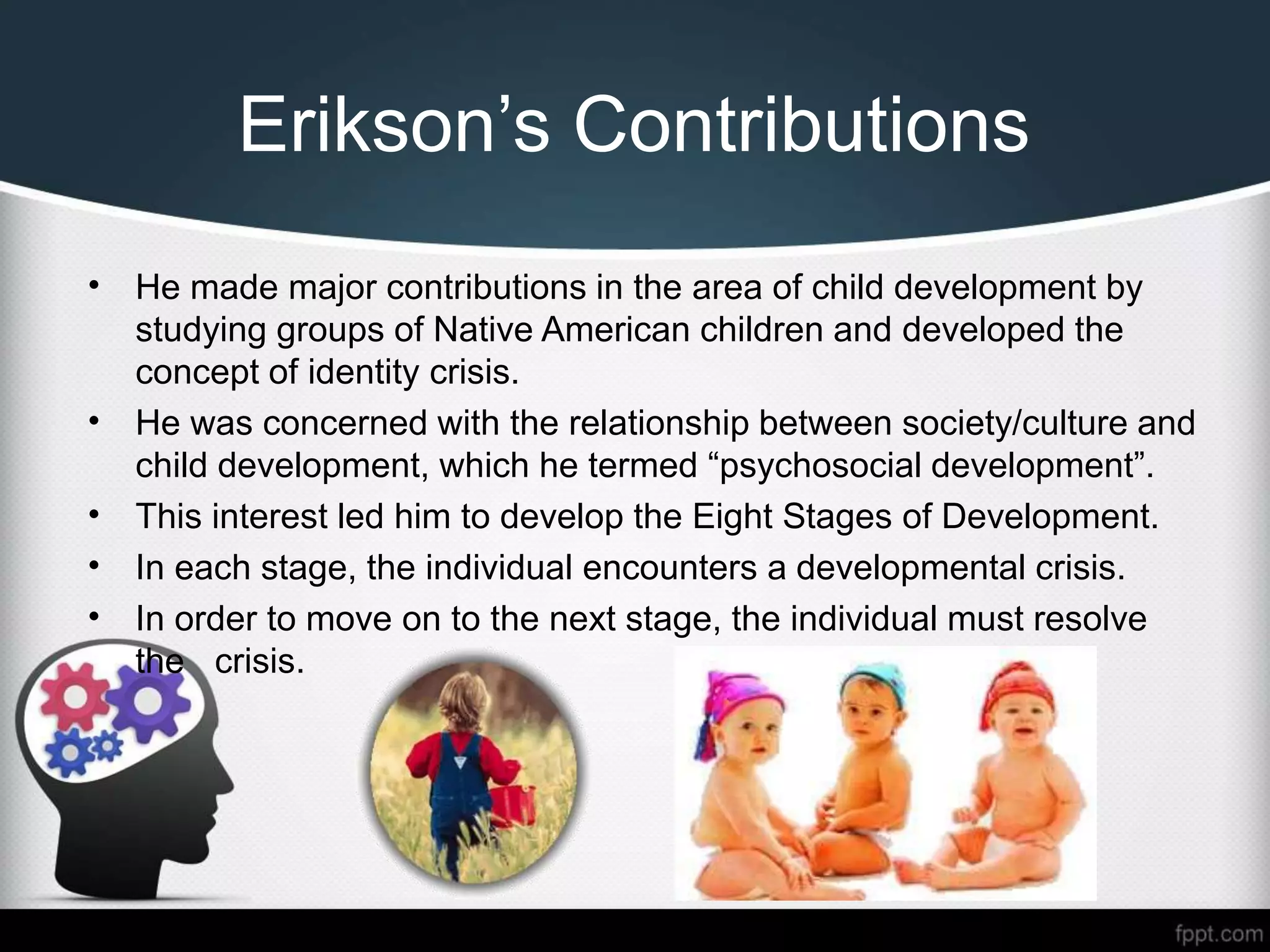
• He made major contributions in the area of child development by
studying groups of Native American children and developed the
concept of identity crisis.
• He was concerned with the relationship between society/culture and
child development, which he termed “psychosocial development”.
• This interest led him to develop the Eight Stages of Development.
• In each stage, the individual encounters a developmental crisis.
• In order to move on to the next stage, the individual must resolve
the crisis.
Criticisms of Erikson
• Ambiguous terms and concepts
• Lack of precision
• Some terms are not easily measured
empirically
• Experiences in stage may only apply to
males
• Identity crisis may only apply to those
affluent enough to explore identities
stagesofdevelopment ishu.ppt

stagesofdevelopment ishu.ppt

  • 2.
    Erik Erikson: Eight Stagesof Development Presented B Ishrat Fa
  • 3.
    Contents Who is ErikErikson? - Background Stages of Development 1 – 4 (Rocky) Stages of Development 5 – 8 (Dan) Additional Works and Criticisms 1 1 2 2 3 3 4 4
  • 4.
    Erik Erikson: TheFather of Psychosocial Development “Children love and want to be loved and they very much prefer the joy of accomplishment to the triumph of hateful failure. Do not mistake a child for his symptom” - Erik Erikson
  • 5.
    Erik Erikson’s Biography •Born June 15,1902 Frankfurt, Germany • Died May 12, 1994 Massachusetts, USA • Nationality American/ German • Fields Developmental Psychology • Influences Sigmund Freud/ Anna Freud • Coined the term Lifespan Development • Key Idea Theories of Social Psychological Development Erik Erikson 1902-1994
  • 6.
    Field of Research •Erikson’s theory consists of eight stages of development. Each stage is characterized by a different conflict that must be resolved by the individual. If a person is unable to resolve a conflict at a particular stage, they will be confront and struggle with it later in life.
  • 7.
    INTRODUCTION Social development isthe sub area of developmental psychology that focuses on the description of children's development of relationships with others, their understanding of the meaning of their relationships with others, and their understanding of others' behaviors, attitudes, and intentions.
  • 9.
    Erik Erikson andthe 8 Stages of Development • Best known theories of personality and development. • Personality develops in a series of predetermined stages. • Psychosocial, and not psychosexual. • In each stage of development conflicts acts as turning points in life.
  • 10.
    Personality • Personality consistsof all the relatively stable and distinctive styles of thought, behavior, and emotional responses that characterize a person’s adaptations to surrounding situations
  • 11.
    Why Study Personality? •Identify patterns in the way people behave. • Explain the differences between people. • How to improve life.
  • 12.
    Psychosocial Development • Refersto the emotional and psychological changes across the life cycle that occurs in the context of the individual’s social environment.
  • 13.
    Psychosocial Development • Accordingto Erikson- Each part of the personality has a particular time in the life span when it must develop, if it is going to develop at all. If it failed to developed on schedule, the rest of the development is unfavorably altered. The individual is then hindered from dealing effectively with reality.
  • 14.
    Psychosocial Stages • Stage1- Trust vs. Mistrust • Stage 2- Autonomy vs. Shame & Doubt • Stage 3- Initiative vs. Guilt • Stage 4- Industry vs. Inferiority • Stage 5- Identity vs. Role Confusion • Stage 6- Intimacy vs. Isolation • Stage 7- Generativity vs. Stagnation • Stage 8- Integrity vs. Despair
  • 15.
    Stage 1-Trust vs.Mistrust • Age- Birth to 18 months • Conflict- Trust vs. Mistrust • Relationship- Mother • Strength- Hopes • Question- Can I trust the world? • Key Event- Feeding
  • 16.
    Stage 1-Trust vs.Mistrust • Children are completely dependent on others • Trust: Established when babies given adequate warmth, touching, love, and physical care-Dependable & Reliable. • Mistrust: Caused by inadequate or unpredictable care and by cold, indifferent, and rejecting parents- Undependable, Unpredictable & Dangerous.
  • 17.
    Stage 2- Autonomy vs.Shame & Doubt • Age- 18 month to 3 years • Conflict- Autonomy vs. Shame • Relationship- Parents • Strength- Will • Question- Is it ok to be me? • Key Event- Toilet Training
  • 18.
    Stage 2- Autonomy vs.Shame & Doubt • Autonomy: Doing things for themselves such as body control & making choices. - Secure and confident self. • Shame: Overprotective or ridiculing parents may cause children to doubt abilities and feel shameful about their actions- Inadequacy & self doubt.
  • 19.
    Stage 3- Initiativevs. Guilt • Age- 3 years to 6 years • Conflict- Initiative vs. Guilt • Relationship- Family • Strength- Purpose • Question- Is it okay for me to do, move & act? • Key Event- Independence
  • 20.
    Stage 3- Initiativevs. Guilt • Initiative: Parents reinforce via giving children freedom to play, use imagination, and ask questions- Creative, Constructive. • Guilt: May occur if parents criticize, prevent play, or discourage a child’s questions- Always being wrong, Failed to explore world. • Initiative and Guilt should be balanced in order to have moral judgment.
  • 21.
    Stage 4- Industryvs. Inferiority • Age- 6 years to 12 years • Conflict- Industry vs. Inferiority • Relationship- Neighbors, School • Strength- Competence • Question- Can I make it in the world of people and things? • Key Event- School
  • 22.
    Stage 4- Industryvs. Inferiority • Children's have to cope with new social and academic demands • Industry: Occurs when child is praised for productive activities, such as painting and building- Sense of competence • Inferiority: Occurs if child’s efforts are regarded as messy or inadequate- Weak sense of self, Incapable to take responsibility
  • 23.
    Stage 5- Identity vs.Role Confusion • Age- 12 years to 18 years • Conflict- Identity vs. Role Confusion • Relationship- Peers, Role Model • Strength- Fidelity • Question- Who am I? what can I be? • Key Event- Peer relationships
  • 24.
    Stage 5- Identity vs.Role Confusion • Children learn a number of different roles. • Identity: One’s organization of individual drives, abilities, beliefs, and experience into consistent image of self. Who we are. • Role Confusion: Failure to establish an individual identity separate from the family and having no peer relationships and plans for an occupation- Ego diffusion
  • 25.
    Stage 6-Intimacy vs.Isolation • Age- 19 years to 40 years • Conflict- Intimacy vs. Isolation • Relationship- Friends, Partners • Strength- Love • Question- Can I love? • Key Event- Love relationships
  • 26.
    Stage 6-Intimacy vs.Isolation • Start of families • Intimacy: Ability to care about others and to share experiences with them- Strong relationship • Isolation: Feeling alone and uncared for in life- Loneliness
  • 27.
    Stage 7- Generativity vs.Stagnation • Age- 40 years to 65 years • Conflict- Generativity vs. Stagnation • Relationship- Household, Workmates • Strength- Care • Question- Can I make my life count? • Key Event- Parenting
  • 28.
    Stage 7- Generativity vs.Stagnation • Primary developmental task is one of contributing to society and helping to guide future generation. • Generativity: Interest in guiding the next generation- Social involvement, Parenting • Stagnation: When one is only concerned with one’s own needs and comforts- Material possession, Physical well being, Non productive
  • 29.
    Stage 8-Integrity vs.Despair • Age- 65 years to Death • Conflict- Integrity vs. Despair • Relationship- Mankind, My kind • Strength- Wisdom • Question- Is it ok to have been me? • Key Event-Reflecting on and acceptance of one’s life
  • 30.
    Stage 8-Integrity vs.Despair • In the last stages of life individuals look back over their lives and judge them. • Integrity: Self-respect; developed when people have lived richly and responsibly- Feeling of wisdom and meaning • Despair: Occurs when previous life events are viewed with regret; experiences heartache and remorse- Regret, Bitterness
  • 31.
    Erikson’s Psychosocial Development Age (Years) Stage Psychosocial Crisis Psychosocial Strength Environmental Influence 1Infancy Trust vs. Mistrust Hope Maternal 2-3 Early childhood Autonomy vs. Shame and Doubt Willpower Both parents or adult substitutes 4-5 Preschool Initiative vs. Guilt Purpose Parents, family and friends 6-11 Middle Childhood Industry vs. Inferiority Competence School 12-18 Adolescence Identity vs. Role confusion Fidelity Peers 18-35 Young adulthood Intimacy vs. Isolation Love Spouse, lover, friends 35-65 Middle age Generativity vs. Stagnation Care Family, society Over 65 Old age Integrity vs. Despair Wisdom All humans
  • 32.
    Assessment in Erikson’sTheory • Psycho historical Analysis – Application of lifespan theory to lives of historical figures • Psychological Tests: – Instruments based on crisis in stages
  • 33.
    Research in Erikson’sTheory • Generativity – Evokes need to feel closer to others – Correlated with extraversion, openness to new experiences – Likely to be involved in community, social relationships
  • 34.
    Research in Erikson’sTheory • Maturity – High ego integrity: spent much time reviewing their lives • Ethnic Identity – Ethnic minorities: ethnic identity significant factor in determining sense of self
  • 35.
    Erikson’s Contributions • Hemade major contributions in the area of child development by studying groups of Native American children and developed the concept of identity crisis. • He was concerned with the relationship between society/culture and child development, which he termed “psychosocial development”. • This interest led him to develop the Eight Stages of Development. • In each stage, the individual encounters a developmental crisis. • In order to move on to the next stage, the individual must resolve the crisis.
  • 36.
    Criticisms of Erikson •Ambiguous terms and concepts • Lack of precision • Some terms are not easily measured empirically • Experiences in stage may only apply to males • Identity crisis may only apply to those affluent enough to explore identities