LATE ADULTHOOD
By C.Settley
2016
Late adulthood
 South African Elderly Persons Act- 65 years and older
 Retirement age
 Psychological age:
 Social age:
 Physical or biological age:
Developmental tasks of the elderly
 Adjustment to physical changes
 Maintaining intellectual vitality
 Adjustment to retirement and income changes
 Establishment of satisfactory housing and physical life circumstances
 Adjustment to changes in the spouse and to his or her death
 Rechanneling energy to new roles and activities
 Fulfillment of social and community obligations
 Establishment of affiliation with peers
Demographic trends
 Page 590 in Human Development
 Mortality rates for males are higher due to:
 1) Genetic differences: Females are less vulnerable to some fatal diseases. X
chromosomes are associated with the production of more antibodies thus
fighting illness.
 2) Lifestyle and habits: Dangerous habits occur more frequently in men.
Might disappear in future as women nowadays do follow the traditional life
pattern of men. EG men smoked more and subjected to more stress than
females.
Physical development
Physical appearance
 Skin
 Hair
 Wound healing
Muscles and skeleton
 Decrease in muscle power
 Exercise
 Falling risk
Physical development
Internal organs
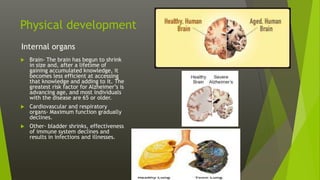
 Brain- The brain has begun to shrink
in size and, after a lifetime of
gaining accumulated knowledge, it
becomes less efficient at accessing
that knowledge and adding to it. The
greatest risk factor for Alzheimer’s is
advancing age, and most individuals
with the disease are 65 or older.
 Cardiovascular and respiratory
organs- Maximum function gradually
declines.
 Other- bladder shrinks, effectiveness
of immune system declines and
results in infections and illnesses.
Physical development
 Senses
 As you age, the way your senses (hearing, vision, taste, smell, touch) give you
information about the world changes. Your senses become less sharp, and this
can make it harder for you to notice details.
 Sensory changes can affect your lifestyle. You may have problems
communicating, enjoying activities, and staying involved with people. Sensory
changes can lead to isolation.
 Your senses receive information from your environment. This information can
be in the form of sound, light, smells, tastes, and touch. Sensory information
is converted into nerve signals that are carried to the brain. There, the
signals are turned into meaningful sensations.
Physical development
 A certain amount of stimulation is required before you become aware of a
sensation. This minimum level of sensation is called the threshold. Aging
raises this threshold. You need more stimulation to be aware of the sensation.
 Aging can affect all of the senses, but usually hearing and vision are most
affected. Devices such as glasses and hearing aids, or lifestyle changes can
improve your ability to hear and see.
 Your ears have 2 jobs. One is hearing and the other is maintaining balance.
Hearing occurs after sound vibrations cross the eardrum to the inner ear. The
vibrations are changed into nerve signals in the inner ear and are carried to
the brain by the auditory nerve.
Physical development
Mental health
 Depression
 Arthritis
 Dementia
 Alzheimer’s disease
Sexuality
 No interruption in sexual needs,
interests and capacity.
 Certainly age related sexually
inhibiting factors such as age,
physical appearance, attraction
etc.
 Read pg 599 in Human
development.
Factors that increase the risk of depression in
the elderly include:
Page 64 in Middleton
 Being female
 Being single, unmarried, divorced or widowed
 Lack of social connections
 Stressful life events
 Physical conditions
 Medication
 Damage to body image
 Chronic or severe pain
 Family history of depression
 Fear of death
 Past suicide attempts
 Previous history of depression
 Substance abuse
Cognitive development: Attention is the
mechanism by which persons:
 Allocate their limited cognitive resources when executing a cognitive task.
 Focus on a limited number of stimuli.
 Determine the content of consciousness.
 Concentrate on executing a cognitive task by excluding other interfering
stimuli
 Allocate their information processing capacity to execute certain mental
operations
 Divided attention is concentration on more than one thing (for example,
listening to two people speaking at once). In psychology, the concept of
attention helps explain cognitive processes such as learning and memory, as
these would be difficult without the ability to concentrate.
Cognitive development: Information
processing speed
 Processing speed is the pace at which you take in information, make sense of it and begin to
respond. This information can be visual, such as letters and numbers. It can also be auditory,
such as spoken language.
 Having slow processing speed has nothing to do with how smart kids are—just how fast they
can take in and use information. It may take kids who struggle with processing speed a lot
longer than other kids to perform tasks, both school-related and in daily life.
 For example, when a child with slow processing speed sees the letters that make up the word
“house,” she may not immediately know what they say. She has to figure out what strategy to
use to understand the meaning of the group of letters in front of her. It’s not that she can’t
read. It’s just that a process that’s quick and automatic for other kids her age takes longer
and requires more effort for her.
 In other words, processing speed declines during late adulthood.
Cognitive development: Intelligence
Our crystallized intelligence (Gc) is the intelligence factor that depends on
knowledge and skills gained through experience, education and training. It
depends on what we learn from our surrounding culture, and may be tested by
vocabulary or general knowledge in IQ tests. Crystallized intelligence tends to
remain constant over the lifespan and can even increase by acquiring more
knowledge and skills.
Our fluid intelligence (Gf) is our on-the-spot reasoning and problem solving
ability, not dependent on background knowledge, education or any specific
expertise. It enables us to see relationships and learn quickly in new situations.
Our fluid intelligence enables us to fluidly: reason, plan, solve problems, think
abstractly – verbally, numerically or spatially, understand complex ideas,
analogies & relationships & learn quickly from experience.
Cognitive development: Intelligence
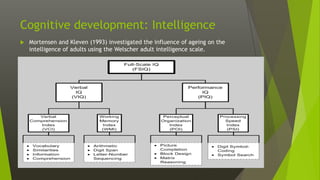
 Mortensen and Kleven (1993) investigated the influence of ageing on the
intelligence of adults using the Welscher adult intelligence scale.
They found that the following factors
reduced the risk of cognitive decline in old
age:
 The absence of cardiovascular and other chronic diseases.
 A favourable environment that is the result of high socio-economic status.
 Involvement in complex and intellectually stimulating activities. ‘a flexible
personality style.
 A spouse with high intellectual status.
 The maintenance of high levels of information-processing speed.
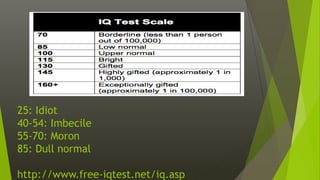
25: Idiot
40-54: Imbecile
55-70: Moron
85: Dull normal
http://www.free-iqtest.net/iq.asp
Cognitive development: Post Formal
operational thinking
 Transcendental operations:
 Implies that individuals reflect on the knowledge they have gained through
their life experiences and on what they have produced.
Cognitive development:
Wisdom
 It involves:
 Knowledge and judgement about the course of life, life tasks and goals.
 Knowledge of the dynamic and conflicts of life.
 Knowledge of social and intergenerational relationships.
 Knowledge of human nature and conduct.
 An understanding of the meaning of life.
 The development of wisdom depends on:
 A certain level of cognitive, personal and social efficacy.
 Practice in solving life problems.
(page 65, Middleton)
Wisdom of the elders: Quotes
 “The journey of a thousand miles begins with one step”. Lao Tzu
 “For beautiful eyes, look for the good in others; for beautiful lips, speak only
words of kindness; and for poise, walk with the knowledge that you are never
alone”. Audrey Hepburn
 “It's not what you look at that matters, it's what you see”. Henry David
Thoreau
 “If you're trying to achieve, there will be roadblocks. I've had them;
everybody has had them. But obstacles don't have to stop you. If you run into
a wall, don't turn around and give up. Figure out how to climb it, go through
it, or work around it”. Michael Jordan
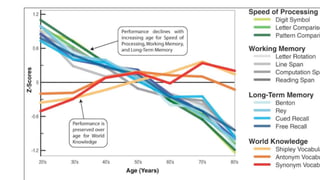
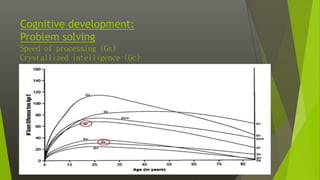
Cognitive development:
Problem solving
Speed of processing (Gs)
Crystallized intelligence (Gc)
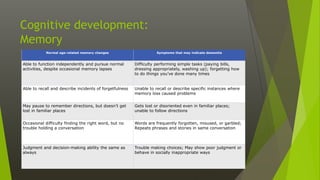
Cognitive development:
Memory
Normal age-related memory changes Symptoms that may indicate dementia
Able to function independently and pursue normal
activities, despite occasional memory lapses
Difficulty performing simple tasks (paying bills,
dressing appropriately, washing up); forgetting how
to do things you’ve done many times
Able to recall and describe incidents of forgetfulness Unable to recall or describe specific instances where
memory loss caused problems
May pause to remember directions, but doesn’t get
lost in familiar places
Gets lost or disoriented even in familiar places;
unable to follow directions
Occasional difficulty finding the right word, but no
trouble holding a conversation
Words are frequently forgotten, misused, or garbled;
Repeats phrases and stories in same conversation
Judgment and decision-making ability the same as
always
Trouble making choices; May show poor judgment or
behave in socially inappropriate ways
Career development: Retirement and
adjustment
 Adjusting to retirement will be influenced by the following:
 Financial security
 Voluntary retirement and health
 The attitudes of others
 Attitude towards work
 Preparation for retirement
Process of retirement
 The pre retirement phase:
 Pre retirement has two phases: remote and near.
 In the remote phase, the individual sees retirement as far off, but as
an expected part of the work cycle. However, few people see
retirement as something to plan for.
 The near phase of pre retirement begins with retirement is looming.
Although many people remain positive, attitudes toward retirement
usually become more negative during this phase. The public definition
of this phase includes pre retirement planning programs, retirement
ceremonies, on-the-job-training for a replacement, and possibly
promotion into a less essential job.
Process of retirement
 The Honeymoon Phase:
 The retirement event is followed by a euphoric phase in which
retirees do all the things they did not have time for before.
 This period may be short or last for years, depending on financial
resources.
 According to Atchley, this phase is critical: "If the individual is able to
settle into a routine that provides a satisfying life, then that routine
will probably stabilize“.
Process of retirement
 The disenchantment phase:
 People may feel ambivalent about or disappointed with retirement
during this disenchantment period.
 They may lament and grieve that retirement is not what they though
it would be.
 They may feel unproductive after many years of working, or feel that
they are at a loss to contribute to the world without work. In
addition, they may feel lonely.
 While the human need to socialize continues unabated after
retirement, retirees may find it to be more difficult to find people to
connect with since previous friendships through the workplace are no
longer available.
Process of retirement
 The reorientation phase:
 After a period of rest and relaxation, honeymooning or
disenchantment, it is common for retirees to review their retirement
expectations and goals.
 They may set new goals and create new plans for how they wish their
retirement to progress in the future.
 A continued need to feel productive and have a purpose in life leads
many retirees to establish new careers, to go back to school, to
volunteer, join community activities and organizations or to take up
new hobbies during this reorientation period.
Process of retirement
 The stability phase:
 The individual masters the retirement role.
 Accepts the challenges and develops a relaxed lifestyle.
Process of retirement
 The termination phase:
 Eventually the retirement routine slows down.
 When a person can no longer fully live independently for whatever
reason.
Effect of retirement
 Health
 Activity
 Social and leisure
 Marital happiness
 Life satisfaction
Factors that promote successful ageing
 Social activity
 Personality factors
 Economic factors
 Role loss
 Life events
 Daily hassles
 Community labelling
 Locus of control
 Dependency
Social development in late adulthood
 Marriage
 Divorce
 Widowhood
 Remarriage
 Interpersonal relationships
 grandchildren
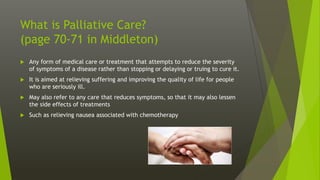
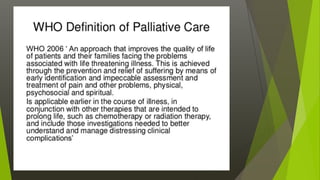
What is Palliative Care?
(page 70-71 in Middleton)
 Any form of medical care or treatment that attempts to reduce the severity
of symptoms of a disease rather than stopping or delaying or truing to cure it.
 It is aimed at relieving suffering and improving the quality of life for people
who are seriously ill.
 May also refer to any care that reduces symptoms, so that it may also lessen
the side effects of treatments
 Such as relieving nausea associated with chemotherapy
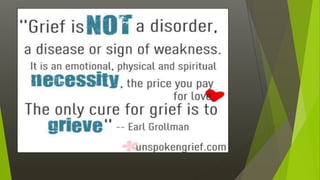
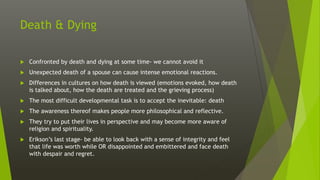
Death & Dying
 Confronted by death and dying at some time- we cannot avoid it
 Unexpected death of a spouse can cause intense emotional reactions.
 Differences in cultures on how death is viewed (emotions evoked, how death
is talked about, how the death are treated and the grieving process)
 The most difficult developmental task is to accept the inevitable: death
 The awareness thereof makes people more philosophical and reflective.
 They try to put their lives in perspective and may become more aware of
religion and spirituality.
 Erikson’s last stage- be able to look back with a sense of integrity and feel
that life was worth while OR disappointed and embittered and face death
with despair and regret.
Death & Dying
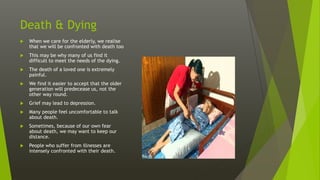
 When we care for the elderly, we realise
that we will be confronted with death too
 This may be why many of us find it
difficult to meet the needs of the dying.
 The death of a loved one is extremely
painful.
 We find it easier to accept that the older
generation will predecease us, not the
other way round.
 Grief may lead to depression.
 Many people feel uncomfortable to talk
about death.
 Sometimes, because of our own fear
about death, we may want to keep our
distance.
 People who suffer from illnesses are
intensely confronted with their death.
Death and Dying
 A person is regarded as dead when his or her physiological processes have
stopped:
 WHEN THE HEART HAS STOPPED BEATING
 WHEN BREATHING HAS STOPPED
 NO LONGER REGISTERS BRAIN ACTIVITY
Application
 Nurses need to be aware of their own attitudes towards and fears about
death.
 These attitudes and fears are often communicated unknowingly to patients
and families, and may affect the relationship between the nurse and the
dying patient as well as the relationship with the grieving family.
Application
 Read case on page 71 (Meena’s story) in Middleton
 It is important to learn about attitudes and beliefs about death in different
cultures, so that communication can be sensitive in this regard.
 What does it mean to enable someone to die with dignity?
 What could you do to ensure that your patients are as free from pain and
distress as possible?
DEATH HAS A NEGATIVE CONNOTATION
FOR MOST PEOPLE:
 Fear of physical suffering:
 Cancer, pain, removal of body parts, operations.
 Fear of isolation and loneliness:
 People often act strangely and artificial like towards dying persons because
they do not know how to handle the situation. Many people develop a fear
that they will be avoided and therefore become isolated and lonely when
dying.
DEATH HAS A NEGATIVE CONNOTATION
FOR MOST PEOPLE:
 Fear of nonbeing:
 It is alleged that human beings are the only creatures on earth who live with
the constant awareness that they will someday have to die.
 Can lead to intense anxiety.
 Fear of cowardice and humiliation:
 Many people fear that they will become cowards in the face of death.
DEATH HAS A NEGATIVE CONNOTATION
FOR MOST PEOPLE:
 Fear of failing to achieve important goals:
 Some people define the length of their lives not in terms of years but in terms
of accomplishments.
 We may therefore fear death because it will deprive us of achievement.
 Fear of the impact of death on those who outlive you:
 Fear of the financial, psychological and emotional impact that death may
have on loved ones and other survivors.
DEATH HAS A NEGATIVE CONNOTATION
FOR MOST PEOPLE:
 Fear of punishment or the unknown:
 Some religions preach that sinners are doomed after death and will forever
burn in hell.
 The fear that they are in this category evokes fear. Religion may also have the
opposite effect.
 Fear of the death of others:
 Fear of loosing another.
 Emotional and physical pain.
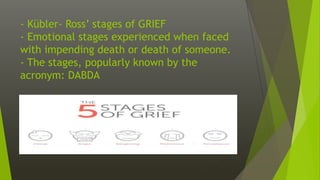
- Kübler- Ross’ stages of GRIEF
- Emotional stages experienced when faced
with impending death or death of someone.
- The stages, popularly known by the
acronym: DABDA
Kübler- Ross’ stages of dying
 STAGE 1-
 The first typical reaction is to deny it
 Eg “this is not possible. This cant be happening to me. This is a mistake”.
 Against reality
 Temporary shock and disbelief before reality sets in.
Kübler- Ross’ stages of dying
 STAGE 2-
 The individual realise that death is approaching and often expresses anger.
 Eg “why me? May others smoke but they don’t get lung cancer”
 The anger may be directed at others- close relatives, the hospital staff, and even God.
Kübler- Ross’ stages of dying
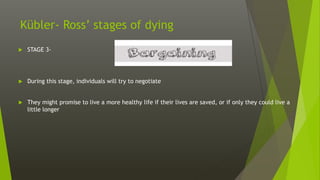
 STAGE 3-
 During this stage, individuals will try to negotiate
 They might promise to live a more healthy life if their lives are saved, or if only they could live a
little longer
Kübler- Ross’ stages of dying
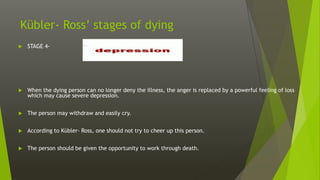
 STAGE 4-
 When the dying person can no longer deny the illness, the anger is replaced by a powerful feeling of loss
which may cause severe depression.
 The person may withdraw and easily cry.
 According to Kübler- Ross, one should not try to cheer up this person.
 The person should be given the opportunity to work through death.
Kübler- Ross’ stages of dying
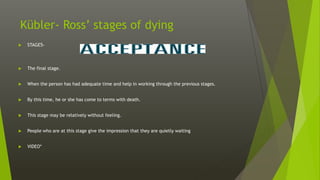
 STAGE5-
 The final stage.
 When the person has had adequate time and help in working through the previous stages.
 By this time, he or she has come to terms with death.
 This stage may be relatively without feeling.
 People who are at this stage give the impression that they are quietly waiting
 VIDEO*
Kübler- Ross’ stages of dying
 According to Kübler- Ross, these stages do not always occur in the same sequence.
 They may overlap.
 Not all individuals experience all the stages
 Culture, personality traits and a personal philosophy influences people’s reactions
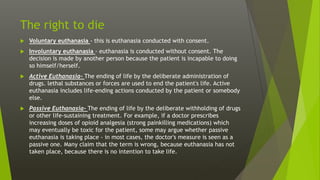
The right to die
 Voluntary euthanasia - this is euthanasia conducted with consent.
 Involuntary euthanasia - euthanasia is conducted without consent. The
decision is made by another person because the patient is incapable to doing
so himself/herself.
 Active Euthanasia- The ending of life by the deliberate administration of
drugs. lethal substances or forces are used to end the patient's life. Active
euthanasia includes life-ending actions conducted by the patient or somebody
else.
 Passive Euthanasia- The ending of life by the deliberate withholding of drugs
or other life-sustaining treatment. For example, if a doctor prescribes
increasing doses of opioid analgesia (strong painkilling medications) which
may eventually be toxic for the patient, some may argue whether passive
euthanasia is taking place - in most cases, the doctor's measure is seen as a
passive one. Many claim that the term is wrong, because euthanasia has not
taken place, because there is no intention to take life.
References
 Louw, D.A, Van Ede, D.M.& Louw, A.E (1998). Human development. 2nd edition. Cape Town. Kagiso.
 Louw, D.A & Edwards, D.J.A (2008) Psychology: An introduction for students in South Africa. 2nd
edition. Cape Town: Heinemann Higher and Further education.
 Middleton, L. Nicholson, G. & O’Neill, V. Juta’s Nursing Psychology. Applying Psychological concepts
to Nursing Practice
 http://youtu.be/UfoBPMKwnb0. retrieved on 10/02/2015
 http://medical-dictionary.thefreedictionary.com/active+euthanasia. Retrieved on 10/02/2015.
 http://youtu.be/2aBWXM1KUuI. Retrieved on 18 February 2016.
 http://learn-your-iq.com/iq-test-scale.html
 http://www.helpguide.org/articles/memory/age-related-memory-loss.htm
 https://www.google.co.za/url?sa=i&rct=j&q=&esrc=s&source=images&cd=&cad=rja&uact=8&ved=0a
hUKEwiTv7L_7dPMAhVBfxoKHSLwCNcQjB0IBg&url=https%3A%2F%2Fneuroethicscanada.wordpress.co
m%2F2013%2F09%2F09%2Frestoring_with_videogame%2F&bvm=bv.121658157,d.ZGg&psig=AFQjCNEa4
a15oLPCa_D0gTJ4f3i54J6Uuw&ust=1463119186453537

Late adulthood

  • 1.
  • 2.
    Late adulthood  SouthAfrican Elderly Persons Act- 65 years and older  Retirement age  Psychological age:  Social age:  Physical or biological age:
  • 3.
    Developmental tasks ofthe elderly  Adjustment to physical changes  Maintaining intellectual vitality  Adjustment to retirement and income changes  Establishment of satisfactory housing and physical life circumstances  Adjustment to changes in the spouse and to his or her death  Rechanneling energy to new roles and activities  Fulfillment of social and community obligations  Establishment of affiliation with peers
  • 4.
    Demographic trends  Page590 in Human Development  Mortality rates for males are higher due to:  1) Genetic differences: Females are less vulnerable to some fatal diseases. X chromosomes are associated with the production of more antibodies thus fighting illness.  2) Lifestyle and habits: Dangerous habits occur more frequently in men. Might disappear in future as women nowadays do follow the traditional life pattern of men. EG men smoked more and subjected to more stress than females.
  • 5.
    Physical development Physical appearance Skin  Hair  Wound healing Muscles and skeleton  Decrease in muscle power  Exercise  Falling risk
  • 6.
    Physical development Internal organs Brain- The brain has begun to shrink in size and, after a lifetime of gaining accumulated knowledge, it becomes less efficient at accessing that knowledge and adding to it. The greatest risk factor for Alzheimer’s is advancing age, and most individuals with the disease are 65 or older.  Cardiovascular and respiratory organs- Maximum function gradually declines.  Other- bladder shrinks, effectiveness of immune system declines and results in infections and illnesses.
  • 7.
    Physical development  Senses As you age, the way your senses (hearing, vision, taste, smell, touch) give you information about the world changes. Your senses become less sharp, and this can make it harder for you to notice details.  Sensory changes can affect your lifestyle. You may have problems communicating, enjoying activities, and staying involved with people. Sensory changes can lead to isolation.  Your senses receive information from your environment. This information can be in the form of sound, light, smells, tastes, and touch. Sensory information is converted into nerve signals that are carried to the brain. There, the signals are turned into meaningful sensations.
  • 8.
    Physical development  Acertain amount of stimulation is required before you become aware of a sensation. This minimum level of sensation is called the threshold. Aging raises this threshold. You need more stimulation to be aware of the sensation.  Aging can affect all of the senses, but usually hearing and vision are most affected. Devices such as glasses and hearing aids, or lifestyle changes can improve your ability to hear and see.  Your ears have 2 jobs. One is hearing and the other is maintaining balance. Hearing occurs after sound vibrations cross the eardrum to the inner ear. The vibrations are changed into nerve signals in the inner ear and are carried to the brain by the auditory nerve.
  • 9.
    Physical development Mental health Depression  Arthritis  Dementia  Alzheimer’s disease Sexuality  No interruption in sexual needs, interests and capacity.  Certainly age related sexually inhibiting factors such as age, physical appearance, attraction etc.  Read pg 599 in Human development.
  • 10.
    Factors that increasethe risk of depression in the elderly include: Page 64 in Middleton  Being female  Being single, unmarried, divorced or widowed  Lack of social connections  Stressful life events  Physical conditions  Medication  Damage to body image  Chronic or severe pain  Family history of depression  Fear of death  Past suicide attempts  Previous history of depression  Substance abuse
  • 11.
    Cognitive development: Attentionis the mechanism by which persons:  Allocate their limited cognitive resources when executing a cognitive task.  Focus on a limited number of stimuli.  Determine the content of consciousness.  Concentrate on executing a cognitive task by excluding other interfering stimuli  Allocate their information processing capacity to execute certain mental operations  Divided attention is concentration on more than one thing (for example, listening to two people speaking at once). In psychology, the concept of attention helps explain cognitive processes such as learning and memory, as these would be difficult without the ability to concentrate.
  • 12.
    Cognitive development: Information processingspeed  Processing speed is the pace at which you take in information, make sense of it and begin to respond. This information can be visual, such as letters and numbers. It can also be auditory, such as spoken language.  Having slow processing speed has nothing to do with how smart kids are—just how fast they can take in and use information. It may take kids who struggle with processing speed a lot longer than other kids to perform tasks, both school-related and in daily life.  For example, when a child with slow processing speed sees the letters that make up the word “house,” she may not immediately know what they say. She has to figure out what strategy to use to understand the meaning of the group of letters in front of her. It’s not that she can’t read. It’s just that a process that’s quick and automatic for other kids her age takes longer and requires more effort for her.  In other words, processing speed declines during late adulthood.
  • 13.
    Cognitive development: Intelligence Ourcrystallized intelligence (Gc) is the intelligence factor that depends on knowledge and skills gained through experience, education and training. It depends on what we learn from our surrounding culture, and may be tested by vocabulary or general knowledge in IQ tests. Crystallized intelligence tends to remain constant over the lifespan and can even increase by acquiring more knowledge and skills. Our fluid intelligence (Gf) is our on-the-spot reasoning and problem solving ability, not dependent on background knowledge, education or any specific expertise. It enables us to see relationships and learn quickly in new situations. Our fluid intelligence enables us to fluidly: reason, plan, solve problems, think abstractly – verbally, numerically or spatially, understand complex ideas, analogies & relationships & learn quickly from experience.
  • 15.
    Cognitive development: Intelligence Mortensen and Kleven (1993) investigated the influence of ageing on the intelligence of adults using the Welscher adult intelligence scale.
  • 16.
    They found thatthe following factors reduced the risk of cognitive decline in old age:  The absence of cardiovascular and other chronic diseases.  A favourable environment that is the result of high socio-economic status.  Involvement in complex and intellectually stimulating activities. ‘a flexible personality style.  A spouse with high intellectual status.  The maintenance of high levels of information-processing speed.
  • 17.
    25: Idiot 40-54: Imbecile 55-70:Moron 85: Dull normal http://www.free-iqtest.net/iq.asp
  • 18.
    Cognitive development: PostFormal operational thinking  Transcendental operations:  Implies that individuals reflect on the knowledge they have gained through their life experiences and on what they have produced.
  • 19.
    Cognitive development: Wisdom  Itinvolves:  Knowledge and judgement about the course of life, life tasks and goals.  Knowledge of the dynamic and conflicts of life.  Knowledge of social and intergenerational relationships.  Knowledge of human nature and conduct.  An understanding of the meaning of life.  The development of wisdom depends on:  A certain level of cognitive, personal and social efficacy.  Practice in solving life problems.
  • 20.
    (page 65, Middleton) Wisdomof the elders: Quotes  “The journey of a thousand miles begins with one step”. Lao Tzu  “For beautiful eyes, look for the good in others; for beautiful lips, speak only words of kindness; and for poise, walk with the knowledge that you are never alone”. Audrey Hepburn  “It's not what you look at that matters, it's what you see”. Henry David Thoreau  “If you're trying to achieve, there will be roadblocks. I've had them; everybody has had them. But obstacles don't have to stop you. If you run into a wall, don't turn around and give up. Figure out how to climb it, go through it, or work around it”. Michael Jordan
  • 21.
    Cognitive development: Problem solving Speedof processing (Gs) Crystallized intelligence (Gc)
  • 22.
    Cognitive development: Memory Normal age-relatedmemory changes Symptoms that may indicate dementia Able to function independently and pursue normal activities, despite occasional memory lapses Difficulty performing simple tasks (paying bills, dressing appropriately, washing up); forgetting how to do things you’ve done many times Able to recall and describe incidents of forgetfulness Unable to recall or describe specific instances where memory loss caused problems May pause to remember directions, but doesn’t get lost in familiar places Gets lost or disoriented even in familiar places; unable to follow directions Occasional difficulty finding the right word, but no trouble holding a conversation Words are frequently forgotten, misused, or garbled; Repeats phrases and stories in same conversation Judgment and decision-making ability the same as always Trouble making choices; May show poor judgment or behave in socially inappropriate ways
  • 23.
    Career development: Retirementand adjustment  Adjusting to retirement will be influenced by the following:  Financial security  Voluntary retirement and health  The attitudes of others  Attitude towards work  Preparation for retirement
  • 24.
    Process of retirement The pre retirement phase:  Pre retirement has two phases: remote and near.  In the remote phase, the individual sees retirement as far off, but as an expected part of the work cycle. However, few people see retirement as something to plan for.  The near phase of pre retirement begins with retirement is looming. Although many people remain positive, attitudes toward retirement usually become more negative during this phase. The public definition of this phase includes pre retirement planning programs, retirement ceremonies, on-the-job-training for a replacement, and possibly promotion into a less essential job.
  • 25.
    Process of retirement The Honeymoon Phase:  The retirement event is followed by a euphoric phase in which retirees do all the things they did not have time for before.  This period may be short or last for years, depending on financial resources.  According to Atchley, this phase is critical: "If the individual is able to settle into a routine that provides a satisfying life, then that routine will probably stabilize“.
  • 26.
    Process of retirement The disenchantment phase:  People may feel ambivalent about or disappointed with retirement during this disenchantment period.  They may lament and grieve that retirement is not what they though it would be.  They may feel unproductive after many years of working, or feel that they are at a loss to contribute to the world without work. In addition, they may feel lonely.  While the human need to socialize continues unabated after retirement, retirees may find it to be more difficult to find people to connect with since previous friendships through the workplace are no longer available.
  • 27.
    Process of retirement The reorientation phase:  After a period of rest and relaxation, honeymooning or disenchantment, it is common for retirees to review their retirement expectations and goals.  They may set new goals and create new plans for how they wish their retirement to progress in the future.  A continued need to feel productive and have a purpose in life leads many retirees to establish new careers, to go back to school, to volunteer, join community activities and organizations or to take up new hobbies during this reorientation period.
  • 28.
    Process of retirement The stability phase:  The individual masters the retirement role.  Accepts the challenges and develops a relaxed lifestyle.
  • 29.
    Process of retirement The termination phase:  Eventually the retirement routine slows down.  When a person can no longer fully live independently for whatever reason.
  • 30.
    Effect of retirement Health  Activity  Social and leisure  Marital happiness  Life satisfaction
  • 31.
    Factors that promotesuccessful ageing  Social activity  Personality factors  Economic factors  Role loss  Life events  Daily hassles  Community labelling  Locus of control  Dependency
  • 32.
    Social development inlate adulthood  Marriage  Divorce  Widowhood  Remarriage  Interpersonal relationships  grandchildren
  • 33.
    What is PalliativeCare? (page 70-71 in Middleton)  Any form of medical care or treatment that attempts to reduce the severity of symptoms of a disease rather than stopping or delaying or truing to cure it.  It is aimed at relieving suffering and improving the quality of life for people who are seriously ill.  May also refer to any care that reduces symptoms, so that it may also lessen the side effects of treatments  Such as relieving nausea associated with chemotherapy
  • 35.
    Death & Dying Confronted by death and dying at some time- we cannot avoid it  Unexpected death of a spouse can cause intense emotional reactions.  Differences in cultures on how death is viewed (emotions evoked, how death is talked about, how the death are treated and the grieving process)  The most difficult developmental task is to accept the inevitable: death  The awareness thereof makes people more philosophical and reflective.  They try to put their lives in perspective and may become more aware of religion and spirituality.  Erikson’s last stage- be able to look back with a sense of integrity and feel that life was worth while OR disappointed and embittered and face death with despair and regret.
  • 36.
    Death & Dying When we care for the elderly, we realise that we will be confronted with death too  This may be why many of us find it difficult to meet the needs of the dying.  The death of a loved one is extremely painful.  We find it easier to accept that the older generation will predecease us, not the other way round.  Grief may lead to depression.  Many people feel uncomfortable to talk about death.  Sometimes, because of our own fear about death, we may want to keep our distance.  People who suffer from illnesses are intensely confronted with their death.
  • 37.
    Death and Dying A person is regarded as dead when his or her physiological processes have stopped:  WHEN THE HEART HAS STOPPED BEATING  WHEN BREATHING HAS STOPPED  NO LONGER REGISTERS BRAIN ACTIVITY
  • 38.
    Application  Nurses needto be aware of their own attitudes towards and fears about death.  These attitudes and fears are often communicated unknowingly to patients and families, and may affect the relationship between the nurse and the dying patient as well as the relationship with the grieving family.
  • 39.
    Application  Read caseon page 71 (Meena’s story) in Middleton  It is important to learn about attitudes and beliefs about death in different cultures, so that communication can be sensitive in this regard.  What does it mean to enable someone to die with dignity?  What could you do to ensure that your patients are as free from pain and distress as possible?
  • 40.
    DEATH HAS ANEGATIVE CONNOTATION FOR MOST PEOPLE:  Fear of physical suffering:  Cancer, pain, removal of body parts, operations.  Fear of isolation and loneliness:  People often act strangely and artificial like towards dying persons because they do not know how to handle the situation. Many people develop a fear that they will be avoided and therefore become isolated and lonely when dying.
  • 41.
    DEATH HAS ANEGATIVE CONNOTATION FOR MOST PEOPLE:  Fear of nonbeing:  It is alleged that human beings are the only creatures on earth who live with the constant awareness that they will someday have to die.  Can lead to intense anxiety.  Fear of cowardice and humiliation:  Many people fear that they will become cowards in the face of death.
  • 42.
    DEATH HAS ANEGATIVE CONNOTATION FOR MOST PEOPLE:  Fear of failing to achieve important goals:  Some people define the length of their lives not in terms of years but in terms of accomplishments.  We may therefore fear death because it will deprive us of achievement.  Fear of the impact of death on those who outlive you:  Fear of the financial, psychological and emotional impact that death may have on loved ones and other survivors.
  • 43.
    DEATH HAS ANEGATIVE CONNOTATION FOR MOST PEOPLE:  Fear of punishment or the unknown:  Some religions preach that sinners are doomed after death and will forever burn in hell.  The fear that they are in this category evokes fear. Religion may also have the opposite effect.  Fear of the death of others:  Fear of loosing another.  Emotional and physical pain.
  • 44.
    - Kübler- Ross’stages of GRIEF - Emotional stages experienced when faced with impending death or death of someone. - The stages, popularly known by the acronym: DABDA
  • 45.
    Kübler- Ross’ stagesof dying  STAGE 1-  The first typical reaction is to deny it  Eg “this is not possible. This cant be happening to me. This is a mistake”.  Against reality  Temporary shock and disbelief before reality sets in.
  • 46.
    Kübler- Ross’ stagesof dying  STAGE 2-  The individual realise that death is approaching and often expresses anger.  Eg “why me? May others smoke but they don’t get lung cancer”  The anger may be directed at others- close relatives, the hospital staff, and even God.
  • 47.
    Kübler- Ross’ stagesof dying  STAGE 3-  During this stage, individuals will try to negotiate  They might promise to live a more healthy life if their lives are saved, or if only they could live a little longer
  • 48.
    Kübler- Ross’ stagesof dying  STAGE 4-  When the dying person can no longer deny the illness, the anger is replaced by a powerful feeling of loss which may cause severe depression.  The person may withdraw and easily cry.  According to Kübler- Ross, one should not try to cheer up this person.  The person should be given the opportunity to work through death.
  • 49.
    Kübler- Ross’ stagesof dying  STAGE5-  The final stage.  When the person has had adequate time and help in working through the previous stages.  By this time, he or she has come to terms with death.  This stage may be relatively without feeling.  People who are at this stage give the impression that they are quietly waiting  VIDEO*
  • 50.
    Kübler- Ross’ stagesof dying  According to Kübler- Ross, these stages do not always occur in the same sequence.  They may overlap.  Not all individuals experience all the stages  Culture, personality traits and a personal philosophy influences people’s reactions
  • 52.
    The right todie  Voluntary euthanasia - this is euthanasia conducted with consent.  Involuntary euthanasia - euthanasia is conducted without consent. The decision is made by another person because the patient is incapable to doing so himself/herself.  Active Euthanasia- The ending of life by the deliberate administration of drugs. lethal substances or forces are used to end the patient's life. Active euthanasia includes life-ending actions conducted by the patient or somebody else.  Passive Euthanasia- The ending of life by the deliberate withholding of drugs or other life-sustaining treatment. For example, if a doctor prescribes increasing doses of opioid analgesia (strong painkilling medications) which may eventually be toxic for the patient, some may argue whether passive euthanasia is taking place - in most cases, the doctor's measure is seen as a passive one. Many claim that the term is wrong, because euthanasia has not taken place, because there is no intention to take life.
  • 53.
    References  Louw, D.A,Van Ede, D.M.& Louw, A.E (1998). Human development. 2nd edition. Cape Town. Kagiso.  Louw, D.A & Edwards, D.J.A (2008) Psychology: An introduction for students in South Africa. 2nd edition. Cape Town: Heinemann Higher and Further education.  Middleton, L. Nicholson, G. & O’Neill, V. Juta’s Nursing Psychology. Applying Psychological concepts to Nursing Practice  http://youtu.be/UfoBPMKwnb0. retrieved on 10/02/2015  http://medical-dictionary.thefreedictionary.com/active+euthanasia. Retrieved on 10/02/2015.  http://youtu.be/2aBWXM1KUuI. Retrieved on 18 February 2016.  http://learn-your-iq.com/iq-test-scale.html  http://www.helpguide.org/articles/memory/age-related-memory-loss.htm  https://www.google.co.za/url?sa=i&rct=j&q=&esrc=s&source=images&cd=&cad=rja&uact=8&ved=0a hUKEwiTv7L_7dPMAhVBfxoKHSLwCNcQjB0IBg&url=https%3A%2F%2Fneuroethicscanada.wordpress.co m%2F2013%2F09%2F09%2Frestoring_with_videogame%2F&bvm=bv.121658157,d.ZGg&psig=AFQjCNEa4 a15oLPCa_D0gTJ4f3i54J6Uuw&ust=1463119186453537