© BLR®, a division of Simplify Compliance LLC 2106
Ergonomics Industrial
ERGONOMICS INDUSTRIAL
2107
About This Module
Welcome to BLR training. Be sure to ask
your supervisor or trainer if you do not
understand any of the information
presented in the program.
Session
Objectives
Overview
Welcome
ERGONOMICS INDUSTRIAL
2107
About This Module
Session
Objectives
Overview
Welcome
MSDs are among the most frequently reported
causes of lost work time. Workers in many
different industries and occupations can be
exposed to MSD risk factors at work. By
understanding basic ergonomics, you can
minimize MSD risk factors, avoid strains on your
body, and reduce your risk of injury.
ERGONOMICS INDUSTRIAL
2107
About This Module
At the completion of this module, the participant
will be able to:
• Recognize the importance of ergonomics
• Define MSDs
• Identify ergonomic risk factors
• Recognize MSD symptoms
• Identify control methods for MSD hazards
• Perform tasks safely, and avoid musculoskeletal
injuries and illness
Session
Objectives
Overview
Welcome
ERGONOMICS INDUSTRIAL
2107
What Is Ergonomics?
• Fit task to worker
• Reduce injuries and illnesses
• Engineering controls
• Administrative and work
practice controls
• PPE
ERGONOMICS INDUSTRIAL
2107
OSHA Regulation of Ergonomics
General Duty Clause
• Applies to unregulated hazards
• Failure to keep a hazard-free workplace
• Hazard recognized by employer or employer’s industry
• Hazard could cause death or serious harm
• Method exists to correct the hazard
ERGONOMICS INDUSTRIAL
2107
What Are MSDs?
Injuries or disorders involving:
• Muscles
• Tendons and ligaments
• Joints
• Cartilage
• Blood vessels
• Nerves
ERGONOMICS INDUSTRIAL
2107
Characteristics of MSDs
• Occur from a single event or many small injuries
• Take weeks, months, or years to develop
• Produce no symptoms in early stages but show symptoms
after injury has occurred
• Contributing causes may occur at home and at work
• Same MSD may differ in severity from person to person doing
a similar task
ERGONOMICS INDUSTRIAL
2107
MSD Symptoms
• Back and neck—shooting pain,
stiffness
• Shoulders—pain, stiffness, loss
of mobility
• Arms and legs—shooting pains,
numbness
• Elbow and knee joints— pain,
swelling, stiffness, soreness
ERGONOMICS INDUSTRIAL
2107
MSD Symptoms (cont.)
• Hands and wrists— swelling,
numbness, loss of strength
• Fingers—jerking movements or loss
of strength, mobility, and feeling
• Thumbs—pain at the base
• Feet and toes—numbness, tingling,
stiffness, burning sensation
ERGONOMICS INDUSTRIAL
2107
Outward Signs of MSDs
• Swelling or inflammation
of joints
• Vigorously shaking hands
• Massaging hands, wrists,
or arms
• Cradling arms
• Limping
• Stiff back
ERGONOMICS INDUSTRIAL
2107
Common MSDs
• Carpal tunnel syndrome
• Low back pain
• Tendinitis
• Trigger finger
ERGONOMICS INDUSTRIAL
2107
Common MSDs (cont.)
• De Quervain’s disease—
forceful grip
• Carpet layer’s knee—contact
trauma
• Rotator cuff tendinitis—
repetitive motion
• Herniated disk— bending and
twisting
• Hand-arm vibration syndrome
ERGONOMICS INDUSTRIAL
2107
Act on the Signs of MSDs
Act immediately:
• Report the problem
• Seek medical attention
• Early intervention can
prevent permanent injury
ERGONOMICS INDUSTRIAL
2107
Risk Factors That Lead to MSDs
• Repetitive motions
• Forceful exertions
• Awkward postures
• Pressure points or
contact stress
• Vibrations
• Using tools not
ergonomically designed
ERGONOMICS INDUSTRIAL
2107
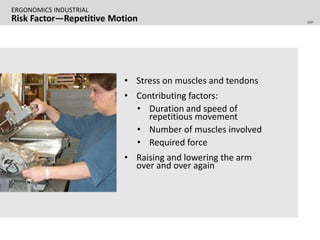
Risk Factor—Repetitive Motion
• Stress on muscles and tendons
• Contributing factors:
• Duration and speed of
repetitious movement
• Number of muscles involved
• Required force
• Raising and lowering the arm
over and over again
ERGONOMICS INDUSTRIAL
2107
Forceful Exertions
• Inflammation of tendons,
nerves, joints
• Contributing factors:
• Type of grip
• Weight of object
• Body posture
• Type and duration of
the task
Image Credit: OSHA
ERGONOMICS INDUSTRIAL
2107
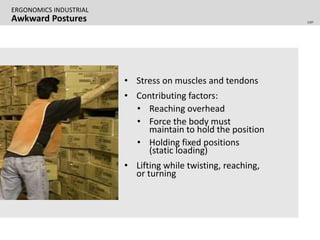
Awkward Postures
• Stress on muscles and tendons
• Contributing factors:
• Reaching overhead
• Force the body must
maintain to hold the position
• Holding fixed positions
(static loading)
• Lifting while twisting, reaching,
or turning
ERGONOMICS INDUSTRIAL
2107
Contact Stress
• Pressing against or
grabbing a hard object puts
pressure on nerves,
tendons, and blood vessels
• Contributing factors:
• Repetition
• Duration of contact
• Grip strength required
ERGONOMICS INDUSTRIAL
2107
Vibration
• Affects tendons, muscles,
joints, nerves
• Contributing factors:
• Prolonged grip
• Restricts blood supply to
hands and fingers
• Tools without vibration-
dampening device
• Poor power tool
maintenance
ERGONOMICS INDUSTRIAL
2107
Ergonomics Engagement
• Job assessment
• MSD reporting and response system
• Designated coordinator
• Training
• Encourage employee participation and reporting of MSDs
ERGONOMICS INDUSTRIAL
2107
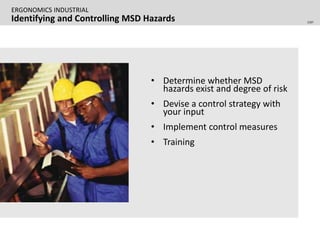
Identifying and Controlling MSD Hazards
• Determine whether MSD
hazards exist and degree of risk
• Devise a control strategy with
your input
• Implement control measures
• Training
ERGONOMICS INDUSTRIAL
2107
Control Methods
• Install engineering controls including, workstation layout
and proper tools
• Institute work practice controls including, neutral postures
for performing tasks
• Administrative controls, including rescheduling to reduce
frequency or duration of exposure to MSDs
• PPE to provide a protective barrier between worker and
MSD hazard
ERGONOMICS INDUSTRIAL
2107
How to Protect Yourself
• Change positions often; take
stretch breaks
• Maintain neutral posture
whenever possible
• Eliminate or reduce MSD
risk factors
• Use material-handling aids
• Report MSD symptoms
ERGONOMICS INDUSTRIAL
2107
Key Points to Remember
• Ergonomics fits task to
worker to reduce injuries
• MSDs are disorders of
nervous system, soft tissue
• Risk factors: repetition,
forceful exertion, awkward
postures, contact stress,
vibration
• Most common symptom is
pain or stiffness
• Set up your workstation to
minimize strain
• Perform tasks safely by
changing positions and
using neutral posture

document_rgonomics_industrialengineering

  • 1.
    © BLR®, adivision of Simplify Compliance LLC 2106 Ergonomics Industrial
  • 2.
    ERGONOMICS INDUSTRIAL 2107 About ThisModule Welcome to BLR training. Be sure to ask your supervisor or trainer if you do not understand any of the information presented in the program. Session Objectives Overview Welcome
  • 3.
    ERGONOMICS INDUSTRIAL 2107 About ThisModule Session Objectives Overview Welcome MSDs are among the most frequently reported causes of lost work time. Workers in many different industries and occupations can be exposed to MSD risk factors at work. By understanding basic ergonomics, you can minimize MSD risk factors, avoid strains on your body, and reduce your risk of injury.
  • 4.
    ERGONOMICS INDUSTRIAL 2107 About ThisModule At the completion of this module, the participant will be able to: • Recognize the importance of ergonomics • Define MSDs • Identify ergonomic risk factors • Recognize MSD symptoms • Identify control methods for MSD hazards • Perform tasks safely, and avoid musculoskeletal injuries and illness Session Objectives Overview Welcome
  • 5.
    ERGONOMICS INDUSTRIAL 2107 What IsErgonomics? • Fit task to worker • Reduce injuries and illnesses • Engineering controls • Administrative and work practice controls • PPE
  • 6.
    ERGONOMICS INDUSTRIAL 2107 OSHA Regulationof Ergonomics General Duty Clause • Applies to unregulated hazards • Failure to keep a hazard-free workplace • Hazard recognized by employer or employer’s industry • Hazard could cause death or serious harm • Method exists to correct the hazard
  • 7.
    ERGONOMICS INDUSTRIAL 2107 What AreMSDs? Injuries or disorders involving: • Muscles • Tendons and ligaments • Joints • Cartilage • Blood vessels • Nerves
  • 8.
    ERGONOMICS INDUSTRIAL 2107 Characteristics ofMSDs • Occur from a single event or many small injuries • Take weeks, months, or years to develop • Produce no symptoms in early stages but show symptoms after injury has occurred • Contributing causes may occur at home and at work • Same MSD may differ in severity from person to person doing a similar task
  • 9.
    ERGONOMICS INDUSTRIAL 2107 MSD Symptoms •Back and neck—shooting pain, stiffness • Shoulders—pain, stiffness, loss of mobility • Arms and legs—shooting pains, numbness • Elbow and knee joints— pain, swelling, stiffness, soreness
  • 10.
    ERGONOMICS INDUSTRIAL 2107 MSD Symptoms(cont.) • Hands and wrists— swelling, numbness, loss of strength • Fingers—jerking movements or loss of strength, mobility, and feeling • Thumbs—pain at the base • Feet and toes—numbness, tingling, stiffness, burning sensation
  • 11.
    ERGONOMICS INDUSTRIAL 2107 Outward Signsof MSDs • Swelling or inflammation of joints • Vigorously shaking hands • Massaging hands, wrists, or arms • Cradling arms • Limping • Stiff back
  • 12.
    ERGONOMICS INDUSTRIAL 2107 Common MSDs •Carpal tunnel syndrome • Low back pain • Tendinitis • Trigger finger
  • 13.
    ERGONOMICS INDUSTRIAL 2107 Common MSDs(cont.) • De Quervain’s disease— forceful grip • Carpet layer’s knee—contact trauma • Rotator cuff tendinitis— repetitive motion • Herniated disk— bending and twisting • Hand-arm vibration syndrome
  • 14.
    ERGONOMICS INDUSTRIAL 2107 Act onthe Signs of MSDs Act immediately: • Report the problem • Seek medical attention • Early intervention can prevent permanent injury
  • 15.
    ERGONOMICS INDUSTRIAL 2107 Risk FactorsThat Lead to MSDs • Repetitive motions • Forceful exertions • Awkward postures • Pressure points or contact stress • Vibrations • Using tools not ergonomically designed
  • 16.
    ERGONOMICS INDUSTRIAL 2107 Risk Factor—RepetitiveMotion • Stress on muscles and tendons • Contributing factors: • Duration and speed of repetitious movement • Number of muscles involved • Required force • Raising and lowering the arm over and over again
  • 17.
    ERGONOMICS INDUSTRIAL 2107 Forceful Exertions •Inflammation of tendons, nerves, joints • Contributing factors: • Type of grip • Weight of object • Body posture • Type and duration of the task Image Credit: OSHA
  • 18.
    ERGONOMICS INDUSTRIAL 2107 Awkward Postures •Stress on muscles and tendons • Contributing factors: • Reaching overhead • Force the body must maintain to hold the position • Holding fixed positions (static loading) • Lifting while twisting, reaching, or turning
  • 19.
    ERGONOMICS INDUSTRIAL 2107 Contact Stress •Pressing against or grabbing a hard object puts pressure on nerves, tendons, and blood vessels • Contributing factors: • Repetition • Duration of contact • Grip strength required
  • 20.
    ERGONOMICS INDUSTRIAL 2107 Vibration • Affectstendons, muscles, joints, nerves • Contributing factors: • Prolonged grip • Restricts blood supply to hands and fingers • Tools without vibration- dampening device • Poor power tool maintenance
  • 21.
    ERGONOMICS INDUSTRIAL 2107 Ergonomics Engagement •Job assessment • MSD reporting and response system • Designated coordinator • Training • Encourage employee participation and reporting of MSDs
  • 22.
    ERGONOMICS INDUSTRIAL 2107 Identifying andControlling MSD Hazards • Determine whether MSD hazards exist and degree of risk • Devise a control strategy with your input • Implement control measures • Training
  • 23.
    ERGONOMICS INDUSTRIAL 2107 Control Methods •Install engineering controls including, workstation layout and proper tools • Institute work practice controls including, neutral postures for performing tasks • Administrative controls, including rescheduling to reduce frequency or duration of exposure to MSDs • PPE to provide a protective barrier between worker and MSD hazard
  • 24.
    ERGONOMICS INDUSTRIAL 2107 How toProtect Yourself • Change positions often; take stretch breaks • Maintain neutral posture whenever possible • Eliminate or reduce MSD risk factors • Use material-handling aids • Report MSD symptoms
  • 25.
    ERGONOMICS INDUSTRIAL 2107 Key Pointsto Remember • Ergonomics fits task to worker to reduce injuries • MSDs are disorders of nervous system, soft tissue • Risk factors: repetition, forceful exertion, awkward postures, contact stress, vibration • Most common symptom is pain or stiffness • Set up your workstation to minimize strain • Perform tasks safely by changing positions and using neutral posture

Editor's Notes

  • #6 What is ergonomics? • Ergonomics is the science of fitting the task to the worker performing the task.  • The goal of ergonomics is to reduce injuries and illnesses, such as MSDs, caused by stress and strain on the job from repetitive reaching, using forceful exertions, bending and lifting, or working with vibrating equipment. • Ergonomics involves engineering controls, administrative controls, and personal protective equipment, or PPE. Engineering controls implement a physical change to the workplace. For example, changing the design of a workstation, production line, or tool can eliminate or reduce the hazard of the task. • Administrative and work practice controls establish efficient processes or procedures-for example, requiring that heavy loads only be lifted by two people or allowing workers to rotate through different types of jobs so that their exposure to risk factors is reduced. • Finally, although it is less commonly used, PPE can reduce exposure to ergonomicsrelated risk factors. Examples of PPE include vibration-reduction gloves or knee pads for carpet layers. 
  • #7 OSHA’s regulation of ergonomics and MSDs does not stem from a specific rule, but rather from what is known as the “General Duty Clause” of the Occupational Safety and Health Act. The General Duty Clause is a federal statute that requires employers to provide a workplace that is “free from recognized hazards that are causing or likely to cause death or serious physical harm.” • The General Duty Clause applies to unregulated hazards-that is, hazards that are recognized as existing, but for which there is no specific standard. In other words, an unsafe condition that is not covered by one of OSHA’s specific standards is considered to be covered by the General Duty Clause if: • There is a failure by the employer to keep a hazard-free workplace. • The hazard is recognized as a hazard by the employer or the employer’s industry in general. • The hazard is causing, or is likely to cause, death or serious harm. • A feasible and useful method exists to correct the hazard. The General Duty Clause applies here because MSDs are recognized as a hazard that can cause serious harm, and implementing ergonomic work practices is a feasible and useful method for correcting this hazard.
  • #8 MSDs are disorders involving the nervous system or soft tissue in the fingers, wrists, elbows, shoulders, neck, back, and knees. Work-related MSDs are caused by stress and strain due to activities that you perform on the job, such as repetitive reaching, using forceful exertions, bending and lifting, or working with vibrating equipment.  Affected body tissues include: • Muscles • Tendons and ligaments • Joints • Cartilage • Blood vessels • Nerves
  • #9 Here are the common characteristics of MSDs: • They may occur either from a single event, such as a strain or a sprain, or they may result from gradually increasing tissue damage from many small injuries. • They take weeks, months, or even years to develop. • They produce no symptoms in their early stages but show symptoms later after injury has already occurred. • Contributing causes of MSDs may be present both at work and in the home or during recreational activity. • The same MSD may differ in severity from person to person, even if they have been doing similar tasks for similar periods of time.
  • #10 MSD symptoms may include the following: • Your back and neck may experience shooting pains or prolonged stiffness. • Your shoulders may experience pain, stiffness, or a loss of mobility. • Your arms and legs might have periods of shooting or stabbing pains or a feeling of numbness. • Your elbow or knee joints could have pain, swelling, stiffness, or soreness. Understanding and recognizing the signs and symptoms of MSDs can help you prevent them. The first step is to reduce your exposure to risk factors that may cause MSD signs and symptoms. Remember that an MSD can cause pain or discomfort in a number of body parts and that the type of discomfort you experience depends on the type of MSD.
  • #11 Some additional possible MSD symptoms include the following: • Hands and wrists may experience various symptoms such as swelling, numbness, or loss of strength. • Fingers may experience such symptoms as jerking movements, loss of strength, loss of mobility, or loss of feeling. • Thumbs might experience pain at the base. • Feet and toes might also experience symptoms such as numbness or tingling, stiffness, or a burning sensation.
  • #12 Outward signs of MSDs may include: • Visible swelling or inflammation of joints, such as shoulders, elbows, wrists, or knees; • Vigorous shaking of the hands as though trying to regain circulation; • Massaging of hands, wrists, and arms as though to relieve pain or regain circulation; • Cradling of arms when standing or sitting as if trying to find a less painful position; • Limping or wincing with pain when walking; and • Moving with a stiff back or difficulty bending over to pick up something or placing hands on lower back as if trying to support it.
  • #13 Common MSDs include: • Carpal tunnel syndrome is the compression of the median nerve where it passes through the wrist and into the hand. It sometimes develops when someone types with his or her wrist bent and resting on a table. • Low back pain is often the result of injury to muscles from improper bending and lifting heavy objects, or from improper posture when sitting or standing. • Tendinitis is inflammation of a tendon that happens when a muscle or tendon is repeatedly tensed. It often results from overuse of the wrist, shoulder, or elbow. • Trigger finger is a tendon disorder that occurs in the flexing tendon of the finger. The finger has snapping or jerking movements when you attempt to move it. This type of MSD is associated with using tools that have handles with hard or sharp edges.
  • #14 Additional common MSDs include: • De Quervain’s disease is inflammation of the tendon sheath of the thumb caused by excessive friction between two thumb tendons. This is usually the result of twisting and forceful gripping motions. • Carpet layer’s knee is a variety of symptoms that are caused by frequent kneeling on hard surfaces and using a knee kicker for stretching wall-to-wall carpet. Symptoms include bursitis of the knee, fluid buildup, and skin infections.  • Rotator cuff tendinitis occurs from working with the hands above the head repeatedly over a long period of time. • A herniated disk is a bulge in one of the disks that cushion the backbone. The most common symptom is sciatica, a sharp shooting pain down the back of the leg. This is caused by pressure on the spinal nerve, which can occur from repeated bending, twisting, or carrying loads at arm’s length. Other symptoms include weakness in one leg or burning pain in the back. • Finally, hand-arm vibration syndrome occurs when the blood vessels of the hand are damaged from repeated exposure to vibration for long periods of time. The skin and muscles of the hand do not get the blood or oxygen they need, and experience numbness, tingling, loss of color, loss of sensation in the hand, or loss of control of the hand.
  • #15 You should act immediately on any sign of MSDs: • Report the problem immediately to your supervisor. • Seek medical attention. • Remember that early treatment and intervention often can prevent the condition from getting worse or becoming permanent.
  • #16 There are many risk factors in the workplace that lead to MSDs. The most common risk factors are: • Repetitive motions; • Forceful exertions; • Awkward postures; • Contact stress or pressure points; • Vibrations; and • Using tools that are not ergonomically designed, such as screwdrivers with narrow handles or pliers that require a wide grip.
  • #17 Repetitive motion is a common risk factor for MSDs. • Stress on the muscles and tendons result from doing the same motion over and over. • Certain contributing factors determine whether repetition is likely to cause MSDs and include: • The duration and speed of the motion-how often and how quickly it is repeated; • The number of muscles involved in the motion; and • The required force to perform the movement. • Raising and lowering the arm over and over again with the same degree of force is also an example of a risk factor.
  • #18 Forceful exertions that are required by certain jobs are a major risk factor for MSDs. • Inflammation of the tendons, nerves, and joints is frequently the result of forceful exertions. • Contributing factors to the risk of MSDs from forceful exertions include: • The type of grip required-for example, whether using force requires a natural grip or an awkward grip; • The weight of the object; • Body posture required with the exertion; and • The specific type and duration of the task.
  • #19 Awkward postures are sometimes a risk factor for MSDs. • Stress on muscles and tendons can result from awkward postures. This can lead to back pain, tendinitis, and damage to joints by forcing them out of their natural positions. • Contributing factors to awkward posture as an MSD risk include: • Reaching overhead; • The force the body must maintain in order to hold the awkward position; and • Holding fixed positions, such as bending and twisting, known as static loading. • Lifting an object while twisting, reaching, or turning is another example of an awkward motion that could mean a risk for MSDs.
  • #20 “Contact stress” is defined as continuous contact or rubbing between hard or sharp objects or surfaces and sensitive body tissues, such as the soft tissue of the fingers, palms, thighs, and feet. • Pressing against or grabbing a hard object puts pressure on the nerves, tendons, and blood vessels and can inhibit their function. • Contributing factors for contact stress include: • Repetition, or how often the stress must be repeated; • The duration of the contact; and • The strength of grip required.
  • #21 Vibration for long periods of time can be a major risk factor for MSDs such as hand-arm vibration syndrome. • Vibration affects the tendons, muscles, joints, and nerves. • Contributing factors that can lead to MSDs caused by vibrations include: • Prolonged grip on a vibrating object; • Restrictions on the blood supply to the hands and fingers; • Using tools that do not have vibration-dampening devices; and • Poor power tool maintenance, causing them to vibrate more than they should. • Prolonged use of a grinder is another example of vibration as an MSD risk factor. Other examples involving power tools include prolonged use of jackhammers, sanders, saws, chippers, routers, and drills.
  • #22 There are a variety of ways to manage, prevent, and control MSD hazards. Ergonomics management is the first step, and it includes the following: • A job assessment, or job hazard analysis, which is conducted for the various workstations and tasks in the facility, to identify possible MSD hazards; • An MSD reporting and response system, which is designed and included in the ergonomics program; • A designated ergonomics coordinator, who is involved in all aspects of the program to control and prevent MSDs through ergonomics; • Employee training to teach employees about ergonomics and MSD prevention; and • The ergonomics program encourages employee participation and reporting of MSDs.
  • #23 Identifying and controlling MSD hazards is the next step that follows in an ergonomics management program.  • First, your employer identifies MSD hazards and the degree of risk through a job hazard analysis. • Next, your employer devises a control strategy, with input from employees, for those jobs that have MSD risk factors and a high degree of risk. Employees’ involvement in designing the control strategy is important because workers know the hazards and may already have experienced MSD signs and symptoms. • Then, your employer implements the control measures to reduce the hazards. • Finally, specific training is provided for affected employees and supervisors once control measures are in place so that everyone better understands how to prevent MSDs. 
  • #24 There are many important control methods for MSD hazards. • Engineering controls are the preferred approach. Examples of engineering controls include designing the workstation layout ergonomically and using ergonomically designed tools. • Work practice controls are changes in the way employees perform the physical activities of a job to reduce MSD hazards. One work practice control is to use neutral postures to perform tasks-for instance, keeping wrists straight or lifting close to the body rather than working with wrists bent or lifting with arms extended. Another example would be to use two-person lift teams. • Administrative controls include rescheduling of job assignments in ways that may reduce the frequency or duration of exposure to MSD hazards. Examples of administrative controls include employee rotation; assigning alternative tasks; changing the pace of the work; and job task enlargement, which means requiring a wider variety of tasks and motions rather than the same repetitive motion or activity for long periods of time. • A final control method is PPE that provides a protective barrier between the worker and the MSD hazard. Examples of PPE include vibration-reduction gloves or knee pads for carpet layers.
  • #25 There are many ways to protect yourself against MSDs. • Change positions often and take stretch breaks to reduce your exposure to excessive repetitive motions. Another idea is to switch to other tasks that require the use of different muscles. • Maintain a neutral posture whenever possible, and avoid working in an awkward posture whenever you can. Stand with your back straight, avoid bending forward or stooping, limit squatting and kneeling, keep your head straight and face forward, and avoid raising or hunching your shoulders. Always use proper lifting techniques and posture. • Eliminate or reduce ergonomic risk factors by evaluating your job for possible risk factors. Inform your supervisor about these risk factors and work to make changes that will help reduce or eliminate them. • Use material-handling aids, such as hand trucks, whenever possible, to reduce your need to apply force to a task, such as heavy lifting. • Finally, report any MSD symptoms you may have to your supervisor.
  • #26 Here are the main points to remember from this session on industrial ergonomics: • The goal of ergonomics-the science of fitting the task to the worker-is to reduce the risk of injuries. MSDs are injuries and disorders involving the nervous system or soft tissue in the back, neck, shoulders, arms, and/or legs caused by stress and strain due to activities that you perform on the job. • Repetitive motions, forceful exertions, awkward postures, contact stress, and vibrations are common ergonomic risk factors for industrial workers.  • For industrial workers, the most common MSD symptoms are pain or stiffness in the back, neck, shoulders, arms, or legs.  • Set up your workstation to minimize strain by having an ergonomic layout and using ergonomically designed tools.  • Perform tasks safely by changing positions often and maintaining a neutral posture. This concludes the Ergonomics: Industrial training session. Please be sure to go back and review any information that is not completely clear. If you still have questions, ask your supervisor or trainer.