Ergonomics and Safety
Ergonomicsand Safety
Responsibilities
Responsibilities
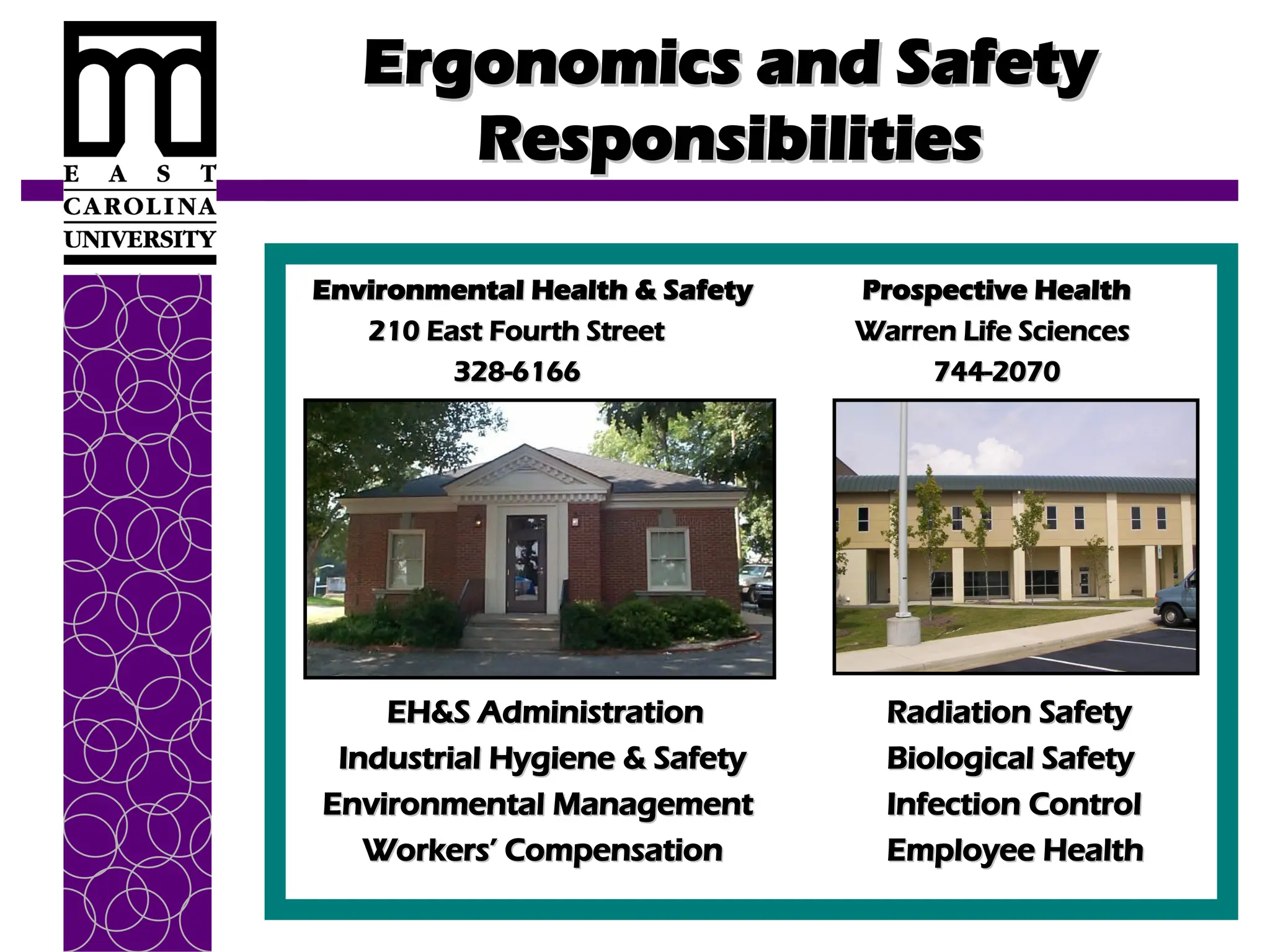
Environmental Health & Safety
Environmental Health & Safety Prospective Health
Prospective Health
210 East Fourth Street
210 East Fourth Street Warren Life Sciences
Warren Life Sciences
328-6166
328-6166 744-2070
744-2070
EH&S Administration
EH&S Administration Radiation Safety
Radiation Safety
Industrial Hygiene & Safety
Industrial Hygiene & Safety Biological Safety
Biological Safety
Environmental Management
Environmental Management Infection Control
Infection Control
Workers’ Compensation
Workers’ Compensation Employee Health
Employee Health
2.
Ergonomics
Ergonomics
The way weinteract
The way we interact
with our environment
with our environment
at work, play and rest.
at work, play and rest.
Fitting the way we work
Fitting the way we work
to the way our body is
to the way our body is
built is the key.
built is the key.
3.
Agenda
Agenda
What isergonomics?
What is ergonomics?
What do I need to know
What do I need to know
about musculoskeletal
about musculoskeletal
disorders?
disorders?
Adapting my work place.
Adapting my work place.
More information.
More information.
4.
Ergonomics is…
Ergonomics is…
Adapting the tasks to fit you.
Adapting the tasks to fit you.
Maximizing your health and comfort
Maximizing your health and comfort
by using your body in efficient ways.
by using your body in efficient ways.
Self-evaluation of the behaviors and
Self-evaluation of the behaviors and
postures you use at work and play.
postures you use at work and play.
Learning to recognize the signs and
Learning to recognize the signs and
symptoms associated with an action
symptoms associated with an action
that may lead to musculoskeletal
that may lead to musculoskeletal
disorders.
disorders.
5.
Musculoskeletal Disorders (MSD)
MusculoskeletalDisorders (MSD)
Illness resulting from cumulative
Illness resulting from cumulative
trauma to the muscles, nerves,
trauma to the muscles, nerves,
tendons, ligaments, joints,
tendons, ligaments, joints,
cartilage, blood vessels or spine
cartilage, blood vessels or spine
discs.
discs.
An injury caused by an acute
An injury caused by an acute
incident e.g., a fall or auto
incident e.g., a fall or auto
accident, or symptoms of a
accident, or symptoms of a
degenerative disease are not
degenerative disease are not
considered a MSD and must be
considered a MSD and must be
treated differently.
treated differently.
6.
Symptoms of aMSD
Symptoms of a MSD
Subjective indicators of potential concern
Subjective indicators of potential concern
Painful Joints
Painful Joints
Pain, tingling or numbness in hands or
Pain, tingling or numbness in hands or
feet
feet
Shooting or stabbing pains in arms or
Shooting or stabbing pains in arms or
legs
legs
Swelling or inflammation
Swelling or inflammation
Pain in wrists, shoulders, forearms,
Pain in wrists, shoulders, forearms,
knees
knees
Fingers or toes turning white
Fingers or toes turning white
Back and neck pain
Back and neck pain
Stiffness or burning sensations
Stiffness or burning sensations
7.
MSD Signs
Objective indicatorsidentified
Objective indicators identified
by a physician to help diagnose
by a physician to help diagnose
specific problems.
specific problems.
Decreased range of motion
Decreased range of motion
Deformity
Deformity
Decreased grip strength
Decreased grip strength
Loss of muscle function
Loss of muscle function
Inability to physically perform normal
Inability to physically perform normal
tasks
tasks
Repetition
Doing thesame motions over and
Doing the same motions over and
over again places stress on the
over again places stress on the
muscles and tendons. The severity
muscles and tendons. The severity
of risk depends on how often the
of risk depends on how often the
action is repeated, the speed of the
action is repeated, the speed of the
movement, the number of muscles
movement, the number of muscles
involved and the required force.
involved and the required force.
E.g., steady computer use for 4
E.g., steady computer use for 4
hrs/day; a repeated cycle of
hrs/day; a repeated cycle of
motions 2 or more times per
motions 2 or more times per
minute.
minute.
10.
Force
Force
The amountof physical effort required to
The amount of physical effort required to
perform a task or maintain control of
perform a task or maintain control of
equipment or tools.
equipment or tools.
Force depends upon type of grip, weight
Force depends upon type of grip, weight
of the object, body posture, type of
of the object, body posture, type of
activity, and duration of task.
activity, and duration of task.
E.g., Lifting 75 lbs one time or 55lbs
E.g., Lifting 75 lbs one time or 55lbs
more than 10 times per shift or 25 lbs
more than 10 times per shift or 25 lbs
below the knees or above shoulder
below the knees or above shoulder
height. Pinching 2 lbs or for 2 or more
height. Pinching 2 lbs or for 2 or more
total hours per shift.
total hours per shift.
11.
Awkward Posture
Awkward Posture
Repeated or prolonged reaching, twisting,
Repeated or prolonged reaching, twisting,
bending, kneeling, squatting, working
bending, kneeling, squatting, working
overhead with your hands or arms, or
overhead with your hands or arms, or
holding fixed positions.
holding fixed positions.
E.g., Working with hands over head,
E.g., Working with hands over head,
kneeling or squatting for 2 hours/day;
kneeling or squatting for 2 hours/day;
working with back, neck or wrist bent for 2
working with back, neck or wrist bent for 2
hours/day.
hours/day.
Potential fixes: portable stools, turn or
Potential fixes: portable stools, turn or
move the work, use frequent mini-breaks,
move the work, use frequent mini-breaks,
integrate the work with other tasks to
integrate the work with other tasks to
avoid prolonged use of the awkward
avoid prolonged use of the awkward
posture.
posture.
12.
Contact Stress
Contact Stress
Pressing the body (or body part)
Pressing the body (or body part)
against a hard or sharp edge can
against a hard or sharp edge can
result in placing too much
result in placing too much
pressure on nerves, tendons and
pressure on nerves, tendons and
blood vessels.
blood vessels.
For example, using the palm of
For example, using the palm of
your hand as a hammer regularly
your hand as a hammer regularly
or typing while resting your arms
or typing while resting your arms
or wrists on the hard desk edge.
or wrists on the hard desk edge.
13.
Vibration
Vibration
Operating vibratingtools such
Operating vibrating tools such
as sanders, grinders, chippers,
as sanders, grinders, chippers,
routers, drills, saws and yard
routers, drills, saws and yard
equipment on a regular basis
equipment on a regular basis
can lead to nerve damage.
can lead to nerve damage.
Potential fixes: vibration
Potential fixes: vibration
dampening gloves, job
dampening gloves, job
rotation, modified clutching
rotation, modified clutching
mechanisms.
mechanisms.
14.
Personal Risk Factors
PersonalRisk Factors
Age
Age
Gender
Gender
Previous injury
Previous injury
Personal health
Personal health
Physical
Physical
condition
condition
Size and shape
Size and shape
Life style
Life style
Life stress
Life stress
Hobbies
Hobbies
Rest and recovery
Rest and recovery
time available
time available
Short-term
Short-term
changes in
changes in
health.
health.
Attitude towards
Attitude towards
making changes
making changes
to improve long
to improve long
term health
term health
15.
Neutral Standing Posture
NeutralStanding Posture
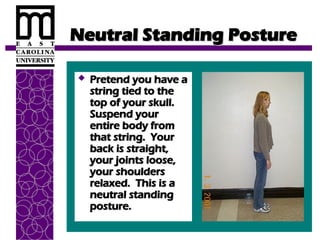
Pretend you have a
Pretend you have a
string tied to the
string tied to the
top of your skull.
top of your skull.
Suspend your
Suspend your
entire body from
entire body from
that string. Your
that string. Your
back is straight,
back is straight,
your joints loose,
your joints loose,
your shoulders
your shoulders
relaxed. This is a
relaxed. This is a
neutral standing
neutral standing
posture.
posture.
16.
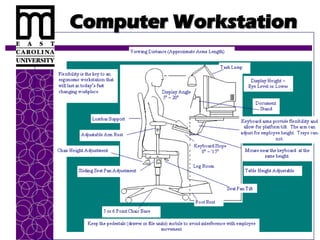
Neutral Seated Posture
NeutralSeated Posture
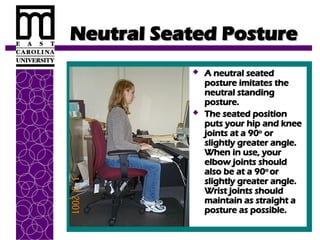
A neutral seated
A neutral seated
posture imitates the
posture imitates the
neutral standing
neutral standing
posture.
posture.
The seated position
The seated position
puts your hip and knee
puts your hip and knee
joints at a 90
joints at a 90o
o
or
or
slightly greater angle.
slightly greater angle.
When in use, your
When in use, your
elbow joints should
elbow joints should
also be at a 90
also be at a 90o
o
or
or
slightly greater angle.
slightly greater angle.
Wrist joints should
Wrist joints should
maintain as straight a
maintain as straight a
posture as possible.
posture as possible.
17.
Fixing the Job
Fixingthe Job
Use neutral postures to perform tasks.
Use neutral postures to perform tasks.
Adjust the work station to remove the risk
Adjust the work station to remove the risk
factor.
factor. E.g., raise or lower the work surface, turn
E.g., raise or lower the work surface, turn
the piece, etc.
the piece, etc.
Rotate between jobs.
Rotate between jobs. E.g., break up long
E.g., break up long
typing sessions with some filing or copying, break
typing sessions with some filing or copying, break
up leaf blowing with short raking sessions.
up leaf blowing with short raking sessions.
Use mechanical assistance.
Use mechanical assistance. E.g., use a lift to
E.g., use a lift to
move heavy parts, use a two wheeled truck to
move heavy parts, use a two wheeled truck to
move multiple boxes or one heavy box.
move multiple boxes or one heavy box.
Get help.
Get help. E.g., use a buddy to help in heavy
E.g., use a buddy to help in heavy
lifting tasks.
lifting tasks.
18.
Fixing the Job(continued)
Fixing the Job (continued)
Use personal protective equipment.
Use personal protective equipment. E.g.,
E.g.,
anti-vibration gloves when using vibrating hand
anti-vibration gloves when using vibrating hand
or yard tools.
or yard tools.
Observe micro-breaks.
Observe micro-breaks. E.g., take a stretch
E.g., take a stretch
break every hour you spend in continuous
break every hour you spend in continuous
typing, writing or telephone use.
typing, writing or telephone use.
Share your ideas.
Share your ideas. If you find something that
If you find something that
works let your supervisor, co-workers and EH&S
works let your supervisor, co-workers and EH&S
know so others may benefit.
know so others may benefit.
Use the self-help tools available on the
Use the self-help tools available on the
web at
web at http://www.ecu.edu/oehs
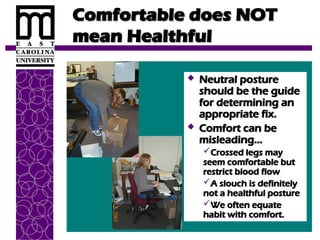
Comfortable does NOT
Comfortabledoes NOT
mean Healthful
mean Healthful
Neutral posture
Neutral posture
should be the guide
should be the guide
for determining an
for determining an
appropriate fix.
appropriate fix.
Comfort can be
Comfort can be
misleading…
misleading…
Crossed legs may
Crossed legs may
seem comfortable but
seem comfortable but
restrict blood flow
restrict blood flow
A slouch is definitely
A slouch is definitely
not a healthful posture
not a healthful posture
We often equate
We often equate
habit with comfort.
habit with comfort.
21.
If you havesymptoms…
If you have symptoms…
Report symptoms, discomforts or
Report symptoms, discomforts or
problems to your supervisor as soon as
problems to your supervisor as soon as
noticed.
noticed.
Work together to try to identify the
Work together to try to identify the
source of the discomfort and creative
source of the discomfort and creative
solutions.
solutions.
If the discomfort lasts more than 7 days
If the discomfort lasts more than 7 days
and you have not located the probable
and you have not located the probable
source or a way to correct the problem,
source or a way to correct the problem,
report your discomfort to EH&S for a
report your discomfort to EH&S for a
worksite evaluation.
worksite evaluation.
22.
How to reporta discomfort or
How to report a discomfort or
a job that needs evaluated.
a job that needs evaluated.
Email
Email
safety@mail.ecu
.edu
Call EH&S at
Call EH&S at
328-6166
328-6166
Stop by our
Stop by our
office at 210 E.
office at 210 E.
4
4th
th
St
St
Tell us…
Tell us…
About your job.
About your job.
Where you are
Where you are
located.
located.
What is
What is
uncomfortable.
uncomfortable.
How long the
How long the
discomfort has
discomfort has
existed.
existed.
What you have
What you have
already tried.
already tried.
Are you the only
Are you the only
one doing this job?
one doing this job?
EH&S Policy Statement
EH&SPolicy Statement
Protect and promote the health and safety of
Protect and promote the health and safety of
students, employees, patients, visitors, and the
students, employees, patients, visitors, and the
environment
environment
Primary responsibility rests with the Chancellor
Primary responsibility rests with the Chancellor
and, by delegated authority, to the Vice
and, by delegated authority, to the Vice
Chancellor for Administration and Finance
Chancellor for Administration and Finance
Operational component delegated to the
Operational component delegated to the
Directors of EH&S and Prospective Health
Directors of EH&S and Prospective Health
The ultimate success of the safety and
The ultimate success of the safety and
environmental programs depends upon the
environmental programs depends upon the
conscientious and cooperative efforts of all
conscientious and cooperative efforts of all
Expectation that
Expectation that every employee actively
every employee actively
promote and support the safety and
promote and support the safety and
environmental program
environmental program
26.
Employer Responsibilities
Employer Responsibilities
Employer must comply with OSHA
Employer must comply with OSHA
and other safety and health
and other safety and health
standards
standards
“
“General duty” to provide
General duty” to provide
workplace free of recognized
workplace free of recognized
hazards likely to cause injury
hazards likely to cause injury
University subject to inspection by
University subject to inspection by
OSHA, EPA and other regulatory
OSHA, EPA and other regulatory
agencies
agencies
27.
Employee Rights and
EmployeeRights and
Responsibilities
Responsibilities
Comply with applicable rules,
Comply with applicable rules,
regulations and policies
regulations and policies
Participate in training
Participate in training
Notify supervisor of accidents
Notify supervisor of accidents
(including near misses), spills,
(including near misses), spills,
damaged equipment, safety
damaged equipment, safety
deficiencies, prescription drug use
deficiencies, prescription drug use
or other conditions that may affect
or other conditions that may affect
alertness or ability, etc.
alertness or ability, etc.
28.
Employee Rights and
EmployeeRights and
Responsibilities
Responsibilities
Employee has basic right to make a
Employee has basic right to make a
complaint regarding unsafe or
complaint regarding unsafe or
unhealthy workplace conditions
unhealthy workplace conditions
Address complaint in-house by notifying
Address complaint in-house by notifying
supervisor and/or EH&S at 328-6166
supervisor and/or EH&S at 328-6166
Contact NCDOL if issue cannot be
Contact NCDOL if issue cannot be
resolved in-house (1-800-LABOR-NC)
resolved in-house (1-800-LABOR-NC)
Employer cannot retaliate against an
Employer cannot retaliate against an
employee for making a complaint
employee for making a complaint
Employee confidentiality
Employee confidentiality
29.
Required Training for
RequiredTraining for
All University Personnel
All University Personnel
Hazard Communication
Hazard Communication
Ergonomics
Ergonomics
Accident Reporting
Accident Reporting
Procedures
Procedures
Emergency Action Plans
Emergency Action Plans
30.
Required Training for
RequiredTraining for
Clinical and Lab Personnel
Clinical and Lab Personnel
Hazard Communication,
Hazard Communication,
Ergonomics, Accident Reporting
Ergonomics, Accident Reporting
Procedures and Emergency Action
Procedures and Emergency Action
Plans
Plans
Lab Safety
Lab Safety
Bloodborne Pathogens
Bloodborne Pathogens
Radiation Safety
Radiation Safety
Other Toxic and Hazardous
Other Toxic and Hazardous
Substances
Substances
31.
Required Training for
RequiredTraining for
Facilities Services Personnel
Facilities Services Personnel
Hazard Communication, Ergonomics, Accident
Hazard Communication, Ergonomics, Accident
Reporting Procedures and Emergency Action Plans
Reporting Procedures and Emergency Action Plans
Asbestos Awareness
Asbestos Awareness
Electrical Safety
Electrical Safety
Excavations
Excavations
PPE, Respiratory Protection, Hearing Protection,
PPE, Respiratory Protection, Hearing Protection,
Fall Protection
Fall Protection
Lockout/Tagout
Lockout/Tagout
Power Tools, Woodworking Machinery, Platforms,
Power Tools, Woodworking Machinery, Platforms,
Forklifts, Scaffolding, Ladders and other equipment
Forklifts, Scaffolding, Ladders and other equipment
Confined Spaces
Confined Spaces
Hazwoper
Hazwoper
EH&S Monthly and Quarterly Training
EH&S Monthly and Quarterly Training
Opportunities
Opportunities
32.
Safety and Environmental
Safetyand Environmental
Compliance at ECU
Compliance at ECU
QUESTIONS?
QUESTIONS?
Environmental Health & Safety
Environmental Health & Safety Prospective Health
Prospective Health
210 East Fourth Street
210 East Fourth Street Warren Life Sciences
Warren Life Sciences
328-6166
328-6166 744-2070
744-2070
safety@mail.ecu.edu
safety@mail.ecu.edu
Editor's Notes
#3 During this program we will answer the questions
What is ergonomics?
What do I need to know about musculoskeletal disorders?
How do I adapt my work place?
Where can I get additional information about ergonomics?
#25 Protect and promote the health and safety of our students, employees, patients, campus visitors, and the environment and through compliance with applicable safety and environmental regulations, accreditation requirements, and consensus standards.
Primary responsibility rests with the Chancellor and, by delegated authority, to the Vice Chancellor for Administration and Finance. They are responsible for ensuring that safety and environmental responsibility are given an appropriate level of importance and support.
The operational component of the safety and environmental programs has been delegated to the Directors of Environmental Health & Safety and Prospective Health through the Vice Chancellor for Administration and Finance and the Vice Chancellor for Health Sciences, respectively.
The ultimate success of the safety and environmental programs depends upon the conscientious and cooperative efforts of faculty, management, supervisors, employees, and students. Faculty, management and supervisors are expected to demonstrate leadership through displaying proper attitudes and providing the necessary resources and supervision to conduct activities safely and to help ensure environmental compliance. The University also expects every employee to actively promote and support the safety and environmental program by observing applicable rules and continuously improving their safety and environmental skills through taking advantage of available training and resources.



![ergonomics[1].pptx](https://cdn.slidesharecdn.com/ss_thumbnails/ergonomics1-230226092320-24f170c5-thumbnail.jpg?width=640&height=640&fit=bounds)


