ERECTILE
DYSFUNCTION
“Man survives earthquakes, experiences the
horrors of illness, and all of the tortures of
the soul. But the most tormenting tragedy
of all time is, and will be, the tragedy of the
bedroom.”
Tolstoy
The consistent inability to achieve and/or
maintain an erection adequate for
satisfactory sexual intercourse.
Definition of Erectile
Dysfunction(ED)
“This definition is simple, but the condition is not”
DSM-IV (American Psychiatric Association, 2000)
Persistent or recurrent inability to attain, or to
maintain until completion of the sexual activity, an
adequate erection
The disturbance causes marked distress or
interpersonal difficulty
The erectile dysfunction is not better accounted for by
another Axis I disorder (other than a sexual dysfunction)
and is not due exclusively to the direct physiological
effects of a substance (e.g. a drug of abuse, a
medication) or a general medical condition
Anatomy of Penis
Normal Male Sexual Function requires:
1) An intact Libido
2) Detumescence
3) Ability to achieve and maintain penile Erection
4) Ejaculation
Parasympathetic nerves S2-4 mediate erection
Sympathetic nerves T11-L2 control ejaculation and
detumescence
Penile erection is a neurovascular event
modulated by psychological factors and
hormonal status. On sexual stimulation, there
is increased flow of blood into the lacunar
network. Subsequent compression of the
trabecular smooth muscle causes a closure of
the emissary veins and accumulation of blood
in the corpora. The corpora becomes non-
compressible and blood cannot escape.
Physiology Of Erection
Nerve impulses cause the
release of
neurotransmitters (NO)
from the cavernous nerve
terminals. Nitric oxide
diffuses into cavernosal
smooth muscle cells,
activates Guanylate
cyclase, which converts
GTP to cGMP resulting in
smooth muscle relaxation
in the arteries and
arterioles supplying the
erectile tissue and a
several fold increase in
penile blood flow.
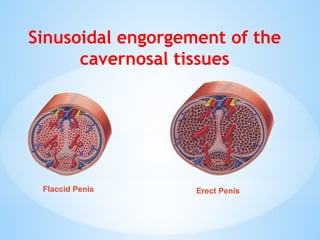
At the same time, relaxation of the
trabecular smooth muscle increases
the compliance of the sinusoids,
facilitating rapid filling and expansion
of the sinusoidal system.
Sinusoidal engorgement of the
cavernosal tissues
Flaccid Penis Erect Penis
The subtunical venular plexuses are thus
compressed between the trabeculae and the tunica
albuginea, resulting in almost total occlusion of
venous outflow.
These events trap the blood within the
corpora cavernosa and raise the penis from a
dependent position to an erect position, with
an intracavernous pressure of approximately
100 mm Hg (the phase of full erection).
Sexual impulse
Neurotransmitter
Release of NO & chemical substrates
Smooth muscle relaxation
Tumescence
Venous occlusion
Rigidity
Erection
Normal pathway to erection
Types of Erectile Dysfunction
It can be primary or secondary
 Primary means present from the first attempt
at intercourse or it may be secondary in which
person develop ED after a period of normal
function.
In situational male ED, a man is able to have
coitus in certain circumstances but not in others
More common in older than younger men (in
contrast to premature ejaculation)
Causes of ED
Psychogenic
Performance anxiety
Relationship problems/difficulties
Loss of attraction to partner
Depression and anxiety disorders
• Anxiety
• Depression
• Fatigue
• Guilt
• Stress
• Marital Discord
• Excessive alcohol consumption
Psychogenic ED
Vasculogenic (arterial or
cavernosal):
Atherosclerosis
Hypertension
Trauma
Caused by other systemic
diseases and aging:
Old age
Diabetes mellitus
Chronic renal failure
Coronary heart disease
Neurogenic:
Stroke or Alzheimer’s disease
Spinal cord injury
Radical pelvic surgery
Diabetic neuropathy
Pelvic injury
Hormonal:
Hypogonadism
Hyperprolactinemia
Drug-induced:
Antihypertensive and antidepressant drugs
Antiandrogens
Alcohol abuse
Cigarette smoking
Medications & ED
More likely to affect sexual function
Beta blockers(propranolol,atenolol)
Statins
Diuretics(thiazide)
Anti-
depressants(fluoxetine,sertraline,amitriptyline)
Anti-psychotics(chlorpromazine,risperidone)
Less likely to affect sexual function
Calcium channel blockers
ACE inhibitors
Causes of ED
Sydney Men’s Health
Clues differentiating psychogenic
from organic causes
Psychogenic
Sudden onset
Situational
Normal waking and nocturnal
erections
Normal erection with masturbation
Tumescence present
Relationship problems
Major Life event
Anxiety, fear, depression
Organic
Gradual onset
All situations
Reduced or absent waking and
nocturnal erections
No erection with masturbation
Lack of tumescence
Normal libido, normal ejaculation
Known Cardiovascular,
endocrinal,, neurological
conditions
Operations, radiotherapy, trauma
to testes/scrotum
Medications, smoking, alcohol
Risk factors for ED
 Aging
 Chronic disease conditions
• Heart disease (1.8 times)
• HTN (1.6 times)
• DM (4.1 times)
• Peripheral vascular disease
(2.6 times)
 Smoking (24%)
 Alcohol use
 Obesity (22%)
 Lack of physical activity
 Depression (1.8 times)
 Elevated cholesterol (1.7 times)
History
Medical
Surgical
Psychiatric
Medication
Smoking
Alcohol
Recreational drug use
Assessment
A thorough history (medical, sexual, and
psychosocial)
Has there been a previous period of normal
function?
Has the failure occurred with more than one
partner?
Does erection occur during foreplay?
Does erection occur on waking or in response to
masturbation?
Is there evidence of alcohol or drug abuse? (ask the
partner as well as the patient)
Are there possible effects of any medications?
The International Index of
Erectile Function (IIEF-5)
Questionnaire
Questions 1 2 3 4 5
1. How do you rate
your confidence that you could
get and keep an erection?
Very low Low Moderate High Very high
2. When you had erections with
sexual stimulation, how
often were your erections hard
enough for penetration?
Almost
never/never
A few times
(much less
than half the
time)
Sometimes
(about half the
time)
Most times
(much more
than half the
time)
Almost
always/always
3. During sexual intercourse, how
often were you able to maintain
your erection after you had
penetrated (entered) your
partner?
Almost
never/never
A few times
(much less
than half the
time)
Sometimes
(about half the
time)
Most times
(much more
than half the
time)
Almost
always/always
4. During sexual intercourse, how
difficult was it to maintain your
erection to completion of
intercourse?
Extremely
difficult
Very difficult Difficult Slightly
difficult
Not difficult
5. When you attempted sexual
intercourse, how often was it
satisfactory for you?
Almost
never/never
A few times
(much less
than half the
time)
Sometimes
(about half the
time)
Most times
(much more
than half the
time)
Almost
always/always
Over the Past 6 Months
The IIEF-5 score is the sum of the ordinal
responses to the 5 items.
 22-25: No erectile dysfunction
 17-21: Mild erectile dysfunction
 12-16: Mild to moderate erectile dysfunction
 8-11: Moderate erectile dysfunction
 5-7: Severe erectile dysfunction
Scoring System
Examination
Blood pressure
Peripheral pulses, palpate for AAA
Testes size and consistency
Secondary sexual characteristics
Penis for Peyronie’s plaques, Phimosis
Investigations
Serum Testosterone
Serum Prolactin
Screening Profile
•Sugars
•Lipids
•Thyroid Functions
Test for erections during
REM sleep
It is normal for a man to have
five to six erections during sleep,
especially during rapid eye
movement (REM). Their absence
may indicate a problem with
nerve function or blood supply in
the penis. There are two methods
for measuring changes in penile
rigidity and circumference during
nocturnal erection: snap gauge
and strain gauge.
Nocturnal penile tumescence (NPT)
Treatment of Erectile
Dysfunction
General Measures
Psychosexual Therapy
Drug Therapy
Vacuum devices
Surgical treatments
ED treatment algorithm
1st
line – lifestyle changes,
hormone issues
2nd
line – oral medication,
counseling
3rd
line – penile injections,
vacuum devices
4th
line – implants, vascular
surgery
Treatment of ED General
Measures
Smoking cessation
Reduce alcohol
Weight loss
Exercise
Psychosexual therapy
Even if cause of ED is physical the patient
will develop psychosexual issues
Performance anxiety
Sensate focus exercises
Relationship counselling
Drugs for ED
 Oral agents:
• Phosphodiesterase type 5 inhibitors
• Oral phentolamine and apomorphine
• Yohimbine
 Intra-cavernosal
• Prostaglandin E1 Alprostadil
• Papaverine
 Intra-urethral:
• Alprostadil
PDE5 inhibitors
Sildenafil (Viagra) 25mg, 50mg, 100mg
•1 hour before sexual activity
•4-6 hour window
•Absorption delayed by fatty meal
Tadalafil (Cialis) 5mg, 10mg, 20mg
•30 minutes before sexual activity
•36 hour window
•Absorption not affected by food
Vardenafil (Levitra) 5mg, 10mg, 20mg
•30-60 minutes before sexual activity
•4-6 hour window
•Absorption delayed by fatty meal
Most commonly usedPDE5
Inhibitor-Sildenafil
Sildenafil is a selective inhibitor of phosphodiesterase
type 5, which inactivates cyclic GMP. When sexual
stimulation releases nitric oxide into the penile
smooth muscle, inhibition of phosphodiesterase type 5
by sildenafil causes a marked elevation of cyclic GMP
concentrations in the glans penis, corpus cavernosum,
and corpus spongiosum, resulting in increased smooth-
muscle relaxation and better erection. Sildenafil has
no effect on the penis in the absence of sexual
stimulation, when the concentrations of nitric oxide
and cyclic GMP are low.
PDE5 Physiology
PDE5 Inhibitors
PDE5 Inhibitors Side Effects
Facial flushing
Headache
Nasal congestion
Dizziness
Dyspepsia
Visual disturbance (blue halo)
Priapism
Non-arteritic anterior ischaemic optic
neuropathy
PDE5 Inhibitor Contraindications
Recent cardiovascular event
Nitrates
Hypotension
Anatomical deformity
•Angulation,
•Cavernosal fibrosis
•Peyronie’s disease
Predisposition to prolonged erection
•Sickle cell disease
•Multiple myeloma
•Leukaemia
PDE5 Inhibitors Drug
Interactions
Nitrates
•Glyceryl trinitrate, isosorbide mono or dinitrate
•Chest pain after taking Sildenafil/Vardenafil no
nitrates 24 hours, Tadalafil no nitrates 48 hours
•Recreational amyl nitrate (Poppers)
Cytochrome P450 inhibitors
•Protease inhibitors especially Ritonavir use very
small dose
•Cimetidine, Ketoconazole, Erythromycin
Alpha blockers
Comparision of the 3 Major
PDE5 Inhibitors
Intracavernosal Injections
Alprostadil (Caverject, Viridal) 5-40 mcg
•Independent of intact nervous system
•Manual dexterity, adequate vision, training
•Contraindicated: bleeding disorders, sickle cell
anaemia, multiple myeloma, leukaemia
•Side effects: peno-scrotal pain, haematoma,
fibrosis at injection sites, priapism
Papaverine, Phentolamine, Aviptadil (vaso-intestinal
peptide) been used sole or with Alprostadil
Intracavernosal Injections
Intraurethral
Alprostadil (Muse) 125mg, 250mg, 500mg, 1g
•Pellet inserted with applicator
•Massage penis to aid absorption
•Side effects: Penile pain, dizziness,
priapism rare
Intraurethral Alprostadil
Vacuum Devices
Blood trapped in intracorporal and
extracorporal compartments of penis
Constricting ring at base of penis
Cyanosis, oedema, cold
Pivots at base below ring
Maximum time 30 minutes
Vacuum Devices
Penile Prostheses
Semi-rigid rods
2 piece inflatable prosthesis
3 piece inflatable prosthesis with abdominal
reservoir
Risks
•Infection
•Destroys corpora cavernosa
•Erosion and extrusion
•Mechanical failure
Penile Prosthesis
®
THANK YOU

erectiledysfunction in men prevention nd cure.pptx

  • 1.
  • 2.
    “Man survives earthquakes,experiences the horrors of illness, and all of the tortures of the soul. But the most tormenting tragedy of all time is, and will be, the tragedy of the bedroom.” Tolstoy
  • 3.
    The consistent inabilityto achieve and/or maintain an erection adequate for satisfactory sexual intercourse. Definition of Erectile Dysfunction(ED) “This definition is simple, but the condition is not”
  • 4.
    DSM-IV (American PsychiatricAssociation, 2000) Persistent or recurrent inability to attain, or to maintain until completion of the sexual activity, an adequate erection The disturbance causes marked distress or interpersonal difficulty The erectile dysfunction is not better accounted for by another Axis I disorder (other than a sexual dysfunction) and is not due exclusively to the direct physiological effects of a substance (e.g. a drug of abuse, a medication) or a general medical condition
  • 5.
  • 6.
    Normal Male SexualFunction requires: 1) An intact Libido 2) Detumescence 3) Ability to achieve and maintain penile Erection 4) Ejaculation Parasympathetic nerves S2-4 mediate erection Sympathetic nerves T11-L2 control ejaculation and detumescence
  • 7.
    Penile erection isa neurovascular event modulated by psychological factors and hormonal status. On sexual stimulation, there is increased flow of blood into the lacunar network. Subsequent compression of the trabecular smooth muscle causes a closure of the emissary veins and accumulation of blood in the corpora. The corpora becomes non- compressible and blood cannot escape. Physiology Of Erection
  • 8.
    Nerve impulses causethe release of neurotransmitters (NO) from the cavernous nerve terminals. Nitric oxide diffuses into cavernosal smooth muscle cells, activates Guanylate cyclase, which converts GTP to cGMP resulting in smooth muscle relaxation in the arteries and arterioles supplying the erectile tissue and a several fold increase in penile blood flow.
  • 9.
    At the sametime, relaxation of the trabecular smooth muscle increases the compliance of the sinusoids, facilitating rapid filling and expansion of the sinusoidal system.
  • 10.
    Sinusoidal engorgement ofthe cavernosal tissues Flaccid Penis Erect Penis
  • 11.
    The subtunical venularplexuses are thus compressed between the trabeculae and the tunica albuginea, resulting in almost total occlusion of venous outflow.
  • 12.
    These events trapthe blood within the corpora cavernosa and raise the penis from a dependent position to an erect position, with an intracavernous pressure of approximately 100 mm Hg (the phase of full erection).
  • 13.
    Sexual impulse Neurotransmitter Release ofNO & chemical substrates Smooth muscle relaxation Tumescence Venous occlusion Rigidity Erection Normal pathway to erection
  • 15.
    Types of ErectileDysfunction It can be primary or secondary  Primary means present from the first attempt at intercourse or it may be secondary in which person develop ED after a period of normal function. In situational male ED, a man is able to have coitus in certain circumstances but not in others More common in older than younger men (in contrast to premature ejaculation)
  • 16.
  • 17.
    Psychogenic Performance anxiety Relationship problems/difficulties Lossof attraction to partner Depression and anxiety disorders • Anxiety • Depression • Fatigue • Guilt • Stress • Marital Discord • Excessive alcohol consumption
  • 18.
  • 19.
  • 20.
    Caused by othersystemic diseases and aging: Old age Diabetes mellitus Chronic renal failure Coronary heart disease
  • 21.
    Neurogenic: Stroke or Alzheimer’sdisease Spinal cord injury Radical pelvic surgery Diabetic neuropathy Pelvic injury
  • 22.
  • 23.
    Drug-induced: Antihypertensive and antidepressantdrugs Antiandrogens Alcohol abuse Cigarette smoking
  • 24.
    Medications & ED Morelikely to affect sexual function Beta blockers(propranolol,atenolol) Statins Diuretics(thiazide) Anti- depressants(fluoxetine,sertraline,amitriptyline) Anti-psychotics(chlorpromazine,risperidone) Less likely to affect sexual function Calcium channel blockers ACE inhibitors
  • 25.
    Causes of ED SydneyMen’s Health
  • 26.
    Clues differentiating psychogenic fromorganic causes Psychogenic Sudden onset Situational Normal waking and nocturnal erections Normal erection with masturbation Tumescence present Relationship problems Major Life event Anxiety, fear, depression Organic Gradual onset All situations Reduced or absent waking and nocturnal erections No erection with masturbation Lack of tumescence Normal libido, normal ejaculation Known Cardiovascular, endocrinal,, neurological conditions Operations, radiotherapy, trauma to testes/scrotum Medications, smoking, alcohol
  • 27.
    Risk factors forED  Aging  Chronic disease conditions • Heart disease (1.8 times) • HTN (1.6 times) • DM (4.1 times) • Peripheral vascular disease (2.6 times)  Smoking (24%)  Alcohol use  Obesity (22%)  Lack of physical activity  Depression (1.8 times)  Elevated cholesterol (1.7 times)
  • 28.
  • 29.
    Assessment A thorough history(medical, sexual, and psychosocial) Has there been a previous period of normal function? Has the failure occurred with more than one partner? Does erection occur during foreplay? Does erection occur on waking or in response to masturbation? Is there evidence of alcohol or drug abuse? (ask the partner as well as the patient) Are there possible effects of any medications?
  • 30.
    The International Indexof Erectile Function (IIEF-5) Questionnaire
  • 31.
    Questions 1 23 4 5 1. How do you rate your confidence that you could get and keep an erection? Very low Low Moderate High Very high 2. When you had erections with sexual stimulation, how often were your erections hard enough for penetration? Almost never/never A few times (much less than half the time) Sometimes (about half the time) Most times (much more than half the time) Almost always/always 3. During sexual intercourse, how often were you able to maintain your erection after you had penetrated (entered) your partner? Almost never/never A few times (much less than half the time) Sometimes (about half the time) Most times (much more than half the time) Almost always/always 4. During sexual intercourse, how difficult was it to maintain your erection to completion of intercourse? Extremely difficult Very difficult Difficult Slightly difficult Not difficult 5. When you attempted sexual intercourse, how often was it satisfactory for you? Almost never/never A few times (much less than half the time) Sometimes (about half the time) Most times (much more than half the time) Almost always/always Over the Past 6 Months
  • 32.
    The IIEF-5 scoreis the sum of the ordinal responses to the 5 items.  22-25: No erectile dysfunction  17-21: Mild erectile dysfunction  12-16: Mild to moderate erectile dysfunction  8-11: Moderate erectile dysfunction  5-7: Severe erectile dysfunction Scoring System
  • 33.
    Examination Blood pressure Peripheral pulses,palpate for AAA Testes size and consistency Secondary sexual characteristics Penis for Peyronie’s plaques, Phimosis
  • 34.
    Investigations Serum Testosterone Serum Prolactin ScreeningProfile •Sugars •Lipids •Thyroid Functions
  • 35.
    Test for erectionsduring REM sleep It is normal for a man to have five to six erections during sleep, especially during rapid eye movement (REM). Their absence may indicate a problem with nerve function or blood supply in the penis. There are two methods for measuring changes in penile rigidity and circumference during nocturnal erection: snap gauge and strain gauge. Nocturnal penile tumescence (NPT)
  • 36.
  • 37.
    General Measures Psychosexual Therapy DrugTherapy Vacuum devices Surgical treatments
  • 38.
    ED treatment algorithm 1st line– lifestyle changes, hormone issues 2nd line – oral medication, counseling 3rd line – penile injections, vacuum devices 4th line – implants, vascular surgery
  • 39.
    Treatment of EDGeneral Measures Smoking cessation Reduce alcohol Weight loss Exercise
  • 40.
    Psychosexual therapy Even ifcause of ED is physical the patient will develop psychosexual issues Performance anxiety Sensate focus exercises Relationship counselling
  • 41.
    Drugs for ED Oral agents: • Phosphodiesterase type 5 inhibitors • Oral phentolamine and apomorphine • Yohimbine  Intra-cavernosal • Prostaglandin E1 Alprostadil • Papaverine  Intra-urethral: • Alprostadil
  • 42.
    PDE5 inhibitors Sildenafil (Viagra)25mg, 50mg, 100mg •1 hour before sexual activity •4-6 hour window •Absorption delayed by fatty meal Tadalafil (Cialis) 5mg, 10mg, 20mg •30 minutes before sexual activity •36 hour window •Absorption not affected by food Vardenafil (Levitra) 5mg, 10mg, 20mg •30-60 minutes before sexual activity •4-6 hour window •Absorption delayed by fatty meal
  • 43.
    Most commonly usedPDE5 Inhibitor-Sildenafil Sildenafilis a selective inhibitor of phosphodiesterase type 5, which inactivates cyclic GMP. When sexual stimulation releases nitric oxide into the penile smooth muscle, inhibition of phosphodiesterase type 5 by sildenafil causes a marked elevation of cyclic GMP concentrations in the glans penis, corpus cavernosum, and corpus spongiosum, resulting in increased smooth- muscle relaxation and better erection. Sildenafil has no effect on the penis in the absence of sexual stimulation, when the concentrations of nitric oxide and cyclic GMP are low.
  • 44.
  • 45.
    PDE5 Inhibitors SideEffects Facial flushing Headache Nasal congestion Dizziness Dyspepsia Visual disturbance (blue halo) Priapism Non-arteritic anterior ischaemic optic neuropathy
  • 46.
    PDE5 Inhibitor Contraindications Recentcardiovascular event Nitrates Hypotension Anatomical deformity •Angulation, •Cavernosal fibrosis •Peyronie’s disease Predisposition to prolonged erection •Sickle cell disease •Multiple myeloma •Leukaemia
  • 47.
    PDE5 Inhibitors Drug Interactions Nitrates •Glyceryltrinitrate, isosorbide mono or dinitrate •Chest pain after taking Sildenafil/Vardenafil no nitrates 24 hours, Tadalafil no nitrates 48 hours •Recreational amyl nitrate (Poppers) Cytochrome P450 inhibitors •Protease inhibitors especially Ritonavir use very small dose •Cimetidine, Ketoconazole, Erythromycin Alpha blockers
  • 48.
    Comparision of the3 Major PDE5 Inhibitors
  • 49.
    Intracavernosal Injections Alprostadil (Caverject,Viridal) 5-40 mcg •Independent of intact nervous system •Manual dexterity, adequate vision, training •Contraindicated: bleeding disorders, sickle cell anaemia, multiple myeloma, leukaemia •Side effects: peno-scrotal pain, haematoma, fibrosis at injection sites, priapism Papaverine, Phentolamine, Aviptadil (vaso-intestinal peptide) been used sole or with Alprostadil
  • 50.
  • 51.
    Intraurethral Alprostadil (Muse) 125mg,250mg, 500mg, 1g •Pellet inserted with applicator •Massage penis to aid absorption •Side effects: Penile pain, dizziness, priapism rare
  • 52.
  • 53.
    Vacuum Devices Blood trappedin intracorporal and extracorporal compartments of penis Constricting ring at base of penis Cyanosis, oedema, cold Pivots at base below ring Maximum time 30 minutes
  • 54.
  • 55.
    Penile Prostheses Semi-rigid rods 2piece inflatable prosthesis 3 piece inflatable prosthesis with abdominal reservoir Risks •Infection •Destroys corpora cavernosa •Erosion and extrusion •Mechanical failure
  • 56.
  • 57.
  • 58.