Erectile Dysfunction
Definition
 The inability to attain and/or maintain an erection sufficient for
satisfactory sexual performance and persistent in 3 months.
 National Institute of Health. JAMA. 1993
 Erectile dysfunction is a multidimensional but common male sexual dysfunction that involves an alteration in any of the
components of the erectile response, including organic, relational and psychological.
 Faysal A. Yafi, Wayne J. G. et al. 2016
Pathophysiology
Epidemiology
 Massachusetts Male Aging Study (MMAS) reported an
overall prevalence of 52% ED in non institutionalized men
aged 40-70 years in the Boston area; specific prevalence
for minimal, moderate, and complete ED was 17.2%,
25.2%, and 9.6%, respectively.1
 European Male Ageing Study (EMAS) reported a
prevalence of erectile dysfunction ranging from 6% to
64% depending on different age subgroups and
increasing with age, with an average prevalence of 30%.2
1. Feldman HA, Goldstein I, Hatzichristou DG, Krane RJ, McKinlay JB. Impotence and its medical and psychosocial correlates: results of the Massachusetts Male Aging Study. J
Urol. 1994;151:54–61.
2. Age-related changes in general and sexual health in middle-aged and older men: results from the European Male Ageing Study (EMAS).Corona G, Lee DM, Forti G, O'Connor DB, Maggi
M, O'Neill TW, Pendleton N, Bartfai G, Boonen S, Casanueva FF, Finn JD, Giwercman A, Han TS, Huhtaniemi IT, Kula K, Lean ME, Punab M, Silman AJ, Vanderschueren D, Wu FC, EMAS
Study Group. J Sex Med. 2010 Apr; 7(4 Pt 1):1362-80.
Patophysiology
Classification
 Primary Organic (most common, 70%)
 Vascular
 Hormonal
 Neurological
 Medications
 Primary Psychogenic
 Mixed psychogenic and organic
EAU Guidelines 2019
Diagnostic
EAU Guidelines 2019
Clinical Evaluation for ED
• Hypertension
• DM
• Smoking
• Alcohol
• Medications
• Depression, anxiety
• Hypogonadysm
• Thyroid dysfunction
• Uraemia
• Pelvic surgery /
trauma
• Partner problems
• Libido
• Nocturnal erection
EAU Guidelines 2019
Sexual History
 The sexual history must include information about:
 sexual orientation, previous and current sexual relationships, current emotional status, onset and
duration of the erectile problem, and previous consultations and treatments
 The sexual health status of the partner(s)
 Detailed description of the rigidity and duration of both sexually-stimulated and morning
erections and of problems with sexual desire, arousal, ejaculation, and orgasm
 Validated psychometric questionnaires (IIEF/SHIM), help to assess the different sexual function
domains (i.e. sexual desire, EF, orgasmic function, intercourse, and overall satisfaction), as well as
the impact of a specific treatment modality.
 Screen for symptoms of possible hypogonadism (testosterone deficiency), including decreased
energy, libido, fatigue, and cognitive impairment, as well as for LUTS
EAU Guidelines 2019
IIEF-5
5-Item International Index of Erectile
Function (IIEF-5).
 ED Classification according IIEF-5 Score:
 Severe (5-7),
 Moderate (8-11),
 Mild – Moderate (12-16),
 Mild (17-21),
 No ED (22-25).
Physical Examination
• Blood pressure
• Cardiac, thyroid, testicular, prostate examination
• Penile anatomical abnormalities
• Gynecomastia
• Exercise treadmill test (if cardiac risk factors are present)
• BMI calculation or waist circumference measurment
EAU Guidelines 2019
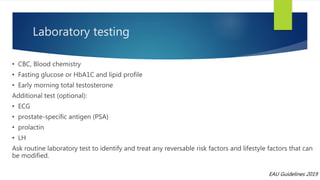
Laboratory testing
• CBC, Blood chemistry
• Fasting glucose or HbA1C and lipid profile
• Early morning total testosterone
Additional test (optional):
• ECG
• prostate-specific antigen (PSA)
• prolactin
• LH
Ask routine laboratory test to identify and treat any reversable risk factors and lifestyle factors that can
be modified.
EAU Guidelines 2019
ED & Cardiovascular
Disease (CVD)
• Share the same pathophysiology (vasculopathy,
endothelial dysfuntion)
• Patients with CVD and CVD’s risk factors has
increasing risk of having ED
• ED may be a manifestation of a CVD, even as a
sentinel of silent CVD
EAU Guidelines 2019
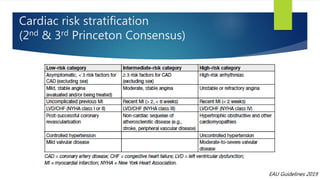
Cardiac risk stratification
(2nd & 3rd Princeton Consensus)
EAU Guidelines 2019
Indication for specific diagnostic test
 Young patients with a history of pelvic or perineal trauma (who could benefit from
potentially curative vascular surgery.)
 Patients with penile deformities which might require surgical correction (e.g., Peyronie’s
disease, congenital curvature).
 Patients with complex psychiatric or psychosexual disorders.
 Patients with complex endocrine disorders.
 At the request of the patient or his partner.
 Medico-legal reasons (e.g., implantation of penile prosthesis, sexual abuse).
EAU Guidelines 2019
Specific Diagnostic Test
• Include specific diagnostic tests in the initial evaluation of ED in the presence of the
indicated conditions
EAU Guidelines 2019
Summary of Treatment
 First-Line
 Treat underlying disease
 Life style modification
 PDE5I
 Vacuum Erection Device
 Intraurethral Alprostadil
 Shockwave therapy
 Second-Line
 Intracavernous Injection
 Third-Line
 Penile prostheses
EAU Guidelines 2019
ED Management Algorithm
EAU Guidelines 2019
ED Management Algorithm
EAU Guidelines 2019
ED Management Algorithm
EAU Guidelines 2019
Treatment Option (First-Line)
 Identify the “curable” cause of ED
 Controlled the Underlying conditions such as Diabetes, hypertension, hypercholesterolemia,
obstructive urinary symptoms, BPE, CVD, evaluation of antidepressant & antihypertensive
currently used
 It is important to tell the patient
 “ED can be treated successfully, but it cannot be cured”
 The only exception was psychogenic ED, post-traumatic arteriogenic ED, hormonal
causes  need specific treatment
 Lifestyle modification
 Modifiable risk factors (stop smoking, exercise to reduce body weight for obese patient)
EAU Guidelines 2019
Treatment Option (First-Line)
 Oral Pharmacotherapy
 PDE5-I drug
 Sildenafil
 Tadalafil
 Valdenafil
 Avanafil
 Please be advised, PDE5I is not an initiator of erection, patient still need
sexual stimulation to facilitate erection.
EAU Guidelines 2019
PDE5 Inhibitor
PDE5 Inhibitor
EAU Guidelines 2019
PDE5 Inhibitor
 Avanafil1,2
 Latest PDE5I, available in 2013
 Recommended starting dose 100 mg, 15 – 30
minutes before sexual intercourse
 Maximum dosing frequency once a day
 Mean percentage of successful intercourse
Dosage Successful
Sexual
Intercourse
Placebo
50 mg 47% 28%
100 mg 58% 28%
200 mg 59% 28%
1. Wang, R., et al. Selectivity of avanafil, a PDE5 inhibitor for the treatment of erectile dysfunction: implications for clinical safety and improved tolerability. J Sex Med, 2012.
9: 2122. https://www.ncbi.nlm.nih.gov/pubmed/22759639
2. Goldstein, I., et al. A randomized, double-blind, placebo-controlled evaluation of the safety and efficacy of avanafil in subjects with erectile dysfunction. J Sex Med, 2012.
9: 1122. https://www.ncbi.nlm.nih.gov/pubmed/22248153
PDE5 Inhibitor
EAU Guidelines 2019
PDE5 Inhibitor Safety Issue
 Cardiovascular Safety
 Sildenafil, Tadalafil, Vardenafil  no increase in myocardial infarction rate
 It is CONTRAINDICATED in
 Patient suffered from myocardial infarction, stroke, life threatening arrythmia within the LAST 6 MONTHS
 Resting hypotension < 90/50 mmHg or hypertension >170/100 mmHg
 Unstable angina, Angina with sexual intercourse or CHF NYHA IV
 Nitrates  result in cGMP accumulation and unpredictable blood pressure drop. If patient taken PDE5I,
develop angina, nitrate should be postponed base of PDE5I drugs half-life.
 Co-administrative with other anti hypertensive agent, considered safe
 Interaction with alpha-blocker orthostatic hypotension
EAU Guidelines 2019
Management of non-PDE5I responder
 Most common causes
 Failure to use adequate sexual stimulation
 Inadequate dose
 Failure to wait an adequate amount of time between taking medication and attempting
sexual intercourse (ingestion of high fat meal, before taking drugs)
EAU Guidelines 2019
Treatment Option (First-
Line)
 Vacuum erection devices (drug free management)
 Satisfactory is as high as 90%, for patient without
bleeding disorder or anticoagulant therapy1
 Adverse event (< 30% patient)
 Pain
 Unable to ejaculate
 Petechiae
 Bruising
 Numbness
 Remove the ring, before 30 minutes after intercourse 
Prevent skin necrosis
EAU Guidelines 2019
Treatment Option
(First-Line)
 Topical/intraurethral Alprostadil
 Vasoactive agent, topical route (300 ug) or
medicated pellet (500 ug) via urethral meatus
 Intercourse achieved in 30-65.9% patients
 Provides alternative treatment for intracavernous
injection patients, who prefer less invasive even
though it is less-efficacious treatment
 Adverse effect
 Local pain
 Penile erythema
 Dizziness / hypotension
 UTI
EAU Guidelines 2019
Treatment Option (First-Line)
 Shockwave therapy
 Low-intensity extracorporeal shockwave therapy
 EAU recent studies showed that LI-SWT could improve the IIEF and Erection Hardness
Score of mild ED patient.
 Still unclear for definitive recommendation
EAU Guidelines 2019
Treatment Option (Second-Line)
 Not responding to oral drugs  offered intracavernous injection
 Intracavernous Alprostadil, dose 5 – 40 ug
 Erection appears after 5 to 15 minutes
 Satisfaction rates
 87 – 93.5% in patients
 80 – 90.3% in partners
 Complications
 Penile pain, prolonged erection, priapism
 Fibrosis
EAU Guidelines 2019
Treatment Option (Second-Line)
 Intracavernous Alprostadil contraindication
 Hypersensitivity to Alprostadil
 Bleeding disorder
 Risk of priapism
EAU Guidelines 2019
Treatment Option (Third-Line)
 Penile prostheses
 Patient who failed pharmacotherapy and prefer a permanent solution
 2 classes of implant
 Inflatable
 Semi-rigid
 2 surgical approaches
 Penoscrotal
 (+) Excellent exposure, avoid dorsal nerve injury, direct visualization of pump placement
 (-) Blind reservoir placement or need to do separate incision to insert reservoir under direct vision
 Infrapubic
 (+) Insert reservoir under direct vision
 (-) risk of dorsal nerve injury when inserted the pump
EAU Guidelines 2019
Treatment Option (Third-Line)
 Complication
 Mechanical failure
 infection
EAU Guidelines 2019
 THANK YOU

Erectile Dysfunction

  • 1.
  • 2.
    Definition  The inabilityto attain and/or maintain an erection sufficient for satisfactory sexual performance and persistent in 3 months.  National Institute of Health. JAMA. 1993  Erectile dysfunction is a multidimensional but common male sexual dysfunction that involves an alteration in any of the components of the erectile response, including organic, relational and psychological.  Faysal A. Yafi, Wayne J. G. et al. 2016
  • 3.
  • 4.
    Epidemiology  Massachusetts MaleAging Study (MMAS) reported an overall prevalence of 52% ED in non institutionalized men aged 40-70 years in the Boston area; specific prevalence for minimal, moderate, and complete ED was 17.2%, 25.2%, and 9.6%, respectively.1  European Male Ageing Study (EMAS) reported a prevalence of erectile dysfunction ranging from 6% to 64% depending on different age subgroups and increasing with age, with an average prevalence of 30%.2 1. Feldman HA, Goldstein I, Hatzichristou DG, Krane RJ, McKinlay JB. Impotence and its medical and psychosocial correlates: results of the Massachusetts Male Aging Study. J Urol. 1994;151:54–61. 2. Age-related changes in general and sexual health in middle-aged and older men: results from the European Male Ageing Study (EMAS).Corona G, Lee DM, Forti G, O'Connor DB, Maggi M, O'Neill TW, Pendleton N, Bartfai G, Boonen S, Casanueva FF, Finn JD, Giwercman A, Han TS, Huhtaniemi IT, Kula K, Lean ME, Punab M, Silman AJ, Vanderschueren D, Wu FC, EMAS Study Group. J Sex Med. 2010 Apr; 7(4 Pt 1):1362-80.
  • 5.
  • 6.
    Classification  Primary Organic(most common, 70%)  Vascular  Hormonal  Neurological  Medications  Primary Psychogenic  Mixed psychogenic and organic EAU Guidelines 2019
  • 7.
  • 8.
    Clinical Evaluation forED • Hypertension • DM • Smoking • Alcohol • Medications • Depression, anxiety • Hypogonadysm • Thyroid dysfunction • Uraemia • Pelvic surgery / trauma • Partner problems • Libido • Nocturnal erection EAU Guidelines 2019
  • 9.
    Sexual History  Thesexual history must include information about:  sexual orientation, previous and current sexual relationships, current emotional status, onset and duration of the erectile problem, and previous consultations and treatments  The sexual health status of the partner(s)  Detailed description of the rigidity and duration of both sexually-stimulated and morning erections and of problems with sexual desire, arousal, ejaculation, and orgasm  Validated psychometric questionnaires (IIEF/SHIM), help to assess the different sexual function domains (i.e. sexual desire, EF, orgasmic function, intercourse, and overall satisfaction), as well as the impact of a specific treatment modality.  Screen for symptoms of possible hypogonadism (testosterone deficiency), including decreased energy, libido, fatigue, and cognitive impairment, as well as for LUTS EAU Guidelines 2019
  • 10.
  • 11.
    5-Item International Indexof Erectile Function (IIEF-5).  ED Classification according IIEF-5 Score:  Severe (5-7),  Moderate (8-11),  Mild – Moderate (12-16),  Mild (17-21),  No ED (22-25).
  • 12.
    Physical Examination • Bloodpressure • Cardiac, thyroid, testicular, prostate examination • Penile anatomical abnormalities • Gynecomastia • Exercise treadmill test (if cardiac risk factors are present) • BMI calculation or waist circumference measurment EAU Guidelines 2019
  • 14.
    Laboratory testing • CBC,Blood chemistry • Fasting glucose or HbA1C and lipid profile • Early morning total testosterone Additional test (optional): • ECG • prostate-specific antigen (PSA) • prolactin • LH Ask routine laboratory test to identify and treat any reversable risk factors and lifestyle factors that can be modified. EAU Guidelines 2019
  • 15.
    ED & Cardiovascular Disease(CVD) • Share the same pathophysiology (vasculopathy, endothelial dysfuntion) • Patients with CVD and CVD’s risk factors has increasing risk of having ED • ED may be a manifestation of a CVD, even as a sentinel of silent CVD EAU Guidelines 2019
  • 16.
    Cardiac risk stratification (2nd& 3rd Princeton Consensus) EAU Guidelines 2019
  • 17.
    Indication for specificdiagnostic test  Young patients with a history of pelvic or perineal trauma (who could benefit from potentially curative vascular surgery.)  Patients with penile deformities which might require surgical correction (e.g., Peyronie’s disease, congenital curvature).  Patients with complex psychiatric or psychosexual disorders.  Patients with complex endocrine disorders.  At the request of the patient or his partner.  Medico-legal reasons (e.g., implantation of penile prosthesis, sexual abuse). EAU Guidelines 2019
  • 18.
    Specific Diagnostic Test •Include specific diagnostic tests in the initial evaluation of ED in the presence of the indicated conditions EAU Guidelines 2019
  • 19.
    Summary of Treatment First-Line  Treat underlying disease  Life style modification  PDE5I  Vacuum Erection Device  Intraurethral Alprostadil  Shockwave therapy  Second-Line  Intracavernous Injection  Third-Line  Penile prostheses EAU Guidelines 2019
  • 20.
  • 21.
  • 22.
  • 23.
    Treatment Option (First-Line) Identify the “curable” cause of ED  Controlled the Underlying conditions such as Diabetes, hypertension, hypercholesterolemia, obstructive urinary symptoms, BPE, CVD, evaluation of antidepressant & antihypertensive currently used  It is important to tell the patient  “ED can be treated successfully, but it cannot be cured”  The only exception was psychogenic ED, post-traumatic arteriogenic ED, hormonal causes  need specific treatment  Lifestyle modification  Modifiable risk factors (stop smoking, exercise to reduce body weight for obese patient) EAU Guidelines 2019
  • 24.
    Treatment Option (First-Line) Oral Pharmacotherapy  PDE5-I drug  Sildenafil  Tadalafil  Valdenafil  Avanafil  Please be advised, PDE5I is not an initiator of erection, patient still need sexual stimulation to facilitate erection. EAU Guidelines 2019
  • 25.
  • 26.
  • 27.
    PDE5 Inhibitor  Avanafil1,2 Latest PDE5I, available in 2013  Recommended starting dose 100 mg, 15 – 30 minutes before sexual intercourse  Maximum dosing frequency once a day  Mean percentage of successful intercourse Dosage Successful Sexual Intercourse Placebo 50 mg 47% 28% 100 mg 58% 28% 200 mg 59% 28% 1. Wang, R., et al. Selectivity of avanafil, a PDE5 inhibitor for the treatment of erectile dysfunction: implications for clinical safety and improved tolerability. J Sex Med, 2012. 9: 2122. https://www.ncbi.nlm.nih.gov/pubmed/22759639 2. Goldstein, I., et al. A randomized, double-blind, placebo-controlled evaluation of the safety and efficacy of avanafil in subjects with erectile dysfunction. J Sex Med, 2012. 9: 1122. https://www.ncbi.nlm.nih.gov/pubmed/22248153
  • 28.
  • 29.
    PDE5 Inhibitor SafetyIssue  Cardiovascular Safety  Sildenafil, Tadalafil, Vardenafil  no increase in myocardial infarction rate  It is CONTRAINDICATED in  Patient suffered from myocardial infarction, stroke, life threatening arrythmia within the LAST 6 MONTHS  Resting hypotension < 90/50 mmHg or hypertension >170/100 mmHg  Unstable angina, Angina with sexual intercourse or CHF NYHA IV  Nitrates  result in cGMP accumulation and unpredictable blood pressure drop. If patient taken PDE5I, develop angina, nitrate should be postponed base of PDE5I drugs half-life.  Co-administrative with other anti hypertensive agent, considered safe  Interaction with alpha-blocker orthostatic hypotension EAU Guidelines 2019
  • 30.
    Management of non-PDE5Iresponder  Most common causes  Failure to use adequate sexual stimulation  Inadequate dose  Failure to wait an adequate amount of time between taking medication and attempting sexual intercourse (ingestion of high fat meal, before taking drugs) EAU Guidelines 2019
  • 31.
    Treatment Option (First- Line) Vacuum erection devices (drug free management)  Satisfactory is as high as 90%, for patient without bleeding disorder or anticoagulant therapy1  Adverse event (< 30% patient)  Pain  Unable to ejaculate  Petechiae  Bruising  Numbness  Remove the ring, before 30 minutes after intercourse  Prevent skin necrosis EAU Guidelines 2019
  • 32.
    Treatment Option (First-Line)  Topical/intraurethralAlprostadil  Vasoactive agent, topical route (300 ug) or medicated pellet (500 ug) via urethral meatus  Intercourse achieved in 30-65.9% patients  Provides alternative treatment for intracavernous injection patients, who prefer less invasive even though it is less-efficacious treatment  Adverse effect  Local pain  Penile erythema  Dizziness / hypotension  UTI EAU Guidelines 2019
  • 33.
    Treatment Option (First-Line) Shockwave therapy  Low-intensity extracorporeal shockwave therapy  EAU recent studies showed that LI-SWT could improve the IIEF and Erection Hardness Score of mild ED patient.  Still unclear for definitive recommendation EAU Guidelines 2019
  • 36.
    Treatment Option (Second-Line) Not responding to oral drugs  offered intracavernous injection  Intracavernous Alprostadil, dose 5 – 40 ug  Erection appears after 5 to 15 minutes  Satisfaction rates  87 – 93.5% in patients  80 – 90.3% in partners  Complications  Penile pain, prolonged erection, priapism  Fibrosis EAU Guidelines 2019
  • 37.
    Treatment Option (Second-Line) Intracavernous Alprostadil contraindication  Hypersensitivity to Alprostadil  Bleeding disorder  Risk of priapism EAU Guidelines 2019
  • 38.
    Treatment Option (Third-Line) Penile prostheses  Patient who failed pharmacotherapy and prefer a permanent solution  2 classes of implant  Inflatable  Semi-rigid  2 surgical approaches  Penoscrotal  (+) Excellent exposure, avoid dorsal nerve injury, direct visualization of pump placement  (-) Blind reservoir placement or need to do separate incision to insert reservoir under direct vision  Infrapubic  (+) Insert reservoir under direct vision  (-) risk of dorsal nerve injury when inserted the pump EAU Guidelines 2019
  • 39.
    Treatment Option (Third-Line) Complication  Mechanical failure  infection EAU Guidelines 2019
  • 40.