premature ejaculation
ByBy
Nader A. AbdelsattarNader A. Abdelsattar
Assistant lecturer of UrologyAssistant lecturer of Urology
PHYSIOLOGY OF EJACULATION
 Ejaculation is the forcible ejection of seminal
fluid from the urethral meatus .
 Orgasm: is a pleasurable sensation assotiated
with ejaculation.
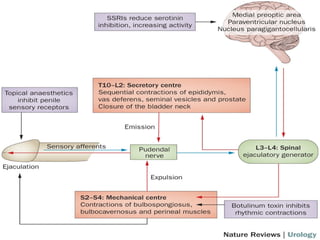
Ejaculation consists of three phases: Emission,
Bladder neck contraction & Expulsion.
 Emission: Defined as the deposition of seminal
fluid into the posterior urethra.
 A sympathetic spinal cord reflex.
 Semen is pushed into the urethra by
contraction of the prostate , seminal vesicles
and vas.
PHYSIOLOGY OF EJACULATION
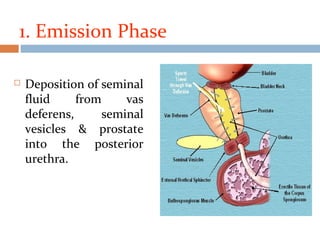
1. Emission Phase
 Deposition of seminal
fluid from vas
deferens, seminal
vesicles & prostate
into the posterior
urethra.
Bladder Neck Contraction
 Bladder neck contraction : introduced by
sympathtic stimulation of alpha adrenergic
receptors.
 Bladder neck closes so the semen not pushed into
the bladder.
EXPULSION PHASE
 Somatic nervous system (represented by
pudendal nerve) is responsible for
expulsion phase of ejaculate.
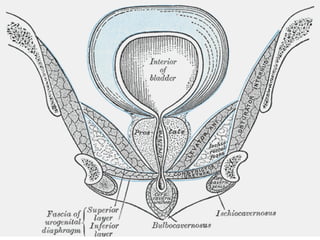
 Rhythmic contraction of urethra by
perineal striated muscles
(ischiocavernosus, bulbospongiosus and
levator ani muscles) and intermittent
relaxation of external urethral sphincter.
Neurotransmitters in Ejaculation
The following neurotransmitters are
involved in the processing of emission
and expulsion:
 Serotonin (5-HT) considered to
be the key inhibitory neurotransmitter involved
in the process of ejaculation.
 Serotonin Receptors present in the
hypothalamus, brainstem and the spinal cord
14 different 5-HT receptor subtypes.
5-HT1A, 5-HT1B, and 5-HT2C receptors subtypes
involved in the regulation of ejaculatory control.
Other neurotransmitters:
 Dopamine (DA).
 Gamma-aminobutyric acid (GABA).
 Noradrenaline.
McMahon et al, 2014
Neurotransmitters in Ejaculation
premature ejaculationpremature ejaculation
DEFINITION OF PE
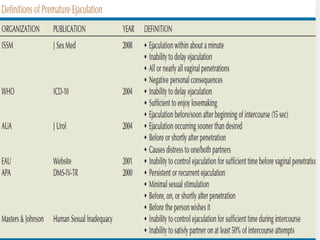
 Numerous authors and various medical
organizations have proposed their own
definitions of premature ejaculation over
the years.
 The early definitions were objected for
being vague and open multiple
interpretations.
McMahon, C. G. e t al. 20 0 8
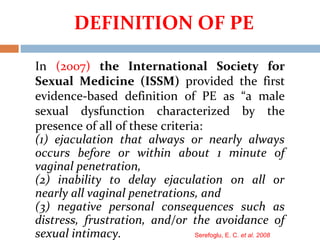
In (2007) the International Society for
Sexual Medicine (ISSM) provided the first
evidence-based definition of PE as “a male
sexual dysfunction characterized by the
presence of all of these criteria:
(1) ejaculation that always or nearly always
occurs before or within about 1 minute of
vaginal penetration,
(2) inability to delay ejaculation on all or
nearly all vaginal penetrations, and
(3) negative personal consequences such as
distress, frustration, and/or the avoidance of
sexual intimacy. Serefoglu, E. C. et al. 2008
DEFINITION OF PE
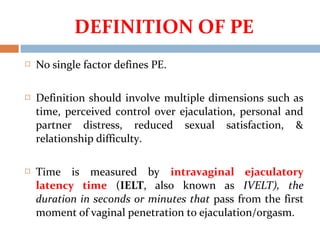
 No single factor defines PE.
 Definition should involve multiple dimensions such as
time, perceived control over ejaculation, personal and
partner distress, reduced sexual satisfaction, &
relationship difficulty.
 Time is measured by intravaginal ejaculatory
latency time (IELT, also known as IVELT), the
duration in seconds or minutes that pass from the first
moment of vaginal penetration to ejaculation/orgasm.
DEFINITION OF PE
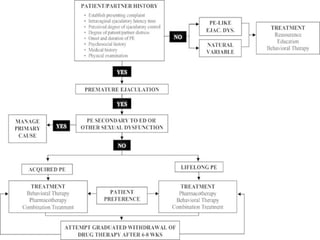
WALDINGER CLASSIFICATION
Waldinger MD and Schweitzer DH (2008)
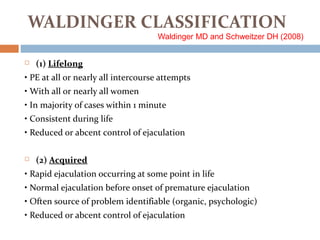
 (1) Lifelong
• PE at all or nearly all intercourse attempts
• With all or nearly all women
• In majority of cases within 1 minute
• Consistent during life
• Reduced or abcent control of ejaculation
 (2) Acquired
• Rapid ejaculation occurring at some point in life
• Normal ejaculation before onset of premature ejaculation
• Often source of problem identifiable (organic, psychologic)
• Reduced or abcent control of ejaculation
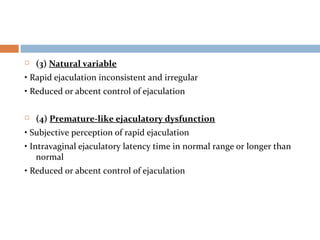
 (3) Natural variable
• Rapid ejaculation inconsistent and irregular
• Reduced or abcent control of ejaculation
 (4) Premature-like ejaculatory dysfunction
• Subjective perception of rapid ejaculation
• Intravaginal ejaculatory latency time in normal range or longer than
normal
• Reduced or abcent control of ejaculation
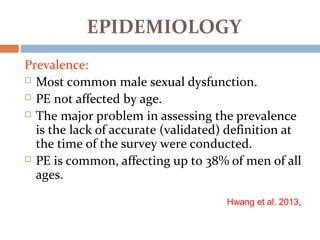
EPIDEMIOLOGY
Prevalence:
 Most common male sexual dysfunction.
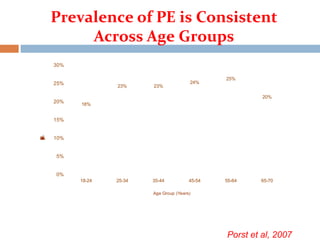
 PE not affected by age.
 The major problem in assessing the prevalence
is the lack of accurate (validated) definition at
the time of the survey were conducted.
 PE is common, affecting up to 38% of men of all
ages.
Hwang et al. 2013,
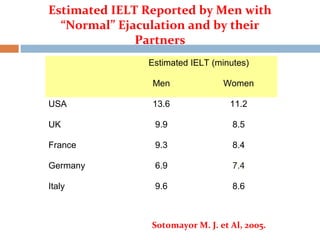
Estimated IELT (minutes)
Men Women
USA 13.6 11.2
UK 9.9 8.5
France 9.3 8.4
Germany 6.9 7.4
Italy 9.6 8.6
Estimated IELT Reported by Men with
“Normal” Ejaculation and by their
Partners
Sotomayor M. J. et Al, 2005.
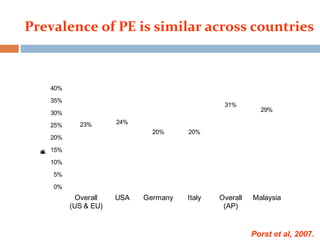
Prevalence of PE is similar across countries
23% 24%
20% 20%
31%
29%
0%
5%
10%
15%
20%
25%
30%
35%
40%
Overall
(US & EU)
USA Germany Italy Overall
(AP)
Malaysia
Prevalance(%)
Porst et al, 2007.
Prevalence of PE is Consistent
Across Age Groups
18%
23% 23%
24%
25%
20%
0%
5%
10%
15%
20%
25%
30%
18-24 25-34 35-44 45-54 55-64 65-70
Prevalance(%)
Age Group (Years)
Porst et al, 2007
PATHOPHYSIOLOGY OF PE
 A complete understanding of the
pathophysiologic mechanisms involved in PE not
yet achieved.
 A number of potential explanations have been
postulated for genesis of PE including
(1) Genetic etiologies,
(2) Psychologic causes,
(3) Hormonal aberrations,
(4) Penile sensory changes, and
(5) Chronic prostatitis
GENETIC FACTORS:
 Genetic factors play a significant role in the
pathophysiology of PE.
(Shapiro 1940s; Waldinger 2004; Finnish study Jern 2007-2009).
Patients with PE may have:
 Hyposensitivity of 5-HT2c
 Hypersensitivity of 5-HT1a
PATHOPHYSIOLOGY OF PE
PSYCHOLOGIC FACTORS:
 Sympathetic nervous system, activated by anxiety, may
result in an earlier emission phase of ejaculation and
subsequently reduced ejaculatory threshold.
 Men with PE may have a faster Ejaculatory reflex,
impairing their ability to learn to control ejaculation.
PATHOPHYSIOLOGY OF PE
2. THYROID HORMONES:
 Hyperthyroid individuals are more lileky to
have PE, & with reversion to a euthyroid state,
the rate of PE dropped
 At present, role of hormones in the genesis of
PE is not completely understood.
[Gorona et al, 2004]
PATHOPHYSIOLOGY OF PE
PENILE SENSITIVITY & CIRCUMCISION
STATUS:
 Two schools :→
1. -Theoretically, circumcision leads to
keratinization of the glans penis, which might
potentially lower penile sensitivity & increase
IELT.
So… Circumcision is effective method to treat
the PE.
PATHOPHYSIOLOGY OF PE
2. Circumcision denudes the penis, exposing
corona of the glans penis to direct stimulation,
causing circumcised men to have a greater
incidence of PE.
Finally: Sufficient data to clarify the relationship
between PE and adult circumcision are lacking.
B. F. Alp et al, 2014
PATHOPHYSIOLOGY OF PE
CHRONIC PROSTATITIS:
 Chronic prostatitis is more prevalent among
men with a diagnosis of PE.
 After 1 month of antibiotic treatment, most of
treated patients show a significant increase in
their IELT.
 Mechanism behind link between chronic
prostatitis and PE and the mean by which
antibiotic treatment improved IELT are unclear.
[Janinni E. et al 2002]
PATHOPHYSIOLOGY OF PE
DIAGNOSIS & EVALUATION
 Diagnosis of PE: based on patient’s medical &
sexual history.
 History should classify PE as lifelong or acquired
& determine whether PE is situational (under
specific circumstances or with a specific partner)
or consistent.
 Special attention to duration time of ejaculation,
degree of sexual stimulus, impact on sexual
activity and QoL, and drug use or abuse.
 Also important to distinguish PE from ED.
A simple PE history algorithm that can be
undertaken is as follows:
(1) asking how long he has experienced PE;
whether lifelong or recently acquired.
(2) Stopwatch-measured IELT from a patient is
useful, appreciating that some men overestimate
this. If a partner is present, seeking corroboration
of the estimated IELT is helpful.
DIAGNOSIS & EVALUATION
(3) asking the patient to define whether his
control over ejaculation is good, fair, or poor.
(4) assessing the bother related to PE and the
impact PE has on his relationship.
DIAGNOSIS & EVALUATION
PE ASSESSMENT QUESTIONNAIRES
 Only two questionnaires can discriminate between
patients who have PE and those who do not.
(1) Premature Ejaculation Diagnostic Tool (PEDT)
(2) Arabic Index of Premature Ejaculation (AIPE)
 Other questionnaires used to characterise PE and
determine treatment effects: PEP, Index of Premature
Ejaculation (IPE), and Male Sexual Health Questionnaire
Ejaculatory Dysfunction (MSHQ-EjD)
Althof SE, et al. 2007
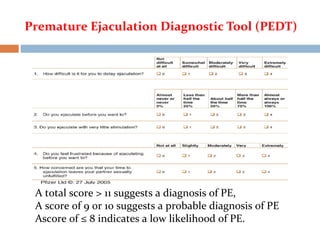
Premature Ejaculation Diagnostic Tool (PEDT)
A total score > 11 suggests a diagnosis of PE,
A score of 9 or 10 suggests a probable diagnosis of PE
Ascore of ≤ 8 indicates a low likelihood of PE.
PE & ED
 It is critical to differentiate PE from ED.
 Both are common conditions & may present in
the same patient.
PE & ED
 Many ED patients develop secondary PE; They
ejaculate rapidly in order to achieve orgasm
before loss of erectile rigidity.
 Treatment should start for ED followed by
treatment for PE.
Physical examination and investigations
 Physical examination rarely helps to define the
etiology of patient’s PE.
 It includes general examination as well as
examination of the genitalia outlining the
scrotum and the penis in details.
 A digital rectal examination to palpate the
prostate gland is also recommended.
 Laboratory and other physiological tests are
rarely indicated Shabsigh R. (2006)
TREATMENT
I. BEHAVIORAL/PSYCHOSEXUAL THERAPY
1. Stop-start technique(James Semans): partner
stimulates the penis until the patient feels the
urge to ejaculate. At this point, he instructs
his partner to stop, waits for the sensation to
pass and then stimulation is resumed.
2. Squeeze technique(Masters & Johnson):
similar but partner applies manual pressure to
base of the head of the penis just before
ejaculation until the patient loses his urge.
 Benefits: improved sexual self-confidence, less
anxiety, resolution of any interpersonal
difficulties, and increased couple
communication.
 Success rates between 45% and 65%
Semans JH. 1956
TREATMENT
 Other Behavioral therapy:
 Precoitus masturbation partially desensitizes the
penis and leads to a delay in ejaculation.
 It may be helpful for younger men suffering from
PE,
[Sadeghi-Nejad and Watson, 2008].
2.2. SSRISSRI(Selective Serotonin Reuptake Inhibitors):(Selective Serotonin Reuptake Inhibitors):
The effect of SSRIs on the delay of ejaculation
was first noted in 1993 by “Patterson” when
treating men with depression Patterson 1993
 In 2009 The International Society of Sexual
Medicine (ICSM) suggest the off-label use of SSRI
for managing PE.
 Commonly used SSRIs include citalopram,
fluoxetine, fluvoxamine, paroxetine and Sertraline.
Althof et al. 2009
Medical Treatment
 Must be given for 1 to 2 weeks to be effective in
PE.
 Short-term adverse effects are yawning, nausea,
excessive sweating and fatigue.
 Long-term adverse effects are loss of bone
density, reduced libido and erectile rigidity.
 Adverse effects usually present at the beginning
of the treatment and they tend to disappear
within 2–3 weeks
[McMahon et al. 2004]
TREATMENT
 A sudden reduction or cessation of long-term
treatment of SSRIs can lead to the “SSRI
discontinuation syndrome,” a group of symptoms
including nausea, vomiting, dizziness, headache,
ataxia, drowsiness, anxiety, and insomnia.
 Begin 1 to 3 days after drug cessation and may
continue for more than a week in some patients.
 Usually reversible.
 Should be gradually withdrawn over a 2- to 4-week
period.
TREATMENT
3-Dapoxetine
 Dapoxetine is the only licensed drug in the
treatment of PE
 A highly potent inhibitor of serotonin reuptake
transporter .
 Following oral administration, it is rapidly
absorbed
 After reaching T max, serum concentration
declines rapidly.
 At 60 mg dose: T max = 1.2 hr
 No interaction when used with food or PDE5
inhibitors.
[Feige et al. 2011]
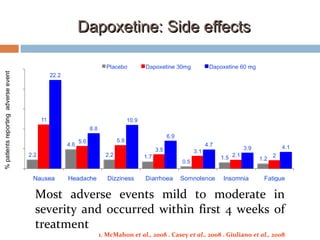
Dapoxetine: Side effectsDapoxetine: Side effects
Most adverse events mild to moderate in
severity and occurred within first 4 weeks of
treatment
1. McMahon et al., 2008 . Casey et al., 2008 . Giuliano et al., 2008
4. Tramadol:
 A centrally acting synthetic opioid analgesic.
 Its mechanism of action in PE is poorly
understood
 In 2009 Safarinejad and Hosseini have published
a randomized, controlled trial on the use of
tramadol HCL to treat PE [Safarinejad and Hosseini, 2009].
 Various research groups have shown tramadol to
have some efficacy in treating PE
[Alghobary et al. 2010]
TREATMENT
 It has two mechanisms of action. It exerts an
effect on the μ-opioid receptor and also inhibits
noradrenaline and serotonin reuptake.
 On demand tramadol 50mg taken 2 hours before
intercourse.
[Salem et al. 2008]
Phosphodiesterase 5 Inhibitors:
 The role of PDE5 inhibitors (PDE5-I) in the
management of PE is controversial.
 Mechanisms of action: 1) A central effect
increased NO and reduced sympathetic tone, 2)
smooth muscle dilatation of vas deferens and
seminal vesicles.
[Wang et al. 2007]
III. TOPICAL AGENTS:
1. Severance Secret Cream(SS Cream):
 Made of the extracts of nine natural products.
 Applied to the glans penis 1hr before and washed
off immediately prior to coitus.
 Stopwatch-IELT increase.
 The main disadvantage of SS-cream is an
unpleasant odor, which makes it unpalatable to
many patients.
[Xin et al. 2000]
TREATMENT
2. Lidocaine:
3. Lidocaine-Prilocaine(EMLA):
 Lidocaine-prilocaine cream (5%) is applied 20-30
min prior to intercourse.
 Prolonged application of topical anaesthetic (30-
45 min) may result in loss of erection due to
numbness of the penis.
 A condom is required to avoid diffusion of topical
anaesthetic agent into the vaginal wall causing
numbness in the partner.
TREATMENT
 A recently developed topical aerosol for PE known
as (PSD-502) is delivered combination of
lidocaine and prilocaine designed for use in PE.
 Can penetrate the glans within 5–10 min, and
can’t penetrate intact keratinised skin so not
anaesthetize the shaft of the penis or the hands
[Carson and Wyllie, 2010]
TREATMENT
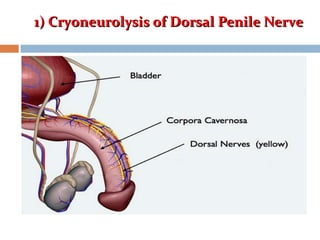
Surgical Treatment
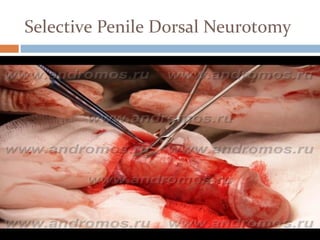
1) Cryoneurolysis of Dorsal Penile Nerve1) Cryoneurolysis of Dorsal Penile Nerve
Selective Penile Dorsal Neurotomy
1 2
3
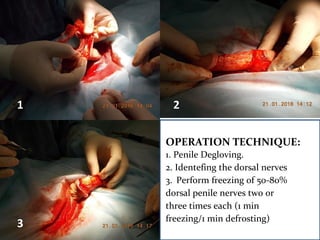
OPERATION TECHNIQUE:
1. Penile Degloving.
2. Identefing the dorsal nerves
3. Perform freezing of 50-80%
dorsal penile nerves two or
three times each (1 min
freezing/1 min defrosting)
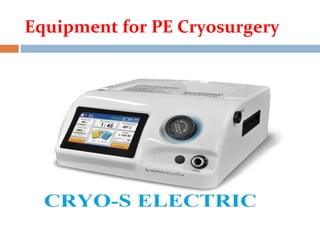
Equipment for PE Cryosurgery
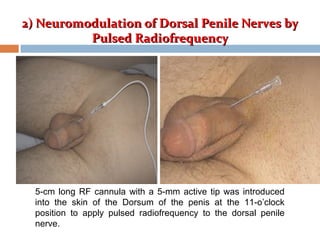
2) Neuromodulation of Dorsal Penile Nerves by2) Neuromodulation of Dorsal Penile Nerves by
Pulsed RadiofrequencyPulsed Radiofrequency
5-cm long RF cannula with a 5-mm active tip was introduced
into the skin of the Dorsum of the penis at the 11-o’clock
position to apply pulsed radiofrequency to the dorsal penile
nerve.
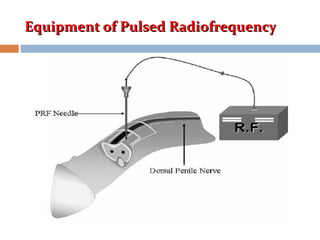
Equipment of Pulsed RadiofrequencyEquipment of Pulsed Radiofrequency
3) Selective resection(neurectomy) of branches3) Selective resection(neurectomy) of branches
of dorsal penile nerveof dorsal penile nerve
 Selective resection(neurectomy) of branches of
dorsal penile nerve should decrease penile
sensitivity & prolong ILET significantly.
Advantages and disadvantages of surgicalAdvantages and disadvantages of surgical
treatmenttreatment
Disadvantages
 ED
 Neuroma
(Numbness, parathesia and
pain)
 May be temporary
treatment.
Advantages
 It Increase The
Intravaginal Ejaculation
Latency Time when the
other lines of
management failed
THANK YOU
10/01/16

Premature ejaculation

  • 1.
    premature ejaculation ByBy Nader A.AbdelsattarNader A. Abdelsattar Assistant lecturer of UrologyAssistant lecturer of Urology
  • 2.
    PHYSIOLOGY OF EJACULATION Ejaculation is the forcible ejection of seminal fluid from the urethral meatus .  Orgasm: is a pleasurable sensation assotiated with ejaculation.
  • 3.
    Ejaculation consists ofthree phases: Emission, Bladder neck contraction & Expulsion.  Emission: Defined as the deposition of seminal fluid into the posterior urethra.  A sympathetic spinal cord reflex.  Semen is pushed into the urethra by contraction of the prostate , seminal vesicles and vas. PHYSIOLOGY OF EJACULATION
  • 4.
    1. Emission Phase Deposition of seminal fluid from vas deferens, seminal vesicles & prostate into the posterior urethra.
  • 5.
    Bladder Neck Contraction Bladder neck contraction : introduced by sympathtic stimulation of alpha adrenergic receptors.  Bladder neck closes so the semen not pushed into the bladder.
  • 6.
    EXPULSION PHASE  Somaticnervous system (represented by pudendal nerve) is responsible for expulsion phase of ejaculate.  Rhythmic contraction of urethra by perineal striated muscles (ischiocavernosus, bulbospongiosus and levator ani muscles) and intermittent relaxation of external urethral sphincter.
  • 8.
    Neurotransmitters in Ejaculation Thefollowing neurotransmitters are involved in the processing of emission and expulsion:  Serotonin (5-HT) considered to be the key inhibitory neurotransmitter involved in the process of ejaculation.  Serotonin Receptors present in the hypothalamus, brainstem and the spinal cord 14 different 5-HT receptor subtypes. 5-HT1A, 5-HT1B, and 5-HT2C receptors subtypes involved in the regulation of ejaculatory control.
  • 9.
    Other neurotransmitters:  Dopamine(DA).  Gamma-aminobutyric acid (GABA).  Noradrenaline. McMahon et al, 2014 Neurotransmitters in Ejaculation
  • 11.
  • 12.
    DEFINITION OF PE Numerous authors and various medical organizations have proposed their own definitions of premature ejaculation over the years.  The early definitions were objected for being vague and open multiple interpretations. McMahon, C. G. e t al. 20 0 8
  • 13.
    In (2007) theInternational Society for Sexual Medicine (ISSM) provided the first evidence-based definition of PE as “a male sexual dysfunction characterized by the presence of all of these criteria: (1) ejaculation that always or nearly always occurs before or within about 1 minute of vaginal penetration, (2) inability to delay ejaculation on all or nearly all vaginal penetrations, and (3) negative personal consequences such as distress, frustration, and/or the avoidance of sexual intimacy. Serefoglu, E. C. et al. 2008 DEFINITION OF PE
  • 15.
     No singlefactor defines PE.  Definition should involve multiple dimensions such as time, perceived control over ejaculation, personal and partner distress, reduced sexual satisfaction, & relationship difficulty.  Time is measured by intravaginal ejaculatory latency time (IELT, also known as IVELT), the duration in seconds or minutes that pass from the first moment of vaginal penetration to ejaculation/orgasm. DEFINITION OF PE
  • 16.
    WALDINGER CLASSIFICATION Waldinger MDand Schweitzer DH (2008)  (1) Lifelong • PE at all or nearly all intercourse attempts • With all or nearly all women • In majority of cases within 1 minute • Consistent during life • Reduced or abcent control of ejaculation  (2) Acquired • Rapid ejaculation occurring at some point in life • Normal ejaculation before onset of premature ejaculation • Often source of problem identifiable (organic, psychologic) • Reduced or abcent control of ejaculation
  • 17.
     (3) Naturalvariable • Rapid ejaculation inconsistent and irregular • Reduced or abcent control of ejaculation  (4) Premature-like ejaculatory dysfunction • Subjective perception of rapid ejaculation • Intravaginal ejaculatory latency time in normal range or longer than normal • Reduced or abcent control of ejaculation
  • 18.
    EPIDEMIOLOGY Prevalence:  Most commonmale sexual dysfunction.  PE not affected by age.  The major problem in assessing the prevalence is the lack of accurate (validated) definition at the time of the survey were conducted.  PE is common, affecting up to 38% of men of all ages. Hwang et al. 2013,
  • 19.
    Estimated IELT (minutes) MenWomen USA 13.6 11.2 UK 9.9 8.5 France 9.3 8.4 Germany 6.9 7.4 Italy 9.6 8.6 Estimated IELT Reported by Men with “Normal” Ejaculation and by their Partners Sotomayor M. J. et Al, 2005.
  • 20.
    Prevalence of PEis similar across countries 23% 24% 20% 20% 31% 29% 0% 5% 10% 15% 20% 25% 30% 35% 40% Overall (US & EU) USA Germany Italy Overall (AP) Malaysia Prevalance(%) Porst et al, 2007.
  • 21.
    Prevalence of PEis Consistent Across Age Groups 18% 23% 23% 24% 25% 20% 0% 5% 10% 15% 20% 25% 30% 18-24 25-34 35-44 45-54 55-64 65-70 Prevalance(%) Age Group (Years) Porst et al, 2007
  • 22.
    PATHOPHYSIOLOGY OF PE A complete understanding of the pathophysiologic mechanisms involved in PE not yet achieved.  A number of potential explanations have been postulated for genesis of PE including (1) Genetic etiologies, (2) Psychologic causes, (3) Hormonal aberrations, (4) Penile sensory changes, and (5) Chronic prostatitis
  • 23.
    GENETIC FACTORS:  Geneticfactors play a significant role in the pathophysiology of PE. (Shapiro 1940s; Waldinger 2004; Finnish study Jern 2007-2009). Patients with PE may have:  Hyposensitivity of 5-HT2c  Hypersensitivity of 5-HT1a PATHOPHYSIOLOGY OF PE
  • 24.
    PSYCHOLOGIC FACTORS:  Sympatheticnervous system, activated by anxiety, may result in an earlier emission phase of ejaculation and subsequently reduced ejaculatory threshold.  Men with PE may have a faster Ejaculatory reflex, impairing their ability to learn to control ejaculation. PATHOPHYSIOLOGY OF PE
  • 25.
    2. THYROID HORMONES: Hyperthyroid individuals are more lileky to have PE, & with reversion to a euthyroid state, the rate of PE dropped  At present, role of hormones in the genesis of PE is not completely understood. [Gorona et al, 2004] PATHOPHYSIOLOGY OF PE
  • 26.
    PENILE SENSITIVITY &CIRCUMCISION STATUS:  Two schools :→ 1. -Theoretically, circumcision leads to keratinization of the glans penis, which might potentially lower penile sensitivity & increase IELT. So… Circumcision is effective method to treat the PE. PATHOPHYSIOLOGY OF PE
  • 27.
    2. Circumcision denudesthe penis, exposing corona of the glans penis to direct stimulation, causing circumcised men to have a greater incidence of PE. Finally: Sufficient data to clarify the relationship between PE and adult circumcision are lacking. B. F. Alp et al, 2014 PATHOPHYSIOLOGY OF PE
  • 28.
    CHRONIC PROSTATITIS:  Chronicprostatitis is more prevalent among men with a diagnosis of PE.  After 1 month of antibiotic treatment, most of treated patients show a significant increase in their IELT.  Mechanism behind link between chronic prostatitis and PE and the mean by which antibiotic treatment improved IELT are unclear. [Janinni E. et al 2002] PATHOPHYSIOLOGY OF PE
  • 29.
    DIAGNOSIS & EVALUATION Diagnosis of PE: based on patient’s medical & sexual history.  History should classify PE as lifelong or acquired & determine whether PE is situational (under specific circumstances or with a specific partner) or consistent.  Special attention to duration time of ejaculation, degree of sexual stimulus, impact on sexual activity and QoL, and drug use or abuse.  Also important to distinguish PE from ED.
  • 30.
    A simple PEhistory algorithm that can be undertaken is as follows: (1) asking how long he has experienced PE; whether lifelong or recently acquired. (2) Stopwatch-measured IELT from a patient is useful, appreciating that some men overestimate this. If a partner is present, seeking corroboration of the estimated IELT is helpful. DIAGNOSIS & EVALUATION
  • 31.
    (3) asking thepatient to define whether his control over ejaculation is good, fair, or poor. (4) assessing the bother related to PE and the impact PE has on his relationship. DIAGNOSIS & EVALUATION
  • 32.
    PE ASSESSMENT QUESTIONNAIRES Only two questionnaires can discriminate between patients who have PE and those who do not. (1) Premature Ejaculation Diagnostic Tool (PEDT) (2) Arabic Index of Premature Ejaculation (AIPE)  Other questionnaires used to characterise PE and determine treatment effects: PEP, Index of Premature Ejaculation (IPE), and Male Sexual Health Questionnaire Ejaculatory Dysfunction (MSHQ-EjD) Althof SE, et al. 2007
  • 33.
    Premature Ejaculation DiagnosticTool (PEDT) A total score > 11 suggests a diagnosis of PE, A score of 9 or 10 suggests a probable diagnosis of PE Ascore of ≤ 8 indicates a low likelihood of PE.
  • 34.
    PE & ED It is critical to differentiate PE from ED.  Both are common conditions & may present in the same patient.
  • 35.
    PE & ED Many ED patients develop secondary PE; They ejaculate rapidly in order to achieve orgasm before loss of erectile rigidity.  Treatment should start for ED followed by treatment for PE.
  • 36.
    Physical examination andinvestigations  Physical examination rarely helps to define the etiology of patient’s PE.  It includes general examination as well as examination of the genitalia outlining the scrotum and the penis in details.  A digital rectal examination to palpate the prostate gland is also recommended.  Laboratory and other physiological tests are rarely indicated Shabsigh R. (2006)
  • 37.
    TREATMENT I. BEHAVIORAL/PSYCHOSEXUAL THERAPY 1.Stop-start technique(James Semans): partner stimulates the penis until the patient feels the urge to ejaculate. At this point, he instructs his partner to stop, waits for the sensation to pass and then stimulation is resumed. 2. Squeeze technique(Masters & Johnson): similar but partner applies manual pressure to base of the head of the penis just before ejaculation until the patient loses his urge.
  • 38.
     Benefits: improvedsexual self-confidence, less anxiety, resolution of any interpersonal difficulties, and increased couple communication.  Success rates between 45% and 65% Semans JH. 1956 TREATMENT
  • 39.
     Other Behavioraltherapy:  Precoitus masturbation partially desensitizes the penis and leads to a delay in ejaculation.  It may be helpful for younger men suffering from PE, [Sadeghi-Nejad and Watson, 2008].
  • 40.
    2.2. SSRISSRI(Selective SerotoninReuptake Inhibitors):(Selective Serotonin Reuptake Inhibitors): The effect of SSRIs on the delay of ejaculation was first noted in 1993 by “Patterson” when treating men with depression Patterson 1993  In 2009 The International Society of Sexual Medicine (ICSM) suggest the off-label use of SSRI for managing PE.  Commonly used SSRIs include citalopram, fluoxetine, fluvoxamine, paroxetine and Sertraline. Althof et al. 2009 Medical Treatment
  • 41.
     Must begiven for 1 to 2 weeks to be effective in PE.  Short-term adverse effects are yawning, nausea, excessive sweating and fatigue.  Long-term adverse effects are loss of bone density, reduced libido and erectile rigidity.  Adverse effects usually present at the beginning of the treatment and they tend to disappear within 2–3 weeks [McMahon et al. 2004] TREATMENT
  • 42.
     A suddenreduction or cessation of long-term treatment of SSRIs can lead to the “SSRI discontinuation syndrome,” a group of symptoms including nausea, vomiting, dizziness, headache, ataxia, drowsiness, anxiety, and insomnia.  Begin 1 to 3 days after drug cessation and may continue for more than a week in some patients.  Usually reversible.  Should be gradually withdrawn over a 2- to 4-week period. TREATMENT
  • 43.
    3-Dapoxetine  Dapoxetine isthe only licensed drug in the treatment of PE  A highly potent inhibitor of serotonin reuptake transporter .  Following oral administration, it is rapidly absorbed  After reaching T max, serum concentration declines rapidly.  At 60 mg dose: T max = 1.2 hr  No interaction when used with food or PDE5 inhibitors. [Feige et al. 2011]
  • 44.
    Dapoxetine: Side effectsDapoxetine:Side effects Most adverse events mild to moderate in severity and occurred within first 4 weeks of treatment 1. McMahon et al., 2008 . Casey et al., 2008 . Giuliano et al., 2008
  • 45.
    4. Tramadol:  Acentrally acting synthetic opioid analgesic.  Its mechanism of action in PE is poorly understood  In 2009 Safarinejad and Hosseini have published a randomized, controlled trial on the use of tramadol HCL to treat PE [Safarinejad and Hosseini, 2009].  Various research groups have shown tramadol to have some efficacy in treating PE [Alghobary et al. 2010] TREATMENT
  • 46.
     It hastwo mechanisms of action. It exerts an effect on the μ-opioid receptor and also inhibits noradrenaline and serotonin reuptake.  On demand tramadol 50mg taken 2 hours before intercourse. [Salem et al. 2008]
  • 47.
    Phosphodiesterase 5 Inhibitors: The role of PDE5 inhibitors (PDE5-I) in the management of PE is controversial.  Mechanisms of action: 1) A central effect increased NO and reduced sympathetic tone, 2) smooth muscle dilatation of vas deferens and seminal vesicles. [Wang et al. 2007]
  • 48.
    III. TOPICAL AGENTS: 1.Severance Secret Cream(SS Cream):  Made of the extracts of nine natural products.  Applied to the glans penis 1hr before and washed off immediately prior to coitus.  Stopwatch-IELT increase.  The main disadvantage of SS-cream is an unpleasant odor, which makes it unpalatable to many patients. [Xin et al. 2000] TREATMENT
  • 49.
    2. Lidocaine: 3. Lidocaine-Prilocaine(EMLA): Lidocaine-prilocaine cream (5%) is applied 20-30 min prior to intercourse.  Prolonged application of topical anaesthetic (30- 45 min) may result in loss of erection due to numbness of the penis.  A condom is required to avoid diffusion of topical anaesthetic agent into the vaginal wall causing numbness in the partner. TREATMENT
  • 50.
     A recentlydeveloped topical aerosol for PE known as (PSD-502) is delivered combination of lidocaine and prilocaine designed for use in PE.  Can penetrate the glans within 5–10 min, and can’t penetrate intact keratinised skin so not anaesthetize the shaft of the penis or the hands [Carson and Wyllie, 2010] TREATMENT
  • 51.
  • 52.
    1) Cryoneurolysis ofDorsal Penile Nerve1) Cryoneurolysis of Dorsal Penile Nerve
  • 53.
  • 54.
    1 2 3 OPERATION TECHNIQUE: 1.Penile Degloving. 2. Identefing the dorsal nerves 3. Perform freezing of 50-80% dorsal penile nerves two or three times each (1 min freezing/1 min defrosting)
  • 55.
    Equipment for PECryosurgery
  • 56.
    2) Neuromodulation ofDorsal Penile Nerves by2) Neuromodulation of Dorsal Penile Nerves by Pulsed RadiofrequencyPulsed Radiofrequency 5-cm long RF cannula with a 5-mm active tip was introduced into the skin of the Dorsum of the penis at the 11-o’clock position to apply pulsed radiofrequency to the dorsal penile nerve.
  • 57.
    Equipment of PulsedRadiofrequencyEquipment of Pulsed Radiofrequency
  • 58.
    3) Selective resection(neurectomy)of branches3) Selective resection(neurectomy) of branches of dorsal penile nerveof dorsal penile nerve  Selective resection(neurectomy) of branches of dorsal penile nerve should decrease penile sensitivity & prolong ILET significantly.
  • 59.
    Advantages and disadvantagesof surgicalAdvantages and disadvantages of surgical treatmenttreatment Disadvantages  ED  Neuroma (Numbness, parathesia and pain)  May be temporary treatment. Advantages  It Increase The Intravaginal Ejaculation Latency Time when the other lines of management failed
  • 61.