Erectile dysfunction – a growing problem   Dr Thomas Fox Endocrine SpR Royal Cornwall Hospital, Truro
Erectile Dysfunction (ED) Definition Epidemiology Aetiology Clinical features History Examination Investigation Treatment
Definition The consistent inability to obtain and maintain penile erection sufficient to complete satisfactory sexual performance
Epidemiology Estimated to affect 152m men worldwide Non-diabetic men 0.1-18.4% prevalence In a study of 541 diabetic males 35% in diabetic men 5.7% in 20-24 year olds 52.4% in 55-59 years olds ED is a growing problem Massachusetts Male Aging Study  estimate an 11% world increase by 2015
Aetiology Vascular Neurological Endocrine Psychological Pharmacological Penile tissue abnormalities Others
Vascular Arterial insufficiency Endothelial dysfunction (up to 95%) Discrete lesions Venous leakage Failure of venule constriction
Neurological Damage to autonomic nervous system Predominant parasympathetic damage
Endocrine Hypogonadism Most commonly primary testosterone deficiency Secondary hypogonadism Hypothyroidism Hyperprolactinaemia
Other causes of ED Penile Balinitis Phymosis Penile finrosis Tumours Trauma Pharmacoloical
Clinical features History Examination
History Patient’s description of the problem Patient’s and partners expectations Duration Speed of onset Intermittent/progressive? History of sexual partners Nocturnal erections? Libido
PMH Glycaemic control Vascular/neurological disease Urological PSH and trauma DH Anti-hypertensives Androgen antagonists Sedatives Drugs that cause hyperprolactinaemia (phenolthiazides) Alcohol Psychological assessment
Examination General Vascular Neurological Genitalia DRE
Investigation Diabetic/vascular Endocrine 9am Testosterone Thyroid function tests Pituitary hormones (LH,FSH,PRL) Imaging
Management Multidisciplinary approach Involvement of partner Couples expectations and desires
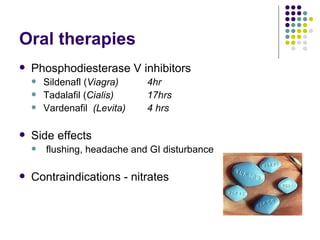
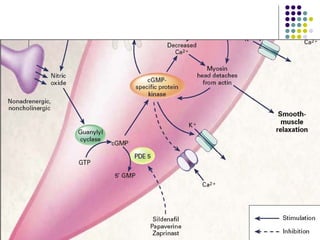
Oral therapies Phosphodiesterase V inhibitors Sildenafl ( Viagra) 4hr Tadalafil ( Cialis) 17hrs Vardenafil  (Levita) 4 hrs Side effects flushing, headache and GI disturbance Contraindications - nitrates
 
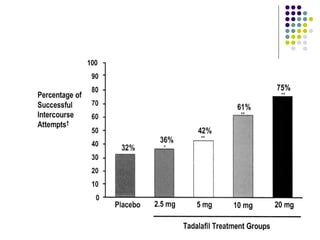
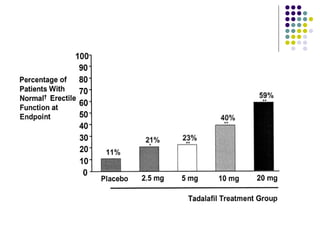
Efficacy of PDE-V inhibitors Hundreds of studies internauinally Improved erections and increased successful episodes of sexual intercourse vs placebo (15 RCTs)
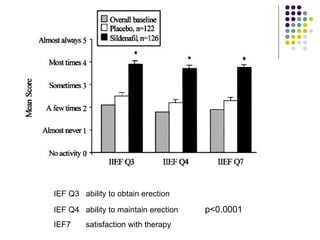
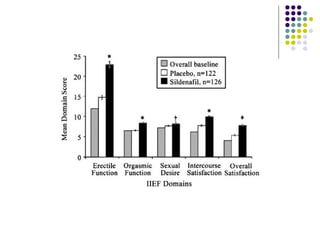
Levinson  et al 1998 254 males over 18 with clinical diagnosis of ED for >6 months Randomised double blind placebo controlled trial Primary end-point Index of Erectile Function (IEF) Variable dose 25mg-100mg adjusted by the patients
IEF Q3 ability to obtain erection IEF Q4 ability to maintain erection  p<0.0001 IEF7 satisfaction with therapy
 
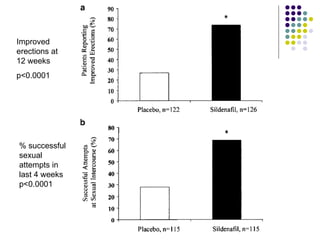
Improved erections at 12 weeks p<0.0001 % successful sexual attempts in last 4 weeks p<0.0001
PDE V inhibitor prescribing Following conditions DM PD, MS, polyiomyelitis Pinal cord injuries, spina bifida Radical prostatectomy Trial of 8 doses with dose titration before classifying as failure of treatment Once correct dose achieved then can prescribe 1 tablet per week
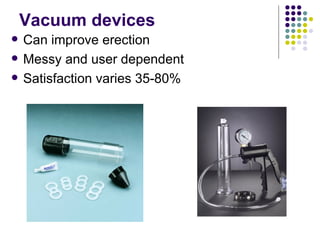
Vacuum devices Can improve erection Messy and user dependent Satisfaction varies 35-80%
Intracavernosal injections Intracavernosal injections with prostaglandins Alprostadil (prostaglandin E1) One large RCT found increased rate of satisfactory erections when alprostadil injected compared to placebo Side effects – pain, priapism
Testosterone replacement Improves erectile function and libido Preparations Topical (testim gel) Im testosterone Long-acting depots
Testosterone replacement improving diabetes? Kapoor  et al  2006 Small double-blind placebo controlled crossover trial (n=24) T II DM with testosterone deficiency (10 on insulin therapy) 3 months treatment with testosterone (200mg im 2-weekly)replacement and 3 months with placebo (1 month washout) Endpoints – fasting glucose, HbA1C and HOMA in non-insulin treated subjects (homeostatic model index) Secondary endpoints waist circumference, BP and lipids
Results HbA1C reduced by 0.37% (p=0.03) Fasting glucose reduced by 1.58mmol/L(p=0.03) HOMA index reduced 1.73 (p=0.02) Waist circumference reduced 1.73cm (p=0.03) Total cholesterol reduced 0.4mmol/L (p=0.03) No effect on BP Conclusions Testosterone replacement can improve T II diabetic control
Intraurethral alprostadil Effective but requires sufficient training required
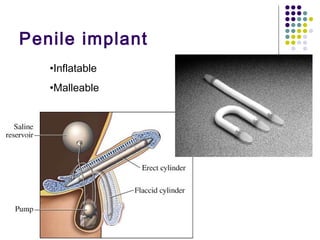
Penile implant Inflatable Malleable
Psychosexual counselling Talking therapies for men and couples
Summary ED Common Marker for other forms of neurovascular complications in diabetes Psychologically damaging Treatable Treat associated hormonal deficiencies
References Efficacy and safety of sildenafil citrate (Viagra ® ) for the treatment of erectile dysfunction in men in Egypt and South Africa  International  Journal of Impotence Research  (2003)  15,  Suppl 1, S25–S29.Levinson et al Testosterone replacement therapy improves insulin resistance, glycaemic control, visceral adiposity and hypercholesterolaemia in hypogonadal men with Type II Diabetes Kapoor et al European Journal of Endocrinology 2006 Diabetes Chronic conplication Wiley press, Shaw et al The role of testosterone in erectile dysfunction Gooren et al


Erectile Dysfunction

  • 1.
    Erectile dysfunction –a growing problem Dr Thomas Fox Endocrine SpR Royal Cornwall Hospital, Truro
  • 2.
    Erectile Dysfunction (ED)Definition Epidemiology Aetiology Clinical features History Examination Investigation Treatment
  • 3.
    Definition The consistentinability to obtain and maintain penile erection sufficient to complete satisfactory sexual performance
  • 4.
    Epidemiology Estimated toaffect 152m men worldwide Non-diabetic men 0.1-18.4% prevalence In a study of 541 diabetic males 35% in diabetic men 5.7% in 20-24 year olds 52.4% in 55-59 years olds ED is a growing problem Massachusetts Male Aging Study estimate an 11% world increase by 2015
  • 5.
    Aetiology Vascular NeurologicalEndocrine Psychological Pharmacological Penile tissue abnormalities Others
  • 6.
    Vascular Arterial insufficiencyEndothelial dysfunction (up to 95%) Discrete lesions Venous leakage Failure of venule constriction
  • 7.
    Neurological Damage toautonomic nervous system Predominant parasympathetic damage
  • 8.
    Endocrine Hypogonadism Mostcommonly primary testosterone deficiency Secondary hypogonadism Hypothyroidism Hyperprolactinaemia
  • 9.
    Other causes ofED Penile Balinitis Phymosis Penile finrosis Tumours Trauma Pharmacoloical
  • 10.
  • 11.
    History Patient’s descriptionof the problem Patient’s and partners expectations Duration Speed of onset Intermittent/progressive? History of sexual partners Nocturnal erections? Libido
  • 12.
    PMH Glycaemic controlVascular/neurological disease Urological PSH and trauma DH Anti-hypertensives Androgen antagonists Sedatives Drugs that cause hyperprolactinaemia (phenolthiazides) Alcohol Psychological assessment
  • 13.
    Examination General VascularNeurological Genitalia DRE
  • 14.
    Investigation Diabetic/vascular Endocrine9am Testosterone Thyroid function tests Pituitary hormones (LH,FSH,PRL) Imaging
  • 15.
    Management Multidisciplinary approachInvolvement of partner Couples expectations and desires
  • 16.
    Oral therapies PhosphodiesteraseV inhibitors Sildenafl ( Viagra) 4hr Tadalafil ( Cialis) 17hrs Vardenafil (Levita) 4 hrs Side effects flushing, headache and GI disturbance Contraindications - nitrates
  • 17.
  • 18.
    Efficacy of PDE-Vinhibitors Hundreds of studies internauinally Improved erections and increased successful episodes of sexual intercourse vs placebo (15 RCTs)
  • 19.
    Levinson etal 1998 254 males over 18 with clinical diagnosis of ED for >6 months Randomised double blind placebo controlled trial Primary end-point Index of Erectile Function (IEF) Variable dose 25mg-100mg adjusted by the patients
  • 20.
    IEF Q3 abilityto obtain erection IEF Q4 ability to maintain erection p<0.0001 IEF7 satisfaction with therapy
  • 21.
  • 22.
    Improved erections at12 weeks p<0.0001 % successful sexual attempts in last 4 weeks p<0.0001
  • 23.
    PDE V inhibitorprescribing Following conditions DM PD, MS, polyiomyelitis Pinal cord injuries, spina bifida Radical prostatectomy Trial of 8 doses with dose titration before classifying as failure of treatment Once correct dose achieved then can prescribe 1 tablet per week
  • 24.
    Vacuum devices Canimprove erection Messy and user dependent Satisfaction varies 35-80%
  • 25.
    Intracavernosal injections Intracavernosalinjections with prostaglandins Alprostadil (prostaglandin E1) One large RCT found increased rate of satisfactory erections when alprostadil injected compared to placebo Side effects – pain, priapism
  • 26.
    Testosterone replacement Improveserectile function and libido Preparations Topical (testim gel) Im testosterone Long-acting depots
  • 27.
    Testosterone replacement improvingdiabetes? Kapoor et al 2006 Small double-blind placebo controlled crossover trial (n=24) T II DM with testosterone deficiency (10 on insulin therapy) 3 months treatment with testosterone (200mg im 2-weekly)replacement and 3 months with placebo (1 month washout) Endpoints – fasting glucose, HbA1C and HOMA in non-insulin treated subjects (homeostatic model index) Secondary endpoints waist circumference, BP and lipids
  • 28.
    Results HbA1C reducedby 0.37% (p=0.03) Fasting glucose reduced by 1.58mmol/L(p=0.03) HOMA index reduced 1.73 (p=0.02) Waist circumference reduced 1.73cm (p=0.03) Total cholesterol reduced 0.4mmol/L (p=0.03) No effect on BP Conclusions Testosterone replacement can improve T II diabetic control
  • 29.
    Intraurethral alprostadil Effectivebut requires sufficient training required
  • 30.
  • 31.
    Psychosexual counselling Talkingtherapies for men and couples
  • 32.
    Summary ED CommonMarker for other forms of neurovascular complications in diabetes Psychologically damaging Treatable Treat associated hormonal deficiencies
  • 33.
    References Efficacy andsafety of sildenafil citrate (Viagra ® ) for the treatment of erectile dysfunction in men in Egypt and South Africa International Journal of Impotence Research (2003) 15, Suppl 1, S25–S29.Levinson et al Testosterone replacement therapy improves insulin resistance, glycaemic control, visceral adiposity and hypercholesterolaemia in hypogonadal men with Type II Diabetes Kapoor et al European Journal of Endocrinology 2006 Diabetes Chronic conplication Wiley press, Shaw et al The role of testosterone in erectile dysfunction Gooren et al
  • 34.
  • 35.
  • 36.