

Service Sector Management at
State Bank of India
"The State Bank of India is owned by the
people of India."
- P. Chidambaram.
Presented by:
Miss. Sneha J Chouhan
(B111207)
Contents
• Introduction of the banking sector ,
• Past, Present and Future the banking sector,
• Marketing Mix of SBI:
- STP Analysis,
- 7 P’s
• Process (Service Blueprint).
1. INTRODUCTION
TO BANKING SECTOR
1. INTRODUCTION TO BANKING SERVICES
• A bank is a financial
institution and a financial
intermediary that
accepts deposits and channels
those deposits
into lending activities, either
directly by loaning or indirectly
through capital markets.
• Here, the people having amount
in surplus lend it to those who
are in need of it via an
intermediary called bank..
Past scenario of the banking sector
• Banking system basically started with the Barter system.
• Later banks were introduced with a view to carry out safe
transactions and avoid any malfunction.
• The first bank in the world was Monte Dei Paschi di Siena.
This Italian bank, with headquarters in Siena, Tuscany,
was founded in the year 1472 and is regarded as the
oldest bank in the world.
• The first bank in India were Bank of Hindustan (1770-
1829) and The General Bank of India, established in 1786
and since defunct.
Present & future Scenario of the banking
sector
• Banks will expand In overseas market.
• Competition set to intensify.
• Passage of 'Banking Laws (Amendment) Bill' aimed
at attracting more foreign investments.
• Increase in the usage of electronic and net banking.
• There is a tendency to discourage customers from
visiting branches since it adds to the cost of the bank
and is also inconvenient for customers.
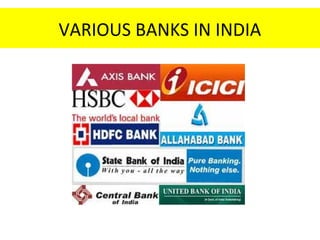
VARIOUS BANKS IN INDIA
1) B. INTRODUCTION TO
STATE BANK OF INDIA
1. INTRODUCTION TO SBI
• State Bank of India (SBI) is a
multinational banking and financial
services company based in India.
• It is a government-owned
corporation with its headquarters
in Mumbai, Maharashtra.
• As of December 2012,
- It has15,003 branches across
India,
- and Including 157 foreign offices,
• It the largest banking and financial
services company in India by assets
Branches of SBI
State Bank of India has 172 foreign offices in
37 countries across the globe.
SBI has about 25,000 ATMs,
SBI has 21,500 branches, including branches
that belong to its associate banks.
SBI includes 99,345 offices in India.
Services Offered by SBI
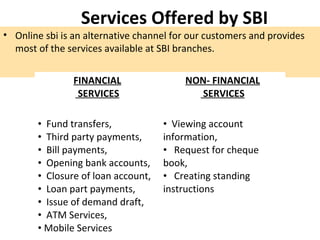
• Online sbi is an alternative channel for our customers and provides
most of the services available at SBI branches.
FINANCIAL
SERVICES
NON- FINANCIAL
SERVICES
• Fund transfers,
• Third party payments,
• Bill payments,
• Opening bank accounts,
• Closure of loan account,
• Loan part payments,
• Issue of demand draft,
• ATM Services,
• Mobile Services
• Viewing account
information,
• Request for cheque
book,
• Creating standing
instructions
2. Past,
Present and
Future of SBI:
Past Scenario of SBI:
- On 1st July State Bank of India was
constituted under the State Bank of India
Act 1955, for the purpose of taking over
the undertaking and business of the
Imperial Bank of India.
- The Imperial Bank of India was founded in
1921 under the Imperial Bank of India Act
1920.
- The Bank transacts general banking
business of every description including,
foreign exchange, merchant banking and
mutual funds.
Present Scenario of SBI
• Due to the process of liberalization ,Globalization,
Privatization and reform of the financial sector, banking
sector has undergone major transformation.
• Banks are extremely useful and indispensable in the
modern community.
• The banks create the purchasing power
• The banks have played substantial role in the growth of
Indian economy.
• Use of information Technology and Internet. (SBI has
appointed TCS as a partner for technology upgradation)
Future Scenario of SBI
• SBI General's current geographical coverage
extends to 38 cities pan India and plans are on
to extend this reach to another 20-25 cities
before the end of the current financial year.
3. Marketing Mix of SBI:
a) STP Analysis
b) 7 P’s
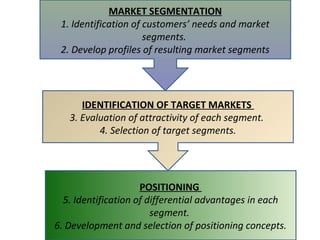
MARKET SEGMENTATION
1. Identification of customers’ needs and market
segments.
2. Develop profiles of resulting market segments
IDENTIFICATION OF TARGET MARKETS
3. Evaluation of attractivity of each segment.
4. Selection of target segments.
POSITIONING
5. Identification of differential advantages in each
segment.
6. Development and selection of positioning concepts.
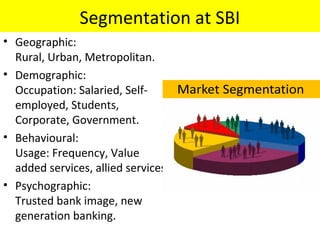
Segmentation at SBI
• Geographic:
Rural, Urban, Metropolitan.
• Demographic:
Occupation: Salaried, Self-
employed, Students,
Corporate, Government.
• Behavioural:
Usage: Frequency, Value
added services, allied services.
• Psychographic:
Trusted bank image, new
generation banking.
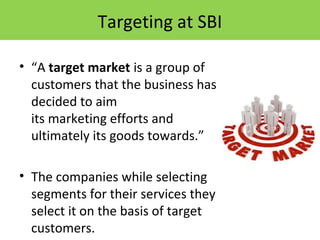
Targeting at SBI
• “A target market is a group of
customers that the business has
decided to aim
its marketing efforts and
ultimately its goods towards.”
• The companies while selecting
segments for their services they
select it on the basis of target
customers.
Positioning at SBI.. Contd..
• It is the peoples most
trusted bank.
• High accessibility with
10,000 branches and
extension of hours of work.
• Relevance to young
customers with value added
services like Net Banking,
Telebanking etc.
Positioning at SBI
• SBI comes among top 50
banks in the world.
• It is the most trusted Bank
amongst the people.
• State Bank of India (SBI) is
the largest nationalized
commercial bank in India in
terms of assets, number of
branches, deposits, profits
and workforce.
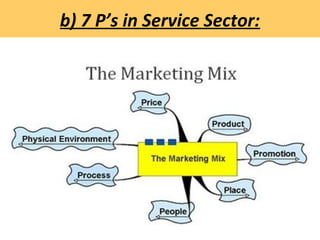
b) 7 P’s in Service Sector:
Future Product
Augmented
product
Augmented
product
Formal product
Core product
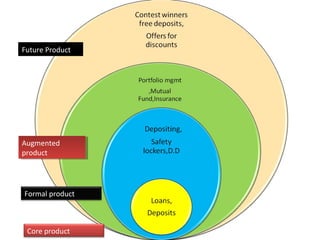
Product at SBI
• Core product:
The basic services in banking form a basic product
Eg: Accepting deposits, granting loans
• Formal product:
It is the set of attributes and conditions expected by the
customers when they purchase the product
Eg: Insurance facilities, locker facilities, ATM’s
• Augmented product:
It is the additional feature that banks provide which exceeds
the customer’s expectations
Eg: Discounts, Good waiting rooms
• Potential product:
It includes Innovations and product differentiation. Banks
alters its services according to the requirement of the
individual customers
Eg: Mobile and internet banking, new schemes tailored for
specific customers
Product at SBI
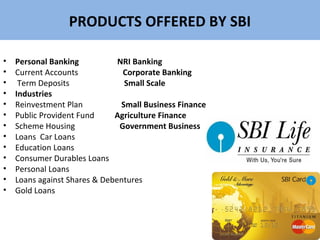
PRODUCTS OFFERED BY SBI
• Personal Banking NRI Banking
• Current Accounts Corporate Banking
• Term Deposits Small Scale
• Industries
• Reinvestment Plan Small Business Finance
• Public Provident Fund Agriculture Finance
• Scheme Housing Government Business
• Loans Car Loans
• Education Loans
• Consumer Durables Loans
• Personal Loans
• Loans against Shares & Debentures
• Gold Loans
Price at SBI
• Interest rates charged
• Transaction charged
• Value pricing
• Going rate pricing
• Mark up pricing
• Charges for cheque books
• Commmission charges
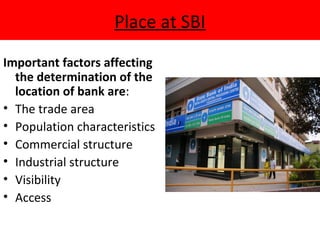
Place at SBI
Important factors affecting
the determination of the
location of bank are:
• The trade area
• Population characteristics
• Commercial structure
• Industrial structure
• Visibility
• Access
Promotion at SBI
• Public relations
• Personal selling
• Word of mouth
promotion
• Internet
• Tele marketing
Physical evidence at SBI
It refers to the overall layout of the place i.e.
how the entire bank is designed. Physical
evidence refers to all those factors that
makes process much easier and smoother.
Eg: In banks the physical evidence would be
the placement of customer service
executive’s desk or the location of the
place for deposting cheques.
Process at SBI
• Process constitutes the overall procedure
involved in using the services offered by the
bank.
• The process should be customer friendly
• If the overall process is too complicated than
the customer may not be inclined to use such
services
People at SBI
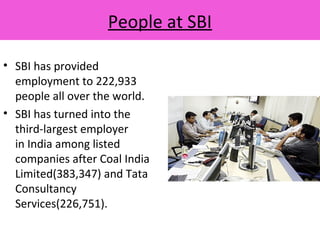
• SBI has provided
employment to 222,933
people all over the world.
• SBI has turned into the
third-largest employer
in India among listed
companies after Coal India
Limited(383,347) and Tata
Consultancy
Services(226,751).
4. Service Process
(Service Blueprint)
“Ultimately, only one thing ”really matters in service
encounters- the customer’s perceptions of what
occurred.”
- (Richard B Chase and Sriram Dasu)
WHAT IS A SERVICE BLUEPRINT?
• It defines the architecture of services
describing the method and sequence of how
service operation system work and how they
link together to create a good service
experience in the customers.
• Badly designed process often leads in poor-
quality, slow, and frustrating service delivery
and annoys the customers.
• Thus, Badly designed processes can ultimately
lead to service failure.
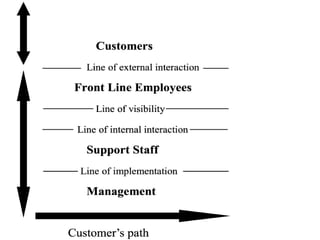
The service blueprint includes:
• Customer Actions:
The steps that customers take as part of the service delivery
process.
• Frontstage (Visible Contact Employee) Actions:
This element is separated from the customer actions by a
‘line of interaction’. These actions are face-to-face actions
between employees and customers.
• Backstage (Invisible Contact Employee) Actions:
The ‘line of visibility’ separates the onstage from the
Backstage actions. Everything that appears above the line of
visibility can be seen by the customers, while everything
under the line of visibility is invisible for the customers. A
very good example of an action in this element, is a
telephone call; this is an action between an employee and a
customer, but they don’t see each other.
• Support Processes:
The ‘internal line of interaction’ separates the contact
employees from the support processes. These are all the
activities carried out by individuals and units within the
company who are not contact employees. These activities
need to happen in order for the service to be delivered.
• Physical Evidence:
For each customer action, and every moment of truth, the
physical evidence that customers come in contact with is
described at the very top of the service blueprint. These are
all the tangibles that customers are exposed to that can
influence their quality perceptions.
The service blueprint includes: …(contd.)
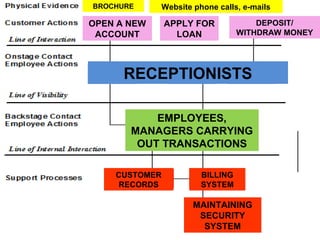
BROCHURE Website phone calls, e-mails
DEPOSIT/
WITHDRAW MONEY
APPLY FOR
LOAN
OPEN A NEW
ACCOUNT
RECEPTIONISTS
EMPLOYEES,
MANAGERS CARRYING
OUT TRANSACTIONS
CUSTOMER
RECORDS
BILLING
SYSTEM
MAINTAINING
SECURITY
SYSTEM
CONCLUSION
Service Sector Management at State Bank of India

Service Sector Management at State Bank of India

  • 1.
    Service Sector Managementat State Bank of India "The State Bank of India is owned by the people of India." - P. Chidambaram.
  • 2.
    Presented by: Miss. SnehaJ Chouhan (B111207)
  • 3.
    Contents • Introduction ofthe banking sector , • Past, Present and Future the banking sector, • Marketing Mix of SBI: - STP Analysis, - 7 P’s • Process (Service Blueprint).
  • 4.
  • 5.
    1. INTRODUCTION TOBANKING SERVICES • A bank is a financial institution and a financial intermediary that accepts deposits and channels those deposits into lending activities, either directly by loaning or indirectly through capital markets. • Here, the people having amount in surplus lend it to those who are in need of it via an intermediary called bank..
  • 6.
    Past scenario ofthe banking sector • Banking system basically started with the Barter system. • Later banks were introduced with a view to carry out safe transactions and avoid any malfunction. • The first bank in the world was Monte Dei Paschi di Siena. This Italian bank, with headquarters in Siena, Tuscany, was founded in the year 1472 and is regarded as the oldest bank in the world. • The first bank in India were Bank of Hindustan (1770- 1829) and The General Bank of India, established in 1786 and since defunct.
  • 7.
    Present & futureScenario of the banking sector • Banks will expand In overseas market. • Competition set to intensify. • Passage of 'Banking Laws (Amendment) Bill' aimed at attracting more foreign investments. • Increase in the usage of electronic and net banking. • There is a tendency to discourage customers from visiting branches since it adds to the cost of the bank and is also inconvenient for customers.
  • 8.
  • 9.
    1) B. INTRODUCTIONTO STATE BANK OF INDIA
  • 10.
    1. INTRODUCTION TOSBI • State Bank of India (SBI) is a multinational banking and financial services company based in India. • It is a government-owned corporation with its headquarters in Mumbai, Maharashtra. • As of December 2012, - It has15,003 branches across India, - and Including 157 foreign offices, • It the largest banking and financial services company in India by assets
  • 11.
    Branches of SBI StateBank of India has 172 foreign offices in 37 countries across the globe. SBI has about 25,000 ATMs, SBI has 21,500 branches, including branches that belong to its associate banks. SBI includes 99,345 offices in India.
  • 12.
    Services Offered bySBI • Online sbi is an alternative channel for our customers and provides most of the services available at SBI branches. FINANCIAL SERVICES NON- FINANCIAL SERVICES • Fund transfers, • Third party payments, • Bill payments, • Opening bank accounts, • Closure of loan account, • Loan part payments, • Issue of demand draft, • ATM Services, • Mobile Services • Viewing account information, • Request for cheque book, • Creating standing instructions
  • 13.
  • 14.
    Past Scenario ofSBI: - On 1st July State Bank of India was constituted under the State Bank of India Act 1955, for the purpose of taking over the undertaking and business of the Imperial Bank of India. - The Imperial Bank of India was founded in 1921 under the Imperial Bank of India Act 1920. - The Bank transacts general banking business of every description including, foreign exchange, merchant banking and mutual funds.
  • 15.
    Present Scenario ofSBI • Due to the process of liberalization ,Globalization, Privatization and reform of the financial sector, banking sector has undergone major transformation. • Banks are extremely useful and indispensable in the modern community. • The banks create the purchasing power • The banks have played substantial role in the growth of Indian economy. • Use of information Technology and Internet. (SBI has appointed TCS as a partner for technology upgradation)
  • 16.
    Future Scenario ofSBI • SBI General's current geographical coverage extends to 38 cities pan India and plans are on to extend this reach to another 20-25 cities before the end of the current financial year.
  • 17.
    3. Marketing Mixof SBI: a) STP Analysis b) 7 P’s
  • 18.
    MARKET SEGMENTATION 1. Identificationof customers’ needs and market segments. 2. Develop profiles of resulting market segments IDENTIFICATION OF TARGET MARKETS 3. Evaluation of attractivity of each segment. 4. Selection of target segments. POSITIONING 5. Identification of differential advantages in each segment. 6. Development and selection of positioning concepts.
  • 19.
    Segmentation at SBI •Geographic: Rural, Urban, Metropolitan. • Demographic: Occupation: Salaried, Self- employed, Students, Corporate, Government. • Behavioural: Usage: Frequency, Value added services, allied services. • Psychographic: Trusted bank image, new generation banking.
  • 20.
    Targeting at SBI •“A target market is a group of customers that the business has decided to aim its marketing efforts and ultimately its goods towards.” • The companies while selecting segments for their services they select it on the basis of target customers.
  • 21.
    Positioning at SBI..Contd.. • It is the peoples most trusted bank. • High accessibility with 10,000 branches and extension of hours of work. • Relevance to young customers with value added services like Net Banking, Telebanking etc.
  • 22.
    Positioning at SBI •SBI comes among top 50 banks in the world. • It is the most trusted Bank amongst the people. • State Bank of India (SBI) is the largest nationalized commercial bank in India in terms of assets, number of branches, deposits, profits and workforce.
  • 23.
    b) 7 P’sin Service Sector:
  • 24.
  • 25.
    Product at SBI •Core product: The basic services in banking form a basic product Eg: Accepting deposits, granting loans • Formal product: It is the set of attributes and conditions expected by the customers when they purchase the product Eg: Insurance facilities, locker facilities, ATM’s
  • 26.
    • Augmented product: Itis the additional feature that banks provide which exceeds the customer’s expectations Eg: Discounts, Good waiting rooms • Potential product: It includes Innovations and product differentiation. Banks alters its services according to the requirement of the individual customers Eg: Mobile and internet banking, new schemes tailored for specific customers Product at SBI
  • 27.
    PRODUCTS OFFERED BYSBI • Personal Banking NRI Banking • Current Accounts Corporate Banking • Term Deposits Small Scale • Industries • Reinvestment Plan Small Business Finance • Public Provident Fund Agriculture Finance • Scheme Housing Government Business • Loans Car Loans • Education Loans • Consumer Durables Loans • Personal Loans • Loans against Shares & Debentures • Gold Loans
  • 28.
    Price at SBI •Interest rates charged • Transaction charged • Value pricing • Going rate pricing • Mark up pricing • Charges for cheque books • Commmission charges
  • 29.
    Place at SBI Importantfactors affecting the determination of the location of bank are: • The trade area • Population characteristics • Commercial structure • Industrial structure • Visibility • Access
  • 30.
    Promotion at SBI •Public relations • Personal selling • Word of mouth promotion • Internet • Tele marketing
  • 31.
    Physical evidence atSBI It refers to the overall layout of the place i.e. how the entire bank is designed. Physical evidence refers to all those factors that makes process much easier and smoother. Eg: In banks the physical evidence would be the placement of customer service executive’s desk or the location of the place for deposting cheques.
  • 32.
    Process at SBI •Process constitutes the overall procedure involved in using the services offered by the bank. • The process should be customer friendly • If the overall process is too complicated than the customer may not be inclined to use such services
  • 33.
    People at SBI •SBI has provided employment to 222,933 people all over the world. • SBI has turned into the third-largest employer in India among listed companies after Coal India Limited(383,347) and Tata Consultancy Services(226,751).
  • 34.
    4. Service Process (ServiceBlueprint) “Ultimately, only one thing ”really matters in service encounters- the customer’s perceptions of what occurred.” - (Richard B Chase and Sriram Dasu)
  • 35.
    WHAT IS ASERVICE BLUEPRINT? • It defines the architecture of services describing the method and sequence of how service operation system work and how they link together to create a good service experience in the customers. • Badly designed process often leads in poor- quality, slow, and frustrating service delivery and annoys the customers. • Thus, Badly designed processes can ultimately lead to service failure.
  • 37.
    The service blueprintincludes: • Customer Actions: The steps that customers take as part of the service delivery process. • Frontstage (Visible Contact Employee) Actions: This element is separated from the customer actions by a ‘line of interaction’. These actions are face-to-face actions between employees and customers. • Backstage (Invisible Contact Employee) Actions: The ‘line of visibility’ separates the onstage from the Backstage actions. Everything that appears above the line of visibility can be seen by the customers, while everything under the line of visibility is invisible for the customers. A very good example of an action in this element, is a telephone call; this is an action between an employee and a customer, but they don’t see each other.
  • 38.
    • Support Processes: The‘internal line of interaction’ separates the contact employees from the support processes. These are all the activities carried out by individuals and units within the company who are not contact employees. These activities need to happen in order for the service to be delivered. • Physical Evidence: For each customer action, and every moment of truth, the physical evidence that customers come in contact with is described at the very top of the service blueprint. These are all the tangibles that customers are exposed to that can influence their quality perceptions. The service blueprint includes: …(contd.)
  • 39.
    BROCHURE Website phonecalls, e-mails DEPOSIT/ WITHDRAW MONEY APPLY FOR LOAN OPEN A NEW ACCOUNT RECEPTIONISTS EMPLOYEES, MANAGERS CARRYING OUT TRANSACTIONS CUSTOMER RECORDS BILLING SYSTEM MAINTAINING SECURITY SYSTEM
  • 40.