Commercial paper
PRESENTED TO:-
Prof. NEETU PUROHIT


                      PRESENTED BY:-
                      Jitendra Tiwari
                      Saurabh Shukla
                      Himanshu Kumar
                      Angad Kumar Singh
INTRODUCTION
• Commercial paper consists of short-term,
  unsecured promissory notes issued by well-
  known and financially strong companies.
• Commercial paper is traded mainly in the
  primary market. Opportunities for resale in
  the secondary market are more limited.
• Commercial paper is rated prime, desirable, or
  satisfactory, depending on the credit standing
  of the issuing company.
• CP can be issued for maturities between a minimum of 7
  days and a maximum of up to one year from the date of
  issue.
• Commercial paper is usually sold at a discount from face
  value, and carries higher interest repayment rates
  than bonds.
Question arises in mind, why it was
            introduced?
• It was introduced in India in 1990 with a view
  to enabling highly rated corporate borrowers
  to diversify their sources of short-term
  borrowings and to provide an additional
  instrument to investors. Subsequently,
  primary dealers and all-India financial
  institutions were also permitted to issue CP to
  enable them to meet their short-term funding
  requirements for their operations.
Types of Commercial Paper
• There are two major types of commercial
  paper.
• Direct paper is issued mainly by large finance
  companies and bank holding companies
  directly to the investor.
• Dealer paper, or industrial paper, is issued by
  security dealers on behalf of their corporate
  customers (mainly nonfinancial companies
  and smaller financial companies).
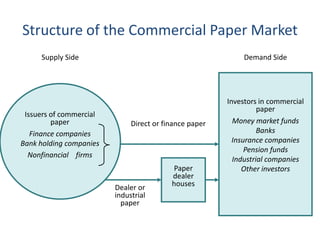
Structure of the Commercial Paper Market
     Supply Side                                             Demand Side


                                                        Investors in commercial
                                                                  paper
 Issuers of commercial
         paper                Direct or finance paper     Money market funds
   Finance companies                                              Banks
Bank holding companies                                    Insurance companies
                                                              Pension funds
  Nonfinancial firms
                                                          Industrial companies
                                          Paper              Other investors
                                          dealer
                         Dealer or        houses
                         industrial
                           paper
Maturities & Rate of Return
• Most commercial paper is issued at a discount
  from par, and yields to the investor are
  calculated by the bank discount method, just
  like Treasury bills.
Growth of Commercial Paper
• The volume of commercial paper has grown
  rapidly due to its relatively low cost and high
  quality, as well as the expanding use of credit
  enhancements.
                       Outstanding Volume
             Year      of Paper in the U.S.

             1960       $    4.5 billion
             1970           33.4
             1980          124.4
             1990          562.7              Effect of
             2000        1,615.3         weaker economy &
                                             terrorism
             2001        1,438.8
Commercial Paper
Advantages
   Commercial paper represents one way for large firms
    to borrow money for the short term.

   companies issue the commercial paper for less than
    its face value and buy back the paper at its face
    value.

   Commercial paper are cheaper than a bank loan.
Commercial Paper
Disadvantages

 It is available only to a few selected blue chip and
 profitable companies.

 By issuing commercial paper, the credit available
 from the banks may get reduced.

 Issue of commercial paper is very closely
  regulated by the RBI guidelines.
Who can issue Commercial Paper (CP)
• Highly rated corporate borrowers, primary
  dealers (PDs) and satellite dealers (SDs) and
  all-India financial institutions (FIs)
Eligibility for issue of CP
a) The tangible net worth of the company, as per
   the latest audited balance sheet, is not less than
   Rs. 4 crore;
b) The working capital (fund-based) limit of the
   company from the banking system is not less
   than Rs.4 crore
c) And the borrower account of the company is
   classified as a Standard Asset by the financing
   bank/s.
To whom issued
• CP is issued to and held by individuals,
  banking companies, other corporate bodies
  registered or incorporated in India and
  unincorporated bodies, Non-Resident Indians
  (NRIs) and Foreign Institutional Investors (FIIs).
Research work


• CPs are issued by companies in the form of usance
  promissory note, redeemable at par to the holder on
  maturity.
• The tangible net worth of the issuing company should be not
  less than Rs.4 crore.
• Working capital (fund based) limit of the company should
  not be less than Rs.4 crore.
• Credit rating should be at least equivalent of
  P2/A2/PP2/Ind.D.2 or higher from any approved rating
  agencies and should be more than 2 months old on the date
  of issue of CP.
• Corporate are allowed to issue CP up to 100% of
  their fund based working capital limits.
• It is issued at a discount to face value
• CP attracts stamp duty.
• CP can be issued for maturities between 15 days and
  less than one year from the date of issue.
• CP may be issued in the multiples of Rs.5 lakh.
• No prior approval of RBI is needed to issue CP and
  underwriting the issue is not mandatory.
• All expenses (such as dealers’ fees, rating agency fee
  and charges for provision of stand-by facilities) for
  issue of CP are to be borne by the issuing company
SOLAR INDUSTRIES INDIA LIMITED Issue
    of Commercial Papers(Example)
• On January 27, 2010, the Board considered
  the Issue of Commercial papers and decided
  to issue commercial papers of 50.00 Corers.
  Board further appointed CRISIL as Credit
  Rating Agency for issuing Credit Rating to the
  Company in respect of Commercial Paper
  Issue. Board also appointed Link In time India
  Private Limited to Act as Registrar & Transfer
  Agent for this Issue.
Commercial paper

Commercial paper

  • 1.
    Commercial paper PRESENTED TO:- Prof.NEETU PUROHIT PRESENTED BY:- Jitendra Tiwari Saurabh Shukla Himanshu Kumar Angad Kumar Singh
  • 2.
    INTRODUCTION • Commercial paperconsists of short-term, unsecured promissory notes issued by well- known and financially strong companies. • Commercial paper is traded mainly in the primary market. Opportunities for resale in the secondary market are more limited. • Commercial paper is rated prime, desirable, or satisfactory, depending on the credit standing of the issuing company.
  • 3.
    • CP canbe issued for maturities between a minimum of 7 days and a maximum of up to one year from the date of issue. • Commercial paper is usually sold at a discount from face value, and carries higher interest repayment rates than bonds.
  • 4.
    Question arises inmind, why it was introduced? • It was introduced in India in 1990 with a view to enabling highly rated corporate borrowers to diversify their sources of short-term borrowings and to provide an additional instrument to investors. Subsequently, primary dealers and all-India financial institutions were also permitted to issue CP to enable them to meet their short-term funding requirements for their operations.
  • 5.
    Types of CommercialPaper • There are two major types of commercial paper. • Direct paper is issued mainly by large finance companies and bank holding companies directly to the investor. • Dealer paper, or industrial paper, is issued by security dealers on behalf of their corporate customers (mainly nonfinancial companies and smaller financial companies).
  • 6.
    Structure of theCommercial Paper Market Supply Side Demand Side Investors in commercial paper Issuers of commercial paper Direct or finance paper Money market funds Finance companies Banks Bank holding companies Insurance companies Pension funds Nonfinancial firms Industrial companies Paper Other investors dealer Dealer or houses industrial paper
  • 7.
    Maturities & Rateof Return • Most commercial paper is issued at a discount from par, and yields to the investor are calculated by the bank discount method, just like Treasury bills.
  • 8.
    Growth of CommercialPaper • The volume of commercial paper has grown rapidly due to its relatively low cost and high quality, as well as the expanding use of credit enhancements. Outstanding Volume Year of Paper in the U.S. 1960 $ 4.5 billion 1970 33.4 1980 124.4 1990 562.7 Effect of 2000 1,615.3 weaker economy & terrorism 2001 1,438.8
  • 9.
    Commercial Paper Advantages  Commercial paper represents one way for large firms to borrow money for the short term.  companies issue the commercial paper for less than its face value and buy back the paper at its face value.  Commercial paper are cheaper than a bank loan.
  • 10.
    Commercial Paper Disadvantages  Itis available only to a few selected blue chip and profitable companies.  By issuing commercial paper, the credit available from the banks may get reduced.  Issue of commercial paper is very closely regulated by the RBI guidelines.
  • 11.
    Who can issueCommercial Paper (CP) • Highly rated corporate borrowers, primary dealers (PDs) and satellite dealers (SDs) and all-India financial institutions (FIs)
  • 12.
    Eligibility for issueof CP a) The tangible net worth of the company, as per the latest audited balance sheet, is not less than Rs. 4 crore; b) The working capital (fund-based) limit of the company from the banking system is not less than Rs.4 crore c) And the borrower account of the company is classified as a Standard Asset by the financing bank/s.
  • 13.
    To whom issued •CP is issued to and held by individuals, banking companies, other corporate bodies registered or incorporated in India and unincorporated bodies, Non-Resident Indians (NRIs) and Foreign Institutional Investors (FIIs).
  • 14.
    Research work • CPsare issued by companies in the form of usance promissory note, redeemable at par to the holder on maturity. • The tangible net worth of the issuing company should be not less than Rs.4 crore. • Working capital (fund based) limit of the company should not be less than Rs.4 crore. • Credit rating should be at least equivalent of P2/A2/PP2/Ind.D.2 or higher from any approved rating agencies and should be more than 2 months old on the date of issue of CP.
  • 15.
    • Corporate areallowed to issue CP up to 100% of their fund based working capital limits. • It is issued at a discount to face value • CP attracts stamp duty. • CP can be issued for maturities between 15 days and less than one year from the date of issue. • CP may be issued in the multiples of Rs.5 lakh. • No prior approval of RBI is needed to issue CP and underwriting the issue is not mandatory. • All expenses (such as dealers’ fees, rating agency fee and charges for provision of stand-by facilities) for issue of CP are to be borne by the issuing company
  • 16.
    SOLAR INDUSTRIES INDIALIMITED Issue of Commercial Papers(Example) • On January 27, 2010, the Board considered the Issue of Commercial papers and decided to issue commercial papers of 50.00 Corers. Board further appointed CRISIL as Credit Rating Agency for issuing Credit Rating to the Company in respect of Commercial Paper Issue. Board also appointed Link In time India Private Limited to Act as Registrar & Transfer Agent for this Issue.