Prepared by :
Jay Patel (110750106006)
Malay Patel (110750106024)
Kushagra Rawal (110750106028)
 What is Beam-Column Joint ?
 Types & Importance of Beam-Column Joint
 Earthquake Behaviour of Joints
 Reinforcing of Beam-column Joints
 How to provide Horizontal ties in beams ?
 Anchorage of beam bars
Exterior joint
Interior Joints
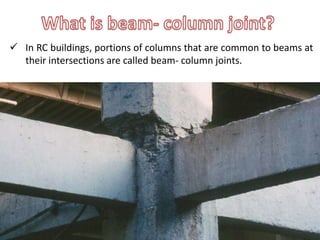
 In RC buildings, portions of columns that are common to beams at
their intersections are called beam- column joints.
 Since their constituent materials have limited
strengths, the joints have limited force carrying capacity.
 When forces larger than these are applied during
earthquakes, joints are severely damaged.
 Repairing damaged joints is difficult, and so damage
must be avoided. Thus, beam-column joints must be
designed to resist earthquake effects.
 Under earthquake shaking, the beams adjoining a joint are
subjected to moments in the same (clockwise or counter-
clockwise) direction .
 Under these moments, the top bars in the beam-column joint are
pulled in one direction and the bottom ones in the opposite
direction .
 If the column is not wide enough or if the strength of concrete in
the joint is low, there is insufficient grip of concrete on the steel
bars.
 In such circumstances, the bar slips inside the joint region, and
beams loose their capacity to carry load.
 Further, under the action of the above pull-push forces at top and bottom ends
one diagonal length of the joint elongates and the other compresses . If the
column cross-sectional size is insufficient, the concrete in the joint develops
diagonal cracks.
 Diagonal cracking & crushing of
concrete can be prevented in Joints.
 Mostly, for this large column size is
the most effective.
 Another way is providing steel ties
also known as stirrups.
 Providing closed loop ties needs some extra effort.
 Indian Standard IS:13920-1993 recommends continuing the
transverse loops around the column bars through the joint
region.
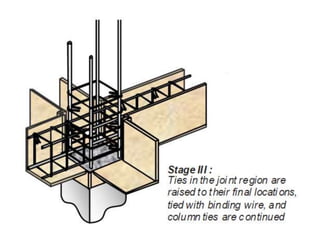
 In practice, this is achieved by preparing the cage of the
reinforcement (both longitudinal bars and stirrups) of all beams
at a floor level to be prepared on top of the beam formwork of
that level and lowered into the cage .
 However, this may not always be possible particularly when the
beams are long and the entire reinforcement cage becomes
heavy.
How do Beam-Column Joints in RC Buildings Resist Earthquakes?

How do Beam-Column Joints in RC Buildings Resist Earthquakes?

  • 1.
    Prepared by : JayPatel (110750106006) Malay Patel (110750106024) Kushagra Rawal (110750106028)
  • 2.
     What isBeam-Column Joint ?  Types & Importance of Beam-Column Joint  Earthquake Behaviour of Joints  Reinforcing of Beam-column Joints  How to provide Horizontal ties in beams ?  Anchorage of beam bars Exterior joint Interior Joints
  • 3.
     In RCbuildings, portions of columns that are common to beams at their intersections are called beam- column joints.
  • 5.
     Since theirconstituent materials have limited strengths, the joints have limited force carrying capacity.  When forces larger than these are applied during earthquakes, joints are severely damaged.  Repairing damaged joints is difficult, and so damage must be avoided. Thus, beam-column joints must be designed to resist earthquake effects.
  • 6.
     Under earthquakeshaking, the beams adjoining a joint are subjected to moments in the same (clockwise or counter- clockwise) direction .  Under these moments, the top bars in the beam-column joint are pulled in one direction and the bottom ones in the opposite direction .  If the column is not wide enough or if the strength of concrete in the joint is low, there is insufficient grip of concrete on the steel bars.  In such circumstances, the bar slips inside the joint region, and beams loose their capacity to carry load.
  • 7.
     Further, underthe action of the above pull-push forces at top and bottom ends one diagonal length of the joint elongates and the other compresses . If the column cross-sectional size is insufficient, the concrete in the joint develops diagonal cracks.
  • 8.
     Diagonal cracking& crushing of concrete can be prevented in Joints.  Mostly, for this large column size is the most effective.  Another way is providing steel ties also known as stirrups.
  • 11.
     Providing closedloop ties needs some extra effort.  Indian Standard IS:13920-1993 recommends continuing the transverse loops around the column bars through the joint region.  In practice, this is achieved by preparing the cage of the reinforcement (both longitudinal bars and stirrups) of all beams at a floor level to be prepared on top of the beam formwork of that level and lowered into the cage .  However, this may not always be possible particularly when the beams are long and the entire reinforcement cage becomes heavy.