How do Beam-Column Joints in RC Buildings Resist Earthquakes?
Earthquake Tip 20
Learning
Earthquake Design
and
Construction
Why Beam-Column Joints are Special
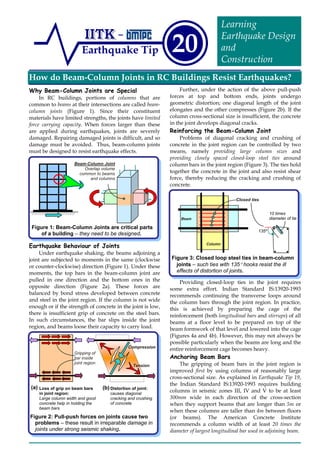
In RC buildings, portions of columns that are
common to beams at their intersections are called beam-
column joints (Figure 1). Since their constituent
materials have limited strengths, the joints have limited
force carrying capacity. When forces larger than these
are applied during earthquakes, joints are severely
damaged. Repairing damaged joints is difficult, and so
damage must be avoided. Thus, beam-column joints
must be designed to resist earthquake effects.
Earthquake Behaviour of Joints
Under earthquake shaking, the beams adjoining a
joint are subjected to moments in the same (clockwise
or counter-clockwise) direction (Figure 1). Under these
moments, the top bars in the beam-column joint are
pulled in one direction and the bottom ones in the
opposite direction (Figure 2a). These forces are
balanced by bond stress developed between concrete
and steel in the joint region. If the column is not wide
enough or if the strength of concrete in the joint is low,
there is insufficient grip of concrete on the steel bars.
In such circumstances, the bar slips inside the joint
region, and beams loose their capacity to carry load.
Further, under the action of the above pull-push
forces at top and bottom ends, joints undergo
geometric distortion; one diagonal length of the joint
elongates and the other compresses (Figure 2b). If the
column cross-sectional size is insufficient, the concrete
in the joint develops diagonal cracks.
Reinforcing the Beam-Column Joint
Problems of diagonal cracking and crushing of
concrete in the joint region can be controlled by two
means, namely providing large column sizes and
providing closely spaced closed-loop steel ties around
column bars in the joint region (Figure 3). The ties hold
together the concrete in the joint and also resist shear
force, thereby reducing the cracking and crushing of
concrete.
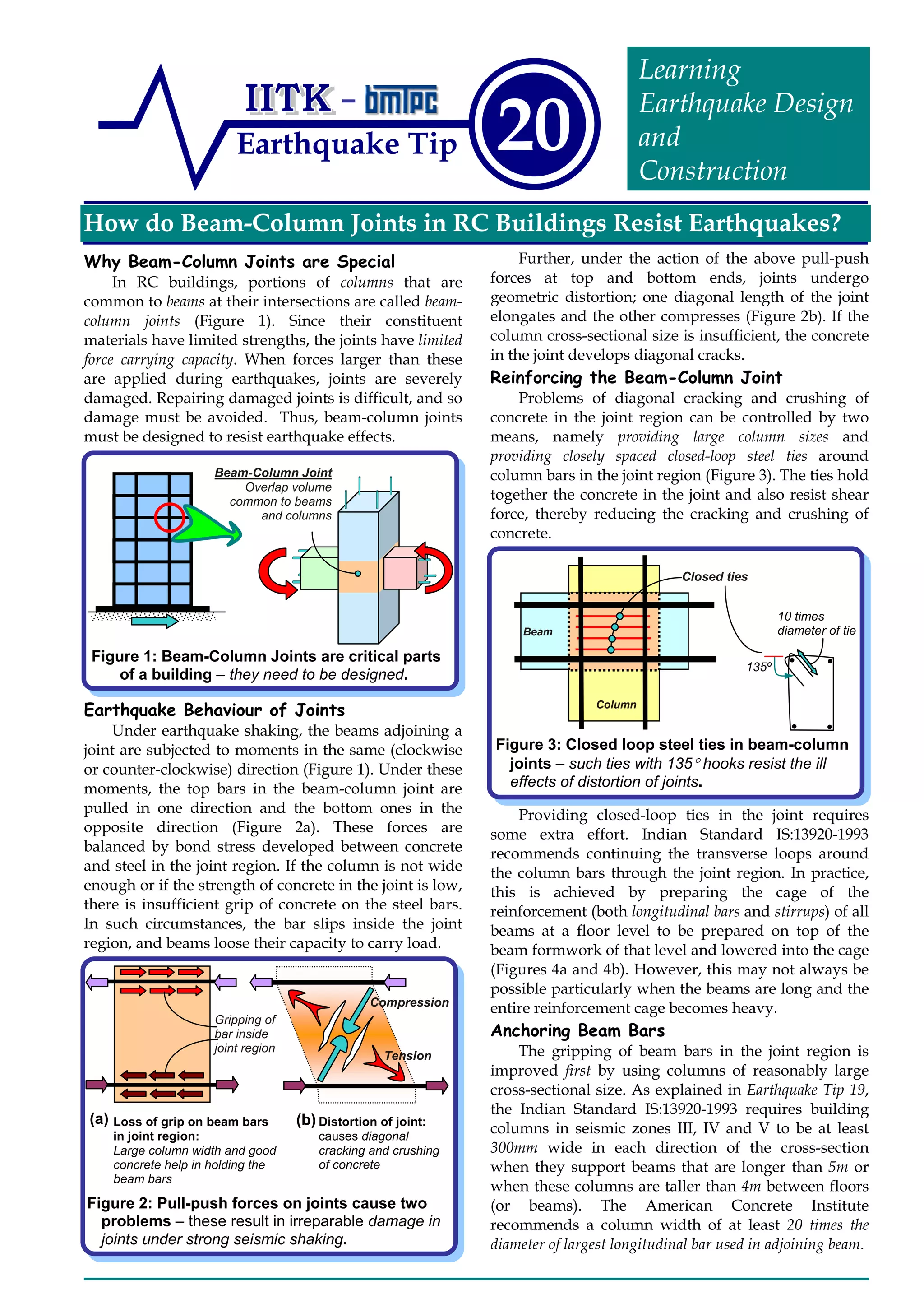
Providing closed-loop ties in the joint requires
some extra effort. Indian Standard IS:13920-1993
recommends continuing the transverse loops around
the column bars through the joint region. In practice,
this is achieved by preparing the cage of the
reinforcement (both longitudinal bars and stirrups) of all
beams at a floor level to be prepared on top of the
beam formwork of that level and lowered into the cage
(Figures 4a and 4b). However, this may not always be
possible particularly when the beams are long and the
entire reinforcement cage becomes heavy.
Anchoring Beam Bars
The gripping of beam bars in the joint region is
improved first by using columns of reasonably large
cross-sectional size. As explained in Earthquake Tip 19,
the Indian Standard IS:13920-1993 requires building
columns in seismic zones III, IV and V to be at least
300mm wide in each direction of the cross-section
when they support beams that are longer than 5m or
when these columns are taller than 4m between floors
(or beams). The American Concrete Institute
recommends a column width of at least 20 times the
diameter of largest longitudinal bar used in adjoining beam.
Figure 1: Beam-Column Joints are critical parts
of a building – they need to be designed.
Beam-Column Joint
Overlap volume
common to beams
and columns
(a) (b)
Figure 2: Pull-push forces on joints cause two
problems – these result in irreparable damage in
joints under strong seismic shaking.
Gripping of
bar inside
joint region
Compression
Tension
Loss of grip on beam bars
in joint region:
Large column width and good
concrete help in holding the
beam bars
Distortion of joint:
causes diagonal
cracking and crushing
of concrete
Figure 3: Closed loop steel ties in beam-column
joints – such ties with 135° hooks resist the ill
effects of distortion of joints.
Closed ties
Beam
Column
10 times
diameter of tie
135º
IITK-BMTPC Earthquake Tip 20
How do Beam-Column Joints in RC Buildings Resist Earthquakes? page 2
In exterior joints where beams terminate at
columns (Figure 5), longitudinal beam bars need to be
anchored into the column to ensure proper gripping of
bar in joint. The length of anchorage for a bar of grade
Fe415 (characteristic tensile strength of 415MPa) is
about 50 times its diameter. This length is measured
from the face of the column to the end of the bar
anchored in the column. In columns of small widths
and when beam bars are of large diameter (Figure 5a),
a portion of beam top bar is embedded in the column
that is cast up to the soffit of the beam, and a part of it
overhangs. It is difficult to hold such an overhanging
beam top bar in position while casting the column up
to the soffit of the beam. On the other hand, if column
width is large, the beam bars may not extend below
the soffit of the beam (Figure 5b). Thus, it is preferable
to have columns with sufficient width. Such an
approach has been used in the American practice
[ACI318M, 2002].
In interior joints, the beam bars (both top and
bottom) need to go through the joint without any cut
in the joint region. Also, these bars must be placed
within the column bars and with no bends (Figure 6).
Related - Earthquake Tip
Tip17: How do Earthquakes Affect Reinforced Concrete Buildings?
Tip18: How do Beams in RC Buildings Resist Earthquakes?
Tip19: How do Columns in RC Buildings Resist Earthquakes?
Resource Material
ACI 318M, (2002), Building Code Requirements for Structural Concrete
and Commentary, American Concrete Institute, Farmington Hills,
(MI), USA.
IS 13920, (1993), Indian Standard Code of Practice for Ductile Detailing of
Reinforced Concrete Structures Subjected to Seismic Forces, Bureau of
Indian Standards, New Delhi.
SP 123, Design of Beam-Column Joints for Seismic Resistance, Special
Publication, American Concrete Institute, USA, 1991
Next Upcoming Tip
Why are Open-Ground Storey Buildings Dangerous in Earthquakes?
Authored by:
C.V.R.Murty
Indian Institute of Technology Kanpur
Kanpur, India
Sponsored by:
Building Materials and Technology Promotion
Council, New Delhi, India
This release is a property of IIT Kanpur and BMTPC New
Delhi. It may be reproduced without changing its contents
and with due acknowledgement. Suggestions/comments
may be sent to: eqtips@iitk.ac.in. Visit www.nicee.org or
www.bmtpc.org, to see previous IITK-BMTPC Earthquake Tips.
November 2003
Figure 6: Anchorage of beam bars in interior
joints – diagrams (a) and (b) show cross-
sectional views in plan of joint region.
(a) Poor Practice
Beam bars bent in joint region do not
carry tension force unless straightened
Beam bars are within column
bars and also straight
(b) Good Practice
Figure 5: Anchorage of beam bars in exterior
joints – diagrams show elevation of joint region.
(a) (b)
Wide ColumnNarrow Column
ACI 318M-2002
Practice
L-shaped
bar ends
Portion of top beam
bar below soffit of the
beam
Portion of column
already cast
Approximately50timesbardiameter
(c)
Shear failure of RC
beam-column joint
during the 1985
Mexico City
Earthquake,
when beam bars
are passed outside
the column cross-
section
Photofrom:TheEERIAnnotatedSlideCD,
98-2,EERI,Oakland,CA,USA
Beam bars are within column
bars and also straight
Beam
Column
Column
Beam
(a) Stage I :
Beam top bars are not
placed, but horizontal
ties in the joint region
are stacked up.
(c)
Stage III :
Ties in the joint region are
raised to their final locations,
tied with binding wire, and
column ties are continued
(b)
Figure 4: Providing horizontal ties in the joints –
three-stage procedure is required.
Stage II :
Top bars of the beam
are inserted in the
beam stirrups, and
beam reinforcement
cage is lowered into
the formwork
Temporary
prop

20

  • 1.
    How do Beam-ColumnJoints in RC Buildings Resist Earthquakes? Earthquake Tip 20 Learning Earthquake Design and Construction Why Beam-Column Joints are Special In RC buildings, portions of columns that are common to beams at their intersections are called beam- column joints (Figure 1). Since their constituent materials have limited strengths, the joints have limited force carrying capacity. When forces larger than these are applied during earthquakes, joints are severely damaged. Repairing damaged joints is difficult, and so damage must be avoided. Thus, beam-column joints must be designed to resist earthquake effects. Earthquake Behaviour of Joints Under earthquake shaking, the beams adjoining a joint are subjected to moments in the same (clockwise or counter-clockwise) direction (Figure 1). Under these moments, the top bars in the beam-column joint are pulled in one direction and the bottom ones in the opposite direction (Figure 2a). These forces are balanced by bond stress developed between concrete and steel in the joint region. If the column is not wide enough or if the strength of concrete in the joint is low, there is insufficient grip of concrete on the steel bars. In such circumstances, the bar slips inside the joint region, and beams loose their capacity to carry load. Further, under the action of the above pull-push forces at top and bottom ends, joints undergo geometric distortion; one diagonal length of the joint elongates and the other compresses (Figure 2b). If the column cross-sectional size is insufficient, the concrete in the joint develops diagonal cracks. Reinforcing the Beam-Column Joint Problems of diagonal cracking and crushing of concrete in the joint region can be controlled by two means, namely providing large column sizes and providing closely spaced closed-loop steel ties around column bars in the joint region (Figure 3). The ties hold together the concrete in the joint and also resist shear force, thereby reducing the cracking and crushing of concrete. Providing closed-loop ties in the joint requires some extra effort. Indian Standard IS:13920-1993 recommends continuing the transverse loops around the column bars through the joint region. In practice, this is achieved by preparing the cage of the reinforcement (both longitudinal bars and stirrups) of all beams at a floor level to be prepared on top of the beam formwork of that level and lowered into the cage (Figures 4a and 4b). However, this may not always be possible particularly when the beams are long and the entire reinforcement cage becomes heavy. Anchoring Beam Bars The gripping of beam bars in the joint region is improved first by using columns of reasonably large cross-sectional size. As explained in Earthquake Tip 19, the Indian Standard IS:13920-1993 requires building columns in seismic zones III, IV and V to be at least 300mm wide in each direction of the cross-section when they support beams that are longer than 5m or when these columns are taller than 4m between floors (or beams). The American Concrete Institute recommends a column width of at least 20 times the diameter of largest longitudinal bar used in adjoining beam. Figure 1: Beam-Column Joints are critical parts of a building – they need to be designed. Beam-Column Joint Overlap volume common to beams and columns (a) (b) Figure 2: Pull-push forces on joints cause two problems – these result in irreparable damage in joints under strong seismic shaking. Gripping of bar inside joint region Compression Tension Loss of grip on beam bars in joint region: Large column width and good concrete help in holding the beam bars Distortion of joint: causes diagonal cracking and crushing of concrete Figure 3: Closed loop steel ties in beam-column joints – such ties with 135° hooks resist the ill effects of distortion of joints. Closed ties Beam Column 10 times diameter of tie 135º
  • 2.
    IITK-BMTPC Earthquake Tip20 How do Beam-Column Joints in RC Buildings Resist Earthquakes? page 2 In exterior joints where beams terminate at columns (Figure 5), longitudinal beam bars need to be anchored into the column to ensure proper gripping of bar in joint. The length of anchorage for a bar of grade Fe415 (characteristic tensile strength of 415MPa) is about 50 times its diameter. This length is measured from the face of the column to the end of the bar anchored in the column. In columns of small widths and when beam bars are of large diameter (Figure 5a), a portion of beam top bar is embedded in the column that is cast up to the soffit of the beam, and a part of it overhangs. It is difficult to hold such an overhanging beam top bar in position while casting the column up to the soffit of the beam. On the other hand, if column width is large, the beam bars may not extend below the soffit of the beam (Figure 5b). Thus, it is preferable to have columns with sufficient width. Such an approach has been used in the American practice [ACI318M, 2002]. In interior joints, the beam bars (both top and bottom) need to go through the joint without any cut in the joint region. Also, these bars must be placed within the column bars and with no bends (Figure 6). Related - Earthquake Tip Tip17: How do Earthquakes Affect Reinforced Concrete Buildings? Tip18: How do Beams in RC Buildings Resist Earthquakes? Tip19: How do Columns in RC Buildings Resist Earthquakes? Resource Material ACI 318M, (2002), Building Code Requirements for Structural Concrete and Commentary, American Concrete Institute, Farmington Hills, (MI), USA. IS 13920, (1993), Indian Standard Code of Practice for Ductile Detailing of Reinforced Concrete Structures Subjected to Seismic Forces, Bureau of Indian Standards, New Delhi. SP 123, Design of Beam-Column Joints for Seismic Resistance, Special Publication, American Concrete Institute, USA, 1991 Next Upcoming Tip Why are Open-Ground Storey Buildings Dangerous in Earthquakes? Authored by: C.V.R.Murty Indian Institute of Technology Kanpur Kanpur, India Sponsored by: Building Materials and Technology Promotion Council, New Delhi, India This release is a property of IIT Kanpur and BMTPC New Delhi. It may be reproduced without changing its contents and with due acknowledgement. Suggestions/comments may be sent to: eqtips@iitk.ac.in. Visit www.nicee.org or www.bmtpc.org, to see previous IITK-BMTPC Earthquake Tips. November 2003 Figure 6: Anchorage of beam bars in interior joints – diagrams (a) and (b) show cross- sectional views in plan of joint region. (a) Poor Practice Beam bars bent in joint region do not carry tension force unless straightened Beam bars are within column bars and also straight (b) Good Practice Figure 5: Anchorage of beam bars in exterior joints – diagrams show elevation of joint region. (a) (b) Wide ColumnNarrow Column ACI 318M-2002 Practice L-shaped bar ends Portion of top beam bar below soffit of the beam Portion of column already cast Approximately50timesbardiameter (c) Shear failure of RC beam-column joint during the 1985 Mexico City Earthquake, when beam bars are passed outside the column cross- section Photofrom:TheEERIAnnotatedSlideCD, 98-2,EERI,Oakland,CA,USA Beam bars are within column bars and also straight Beam Column Column Beam (a) Stage I : Beam top bars are not placed, but horizontal ties in the joint region are stacked up. (c) Stage III : Ties in the joint region are raised to their final locations, tied with binding wire, and column ties are continued (b) Figure 4: Providing horizontal ties in the joints – three-stage procedure is required. Stage II : Top bars of the beam are inserted in the beam stirrups, and beam reinforcement cage is lowered into the formwork Temporary prop