R.N.G.PATEL INSTITUTE OF
TECHNOLOGY
NO. NAME ENROLLMENT NO.
1. RAVAL SUJAL 210840106013
2. CHAUDHARI KRUNAL 210840106005
PREPARED BY:
How do beams & columns in RC buildings resist earthquake
CONTENT
How do beam in RC Buildings Resist Earthquakes.
1.1 Reinforcement and Seismic Damage.
1.2 Design Strategy
How do Columns in RC Building Resist Earthquakes.
2.1 Possible Earthquake Damage
2.2 Design Strategy
1.1Reinforcement and Seismic
Damage
In RC buildings, the vertical and horizontal
members (i.e., the beams and columns) are
built integrally with each other. Thus, under the
action of loads, they act together as a frame
transferring forces from one to another. This
Tip is meant for beams that are part of a
building frame and carry eartquake1/2 induced
forces.
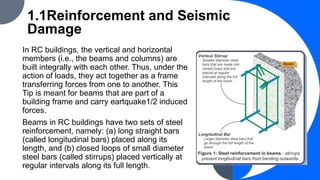
Beams in RC buildings have two sets of steel
reinforcement, namely: (a) long straight bars
(called longitudinal bars) placed along its
length, and (b) closed loops of small diameter
steel bars (called stirrups) placed vertically at
regular intervals along its full length.
1.2 DESIGN STRATEGY
Designing a beam involves the selection material properties
(i.e, grades of steel bars and conc... and shape and size; these
are usually selected as a part of an overall design strategy of
the whole building. And, the amount and distribution of steel to
be provided in the beam must be determined by performing
design calculations as per is:456-2000 and IS13920-1993.
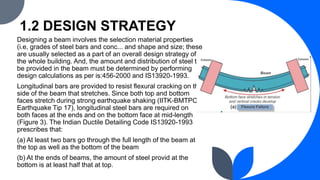
Longitudinal bars are provided to resist flexural cracking on the
side of the beam that stretches. Since both top and bottom
faces stretch during strong earthquake shaking (IITK-BMTPC
Earthquake Tip 17), longitudinal steel bars are required on
both faces at the ends and on the bottom face at mid-length
(Figure 3). The Indian Ductile Detailing Code IS13920-1993
prescribes that:
(a) At least two bars go through the full length of the beam at
the top as well as the bottom of the beam
(b) At the ends of beams, the amount of steel provid at the
bottom is at least half that at top.
•Stirrups in RC beams help in three ways, namely
(i) they carry the vertical shear force and thereby resist diagonal shear cracks in, (ii) they
protect the concrete from bulging outwards due to flexure, and
(iii) they prevent the buckling of the compressed longitudinal bars due to flexure.
In moderate to severe seismic zones, the Indian Standard IS13920-1993prescribes the
following requirements related to stirrups in reinforced concrete beams:
(a) The diameter of stirrup must be at least 6mm; in beams more than 5m long, it must be at
least 8mm.
(b) Both ends of the vertical stirrups should be bentinto a 135 deg hook and
extendedsufficiently beyond this hook to ensure that the stirrup does not open out in an
earthquake.
(b) The spacing of vertical stirrups in any portion of the beam should be determined from
calculations
(c) The maximum spacing of stirrups is less than half the depth of the beam .
(d) For a length of twice the depth of the beam from the face of the column, an even more
stringent spacing of stirrups is specified, namely half the spacing mentioned in (c) above .
2.1 Possible Earthquake Damage
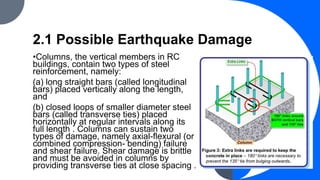
•Columns, the vertical members in RC
buildings, contain two types of steel
reinforcement, namely:
(a) long straight bars (called longitudinal
bars) placed vertically along the length,
and
(b) closed loops of smaller diameter steel
bars (called transverse ties) placed
horizontally at regular intervals along its
full length . Columns can sustain two
types of damage, namely axial-flexural (or
combined compression- bending) failure
and shear failure. Shear damage is brittle
and must be avoided in columns by
providing transverse ties at close spacing .
2.2 Design Strategy
Designing a column involves selection of materials to be used (i.e,
grades of concrete and steel bars), choosing shape and size of
the cross-section, and calculating amount and distribution of steel
reinforcement.
The first two aspects are part of the overall design strategy of the
whole building. The Indian Ductile Detailing Code IS:13920-1993
requires columns to be at least 300mm wide.
A column width of up to 200mm is allowed if unsupported length is
less than 4m a beam length is less than 5m. Columns that are
requi to resist earthquake forces must be designed prevent shear
failure by a skillful selection reinforcement.
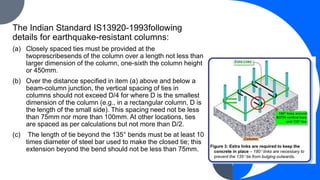
Vertical Bars tied together with Closed
Ties
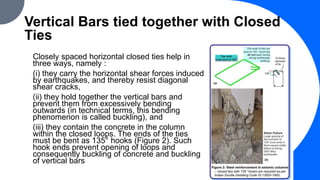
Closely spaced horizontal closed ties help in
three ways, namely :
(i) they carry the horizontal shear forces induced
by earthquakes, and thereby resist diagonal
shear cracks,
(ii) they hold together the vertical bars and
prevent them from excessively bending
outwards (in technical terms, this bending
phenomenon is called buckling), and
(iii) they contain the concrete in the column
within the closed loops. The ends of the ties
must be bent as 135° hooks (Figure 2). Such
hook ends prevent opening of loops and
consequently buckling of concrete and buckling
of vertical bars
The Indian Standard IS13920-1993following
details for earthquake-resistant columns:
(a) Closely spaced ties must be provided at the
twoprescribesends of the column over a length not less than
larger dimension of the column, one-sixth the column height
or 450mm.
(b) Over the distance specified in item (a) above and below a
beam-column junction, the vertical spacing of ties in
columns should not exceed D/4 for where D is the smallest
dimension of the column (e.g., in a rectangular column, D is
the length of the small side). This spacing need not be less
than 75mm nor more than 100mm. At other locations, ties
are spaced as per calculations but not more than D/2.
(c) The length of tie beyond the 135° bends must be at least 10
times diameter of steel bar used to make the closed tie; this
extension beyond the bend should not be less than 75mm.
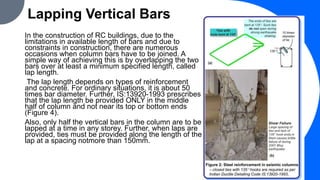
Lapping Vertical Bars
In the construction of RC buildings, due to the
limitations in available length of bars and due to
constraints in construction, there are numerous
occasions when column bars have to be joined. A
simple way of achieving this is by overlapping the two
bars over at least a minimum specified length, called
lap length.
The lap length depends on types of reinforcement
and concrete. For ordinary situations, it is about 50
times bar diameter. Further, IS:13920-1993 prescribes
that the lap length be provided ONLY in the middle
half of column and not near its top or bottom ends
(Figure 4).
Also, only half the vertical bars in the column are to be
lapped at a time in any storey. Further, when laps are
provided, ties must be provided along the length of the
lap at a spacing notmore than 150mm.
THANK
YOU

Jsjdjsjsjjeksksksksmsmmsmsmsmsmsmksksmmsnsns

  • 1.
    R.N.G.PATEL INSTITUTE OF TECHNOLOGY NO.NAME ENROLLMENT NO. 1. RAVAL SUJAL 210840106013 2. CHAUDHARI KRUNAL 210840106005 PREPARED BY: How do beams & columns in RC buildings resist earthquake
  • 2.
    CONTENT How do beamin RC Buildings Resist Earthquakes. 1.1 Reinforcement and Seismic Damage. 1.2 Design Strategy How do Columns in RC Building Resist Earthquakes. 2.1 Possible Earthquake Damage 2.2 Design Strategy
  • 3.
    1.1Reinforcement and Seismic Damage InRC buildings, the vertical and horizontal members (i.e., the beams and columns) are built integrally with each other. Thus, under the action of loads, they act together as a frame transferring forces from one to another. This Tip is meant for beams that are part of a building frame and carry eartquake1/2 induced forces. Beams in RC buildings have two sets of steel reinforcement, namely: (a) long straight bars (called longitudinal bars) placed along its length, and (b) closed loops of small diameter steel bars (called stirrups) placed vertically at regular intervals along its full length.
  • 4.
    1.2 DESIGN STRATEGY Designinga beam involves the selection material properties (i.e, grades of steel bars and conc... and shape and size; these are usually selected as a part of an overall design strategy of the whole building. And, the amount and distribution of steel to be provided in the beam must be determined by performing design calculations as per is:456-2000 and IS13920-1993. Longitudinal bars are provided to resist flexural cracking on the side of the beam that stretches. Since both top and bottom faces stretch during strong earthquake shaking (IITK-BMTPC Earthquake Tip 17), longitudinal steel bars are required on both faces at the ends and on the bottom face at mid-length (Figure 3). The Indian Ductile Detailing Code IS13920-1993 prescribes that: (a) At least two bars go through the full length of the beam at the top as well as the bottom of the beam (b) At the ends of beams, the amount of steel provid at the bottom is at least half that at top.
  • 5.
    •Stirrups in RCbeams help in three ways, namely (i) they carry the vertical shear force and thereby resist diagonal shear cracks in, (ii) they protect the concrete from bulging outwards due to flexure, and (iii) they prevent the buckling of the compressed longitudinal bars due to flexure. In moderate to severe seismic zones, the Indian Standard IS13920-1993prescribes the following requirements related to stirrups in reinforced concrete beams: (a) The diameter of stirrup must be at least 6mm; in beams more than 5m long, it must be at least 8mm. (b) Both ends of the vertical stirrups should be bentinto a 135 deg hook and extendedsufficiently beyond this hook to ensure that the stirrup does not open out in an earthquake. (b) The spacing of vertical stirrups in any portion of the beam should be determined from calculations (c) The maximum spacing of stirrups is less than half the depth of the beam . (d) For a length of twice the depth of the beam from the face of the column, an even more stringent spacing of stirrups is specified, namely half the spacing mentioned in (c) above .
  • 6.
    2.1 Possible EarthquakeDamage •Columns, the vertical members in RC buildings, contain two types of steel reinforcement, namely: (a) long straight bars (called longitudinal bars) placed vertically along the length, and (b) closed loops of smaller diameter steel bars (called transverse ties) placed horizontally at regular intervals along its full length . Columns can sustain two types of damage, namely axial-flexural (or combined compression- bending) failure and shear failure. Shear damage is brittle and must be avoided in columns by providing transverse ties at close spacing .
  • 7.
    2.2 Design Strategy Designinga column involves selection of materials to be used (i.e, grades of concrete and steel bars), choosing shape and size of the cross-section, and calculating amount and distribution of steel reinforcement. The first two aspects are part of the overall design strategy of the whole building. The Indian Ductile Detailing Code IS:13920-1993 requires columns to be at least 300mm wide. A column width of up to 200mm is allowed if unsupported length is less than 4m a beam length is less than 5m. Columns that are requi to resist earthquake forces must be designed prevent shear failure by a skillful selection reinforcement.
  • 8.
    Vertical Bars tiedtogether with Closed Ties Closely spaced horizontal closed ties help in three ways, namely : (i) they carry the horizontal shear forces induced by earthquakes, and thereby resist diagonal shear cracks, (ii) they hold together the vertical bars and prevent them from excessively bending outwards (in technical terms, this bending phenomenon is called buckling), and (iii) they contain the concrete in the column within the closed loops. The ends of the ties must be bent as 135° hooks (Figure 2). Such hook ends prevent opening of loops and consequently buckling of concrete and buckling of vertical bars
  • 9.
    The Indian StandardIS13920-1993following details for earthquake-resistant columns: (a) Closely spaced ties must be provided at the twoprescribesends of the column over a length not less than larger dimension of the column, one-sixth the column height or 450mm. (b) Over the distance specified in item (a) above and below a beam-column junction, the vertical spacing of ties in columns should not exceed D/4 for where D is the smallest dimension of the column (e.g., in a rectangular column, D is the length of the small side). This spacing need not be less than 75mm nor more than 100mm. At other locations, ties are spaced as per calculations but not more than D/2. (c) The length of tie beyond the 135° bends must be at least 10 times diameter of steel bar used to make the closed tie; this extension beyond the bend should not be less than 75mm.
  • 10.
    Lapping Vertical Bars Inthe construction of RC buildings, due to the limitations in available length of bars and due to constraints in construction, there are numerous occasions when column bars have to be joined. A simple way of achieving this is by overlapping the two bars over at least a minimum specified length, called lap length. The lap length depends on types of reinforcement and concrete. For ordinary situations, it is about 50 times bar diameter. Further, IS:13920-1993 prescribes that the lap length be provided ONLY in the middle half of column and not near its top or bottom ends (Figure 4). Also, only half the vertical bars in the column are to be lapped at a time in any storey. Further, when laps are provided, ties must be provided along the length of the lap at a spacing notmore than 150mm.
  • 11.