SYNAPSE
Dr Bishara P Pushkar
• Synapse is the junction between 2 neurons
• Specialized junction between a neuron and a muscle cell, gland cell or
receptor cell
Classification
• Anatomical
Axodendritic, axosomatic, axoaxonic
• Physiological/ Functional
Chemical, electrical, conjoint
Anatomical classification
Axodendritic
• 98% of cerebral cortical and 80% spinal cord synapse
Axosomatic
• 20% of spinal and 2% of cerebral cortical synapse
Axoaxonal
• Seen in spinal cord
Physiological / Functional classification
Chemical
• Synaptic cleft present
• NT from presynaptic neuron excite/ inhibit postsynaptic neuron
Electrical
• Pre and post synaptic cells come closer to form gap junction
• Ions pass through freely
• In lateral vestibular nucleus
Conjoint
• Both electrical and chemical transmission occurs
Structure of chemical synapse
• Components – Presynaptic nerve terminal, Synaptic cleft,
Post synaptic membrane
Presynaptic neuron
• Synaptic knob
• Mitochondria and synaptic vesicles
• Thickened regions- active zones
• Voltage gated Ca channels
Synaptic cleft
• 20-40 nm wide
Postsynaptic neuron
• Post synaptic density
• Receptor proteins
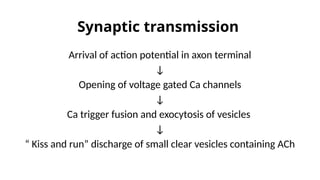
Synaptic transmission
Arrival of action potential in axon terminal
↓
Opening of voltage gated Ca channels
↓
Ca trigger fusion and exocytosis of vesicles
↓
“ Kiss and run” discharge of small clear vesicles containing ACh
↓
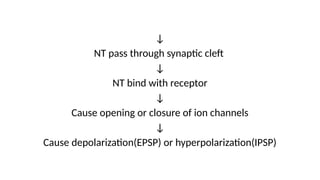
NT pass through synaptic cleft
↓
NT bind with receptor
↓
Cause opening or closure of ion channels
↓
Cause depolarization(EPSP) or hyperpolarization(IPSP)
Synaptic delay
• When an impulse reaches a presynaptic terminal an interval
of at least 0.5 ms occurs before a response is obtained in
post synaptic neuron
• Time taken for NT release and its action on receptor
• Determine whether the pathway is monosynaptic and
polysynaptic
Electrical events in post synaptic neuron
• EPSP (Excitatory postsynaptic potential)
• IPSP (Inhibitory postsynaptic potential)
• AP ( Action Potential)
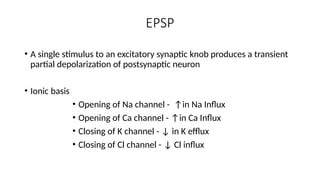
EPSP
• A single stimulus to an excitatory synaptic knob produces a transient
partial depolarization of postsynaptic neuron
• Ionic basis
• Opening of Na channel - ↑in Na Influx
• Opening of Ca channel - ↑in Ca Influx
• Closing of K channel - ↓ in K efflux
• Closing of Cl channel - ↓ Cl influx
Summation of EPSP
• Spatial summation –
• When > 1 synaptic knob is active at the same time their EPSP
summate to reach firing level -> produce AP
• Temporal summation
• Repeated activity of a synaptic knob in quick succession
cause temporal summation of EPSP -> produce AP
Action potential
• EPSP summate
• When +10-+15mv of depolarization occurs it reaches firing level and
AP is produced
• AP is propagated
IPSP
• When an inhibitory synaptic knob becomes active it cause
hyperpolarization of post synaptic neuron
• NT- GABA, Glycine
• Ionic basis
• Opening of Cl channel - ↑in Cl Influx
• Opening of K channel - ↑in K efflux
• Closing of Na channel - ↓ in Na influx
• Closing of Ca channel - ↓ Ca influx
Synaptic inhibition
• Presynaptic and postsynaptic inhibition
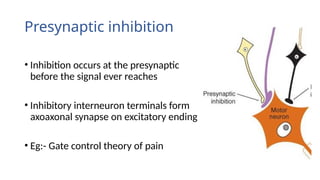
Presynaptic inhibition
• Inhibition occurs at the presynaptic terminals
before the signal ever reaches the synapse
• Inhibitory interneuron terminals form
axoaxonal synapse on excitatory ending
• Eg:- Gate control theory of pain
• Mechanism :-
• Inhibitory NT is released (eg:-GABA)
• Increase Cl influx or K efflux
Post synaptic inhibition
• DIRECT
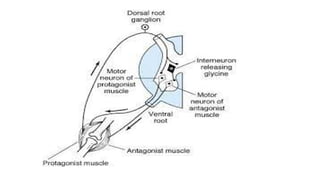
Reciprocal inhibition
• Afferent fiber from muscle spindle in skeletal muscle project
directly to spinal motor neuron supplying same muscle
• Produce EPSP  AP  muscle contraction
• At the same time, IPSPs are produced in the antagonistic muscle
via inhibitory interneuron interposed between afferent fiber and
motor neuron
• Antagonistic muscle relax
Renshaw cell inhibition
• Spinal motor neuron gives off collateral
that synapse with an inhibitory interneuron
• Interneuron terminate on spinal motor
neurons
• Impulses in motor neuron activate
interneuron to secrete inhibitory NT
• This decreases discharge from spinal motor
neuron
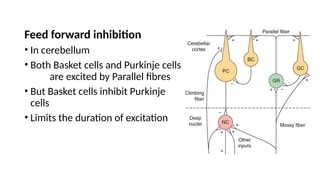
Feed forward inhibition
• In cerebellum
• Both Basket cells and Purkinje cells
are excited by Parallel fibres
• But Basket cells inhibit Purkinje
cells
• Limits the duration of excitation
• INDIRECT
• Inhibition due to effect of previous discharge of post synaptic
neuron
• Post synaptic neuron is in its absolute refractory period
• Or during after hyper polarization it is less excitable
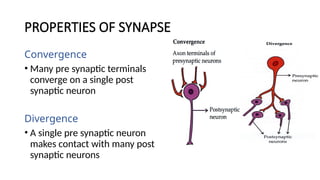
PROPERTIES OF SYNAPSE
Convergence
• Many pre synaptic terminals
converge on a single post
synaptic neuron
Divergence
• A single pre synaptic neuron
makes contact with many post
synaptic neurons
One way conduction
• Neurotransmitter vesicles are present only in presynaptic neuron
Synaptic delay
Synaptic inhibition
Summation
Fatigue
• Repeated stimulation of presynaptic neurons leads to gradual
decrease and final disappearance of postsynaptic response
• d/t exhaustion of chemical transmitter
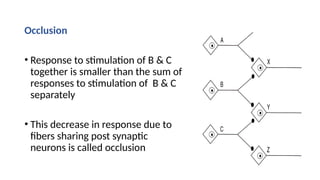
Occlusion
• Response to stimulation of B & C
together is smaller than the sum of
responses to stimulation of B & C
separately
• This decrease in response due to pre synaptic
fibers sharing post synaptic
neurons is called occlusion
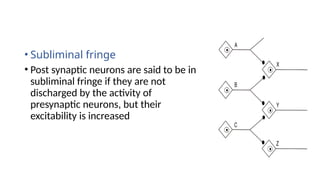
• Subliminal fringe
• Post synaptic neurons are said to be in
subliminal fringe if they are not
discharged by the activity of
presynaptic neurons, but their
excitability is increased
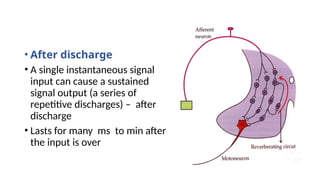
• After discharge
• A single instantaneous signal
input can cause a sustained
signal output (a series of
repetitive discharges) – after
discharge
• Lasts for many ms to min after
the input is over
Synaptic plasticity
• Refers to capability of being easily moulded or changed
• Synaptic transmission can be increased or decreased on the
basis of past experience
• Basis of learning and memory

SYNAPSE between neurons and classification

  • 1.
  • 2.
    • Synapse isthe junction between 2 neurons • Specialized junction between a neuron and a muscle cell, gland cell or receptor cell
  • 3.
    Classification • Anatomical Axodendritic, axosomatic,axoaxonic • Physiological/ Functional Chemical, electrical, conjoint
  • 4.
    Anatomical classification Axodendritic • 98%of cerebral cortical and 80% spinal cord synapse Axosomatic • 20% of spinal and 2% of cerebral cortical synapse Axoaxonal • Seen in spinal cord
  • 5.
    Physiological / Functionalclassification Chemical • Synaptic cleft present • NT from presynaptic neuron excite/ inhibit postsynaptic neuron Electrical • Pre and post synaptic cells come closer to form gap junction • Ions pass through freely • In lateral vestibular nucleus Conjoint • Both electrical and chemical transmission occurs
  • 6.
    Structure of chemicalsynapse • Components – Presynaptic nerve terminal, Synaptic cleft, Post synaptic membrane Presynaptic neuron • Synaptic knob • Mitochondria and synaptic vesicles • Thickened regions- active zones • Voltage gated Ca channels
  • 7.
    Synaptic cleft • 20-40nm wide Postsynaptic neuron • Post synaptic density • Receptor proteins
  • 8.
    Synaptic transmission Arrival ofaction potential in axon terminal ↓ Opening of voltage gated Ca channels ↓ Ca trigger fusion and exocytosis of vesicles ↓ “ Kiss and run” discharge of small clear vesicles containing ACh
  • 9.
    ↓ NT pass throughsynaptic cleft ↓ NT bind with receptor ↓ Cause opening or closure of ion channels ↓ Cause depolarization(EPSP) or hyperpolarization(IPSP)
  • 10.
    Synaptic delay • Whenan impulse reaches a presynaptic terminal an interval of at least 0.5 ms occurs before a response is obtained in post synaptic neuron • Time taken for NT release and its action on receptor • Determine whether the pathway is monosynaptic and polysynaptic
  • 11.
    Electrical events inpost synaptic neuron • EPSP (Excitatory postsynaptic potential) • IPSP (Inhibitory postsynaptic potential) • AP ( Action Potential)
  • 12.
    EPSP • A singlestimulus to an excitatory synaptic knob produces a transient partial depolarization of postsynaptic neuron • Ionic basis • Opening of Na channel - ↑in Na Influx • Opening of Ca channel - ↑in Ca Influx • Closing of K channel - ↓ in K efflux • Closing of Cl channel - ↓ Cl influx
  • 13.
    Summation of EPSP •Spatial summation – • When > 1 synaptic knob is active at the same time their EPSP summate to reach firing level -> produce AP • Temporal summation • Repeated activity of a synaptic knob in quick succession cause temporal summation of EPSP -> produce AP
  • 14.
    Action potential • EPSPsummate • When +10-+15mv of depolarization occurs it reaches firing level and AP is produced • AP is propagated
  • 15.
    IPSP • When aninhibitory synaptic knob becomes active it cause hyperpolarization of post synaptic neuron • NT- GABA, Glycine • Ionic basis • Opening of Cl channel - ↑in Cl Influx • Opening of K channel - ↑in K efflux • Closing of Na channel - ↓ in Na influx • Closing of Ca channel - ↓ Ca influx
  • 16.
    Synaptic inhibition • Presynapticand postsynaptic inhibition
  • 17.
    Presynaptic inhibition • Inhibitionoccurs at the presynaptic terminals before the signal ever reaches the synapse • Inhibitory interneuron terminals form axoaxonal synapse on excitatory ending • Eg:- Gate control theory of pain
  • 18.
    • Mechanism :- •Inhibitory NT is released (eg:-GABA) • Increase Cl influx or K efflux
  • 19.
    Post synaptic inhibition •DIRECT Reciprocal inhibition • Afferent fiber from muscle spindle in skeletal muscle project directly to spinal motor neuron supplying same muscle • Produce EPSP  AP  muscle contraction • At the same time, IPSPs are produced in the antagonistic muscle via inhibitory interneuron interposed between afferent fiber and motor neuron • Antagonistic muscle relax
  • 21.
    Renshaw cell inhibition •Spinal motor neuron gives off collateral that synapse with an inhibitory interneuron • Interneuron terminate on spinal motor neurons • Impulses in motor neuron activate interneuron to secrete inhibitory NT • This decreases discharge from spinal motor neuron
  • 22.
    Feed forward inhibition •In cerebellum • Both Basket cells and Purkinje cells are excited by Parallel fibres • But Basket cells inhibit Purkinje cells • Limits the duration of excitation
  • 23.
    • INDIRECT • Inhibitiondue to effect of previous discharge of post synaptic neuron • Post synaptic neuron is in its absolute refractory period • Or during after hyper polarization it is less excitable
  • 24.
    PROPERTIES OF SYNAPSE Convergence •Many pre synaptic terminals converge on a single post synaptic neuron Divergence • A single pre synaptic neuron makes contact with many post synaptic neurons
  • 25.
    One way conduction •Neurotransmitter vesicles are present only in presynaptic neuron Synaptic delay Synaptic inhibition Summation Fatigue • Repeated stimulation of presynaptic neurons leads to gradual decrease and final disappearance of postsynaptic response • d/t exhaustion of chemical transmitter
  • 26.
    Occlusion • Response tostimulation of B & C together is smaller than the sum of responses to stimulation of B & C separately • This decrease in response due to pre synaptic fibers sharing post synaptic neurons is called occlusion
  • 27.
    • Subliminal fringe •Post synaptic neurons are said to be in subliminal fringe if they are not discharged by the activity of presynaptic neurons, but their excitability is increased
  • 28.
    • After discharge •A single instantaneous signal input can cause a sustained signal output (a series of repetitive discharges) – after discharge • Lasts for many ms to min after the input is over
  • 29.
    Synaptic plasticity • Refersto capability of being easily moulded or changed • Synaptic transmission can be increased or decreased on the basis of past experience • Basis of learning and memory

Editor's Notes

  • #4 Dendrodentritic between mitral and granule cells of olfactory bulb