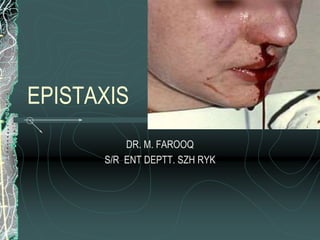
EPISTAXIS
DR. M. FAROOQ
S/R ENT DEPTT. SZH RYK
CONTENTS
DEFINITION
SURGICAL ANATOMY
BLOOD SUPPLY
EPIDEMIOLOGY
CLASSIFICATION
MANAGEMENT
EPISTAXIS
Definition
Bleeding from nose
Greek word- Epistazo ( Epi + Stazo)
Epi - Over / above
Stazo- To drip (from nostrils)
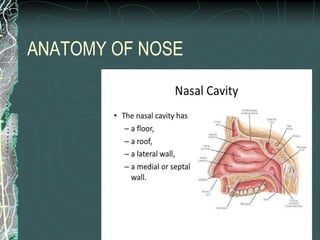
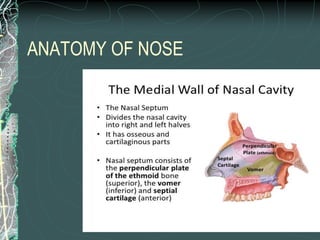
ANATOMY OF NOSE
ANATOMY OF NOSE
ANATOMY OF NOSE
BLOOD SUPPLY
Arterial supply
Ext. Carotid A
Int. Carotid A
Venous Drainage
Facial V
Pterygoid Plexus
Ant. & Post. Ethmoidal Veins
External Carotid Artery
-Sphenopalatine artery
-Greater palatine artery
-Ascending pharyngeal artery
-Posterior nasal artery
-Superior Labial artery
Internal Carotid Artery
-Anterior Ethmoid artery
-Posterior Ethmoid artery
BLOOD SUPPLY
BLOOD SUPPLY
BLOOD SUPPLY
BLOOD SUPPLY
EPIDEMIOLOGY
30% of ENT Admission
Age
Sex
Season
Area / Region
CLASSIFICATION
On the basis of
Etiology - Primary /Secondary
Age - Children / Adult
Site - Ant. / Post.
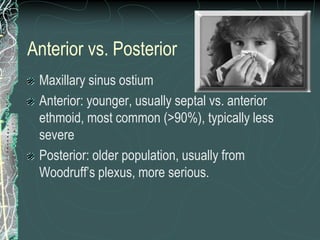
Anterior vs. Posterior
Maxillary sinus ostium
Anterior: younger, usually septal vs. anterior
ethmoid, most common (>90%), typically less
severe
Posterior: older population, usually from
Woodruff’s plexus, more serious.
CAUSES OF EPISTAXIS
Local Causes
General / systemic Causes
Idiopathic Causes
LOCAL CAUSES
Nose
Trauma
Infections
Foreign bodies
Neoplasm
Atmospheric changes
DNS
LOCAL CAUSES
Nasopharynx
Infection
Neoplasm
GENERAL CAUSES
Cardiovascular System
HTN, Mitral stenosis, Pregnancy.
Disorders of Blood & blood Vessels
Aplastic Anaemia, Leukaemia,
Thrombocytopaenias, Vascular Purpura,
Haemophilia, Scurvy, Vit K Defficiency.
GENERAL CAUSES
Liver Disease - Cirrhosis
Kidney Disease- Ch. Nephritis
Drugs- NSAIDS, Anticoagulants (Warfarin)
Mediastinal Compression
Accute General infections-
Measles, Chicken pox.
MANAGEMENT
Aims of Management
To stop blood loss
To replace blood loss
To find out the cause and treat it
MANAGEMENT
MANAGEMENT – Diagnosis+Treatment
Diagnosis
History
Examination
Investigations
CBC
Bleeding & clotting profiles
Radiology - Angiography
MANAGEMENT
Treatment -Hierarchy of treatment
General Measures
Direct Therapy - Primary Epistaxis
Indirect Therapy - Secondary Epistaxis
Surgical Options - Sec. Epistaxis
MANAGEMENT PLAN
Initial Management
ABC’s
Medical history/Medications
Vital signs—need IV?
Physical exam
Anterior rhinoscopy
Endoscopic rhinoscopy
Laboratory exam
Radiologic studies
Non-surgical treatments
Control of hypertension
Correction of coagulopathies/thrombocytopenia
FFP or whole blood/reversal of anticoagulant/platelets
Pressure/Expulsion of clots
Topical decongestants/vasocontrictors
Cautery (AgNo3 , Bipolar)
Nasal packing (effective 80-90% of time)
Nasal packs
Anterior nasal packs
Traditional
Recent modifications
Posterior nasal packs
Traditional
Recent modifications
Ant/Post nasal packing
TSS—Nugauze vs. Merocel
Electron microscopy
Posterior Packs – Admission
Elderly and those with other chronic diseases
may need to be admitted to the ICU
Continuous cardiopulmonary monitoring
Antibiotics
Oxygen supplementation may be needed
Mild sedation/analgesia
IVF
Indications for surgery/embolization
Continued bleeding despite nasal packing
Pt requires transfusion/admit hct of <38%
(barlow)
Nasal anomaly precluding packing
Patient refusal/intolerance of packing
Posterior bleed vs. failed medical mgmt after
>72hrs (wang vs. schaitkin)
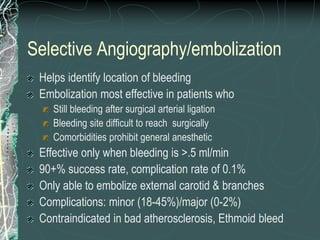
Selective Angiography/embolization
Helps identify location of bleeding
Embolization most effective in patients who
Still bleeding after surgical arterial ligation
Bleeding site difficult to reach surgically
Comorbidities prohibit general anesthetic
Effective only when bleeding is >.5 ml/min
90+% success rate, complication rate of 0.1%
Only able to embolize external carotid & branches
Complications: minor (18-45%)/major (0-2%)
Contraindicated in bad atherosclerosis, Ethmoid bleed
Surgical treatment
Transmaxillary IMA ligation
Intraoral IMA ligation
Anterior/Posterior Ethmoidal ligation
Transnasal Sphenopalatine ligation
External carotid artery ligation
Septodermoplasty/Laser ablation
Transmaxillary IMA ligation
Waters view
Caldwell-Luc
Electrocautery of posterior wall before removal
Microscopic dissection and ligation of IMA --
descending palatine & sphenopalantine most
important
Recurrence rate (failure rate) of 10-15%
Complication rate of 25-30% (oa fistula,dental, n)
Intraoral IMA ligation
Posterior gingivobuccal incision beginning at
second molar
Temporalis mm split and partially dissected
IMAX visualized, clipped and divided
Advantages: children/facial fractures
Disadvantages: more proximal ligation
Complications: trismus, damage to infraorbital n
Ant./Post. Ethmoidal ligation
Patients s/p IMAX ligation still bleeding, superior
nasal cavity epistaxis, or in conjunction when
source unclear
Lynch incision
Fronto-ethmoid
suture line
12-24-6
(14-18, 8-10, 4-6)
Transnasal Endoscopic
Sphenopalatine Artery ligation
Follow Middle Turbinate to posteriormost aspect
Vertical mucoperiosteal incision 7-8mm anterior
to post middle turb (between mid. and inf. turbs)
Elevation of flap—ID neurovascular bundle at
foramen
Ligation with titanium clip
Reapproximate flap
Complications –few, Failures—0-13%
THANK………….
YOU……………….

Epistaxis new