Epistaxsis
Imanuel Darbiantoro Sihotang
H. R. Yusa Herwanto
Introduction
✘ Nose: an important organ that is often exposed to the environment + the nasal
cavity is heavily bleed by blood vessels located on the surface, trauma, the risk of
epistaxis
✘ Epistaxis (nosebleeds) one of the most common ENT emergencies that come to
the ER or primary health facility
○ Epistaxis: symptoms or manifestations of other diseases. Causes: local, systemic and
idiopathic
✘ Classification of epistaxis based on location:
○ Anterior epistaxis usually mild, stops spontaneously or can be controlled by simple measures
○ Posterior apistaxis: difficult to identify and treat  medical treatment
✘ Severe epistaxis: rare an emergency that can be fatal if not treated immediately
Estimated that around 60% of the world's population has
experienced epistaxis at least once in their life and only 6-10%
will develop severe epistaxis medical treatment
Severe epistaxis : characterized by severe/massive bleeding,
difficult to stop and respiratory irregularities  need medical
treatment, giving bad experiences and worries
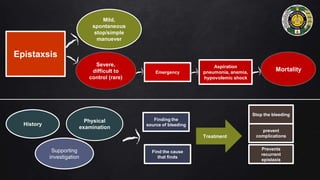
Emergency
Severe,
difficult to
control (rare)
Epistaxsis
Mild,
spontaneous
stop/simple
manuever
Aspiration
pneumonia, anemia,
hypovolemic shock
Mortality
History
Physical
examination
Supporting
investigation
Finding the
source of bleeding
Find the cause
that finds
Stop the bleeding
prevent
complications
Prevents
recurrent
epistaxis
Treatment
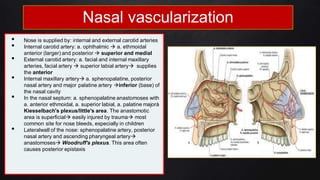
Nasal vascularization
• Nose is supplied by: internal and external carotid arteries
• Internal carotid artery: a. ophthalmic  a. ethmoidal
anterior (larger) and posterior  superior and medial
• External carotid artery: a. facial and internal maxillary
arteries, facial artery  superior labial artery supplies
the anterior
• Internal maxillary artery a. sphenopalatine, posterior
nasal artery and major palatine artery inferior (base) of
the nasal cavity
• In the nasal septum: a. sphenopalatine anastomoses with
a. anterior ethmoidal, a. superior labial, a. palatine majorà
Kiesselbach's plexus/little's area. The anastomotic
area is superficial easily injured by trauma most
common site for nose bleeds, especially in children
• Lateralwall of the nose: sphenopalatine artery, posterior
nasal artery and ascending pharyngeal artery
anastomoses Woodruff's plexus. This area often
causes posterior epistaxis
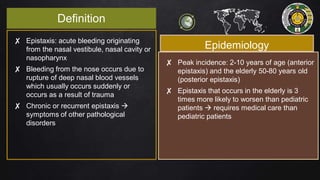
Definition
✘ Epistaxis: acute bleeding originating
from the nasal vestibule, nasal cavity or
nasopharynx
✘ Bleeding from the nose occurs due to
rupture of deep nasal blood vessels
which usually occurs suddenly or
occurs as a result of trauma
✘ Chronic or recurrent epistaxis 
symptoms of other pathological
disorders
✘ Peak incidence: 2-10 years of age (anterior
epistaxis) and the elderly 50-80 years old
(posterior epistaxis)
✘ Epistaxis that occurs in the elderly is 3
times more likely to worsen than pediatric
patients  requires medical care than
pediatric patients
Epidemiology
Classification
1. Anterior apistaxis
✘ About 80-90%, epistaxis occurs along the anterior
nasal septum, mostly from Kiesselbach's
plexus/little's area
✘ Bleeding into smaller vessels and easily
identifiable location pressure (nose lobe or
anterior tampons), electrocautery, topical
treatment or stops spontaneously
2. Posterior epistaxis
✘ About 10% of episodes of epistaxis are of
posterior origin.
✘ Bleeding originates from Woodruff's plexus
which is located posteriorly  more difficult to
identify and treat.
✘ Condition is more risky for aspiration and requires
medical treatment
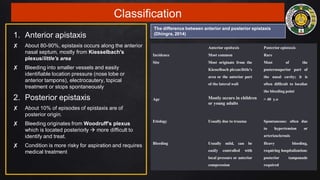
Anterior epsitaxis Posterior epistaxis
Incidence Most common Rare
Site Most originate from the
Kiesselbach plexus/little's
area or the anterior part
of the lateral wall
Most of the
posterosuperior part of
the nasal cavity; it is
often difficult to localize
the bleeding point
Age Mostly occurs in children
or young adults
> 40 y.o
Etiology Usually due to trauma Spontaneous: often due
to hypertension or
arteriosclerosis
Bleeding Usually mild, can be
easily controlled with
local pressure or anterior
compression
Heavy bleeding,
requiring hospitalization:
posterior tamponade
required
The difference between anterior and posterior epistaxis
(Dhingra, 2014)
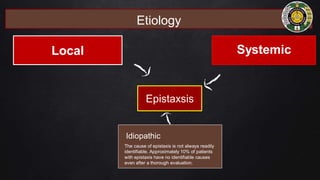
Etiology
Systemic
Idiopathic
The cause of epistaxis is not always readily
identifiable. Approximately 10% of patients
with epistaxis have no identifiable causes
even after a thorough evaluation.
Epistaxsis
Local
• Trauma
○ Minor trauma: picking the nose, minor impact, sneezing or blowing too hard
○ Severe trauma such as being hit, falling or traffic accidents, sharp foreign objects in the nose, surgical trauma, inserting a
nasogastric tube and a nasotracheal tube
• Infection
• Acute : viral rhinitis, rhinosinusitis
• Chronic : any crust-forming disease, eg. atrophic tuberculous rhinitis
• Foreign body: sharp foreign body or surgical trauma
• Neoplasm of the nose and paranasal sinuses (hemangioma and angiofibroma): characterized by
mucus with blood spots
Neurovasculrization fragile bleeding
• Atmospheric changes
Temperatures that are too hot or too cold can also affect local factors causing dryness of the nasal mucosa
• Septum deviation
Deviated septum changes in air turbulence  dry nasal mucosa and stiff blood vessels crusta ulceration  bleeding
Etiology
Local
Etiology
Systemic
✘ Cardiovascular system
○ Hypertension : blood pressure against the walls of blood vessels↑àvessel rupture
○ Arteriosclerosis  blood vessel occlusion  rupture
✘ Blood and blood vessel disorders
○ Trombocytopenia
○ Hemophilia: hereditary (X-linked recessive) coagulation disorders, deficiency of clotting factor VIII (hemophilia A) and IX (hempfilia
B) blood clotting disorders
○ Leukemia: formation of leukocytes ↑  suppression of the formation of other blood cells in the bone marrow (platelets)
thrombocytopenia  epistaxis, bleeding gums, purpura
○ Rendu Osler Weber syndrome (hereditary hemorrhagic telangiectasia) : congenital abnormalities loss of elasticity and contractility
of blood vessels  minor traumableeding
✘ Liver disorders : cirrhosis of the liver  impaired formation of fibrinogen, prothrombin, factors V, VII, IX, X and vitamin K à bleeding
✘ Drugs (warfarin and heparin ), antiplatelet (aspirin and clopidogrel) excessive  epistaxis
✘ Compression mediastinum : tumor medi astinum
✘ Acute systemic infection : dengue infection thrombocytopenia bleeding
✘ Hormonal changes
○ Pregnancy: estrogen and progesterone ↑ nasal mucosa vascularization ↑ swollen and fragile mucosa  epistaxis
○ Menstruation : estrogen↓  capillaries stiff and brittle epistaxis
Pathophysiology
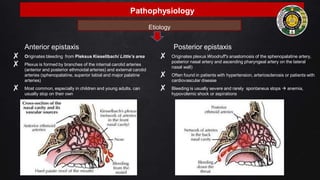
Anterior epistaxis
✘ Originates bleeding from Pleksus Kiesellbach/ Little’s area
✘ Plexus is formed by branches of the internal carotid arteries
(anterior and posterior ethmoidal arteries) and external carotid
arteries (sphenopalatine, superior labial and major palatine
arteries)
✘ Most common, especially in children and young adults. can
usually stop on their own
Posterior epistaxis
✘ Originates plexus Woodruff's anastomosis of the sphenopalatine artery,
posterior nasal artery and ascending pharyngeal artery on the lateral
nasal wall)
✘ Often found in patients with hypertension, arteriosclerosis or patients with
cardiovascular disease
✘ Bleeding is usually severe and rarely spontaneus stops  anemia,
hypovolemic shock or aspirations
Etiology
Diagnosis
Diagnosis : History + Physical examination
History
• Early onset of bleeding: minor trauma to the anterior nasal septum such as the habit of picking the nose
• Amount and duration of bleeding, blood loss, if not severe not a systemic problem
• History of previous bleeding
• Symptoms prior to onset important to ask include sensation of nasal congestion and pain nose or face
• The time and number of previous nosebleeds and their resolution should be identified.
• Prior medical history, known bleeding disorders (including family history) and platelet or coagulation disorders, cancer, liver
cirrhosis, menstruation and pregnancy
• History of taking drugs such as warfarin or aspirin.
• If there is recurrent nasal bleeding, easy bruising or signs of bleeding systemic causes are suspected and a hematological
examination is recommended
• If anterior bleeding sites have been identified  no need for laboratory tests
Diagnosis(continue)
Physical examination
1. Vital sign
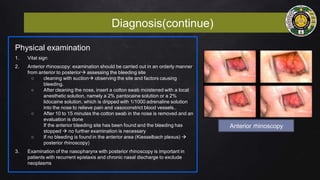
2. Anterior rhinoscopy: examination should be carried out in an orderly manner
from anterior to posterior assessing the bleeding site
○ cleaning with suction observing the site and factors causing
bleeding.
○ After cleaning the nose, insert a cotton swab moistened with a local
anesthetic solution, namely a 2% pantocaine solution or a 2%
lidocaine solution, which is dripped with 1/1000 adrenaline solution
into the nose to relieve pain and vasoconstrict blood vessels..
○ After 10 to 15 minutes the cotton swab in the nose is removed and an
evaluation is done
If the anterior bleeding site has been found and the bleeding has
stopped  no further examination is necessary
○ If no bleeding is found in the anterior area (Kiesselbach plexus) 
posterior rhinoscopy)
3. Examination of the nasopharynx with posterior rhinoscopy is important in
patients with recurrent epistaxis and chronic nasal discharge to exclude
neoplasms
Anterior rhinoscopy
Laboratory test
• In general, there is no need for laboratory tests for epistaxis (not repeated and there
is a history of trauma
• Significant blood loss laboratory tests
• Leukemia or malignancy complete blood count
• PT, aPTT examination: history of taking anti-coagulation drugs such as heparin and warfarin
Suspected disorder coagulopathy complete blood count examination is also carried out
prothrombin time (PT), activated partial thromboplastin time (aPTT) and bleeding time
• Sinus head photo and CT-Scan or MRI
• Head x-ray examination
Viewing the paranasal sinuses, details of the bones of the head, base of the head and facial bony
structures nasal fracture and facial trauma  suspected, and important to identify neoplasm or
infection
• Nasal endoscopy
Endoscopy to identify bleeding or rule out other diseases
Differential Diagnosis
✘ Bleeding that does not come from the nose but blood flows out of
the nose:
1. Hemoptysis
2. Esophageal varices
3. Bleeding at the base of the cranium which then flows through
the sphenoid sinus or eustachian tube
Management
to stop the bleeding
• Suppression of the nostrils/ala nasi
• Cauterization
• Packs
• Arterial ligation
• Embolization
Prevent recurrence of epistaxis
Prevent complications
• Prevention of complications due to
epistaxis
• Complications due to treatment of
epistaxis
Main principles of management
To stop bleeding
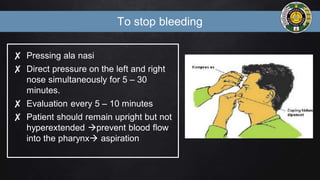
✘ Pressing ala nasi
✘ Direct pressure on the left and right
nose simultaneously for 5 – 30
minutes.
✘ Evaluation every 5 – 10 minutes
✘ Patient should remain upright but not
hyperextended prevent blood flow
into the pharynx aspiration
Cauterization
✘ Originate bleeding from Kiesselbach's plexus with mild bleeding
chemical cauterization
1. Local anesthesia using a cotton tampon that has been moistened with a combination of topical
4% lidocaine with 1:100,000 epinephrine or a combination of 4% topical lidocaine and 0.5%
penylephrine.
2. The pack is inserted in the nasal cavity and left for 5-10 minutes to provide local anesthetic and
vasoconstrictive effects
3. Take out the pack
4. Grease the bleeding site with a 20 – 30% silver nitrate solution or with 10% trichloracetic acid
until a colored crust appears yellowish  sign superficial necrosis
5. Cauterization is not performed on both sides of the septumcausing perforation.
Electrocauterization
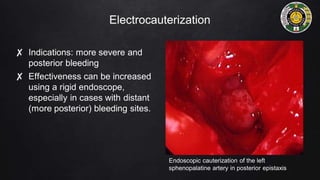
✘ Indications: more severe and
posterior bleeding
✘ Effectiveness can be increased
using a rigid endoscope,
especially in cases with distant
(more posterior) bleeding sites.
Endoscopic cauterization of the left
sphenopalatine artery in posterior epistaxis
Anterior Nasal Packing
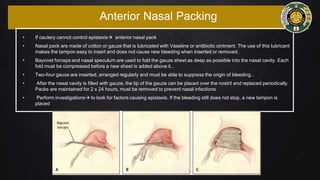
• If cautery cannot control epistaxis anterior nasal pack
• Nasal pack are made of cotton or gauze that is lubricated with Vaseline or antibiotic ointment. The use of this lubricant
makes the tampon easy to insert and does not cause new bleeding when inserted or removed.
• Bayonet forceps and nasal speculum are used to fold the gauze sheet as deep as possible into the nasal cavity. Each
fold must be compressed before a new sheet is added above it..
• Two-four gauze are inserted, arranged regularly and must be able to suppress the origin of bleeding..
• After the nasal cavity is filled with gauze, the tip of the gauze can be placed over the nostril and replaced periodically.
Packs are maintained for 2 x 24 hours, must be removed to prevent nasal infections
• Perform investigations to look for factors causing epistaxis. If the bleeding still does not stop, a new tampon is
placed
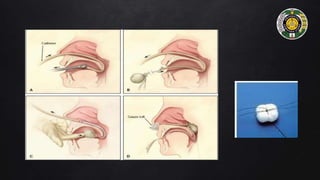
✘ Posterior bleeding: severe and difficult to identify posterior nasal pack ( Bellocq tampon)
✘ This tampon is made of solid gauze in cubes or round shapes with a diameter of 3 cm
✘ This tampon contains 3 threads, 2 on one side and one on the opposite side
✘ To put a posterior tampon on one-sided bleeding, a rubber catheter is used which is inserted
from the nostril until it is visible in the oropharynx, then pulled out of the mouth and can be
drawn.
✘ The tampon needs to be pushed with the help of the index finger to be able to pass through the
soft palate into the nasopharynx
✘ The two threads that come out of the nose are tied to a roll of gauze in front of the anterior
nares, so that the tampon located in the nasopharynx stays in place
✘ Another thread that comes out of the mouth loosely tied to the patient's cheek
✘ If there is still bleeding, an anterior tampon can be added into the nasal cavity
Posterior Nasal Packing
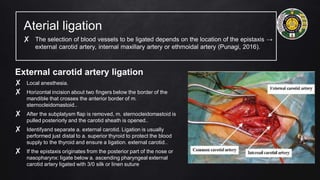
Aterial ligation
✘ The selection of blood vessels to be ligated depends on the location of the epistaxis →
external carotid artery, internal maxillary artery or ethmoidal artery (Punagi, 2016).
External carotid artery ligation
✘ Local anesthesia.
✘ Horizontal incision about two fingers below the border of the
mandible that crosses the anterior border of m.
sternocleidomastoid..
✘ After the subplatysm flap is removed, m. sternocleidomastoid is
pulled posteriorly and the carotid sheath is opened..
✘ Identifyand separate a. external carotid. Ligation is usually
performed just distal to a. superior thyroid to protect the blood
supply to the thyroid and ensure a ligation. external carotid..
✘ If the epistaxis originates from the posterior part of the nose or
nasopharynx: ligate below a. ascending pharyngeal external
carotid artery ligated with 3/0 silk or linen suture
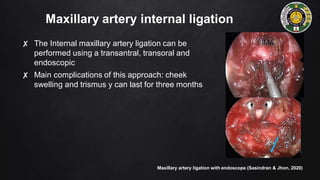
Maxillary artery internal ligation
✘ The Internal maxillary artery ligation can be
performed using a transantral, transoral and
endoscopic
✘ Main complications of this approach: cheek
swelling and trismus y can last for three months
Maxillary artery ligation with endoscope (Sasindran & Jhon, 2020)
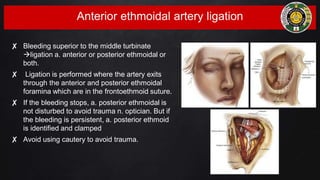
Anterior ethmoidal artery ligation
✘ Bleeding superior to the middle turbinate
ligation a. anterior or posterior ethmoidal or
both.
✘ Ligation is performed where the artery exits
through the anterior and posterior ethmoidal
foramina which are in the frontoethmoid suture.
✘ If the bleeding stops, a. posterior ethmoidal is
not disturbed to avoid trauma n. optician. But if
the bleeding is persistent, a. posterior ethmoid
is identified and clamped
✘ Avoid using cautery to avoid trauma.
Embolization
✘ Evaluation a. internal and external carotid → angiography
✘ Bleeding from the external carotid artery system can be
embolized. Embolization is performed on the interna and
externa maxillary arteries
Pharmacological therapy during epistaxis
Topikal vasocontrictor
✘ Act on alpha-adrenergic receptors in
the nasal mucosa,vasoconstriction
stop bleeding and decongestion
○ Oxymetazoline 0.05% (Afrin)
intranasal
○ Oxymetazoline is usually
combined with lidocaine
4%anesthetic and
vasoconstrictioni
Local anesthetics
✘ Combination of
anesthetic+vasoconstrictor → reduces
pain
✘ Lidocaine 4% (Xylocaine)
✘ Reduces permeability to sodium ions in
nerve membranes→inhibits
depolarization→ inhibits nerve impulse
transmission
Vasoconstrictors, local anesthetics and topical antibiotics
Pharmacological Therapy (continue)
Topical antibiotic
✘ Prevents local infection due to rupture of blood vessels
✘ Muporicin ointment 2% (Bactroban nasal)
✘ Mupirocin ointment → inhibits bacterial growth by
inhibiting RNA and protein synthesis
Pharmacological Therapy
✘ In recurrent or severe
epistaxis
✘ Treatment depends on
the existing disease, the
experience of the
treating physician and
the availability of
additional services
Medical approach:
✘ Adequate pain control in patients with nasal
tamponade, especially posterior tamponade.
○ Oral and topical antibiotics to prevent
rhinosinusitis and possible septic shock.
○ Avoiding aspirin and other nonsteroidal anti-
inflammatory drugs (NSAIDs)
○ Medications to control underlying medical
problems (eg, hypertension, vitamin K
deficiency) in consultation with other
specialists
Prevent complications
✘ Complications due to epistaxis itself: anemia, hypovolemic shock,
aspiration pneumonia
○ Infusion or blood transfusion should be done as soon as possible
○ Rupture blood vessel infectiongiven antibiotics
✘ Complications of coping efforts: rhinosinusitis, bloody tears,
septicemia (anterior epistaxis); otitis media,
hematohaemotympanum, and lacerations of the soft palate and
the corners of the lips (posterior epistaxis
○ Give antibiotics at every insertion of nasal tampons for 2-3 days. If
bleeding still persists new tampon.
Prevents recurrent epistaxis
✘ Knowing the underlying disease complete blood count, CT scan, blood sugar,
hemostasis treatment (hypertension, thrombocytopenia, coagulopathy)
✘ There are several ways to prevent epistaxis, including
a. Use nasal spray or drops of saline solution, two to three times a day
b. Use device for humidifying the air in the house.
c. Use a water-soluble nasal gel on the nose with a cotton bud. Do not insert
the cotton swab more than 0.5 – 0.6 cm into the nose.
d. Avoid blowing your nose too hard.
e. Sneezing through the mouth
f. Avoid inserting hard objects into the nose, including fingers
g. Limit the use of drugs - drugs that can increase bleeding such as aspirin or
ibuprofen
h. Consultation with a doctor if allergies can no longer
i. Quit smoking.
Prognosis
✘ Ninety percent cases of anterior epistaxis will resolve on their own.
✘ In hypertensive patients with/without arteriosclerosis, bleeding is
usually heavy, relapses frequently and the prognosis is poor
Conclusion
✘ Epistaxis is not a disease, but a symptom of a disease.
✘ Generally, this condition often occurs in children aged 2 to 10 years
(anterior epistaxis) and elderly people aged 50 to 80 years with a history of
hypertension or arteriosclerosis and requires more medical treatment
(posterior epistaxis)
✘ Anterior epistaxis originates from the Kiesselbach plexus (Little's area),
whereas posterior epistaxis originates from the Woodruf plexus. Broadly
speaking, the causes of epistaxis are broadly grouped into local factors and
systemic factors
✘ The principle of handling epistaxis is to stop bleeding, prevent
complications and prevent recurrence of epistaxis.
References
• American Rhinologic Society. 2015. Epistaxis (Nosebleeds). ARS [Internet]. Available from:
http://care.americanrhinologic.org/epistaxis
• David, A. R, M., 2020. ‘Simplified management of epistaxis’. Journal of the American Association of Nurse Practitioners,
00(00), pp. 1-5
• Dhingra, P. L., Dhingra, S. 2014. Epistaxis in Diseases of Ear, Nose and Throat Head & and Neck Surgery, 4th edn.
Elsevier. India, pp: 4-5, 70., 4th edn, Elsevier, India, pp. 176-180
• Guyton and Hall, 2016, Textbook of Medical Physiology, Canada : Elsevier
• Jason, P. W. M., Jill, K. M., Marissa, J. S. D. 2018. ‘Epistaxis: Outpatient Management’. Rutgers University Robert Wood
Johnson Medical School, New Brunswick, New Jersey, vol. 98(98), pp. 240
• Lee, S. M., Kim, Y. M., & Kim, B. M. 2016. Epistaxis as the First Manifestation of Silent Renal Cell Carcinoma: A Case
Report with Relevant Literature Review. Iranian journal of radiology : a quarterly journal published by the Iranian
Radiological
• Mangunkusumo, E., Retno, S. W. 2007, Epistaksis. Perdarahan Hidung dan Gangguan Penghidu in Ajar Ilmu Kesehatan
Telinga Hidung Tenggorok Kepala & Leher, 6th edn, ed. Soepardi, E. A, FK UI, Jakarta, pp. 155-159
• Netter, F. H., 2016, Atlas Anatomi Manusia, Singapore : Elsevier
• Nguyen, Q. A. 2020. ‘Epistaxis’. Drugs and Diseases: Otolaryngology and Facial Plastic Surgery. Medscape. Department
of Otolaryngology-Head and Neck Surgery, University of California, Irvine, Medical Center. Available from:
https://emedicine.medscape.com/article/863220-overview#a6
• Paulsen, F., Waschke, J., 2012. Sobotta : Atlas Anatomi Manusia, 23rd ed. Penerbit Buku Kedokteran (EGC), Jakarta
References
• Punagi, A. Q. 2016. Epistaksis. Sistem Trauma dan Kegawatdaruratan. Fakultas Kedokteran Universitas Hasanuddin.
Makassar, pp. 1-30
• Purnama, H. 2014. Penatalaksanaan Epistaksis. RSUD. Kabupaten Bekasi, pp. 1-7
• Qureishi, A., Burton, M. J. 2012. Interventions for recurrent idiopathic epistaxis (nosebleeds) in children. Cochrane
Database Syst Rev, vol. 9:CD004461
• Sasindran, V., & John, M. S. 2020. Role of Endoscopic Internal Maxillary Artery Ligation in Intractable Idiopathic
Epistaxis. Indian journal of otolaryngology and head and neck surgery : official publication of the Association of
Otolaryngologists of India, 72(2), 228–233. https://doi.org/10.1007/s12070-020-01788-y
• Soetjipto, D., Mangunkusumo, E., Retno, S. W. 2007, Hidung in Ajar Ilmu Kesehatan Telinga Hidung Tenggorok Kepala &
Leher, 6th edn, ed. Soepardi, E. A, FK UI, Jakarta, pp. 119-122
• Swift, A. C., Bleier, B. S., Bhalla, R. K., Schlosser, R. J. 2013. Epistaxis: etiology, investigation and management. In
Rhinology and skull base surgery from lab to the opening room: an evidence based approach. Thieme Medical publisher,
New York,USA, pp. 507-523
• Tabassom, A., Cho, J. J. 2022. ‘Epistaxis’. In: StatPearls [Internet]. Treasure Island (FL). Available from:
https://www.ncbi.nlm.nih.gov/books/NBK435997/
• Tunkel, D. E., Anne, S., Payne, S. C., Ishman, S. L., Rosenfeld, R. M., Abramson, P. J., Alikhaani, J. D., Benoit, M. M.,
Bercovitz, R. S., Brown, M. D., Chernobilsky, B., Feldstein, D. A., Hackell, J. M., Holbrook, E. H., Holdsworth, S. M., Lin, K.
W., Lind, M. M., Poetker, D. M., Riley, C. A., … Monjur, T. M. 2020. Clinical Practice Guideline: Nosebleed
(Epistaxis). Otolaryngology–Head and Neck Surgery, 162(1_suppl), S1–S38. https://doi.org/10.1177/0194599819890327
• Zahra, S.S., 2016, 'Anatomi dan Fisiologi Hidung'. Jurnal Kedokteran UNDIP, vol.7. no. 19, pp.23-30
Thank You

Epistaxis

  • 1.
  • 2.
    Introduction ✘ Nose: animportant organ that is often exposed to the environment + the nasal cavity is heavily bleed by blood vessels located on the surface, trauma, the risk of epistaxis ✘ Epistaxis (nosebleeds) one of the most common ENT emergencies that come to the ER or primary health facility ○ Epistaxis: symptoms or manifestations of other diseases. Causes: local, systemic and idiopathic ✘ Classification of epistaxis based on location: ○ Anterior epistaxis usually mild, stops spontaneously or can be controlled by simple measures ○ Posterior apistaxis: difficult to identify and treat  medical treatment ✘ Severe epistaxis: rare an emergency that can be fatal if not treated immediately
  • 3.
    Estimated that around60% of the world's population has experienced epistaxis at least once in their life and only 6-10% will develop severe epistaxis medical treatment Severe epistaxis : characterized by severe/massive bleeding, difficult to stop and respiratory irregularities  need medical treatment, giving bad experiences and worries
  • 4.
    Emergency Severe, difficult to control (rare) Epistaxsis Mild, spontaneous stop/simple manuever Aspiration pneumonia,anemia, hypovolemic shock Mortality History Physical examination Supporting investigation Finding the source of bleeding Find the cause that finds Stop the bleeding prevent complications Prevents recurrent epistaxis Treatment
  • 5.
    Nasal vascularization • Noseis supplied by: internal and external carotid arteries • Internal carotid artery: a. ophthalmic  a. ethmoidal anterior (larger) and posterior  superior and medial • External carotid artery: a. facial and internal maxillary arteries, facial artery  superior labial artery supplies the anterior • Internal maxillary artery a. sphenopalatine, posterior nasal artery and major palatine artery inferior (base) of the nasal cavity • In the nasal septum: a. sphenopalatine anastomoses with a. anterior ethmoidal, a. superior labial, a. palatine majorà Kiesselbach's plexus/little's area. The anastomotic area is superficial easily injured by trauma most common site for nose bleeds, especially in children • Lateralwall of the nose: sphenopalatine artery, posterior nasal artery and ascending pharyngeal artery anastomoses Woodruff's plexus. This area often causes posterior epistaxis
  • 6.
    Definition ✘ Epistaxis: acutebleeding originating from the nasal vestibule, nasal cavity or nasopharynx ✘ Bleeding from the nose occurs due to rupture of deep nasal blood vessels which usually occurs suddenly or occurs as a result of trauma ✘ Chronic or recurrent epistaxis  symptoms of other pathological disorders ✘ Peak incidence: 2-10 years of age (anterior epistaxis) and the elderly 50-80 years old (posterior epistaxis) ✘ Epistaxis that occurs in the elderly is 3 times more likely to worsen than pediatric patients  requires medical care than pediatric patients Epidemiology
  • 7.
    Classification 1. Anterior apistaxis ✘About 80-90%, epistaxis occurs along the anterior nasal septum, mostly from Kiesselbach's plexus/little's area ✘ Bleeding into smaller vessels and easily identifiable location pressure (nose lobe or anterior tampons), electrocautery, topical treatment or stops spontaneously 2. Posterior epistaxis ✘ About 10% of episodes of epistaxis are of posterior origin. ✘ Bleeding originates from Woodruff's plexus which is located posteriorly  more difficult to identify and treat. ✘ Condition is more risky for aspiration and requires medical treatment Anterior epsitaxis Posterior epistaxis Incidence Most common Rare Site Most originate from the Kiesselbach plexus/little's area or the anterior part of the lateral wall Most of the posterosuperior part of the nasal cavity; it is often difficult to localize the bleeding point Age Mostly occurs in children or young adults > 40 y.o Etiology Usually due to trauma Spontaneous: often due to hypertension or arteriosclerosis Bleeding Usually mild, can be easily controlled with local pressure or anterior compression Heavy bleeding, requiring hospitalization: posterior tamponade required The difference between anterior and posterior epistaxis (Dhingra, 2014)
  • 8.
    Etiology Systemic Idiopathic The cause ofepistaxis is not always readily identifiable. Approximately 10% of patients with epistaxis have no identifiable causes even after a thorough evaluation. Epistaxsis Local
  • 9.
    • Trauma ○ Minortrauma: picking the nose, minor impact, sneezing or blowing too hard ○ Severe trauma such as being hit, falling or traffic accidents, sharp foreign objects in the nose, surgical trauma, inserting a nasogastric tube and a nasotracheal tube • Infection • Acute : viral rhinitis, rhinosinusitis • Chronic : any crust-forming disease, eg. atrophic tuberculous rhinitis • Foreign body: sharp foreign body or surgical trauma • Neoplasm of the nose and paranasal sinuses (hemangioma and angiofibroma): characterized by mucus with blood spots Neurovasculrization fragile bleeding • Atmospheric changes Temperatures that are too hot or too cold can also affect local factors causing dryness of the nasal mucosa • Septum deviation Deviated septum changes in air turbulence  dry nasal mucosa and stiff blood vessels crusta ulceration  bleeding Etiology Local
  • 10.
    Etiology Systemic ✘ Cardiovascular system ○Hypertension : blood pressure against the walls of blood vessels↑àvessel rupture ○ Arteriosclerosis  blood vessel occlusion  rupture ✘ Blood and blood vessel disorders ○ Trombocytopenia ○ Hemophilia: hereditary (X-linked recessive) coagulation disorders, deficiency of clotting factor VIII (hemophilia A) and IX (hempfilia B) blood clotting disorders ○ Leukemia: formation of leukocytes ↑  suppression of the formation of other blood cells in the bone marrow (platelets) thrombocytopenia  epistaxis, bleeding gums, purpura ○ Rendu Osler Weber syndrome (hereditary hemorrhagic telangiectasia) : congenital abnormalities loss of elasticity and contractility of blood vessels  minor traumableeding ✘ Liver disorders : cirrhosis of the liver  impaired formation of fibrinogen, prothrombin, factors V, VII, IX, X and vitamin K à bleeding ✘ Drugs (warfarin and heparin ), antiplatelet (aspirin and clopidogrel) excessive  epistaxis ✘ Compression mediastinum : tumor medi astinum ✘ Acute systemic infection : dengue infection thrombocytopenia bleeding ✘ Hormonal changes ○ Pregnancy: estrogen and progesterone ↑ nasal mucosa vascularization ↑ swollen and fragile mucosa  epistaxis ○ Menstruation : estrogen↓  capillaries stiff and brittle epistaxis
  • 11.
    Pathophysiology Anterior epistaxis ✘ Originatesbleeding from Pleksus Kiesellbach/ Little’s area ✘ Plexus is formed by branches of the internal carotid arteries (anterior and posterior ethmoidal arteries) and external carotid arteries (sphenopalatine, superior labial and major palatine arteries) ✘ Most common, especially in children and young adults. can usually stop on their own Posterior epistaxis ✘ Originates plexus Woodruff's anastomosis of the sphenopalatine artery, posterior nasal artery and ascending pharyngeal artery on the lateral nasal wall) ✘ Often found in patients with hypertension, arteriosclerosis or patients with cardiovascular disease ✘ Bleeding is usually severe and rarely spontaneus stops  anemia, hypovolemic shock or aspirations Etiology
  • 12.
    Diagnosis Diagnosis : History+ Physical examination History • Early onset of bleeding: minor trauma to the anterior nasal septum such as the habit of picking the nose • Amount and duration of bleeding, blood loss, if not severe not a systemic problem • History of previous bleeding • Symptoms prior to onset important to ask include sensation of nasal congestion and pain nose or face • The time and number of previous nosebleeds and their resolution should be identified. • Prior medical history, known bleeding disorders (including family history) and platelet or coagulation disorders, cancer, liver cirrhosis, menstruation and pregnancy • History of taking drugs such as warfarin or aspirin. • If there is recurrent nasal bleeding, easy bruising or signs of bleeding systemic causes are suspected and a hematological examination is recommended • If anterior bleeding sites have been identified  no need for laboratory tests
  • 13.
    Diagnosis(continue) Physical examination 1. Vitalsign 2. Anterior rhinoscopy: examination should be carried out in an orderly manner from anterior to posterior assessing the bleeding site ○ cleaning with suction observing the site and factors causing bleeding. ○ After cleaning the nose, insert a cotton swab moistened with a local anesthetic solution, namely a 2% pantocaine solution or a 2% lidocaine solution, which is dripped with 1/1000 adrenaline solution into the nose to relieve pain and vasoconstrict blood vessels.. ○ After 10 to 15 minutes the cotton swab in the nose is removed and an evaluation is done If the anterior bleeding site has been found and the bleeding has stopped  no further examination is necessary ○ If no bleeding is found in the anterior area (Kiesselbach plexus)  posterior rhinoscopy) 3. Examination of the nasopharynx with posterior rhinoscopy is important in patients with recurrent epistaxis and chronic nasal discharge to exclude neoplasms Anterior rhinoscopy
  • 14.
    Laboratory test • Ingeneral, there is no need for laboratory tests for epistaxis (not repeated and there is a history of trauma • Significant blood loss laboratory tests • Leukemia or malignancy complete blood count • PT, aPTT examination: history of taking anti-coagulation drugs such as heparin and warfarin Suspected disorder coagulopathy complete blood count examination is also carried out prothrombin time (PT), activated partial thromboplastin time (aPTT) and bleeding time • Sinus head photo and CT-Scan or MRI • Head x-ray examination Viewing the paranasal sinuses, details of the bones of the head, base of the head and facial bony structures nasal fracture and facial trauma  suspected, and important to identify neoplasm or infection • Nasal endoscopy Endoscopy to identify bleeding or rule out other diseases
  • 15.
    Differential Diagnosis ✘ Bleedingthat does not come from the nose but blood flows out of the nose: 1. Hemoptysis 2. Esophageal varices 3. Bleeding at the base of the cranium which then flows through the sphenoid sinus or eustachian tube
  • 16.
    Management to stop thebleeding • Suppression of the nostrils/ala nasi • Cauterization • Packs • Arterial ligation • Embolization Prevent recurrence of epistaxis Prevent complications • Prevention of complications due to epistaxis • Complications due to treatment of epistaxis Main principles of management
  • 17.
    To stop bleeding ✘Pressing ala nasi ✘ Direct pressure on the left and right nose simultaneously for 5 – 30 minutes. ✘ Evaluation every 5 – 10 minutes ✘ Patient should remain upright but not hyperextended prevent blood flow into the pharynx aspiration
  • 18.
    Cauterization ✘ Originate bleedingfrom Kiesselbach's plexus with mild bleeding chemical cauterization 1. Local anesthesia using a cotton tampon that has been moistened with a combination of topical 4% lidocaine with 1:100,000 epinephrine or a combination of 4% topical lidocaine and 0.5% penylephrine. 2. The pack is inserted in the nasal cavity and left for 5-10 minutes to provide local anesthetic and vasoconstrictive effects 3. Take out the pack 4. Grease the bleeding site with a 20 – 30% silver nitrate solution or with 10% trichloracetic acid until a colored crust appears yellowish  sign superficial necrosis 5. Cauterization is not performed on both sides of the septumcausing perforation.
  • 19.
    Electrocauterization ✘ Indications: moresevere and posterior bleeding ✘ Effectiveness can be increased using a rigid endoscope, especially in cases with distant (more posterior) bleeding sites. Endoscopic cauterization of the left sphenopalatine artery in posterior epistaxis
  • 20.
    Anterior Nasal Packing •If cautery cannot control epistaxis anterior nasal pack • Nasal pack are made of cotton or gauze that is lubricated with Vaseline or antibiotic ointment. The use of this lubricant makes the tampon easy to insert and does not cause new bleeding when inserted or removed. • Bayonet forceps and nasal speculum are used to fold the gauze sheet as deep as possible into the nasal cavity. Each fold must be compressed before a new sheet is added above it.. • Two-four gauze are inserted, arranged regularly and must be able to suppress the origin of bleeding.. • After the nasal cavity is filled with gauze, the tip of the gauze can be placed over the nostril and replaced periodically. Packs are maintained for 2 x 24 hours, must be removed to prevent nasal infections • Perform investigations to look for factors causing epistaxis. If the bleeding still does not stop, a new tampon is placed
  • 21.
    ✘ Posterior bleeding:severe and difficult to identify posterior nasal pack ( Bellocq tampon) ✘ This tampon is made of solid gauze in cubes or round shapes with a diameter of 3 cm ✘ This tampon contains 3 threads, 2 on one side and one on the opposite side ✘ To put a posterior tampon on one-sided bleeding, a rubber catheter is used which is inserted from the nostril until it is visible in the oropharynx, then pulled out of the mouth and can be drawn. ✘ The tampon needs to be pushed with the help of the index finger to be able to pass through the soft palate into the nasopharynx ✘ The two threads that come out of the nose are tied to a roll of gauze in front of the anterior nares, so that the tampon located in the nasopharynx stays in place ✘ Another thread that comes out of the mouth loosely tied to the patient's cheek ✘ If there is still bleeding, an anterior tampon can be added into the nasal cavity Posterior Nasal Packing
  • 23.
    Aterial ligation ✘ Theselection of blood vessels to be ligated depends on the location of the epistaxis → external carotid artery, internal maxillary artery or ethmoidal artery (Punagi, 2016). External carotid artery ligation ✘ Local anesthesia. ✘ Horizontal incision about two fingers below the border of the mandible that crosses the anterior border of m. sternocleidomastoid.. ✘ After the subplatysm flap is removed, m. sternocleidomastoid is pulled posteriorly and the carotid sheath is opened.. ✘ Identifyand separate a. external carotid. Ligation is usually performed just distal to a. superior thyroid to protect the blood supply to the thyroid and ensure a ligation. external carotid.. ✘ If the epistaxis originates from the posterior part of the nose or nasopharynx: ligate below a. ascending pharyngeal external carotid artery ligated with 3/0 silk or linen suture
  • 24.
    Maxillary artery internalligation ✘ The Internal maxillary artery ligation can be performed using a transantral, transoral and endoscopic ✘ Main complications of this approach: cheek swelling and trismus y can last for three months Maxillary artery ligation with endoscope (Sasindran & Jhon, 2020)
  • 25.
    Anterior ethmoidal arteryligation ✘ Bleeding superior to the middle turbinate ligation a. anterior or posterior ethmoidal or both. ✘ Ligation is performed where the artery exits through the anterior and posterior ethmoidal foramina which are in the frontoethmoid suture. ✘ If the bleeding stops, a. posterior ethmoidal is not disturbed to avoid trauma n. optician. But if the bleeding is persistent, a. posterior ethmoid is identified and clamped ✘ Avoid using cautery to avoid trauma.
  • 26.
    Embolization ✘ Evaluation a.internal and external carotid → angiography ✘ Bleeding from the external carotid artery system can be embolized. Embolization is performed on the interna and externa maxillary arteries
  • 27.
    Pharmacological therapy duringepistaxis Topikal vasocontrictor ✘ Act on alpha-adrenergic receptors in the nasal mucosa,vasoconstriction stop bleeding and decongestion ○ Oxymetazoline 0.05% (Afrin) intranasal ○ Oxymetazoline is usually combined with lidocaine 4%anesthetic and vasoconstrictioni Local anesthetics ✘ Combination of anesthetic+vasoconstrictor → reduces pain ✘ Lidocaine 4% (Xylocaine) ✘ Reduces permeability to sodium ions in nerve membranes→inhibits depolarization→ inhibits nerve impulse transmission Vasoconstrictors, local anesthetics and topical antibiotics
  • 28.
    Pharmacological Therapy (continue) Topicalantibiotic ✘ Prevents local infection due to rupture of blood vessels ✘ Muporicin ointment 2% (Bactroban nasal) ✘ Mupirocin ointment → inhibits bacterial growth by inhibiting RNA and protein synthesis
  • 29.
    Pharmacological Therapy ✘ Inrecurrent or severe epistaxis ✘ Treatment depends on the existing disease, the experience of the treating physician and the availability of additional services Medical approach: ✘ Adequate pain control in patients with nasal tamponade, especially posterior tamponade. ○ Oral and topical antibiotics to prevent rhinosinusitis and possible septic shock. ○ Avoiding aspirin and other nonsteroidal anti- inflammatory drugs (NSAIDs) ○ Medications to control underlying medical problems (eg, hypertension, vitamin K deficiency) in consultation with other specialists
  • 30.
    Prevent complications ✘ Complicationsdue to epistaxis itself: anemia, hypovolemic shock, aspiration pneumonia ○ Infusion or blood transfusion should be done as soon as possible ○ Rupture blood vessel infectiongiven antibiotics ✘ Complications of coping efforts: rhinosinusitis, bloody tears, septicemia (anterior epistaxis); otitis media, hematohaemotympanum, and lacerations of the soft palate and the corners of the lips (posterior epistaxis ○ Give antibiotics at every insertion of nasal tampons for 2-3 days. If bleeding still persists new tampon.
  • 31.
    Prevents recurrent epistaxis ✘Knowing the underlying disease complete blood count, CT scan, blood sugar, hemostasis treatment (hypertension, thrombocytopenia, coagulopathy) ✘ There are several ways to prevent epistaxis, including a. Use nasal spray or drops of saline solution, two to three times a day b. Use device for humidifying the air in the house. c. Use a water-soluble nasal gel on the nose with a cotton bud. Do not insert the cotton swab more than 0.5 – 0.6 cm into the nose. d. Avoid blowing your nose too hard. e. Sneezing through the mouth f. Avoid inserting hard objects into the nose, including fingers g. Limit the use of drugs - drugs that can increase bleeding such as aspirin or ibuprofen h. Consultation with a doctor if allergies can no longer i. Quit smoking.
  • 32.
    Prognosis ✘ Ninety percentcases of anterior epistaxis will resolve on their own. ✘ In hypertensive patients with/without arteriosclerosis, bleeding is usually heavy, relapses frequently and the prognosis is poor
  • 33.
    Conclusion ✘ Epistaxis isnot a disease, but a symptom of a disease. ✘ Generally, this condition often occurs in children aged 2 to 10 years (anterior epistaxis) and elderly people aged 50 to 80 years with a history of hypertension or arteriosclerosis and requires more medical treatment (posterior epistaxis) ✘ Anterior epistaxis originates from the Kiesselbach plexus (Little's area), whereas posterior epistaxis originates from the Woodruf plexus. Broadly speaking, the causes of epistaxis are broadly grouped into local factors and systemic factors ✘ The principle of handling epistaxis is to stop bleeding, prevent complications and prevent recurrence of epistaxis.
  • 34.
    References • American RhinologicSociety. 2015. Epistaxis (Nosebleeds). ARS [Internet]. Available from: http://care.americanrhinologic.org/epistaxis • David, A. R, M., 2020. ‘Simplified management of epistaxis’. Journal of the American Association of Nurse Practitioners, 00(00), pp. 1-5 • Dhingra, P. L., Dhingra, S. 2014. Epistaxis in Diseases of Ear, Nose and Throat Head & and Neck Surgery, 4th edn. Elsevier. India, pp: 4-5, 70., 4th edn, Elsevier, India, pp. 176-180 • Guyton and Hall, 2016, Textbook of Medical Physiology, Canada : Elsevier • Jason, P. W. M., Jill, K. M., Marissa, J. S. D. 2018. ‘Epistaxis: Outpatient Management’. Rutgers University Robert Wood Johnson Medical School, New Brunswick, New Jersey, vol. 98(98), pp. 240 • Lee, S. M., Kim, Y. M., & Kim, B. M. 2016. Epistaxis as the First Manifestation of Silent Renal Cell Carcinoma: A Case Report with Relevant Literature Review. Iranian journal of radiology : a quarterly journal published by the Iranian Radiological • Mangunkusumo, E., Retno, S. W. 2007, Epistaksis. Perdarahan Hidung dan Gangguan Penghidu in Ajar Ilmu Kesehatan Telinga Hidung Tenggorok Kepala & Leher, 6th edn, ed. Soepardi, E. A, FK UI, Jakarta, pp. 155-159 • Netter, F. H., 2016, Atlas Anatomi Manusia, Singapore : Elsevier • Nguyen, Q. A. 2020. ‘Epistaxis’. Drugs and Diseases: Otolaryngology and Facial Plastic Surgery. Medscape. Department of Otolaryngology-Head and Neck Surgery, University of California, Irvine, Medical Center. Available from: https://emedicine.medscape.com/article/863220-overview#a6 • Paulsen, F., Waschke, J., 2012. Sobotta : Atlas Anatomi Manusia, 23rd ed. Penerbit Buku Kedokteran (EGC), Jakarta
  • 35.
    References • Punagi, A.Q. 2016. Epistaksis. Sistem Trauma dan Kegawatdaruratan. Fakultas Kedokteran Universitas Hasanuddin. Makassar, pp. 1-30 • Purnama, H. 2014. Penatalaksanaan Epistaksis. RSUD. Kabupaten Bekasi, pp. 1-7 • Qureishi, A., Burton, M. J. 2012. Interventions for recurrent idiopathic epistaxis (nosebleeds) in children. Cochrane Database Syst Rev, vol. 9:CD004461 • Sasindran, V., & John, M. S. 2020. Role of Endoscopic Internal Maxillary Artery Ligation in Intractable Idiopathic Epistaxis. Indian journal of otolaryngology and head and neck surgery : official publication of the Association of Otolaryngologists of India, 72(2), 228–233. https://doi.org/10.1007/s12070-020-01788-y • Soetjipto, D., Mangunkusumo, E., Retno, S. W. 2007, Hidung in Ajar Ilmu Kesehatan Telinga Hidung Tenggorok Kepala & Leher, 6th edn, ed. Soepardi, E. A, FK UI, Jakarta, pp. 119-122 • Swift, A. C., Bleier, B. S., Bhalla, R. K., Schlosser, R. J. 2013. Epistaxis: etiology, investigation and management. In Rhinology and skull base surgery from lab to the opening room: an evidence based approach. Thieme Medical publisher, New York,USA, pp. 507-523 • Tabassom, A., Cho, J. J. 2022. ‘Epistaxis’. In: StatPearls [Internet]. Treasure Island (FL). Available from: https://www.ncbi.nlm.nih.gov/books/NBK435997/ • Tunkel, D. E., Anne, S., Payne, S. C., Ishman, S. L., Rosenfeld, R. M., Abramson, P. J., Alikhaani, J. D., Benoit, M. M., Bercovitz, R. S., Brown, M. D., Chernobilsky, B., Feldstein, D. A., Hackell, J. M., Holbrook, E. H., Holdsworth, S. M., Lin, K. W., Lind, M. M., Poetker, D. M., Riley, C. A., … Monjur, T. M. 2020. Clinical Practice Guideline: Nosebleed (Epistaxis). Otolaryngology–Head and Neck Surgery, 162(1_suppl), S1–S38. https://doi.org/10.1177/0194599819890327 • Zahra, S.S., 2016, 'Anatomi dan Fisiologi Hidung'. Jurnal Kedokteran UNDIP, vol.7. no. 19, pp.23-30
  • 36.