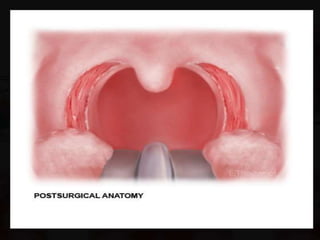

TONSILLECTOMY
NUR FARRA NAJWA BINTI ABDUL AZIM
082015100035
LEARNING OBJECTIVE
• Indication
• Anaesthesia
• Position
• Steps
• Post operative care
• Other method
• Complication
INTRODUCTION
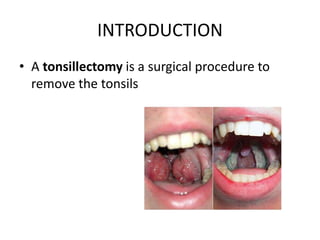
• A tonsillectomy is a surgical procedure to
remove the tonsils
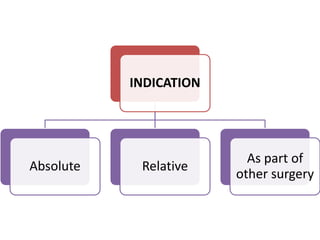
INDICATION
Absolute Relative
As part of
other surgery
A. ABSOLUTE
1. Recurrent infections of throat.
(a) Seven or more episodes in 1 year, or
(b) Five episodes per year for 2 years, or
(c) Three episodes per year for 3 years, or
(d) Two weeks or more of lost school or work in
1 year.
2. Peritonsillar abscess.
3. Tonsillitis.
4. Hypertrophy of tonsils.
5. Suspicion of malignancy.
B. RELATIVE
1. Diphtheria carriers.
2. Streptococcal carriers.
3. Chronic tonsillitis.
4. Recurrent streptococcal tonsillitis in a patient
with valvular heart disease.
C. AS A PART OF ANOTHER OPERATION
1. Palatopharyngoplasty
2. Glossopharyngeal neurectomy.
3. Removal of styloid process.
CONTRAINDICATION
1. Haemoglobin level less than 10 g%.
2. Presence of acute infection in upper respiratory
tract,
3. Children under 3 years of age.
4. Overt or submucous cleft palate.
5. Bleeding disorders
6. At the time of epidemic of polio.
7. Uncontrolled systemic disease.
8. Tonsillectomy is avoided during the period of
menses.
ANAESTHESIA
• General anaesthesia with endotracheal
intubation.
• In adults (may be under local anaesthesia.)
POSITION
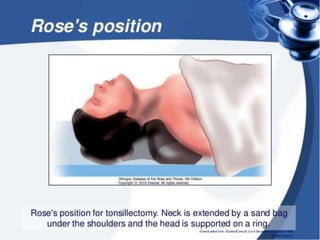
• Rose’s position
• Hyperextension should always be avoided
STEPS OF OPERATION (DISSECTION AND
SNARE METHOD)
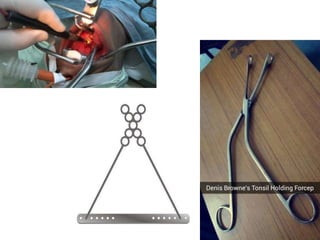
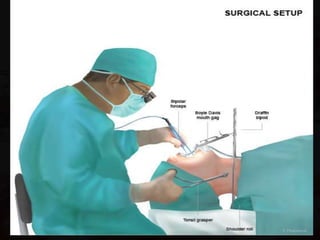
1. Boyle–Davis mouth gag is introduced and opened. Held
in place by Draffin’s bipods or a string over a pulley.
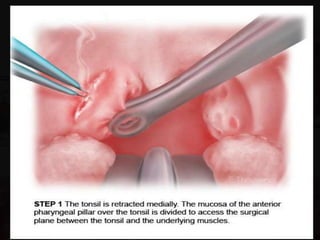
2. Tonsil is grasped with tonsil-holding forceps and pulled
medially.
3. Incision is made in the mucous membrane where it
reflects from the tonsil to anterior pillar. It may be
extended along the upper pole to mucous membrane
between the tonsil and posterior pillar.
Cont.
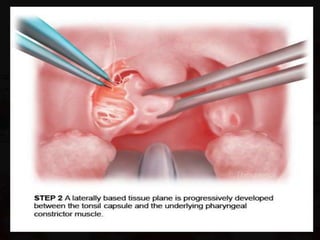
4. A blunt curved scissor may be used to dissect the tonsil
from the peritonsillar tissue and separate its upper pole.
5. Now the tonsil is held at its upper pole and traction
applied downwards and medially. Dissection is continued
with tonsillar dissector or scissors until lower pole is
reached
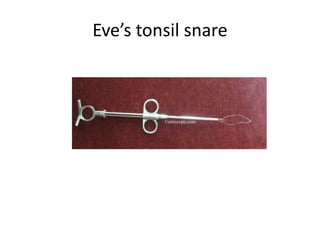
6. Now wire loop of tonsillar snare is threaded over the tonsil
on to its pedicle, tightened, and the pedicle cut and
the tonsil removed.
Eve’s tonsil snare
Cont.
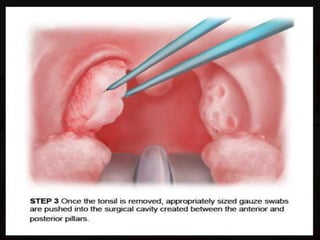
7. A gauze sponge is placed in the fossa and
pressure applied for a few minutes.
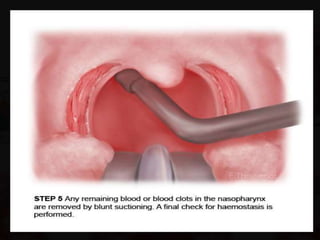
8. Bleeding points are tied with silk. Procedure is
repeated on the other side.
POSTOPERATIVE CARE
1. Immediate general care
(a) Keep the patient in coma position until fully
recovered from anaesthesia.
(b) Keep a watch on bleeding from the nose and
mouth.
(c) Keep check on vital signs.
Cont.
2. Diet.
3. Oral hygiene.
4. Analgesic
5. Antibiotics
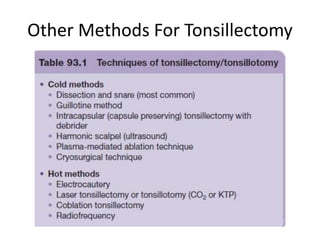
Other Methods For Tonsillectomy
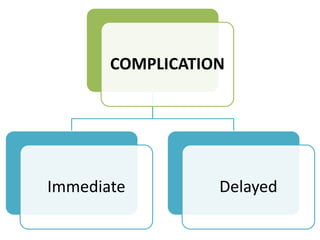
COMPLICATION
Immediate Delayed
IMMEDIATE COMPLICATION
1. Primary haemorrhage.
2. Reactionary haemorrhage.
3. Injury to tonsillar pillars, uvula, soft palate,
tongue or superior constrictor muscle due to
bad surgical technique.
4. Injury to teeth.
5. Aspiration of blood.
6. Facial oedema.
7. Surgical emphysema.
LATE COMPLICATION
1. Secondary haemorrhage.
2. Infection.
3. Lung complications.
4. Scarring in soft palate and pillars.
5. Tonsillar remnants.
6. Hypertrophy of lingual tonsil.
SUMMARY
• Indication
• Anaesthesia
• Position
• Steps
• Post operative care
• Other method
• Complication
REFERENCES
• Diseases of Ear, Nose, and Throat & Head and
Neck Surgery, PL Dhingra, Shruti Dhingra, 6th
Edition
• http://www.elvirethouvenot.com/tonsillecto
my/
Tonsillectomy ENT for undergrad

Tonsillectomy ENT for undergrad

  • 1.
    TONSILLECTOMY NUR FARRA NAJWABINTI ABDUL AZIM 082015100035
  • 2.
    LEARNING OBJECTIVE • Indication •Anaesthesia • Position • Steps • Post operative care • Other method • Complication
  • 3.
    INTRODUCTION • A tonsillectomyis a surgical procedure to remove the tonsils
  • 5.
  • 6.
    A. ABSOLUTE 1. Recurrentinfections of throat. (a) Seven or more episodes in 1 year, or (b) Five episodes per year for 2 years, or (c) Three episodes per year for 3 years, or (d) Two weeks or more of lost school or work in 1 year. 2. Peritonsillar abscess. 3. Tonsillitis. 4. Hypertrophy of tonsils. 5. Suspicion of malignancy.
  • 7.
    B. RELATIVE 1. Diphtheriacarriers. 2. Streptococcal carriers. 3. Chronic tonsillitis. 4. Recurrent streptococcal tonsillitis in a patient with valvular heart disease.
  • 8.
    C. AS APART OF ANOTHER OPERATION 1. Palatopharyngoplasty 2. Glossopharyngeal neurectomy. 3. Removal of styloid process.
  • 9.
    CONTRAINDICATION 1. Haemoglobin levelless than 10 g%. 2. Presence of acute infection in upper respiratory tract, 3. Children under 3 years of age. 4. Overt or submucous cleft palate. 5. Bleeding disorders 6. At the time of epidemic of polio. 7. Uncontrolled systemic disease. 8. Tonsillectomy is avoided during the period of menses.
  • 10.
    ANAESTHESIA • General anaesthesiawith endotracheal intubation. • In adults (may be under local anaesthesia.)
  • 11.
    POSITION • Rose’s position •Hyperextension should always be avoided
  • 13.
    STEPS OF OPERATION(DISSECTION AND SNARE METHOD) 1. Boyle–Davis mouth gag is introduced and opened. Held in place by Draffin’s bipods or a string over a pulley. 2. Tonsil is grasped with tonsil-holding forceps and pulled medially. 3. Incision is made in the mucous membrane where it reflects from the tonsil to anterior pillar. It may be extended along the upper pole to mucous membrane between the tonsil and posterior pillar.
  • 15.
    Cont. 4. A bluntcurved scissor may be used to dissect the tonsil from the peritonsillar tissue and separate its upper pole. 5. Now the tonsil is held at its upper pole and traction applied downwards and medially. Dissection is continued with tonsillar dissector or scissors until lower pole is reached 6. Now wire loop of tonsillar snare is threaded over the tonsil on to its pedicle, tightened, and the pedicle cut and the tonsil removed.
  • 16.
  • 17.
    Cont. 7. A gauzesponge is placed in the fossa and pressure applied for a few minutes. 8. Bleeding points are tied with silk. Procedure is repeated on the other side.
  • 27.
    POSTOPERATIVE CARE 1. Immediategeneral care (a) Keep the patient in coma position until fully recovered from anaesthesia. (b) Keep a watch on bleeding from the nose and mouth. (c) Keep check on vital signs.
  • 28.
    Cont. 2. Diet. 3. Oralhygiene. 4. Analgesic 5. Antibiotics
  • 29.
    Other Methods ForTonsillectomy
  • 30.
  • 31.
    IMMEDIATE COMPLICATION 1. Primaryhaemorrhage. 2. Reactionary haemorrhage. 3. Injury to tonsillar pillars, uvula, soft palate, tongue or superior constrictor muscle due to bad surgical technique. 4. Injury to teeth. 5. Aspiration of blood. 6. Facial oedema. 7. Surgical emphysema.
  • 32.
    LATE COMPLICATION 1. Secondaryhaemorrhage. 2. Infection. 3. Lung complications. 4. Scarring in soft palate and pillars. 5. Tonsillar remnants. 6. Hypertrophy of lingual tonsil.
  • 33.
    SUMMARY • Indication • Anaesthesia •Position • Steps • Post operative care • Other method • Complication
  • 34.
    REFERENCES • Diseases ofEar, Nose, and Throat & Head and Neck Surgery, PL Dhingra, Shruti Dhingra, 6th Edition • http://www.elvirethouvenot.com/tonsillecto my/