DR MARTIN KAMOMGA (MD)
2/17/2023 1
 Definition
 Epidemiology
 Etiology
 Risk factors
 Clinical features
 Complication
 Differentials
 Treatments
 Prevention
2/17/2023 2
 Epistaxis is bleeding from the nose from any
cause.
 Most of the time, bleeding is self-limited, but
can often be serious and life-threatening.
 Epistaxis occurs anteriorly or posteriorly of
the nasal cavity.
2/17/2023 3
Prevalence
o5-10% of the population experience an
episode of epistaxis each year. 10% of those
will see a physician. 1% of those seeking
medical care will need a specialist.
Incidence
oEpistaxis is very common. The incidence
seem to be higher during the low humidity
season.
2/17/2023 4
Age
◦ Nosebleeds occurs with peak incidences in
those under the age of ten and over the age of
50.
◦ Anterior nasal bleed is common in young age
and posterior is common in old age people.
Sex
◦ It occurs more in males than females.
2/17/2023 5
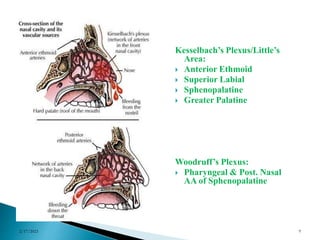
 The nasal cavity get blood supply from
internal and external carotid arteries.
 Many arterial and venous tend to
anastomose.
 Kiesselbach’s plexus (Little’s area) found in
anterior septum, common site for epistaxis.
 Woodruff’s plexus is found in posterior
septum
2/17/2023 6
External Carotid Artery
-Sphenopalatine artery
-Greater palatine artery
-Ascending pharyngeal artery
-Posterior nasal artery
-Superior Labial artery
Internal Carotid Artery
-Anterior Ethmoid artery
-Posterior Ethmoid artery
2/17/2023 7
2/17/2023 8
Kesselbach’s Plexus/Little’s
Area:
 Anterior Ethmoid
 Superior Labial
 Sphenopalatine
 Greater Palatine
Woodruff’s Plexus:
 Pharyngeal & Post. Nasal
AA of Sphenopalatine
2/17/2023 9
2/17/2023 10
 Nosebleeds are due to the rupture of a
blood vessel within the richly perfused
nasal mucosa.
 Rupture may be spontaneous or
initiated by trauma. An increase in
blood pressure (e.g. due to general
hypertension) tends to increase the
duration of spontaneous epistaxis
2/17/2023 11
 Anticoagulant medication and disorders of
blood clotting can promote and prolong
bleeding.
 Spontaneous epistaxis is more common in
the elderly as the nasal mucosa (lining)
becomes dry and thin and blood pressure
tends to be higher.
 The elderly are also more prone to
prolonged nose bleeds as their blood vessels
are less able to constrict and control the
bleeding.
2/17/2023 12
 Causes can be
Local
Systemic
2/17/2023 13
1.Trauma
 Nose picking
 Nose blowing/sneezing
 Nasal fracture
 Trauma to sinuses, orbits, middle
ear, base of skull
 Foreign bodies
2/17/2023 14
2. Neoplasm
Juvenile nasopharyngeal
angiofibroma
Sinonasal tumor
Nasopharyngeal
carcinoma
2/17/2023 15
3. Infection and
inflammation
Rhinitis/Sinusitis
◦Allergic
◦Bacterial
◦Viral
2/17/2023 16
4. Iatrogenic nasal injury
 Functional endoscopic sinus
surgery (FESS)
 Nasogastric /nasotracheal
intubation
 Rhinoplasty
 Nasal reconstruction
2/17/2023 17
5. Dessication
 Cold, dry air—more common in
wintertime where the nasal mucosal
becomes dry and easily cracked when
sneezing/blowing the nose then
bleeding occurs.
 Nasal oxygen
 Atrophic rhinitis
2/17/2023 18
6.Others
 Septal perforation
 Septal deviation
 Septal varices
 Chemical irritants (cocaine, nasal
sprays, etc.)
2/17/2023 19
1.Vascular
Hypertension/Arteriosclero
sis
Hereditary Hemorrhagic
Telangectasias (Osler
Rendu Weber Syndrome)
2/17/2023 20
2.Coagulopathies
Thrombocytopenia
 Platelet dysfunction
◦ Systemic disease (Uremia)
◦ drug-induced (warfarin, NSAIDs)
 Hematologic malignancies
Clotting Factor Deficiencies
◦ Hemophilia (factor VIII)
◦ VonWillebrand’s disease (vWF)
◦ Hepatic failure
2/17/2023 21
3.Infection
/Inflammation
Tuberculosis
Wegener’s
Granulomatosis
SLE
2/17/2023 22
 Children
◦ foreign body, nose picking
 Adults
◦ trauma, idiopathic
 Middle age
◦ tumors
 Old age
◦ hypertension
In about 10% of the cases the condition remains
idiopathic.
2/17/2023 23
 Drugs
 Trauma
 Infections
 Hypertension
 Coagulopathies
 Septal abnormalities
 Vascular abnormalities
2/17/2023 24
Nasal bleeding
Coughing/Vomiting blood
Bleeding down the back of the
throat
2/17/2023 25
 Anemia
 Sinusitis
 Aspiration
 Balloon migration
 Vasovagal episode
 External nasal deformity
 Mucosal pressure necrosis
 Septal hematoma/ parforation
2/17/2023 26
 Tumor
 Trauma
 Leukemia
 Hemophilia
 Hepatic failure
 Allergic rhinitis
 Cocaine toxicity
 Chemical irritants
 Thrombocytopenia
 Nasal foreign bodies
 Disseminated intravascular coagulation
2/17/2023 27
This includes
 A good history
 Thorough physical examination
 Investigation
 Treatment
2/17/2023 28
 Nasal trauma
 Hypertension
 Hepatic diseases
 Use of anticoagulants
 Family history of bleeding
 Previous bleeding episodes
2/17/2023 29
 General condition of the patient
 ABC’s
 If the patient is pale
 Vital signs- PR,BP,T,RR
 Anterior rhinoscopy
 Endoscopic rhinoscopy
2/17/2023 30
(a) Full blood picture
(b) Bleeding and coagulation-Indices
(c) Para nasal sinus X-ray
(d) Chest X-ray
(e) Liver function tests
(f) Renal function tests
2/17/2023 31
 Pinching the nose for 5-10
minutes.
 Anterior nasal packing by using
Vaseline gauze socked with iodine.
 Also packing can be done by using
special expandable sponge packs.
 Silver nitrate cautery
2/17/2023 32
2/17/2023 33
2/17/2023 34
 Formed expandable
sponges are very
effective
 Available in many
shapes, sizes and
some are
impregnated with
antibacterial
properties
2/17/2023 35
 Foley catheter is used to pack posteriorly
 Balloon-type epistaxis devices can also
be used
2/17/2023 36
2/17/2023 37
 The balloons are filled
with water, not air
 It is orient in direction
shown
 Posterior balloon are
filled first, then anterior
 Document volumes
used to fill balloons
2/17/2023 38
 Must be careful after
placement of a posterior
pack to avoid necrosis
of the nasal ala
 Often this can be
avoided by
repositioning the ports
of the balloon pack and
close monitoring of the
site
2/17/2023 39
 The patient need to remain with pack
for 48-72 hours.
 The patient must be on antibiotic to
decrease risk of infection
 The patient avoid straining, bending
forward or removing packing early
2/17/2023 40
(i) Chemical cauterization by
Silver nitrate stick (superficial cauterization
(ii) Electrocautery
- Deeper cautery in case of recurrence after
chemical cautery
(iii) Laser photo cauterization
2/17/2023 41
 Ligation of the external carotid artery
 Clipping of the internal maxillary artery to
which the sphenopalatine is a branch.
 Embolization of the sphenopalatine artery.
 Embolization most effective in patients who
◦ Still bleeding after surgical arterial ligation
◦ Bleeding site difficult to reach surgically
2/17/2023 42
2/17/2023 43
 Bull. P.D (1996):Lecture Notes on diseases of the Ear
Nose and Throat,8th Edition. Blackwell science
 Fonseca R.J,(1998) Oral and Maxillofacial Surgery,2nd
ED ,Saunders
 Hall& Colman's (1995):Diseases of Nose throat head
and neck.14th Ed. Churchill Livingstone
 Hupp, J.,& Tucker, M.R.(Eds).(1998).Contemporary
oral and maxillofacial surgery(3rd ed.,pp.355-390) St
Louis, MO: Mosby
 Ross & Wilson (2001):Anatomy and physiology in
Health and illness.9th Ed. Churchill Livingstone
2/17/2023 44

Session 4 Epistaxis.pptx

  • 1.
    DR MARTIN KAMOMGA(MD) 2/17/2023 1
  • 2.
     Definition  Epidemiology Etiology  Risk factors  Clinical features  Complication  Differentials  Treatments  Prevention 2/17/2023 2
  • 3.
     Epistaxis isbleeding from the nose from any cause.  Most of the time, bleeding is self-limited, but can often be serious and life-threatening.  Epistaxis occurs anteriorly or posteriorly of the nasal cavity. 2/17/2023 3
  • 4.
    Prevalence o5-10% of thepopulation experience an episode of epistaxis each year. 10% of those will see a physician. 1% of those seeking medical care will need a specialist. Incidence oEpistaxis is very common. The incidence seem to be higher during the low humidity season. 2/17/2023 4
  • 5.
    Age ◦ Nosebleeds occurswith peak incidences in those under the age of ten and over the age of 50. ◦ Anterior nasal bleed is common in young age and posterior is common in old age people. Sex ◦ It occurs more in males than females. 2/17/2023 5
  • 6.
     The nasalcavity get blood supply from internal and external carotid arteries.  Many arterial and venous tend to anastomose.  Kiesselbach’s plexus (Little’s area) found in anterior septum, common site for epistaxis.  Woodruff’s plexus is found in posterior septum 2/17/2023 6
  • 7.
    External Carotid Artery -Sphenopalatineartery -Greater palatine artery -Ascending pharyngeal artery -Posterior nasal artery -Superior Labial artery Internal Carotid Artery -Anterior Ethmoid artery -Posterior Ethmoid artery 2/17/2023 7
  • 8.
  • 9.
    Kesselbach’s Plexus/Little’s Area:  AnteriorEthmoid  Superior Labial  Sphenopalatine  Greater Palatine Woodruff’s Plexus:  Pharyngeal & Post. Nasal AA of Sphenopalatine 2/17/2023 9
  • 10.
  • 11.
     Nosebleeds aredue to the rupture of a blood vessel within the richly perfused nasal mucosa.  Rupture may be spontaneous or initiated by trauma. An increase in blood pressure (e.g. due to general hypertension) tends to increase the duration of spontaneous epistaxis 2/17/2023 11
  • 12.
     Anticoagulant medicationand disorders of blood clotting can promote and prolong bleeding.  Spontaneous epistaxis is more common in the elderly as the nasal mucosa (lining) becomes dry and thin and blood pressure tends to be higher.  The elderly are also more prone to prolonged nose bleeds as their blood vessels are less able to constrict and control the bleeding. 2/17/2023 12
  • 13.
     Causes canbe Local Systemic 2/17/2023 13
  • 14.
    1.Trauma  Nose picking Nose blowing/sneezing  Nasal fracture  Trauma to sinuses, orbits, middle ear, base of skull  Foreign bodies 2/17/2023 14
  • 15.
    2. Neoplasm Juvenile nasopharyngeal angiofibroma Sinonasaltumor Nasopharyngeal carcinoma 2/17/2023 15
  • 16.
  • 17.
    4. Iatrogenic nasalinjury  Functional endoscopic sinus surgery (FESS)  Nasogastric /nasotracheal intubation  Rhinoplasty  Nasal reconstruction 2/17/2023 17
  • 18.
    5. Dessication  Cold,dry air—more common in wintertime where the nasal mucosal becomes dry and easily cracked when sneezing/blowing the nose then bleeding occurs.  Nasal oxygen  Atrophic rhinitis 2/17/2023 18
  • 19.
    6.Others  Septal perforation Septal deviation  Septal varices  Chemical irritants (cocaine, nasal sprays, etc.) 2/17/2023 19
  • 20.
  • 21.
    2.Coagulopathies Thrombocytopenia  Platelet dysfunction ◦Systemic disease (Uremia) ◦ drug-induced (warfarin, NSAIDs)  Hematologic malignancies Clotting Factor Deficiencies ◦ Hemophilia (factor VIII) ◦ VonWillebrand’s disease (vWF) ◦ Hepatic failure 2/17/2023 21
  • 22.
  • 23.
     Children ◦ foreignbody, nose picking  Adults ◦ trauma, idiopathic  Middle age ◦ tumors  Old age ◦ hypertension In about 10% of the cases the condition remains idiopathic. 2/17/2023 23
  • 24.
     Drugs  Trauma Infections  Hypertension  Coagulopathies  Septal abnormalities  Vascular abnormalities 2/17/2023 24
  • 25.
    Nasal bleeding Coughing/Vomiting blood Bleedingdown the back of the throat 2/17/2023 25
  • 26.
     Anemia  Sinusitis Aspiration  Balloon migration  Vasovagal episode  External nasal deformity  Mucosal pressure necrosis  Septal hematoma/ parforation 2/17/2023 26
  • 27.
     Tumor  Trauma Leukemia  Hemophilia  Hepatic failure  Allergic rhinitis  Cocaine toxicity  Chemical irritants  Thrombocytopenia  Nasal foreign bodies  Disseminated intravascular coagulation 2/17/2023 27
  • 28.
    This includes  Agood history  Thorough physical examination  Investigation  Treatment 2/17/2023 28
  • 29.
     Nasal trauma Hypertension  Hepatic diseases  Use of anticoagulants  Family history of bleeding  Previous bleeding episodes 2/17/2023 29
  • 30.
     General conditionof the patient  ABC’s  If the patient is pale  Vital signs- PR,BP,T,RR  Anterior rhinoscopy  Endoscopic rhinoscopy 2/17/2023 30
  • 31.
    (a) Full bloodpicture (b) Bleeding and coagulation-Indices (c) Para nasal sinus X-ray (d) Chest X-ray (e) Liver function tests (f) Renal function tests 2/17/2023 31
  • 32.
     Pinching thenose for 5-10 minutes.  Anterior nasal packing by using Vaseline gauze socked with iodine.  Also packing can be done by using special expandable sponge packs.  Silver nitrate cautery 2/17/2023 32
  • 33.
  • 34.
  • 35.
     Formed expandable spongesare very effective  Available in many shapes, sizes and some are impregnated with antibacterial properties 2/17/2023 35
  • 36.
     Foley catheteris used to pack posteriorly  Balloon-type epistaxis devices can also be used 2/17/2023 36
  • 37.
  • 38.
     The balloonsare filled with water, not air  It is orient in direction shown  Posterior balloon are filled first, then anterior  Document volumes used to fill balloons 2/17/2023 38
  • 39.
     Must becareful after placement of a posterior pack to avoid necrosis of the nasal ala  Often this can be avoided by repositioning the ports of the balloon pack and close monitoring of the site 2/17/2023 39
  • 40.
     The patientneed to remain with pack for 48-72 hours.  The patient must be on antibiotic to decrease risk of infection  The patient avoid straining, bending forward or removing packing early 2/17/2023 40
  • 41.
    (i) Chemical cauterizationby Silver nitrate stick (superficial cauterization (ii) Electrocautery - Deeper cautery in case of recurrence after chemical cautery (iii) Laser photo cauterization 2/17/2023 41
  • 42.
     Ligation ofthe external carotid artery  Clipping of the internal maxillary artery to which the sphenopalatine is a branch.  Embolization of the sphenopalatine artery.  Embolization most effective in patients who ◦ Still bleeding after surgical arterial ligation ◦ Bleeding site difficult to reach surgically 2/17/2023 42
  • 43.
  • 44.
     Bull. P.D(1996):Lecture Notes on diseases of the Ear Nose and Throat,8th Edition. Blackwell science  Fonseca R.J,(1998) Oral and Maxillofacial Surgery,2nd ED ,Saunders  Hall& Colman's (1995):Diseases of Nose throat head and neck.14th Ed. Churchill Livingstone  Hupp, J.,& Tucker, M.R.(Eds).(1998).Contemporary oral and maxillofacial surgery(3rd ed.,pp.355-390) St Louis, MO: Mosby  Ross & Wilson (2001):Anatomy and physiology in Health and illness.9th Ed. Churchill Livingstone 2/17/2023 44