
SAJJAD KHUDHUR ABBAS
Ceo , Founder & Head of SHacademy
Chemical Engineering , Al-Muthanna University, Iraq
Oil & Gas Safety and Health Professional – OSHACADEMY
Trainer of Trainers (TOT) - Canadian Center of Human
Development
Episode 44 : 4 Stages Of Solid4 Stages Of Solid
Liquid SeparationsLiquid Separations
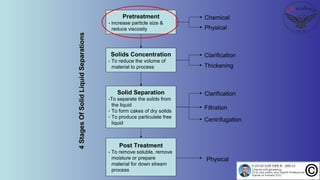
Pretreatment
- increase particle size &
reduce viscosity
Solids Concentration
- To reduce the volume of
material to process
Solid Separation
-To separate the solids from
the liquid
- To form cakes of dry solids
- To produce particulate free
liquid
Post Treatment
- To remove soluble, remove
moisture or prepare
material for down stream
process
4StagesOfSolidLiquidSeparations4StagesOfSolidLiquidSeparations
Chemical
Physical
Clarification
Thickening
Clarification
Filtration
Centrifugation
Physical
PretreatmentPretreatment
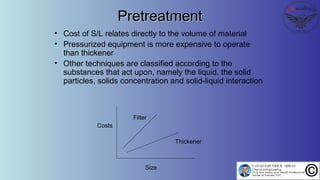
• Cost of S/L relates directly to the volume of material
• Pressurized equipment is more expensive to operate
than thickener
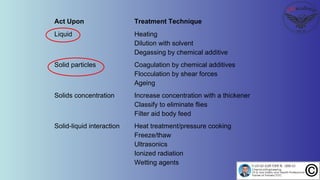
• Other techniques are classified according to the
substances that act upon, namely the liquid, the solid
particles, solids concentration and solid-liquid interaction
Filter
Thickener
Costs
Size
Act Upon Treatment Technique
Liquid Heating
Dilution with solvent
Degassing by chemical additive
Solid particles Coagulation by chemical additives
Flocculation by shear forces
Ageing
Solids concentration Increase concentration with a thickener
Classify to eliminate flies
Filter aid body feed
Solid-liquid interaction Heat treatment/pressure cooking
Freeze/thaw
Ultrasonics
Ionized radiation
Wetting agents
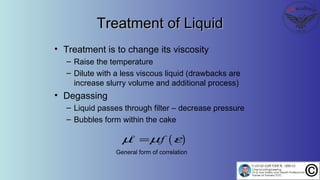
Treatment of LiquidTreatment of Liquid
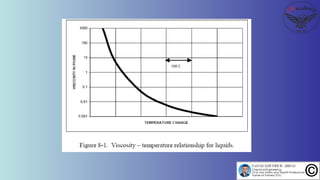
• Treatment is to change its viscosity
– Raise the temperature
– Dilute with a less viscous liquid (drawbacks are
increase slurry volume and additional process)
• Degassing
– Liquid passes through filter – decrease pressure
– Bubbles form within the cake
( )o
fµ µ ε=
General form of correlation
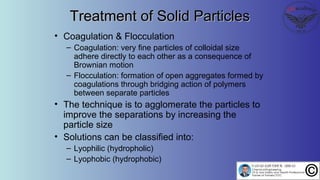
Treatment of Solid ParticlesTreatment of Solid Particles
• Coagulation & Flocculation
– Coagulation: very fine particles of colloidal size
adhere directly to each other as a consequence of
Brownian motion
– Flocculation: formation of open aggregates formed by
coagulations through bridging action of polymers
between separate particles
• The technique is to agglomerate the particles to
improve the separations by increasing the
particle size
• Solutions can be classified into:
– Lyophilic (hydropholic)
– Lyophobic (hydrophobic)
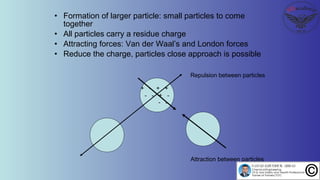
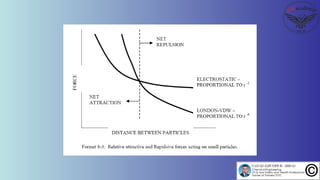
• Formation of larger particle: small particles to come
together
• All particles carry a residue charge
• Attracting forces: Van der Waal’s and London forces
• Reduce the charge, particles close approach is possible
+ - + +
- - + -
- -
Repulsion between particles
Attraction between particles
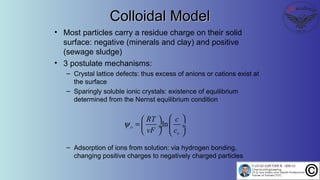
Colloidal ModelColloidal Model
• Most particles carry a residue charge on their solid
surface: negative (minerals and clay) and positive
(sewage sludge)
• 3 postulate mechanisms:
– Crystal lattice defects: thus excess of anions or cations exist at
the surface
– Sparingly soluble ionic crystals: existence of equilibrium
determined from the Nernst equilibrium condition
– Adsorption of ions from solution: via hydrogen bonding,
changing positive charges to negatively charged particles
lno
o
RT c
vF c
ψ
  
=  ÷ ÷
   
- -
- -
- + + -
- + + -
- + + -
- + + -
- -
- -
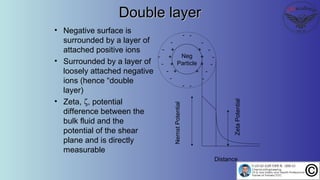
Double layerDouble layer
• Negative surface is
surrounded by a layer of
attached positive ions
• Surrounded by a layer of
loosely attached negative
ions (hence “double
layer)
• Zeta, ζ, potential
difference between the
bulk fluid and the
potential of the shear
plane and is directly
measurable
Neg
Particle
Distance
ZetaPotential
NernstPotential
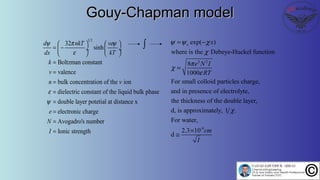
1 2
32
sinh
Boltzman constant
valence
bulk concentration of the ion
dielectric constant of the liquid bulk phase
double layer potetial at distance x
electronic charge
d nkT ve
dx kT
k
v
n v
e
N
ψ π ψ
ε
ε
ψ
   
= − ÷  ÷
   
=
=
=
=
=
=
Avogadro's number
Ionic strengthI
=
=
Gouy-Chapman modelGouy-Chapman model
2 2
exp( )
where is the Debeye-Huckel function
8
1000
For small colloid particles charge,
and in presence of electrolyte,
the thickness of the double layer,
d, is approximately, 1 .
For wate
o x
e N I
RT
ψ ψ χ
χ
π
χ
ε
χ
= −
=
-9
r,
2.3 10
d
cm
I
×
≅
∫
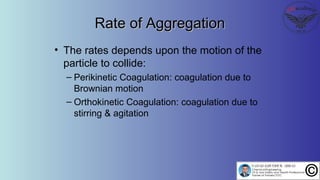
Rate of AggregationRate of Aggregation
• The rates depends upon the motion of the
particle to collide:
– Perikinetic Coagulation: coagulation due to
Brownian motion
– Orthokinetic Coagulation: coagulation due to
stirring & agitation
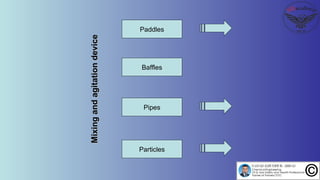
MixingandagitationdeviceMixingandagitationdevice
Paddles
Baffles
Pipes
Particles
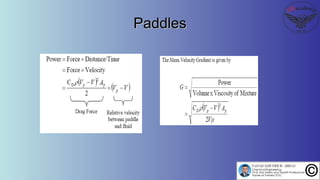
PaddlesPaddles
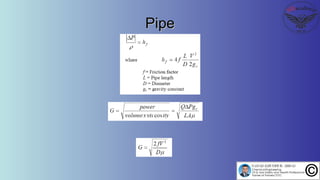
PipePipe
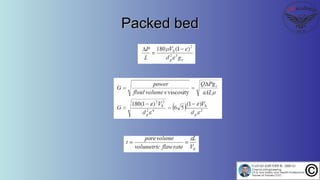
Packed bedPacked bed
Thanks for Watching
Please follow me / SAJJAD KHUDHUR ABBAS

Episode 44 : 4 Stages Of Solid Liquid Separations

  • 1.
    SAJJAD KHUDHUR ABBAS Ceo, Founder & Head of SHacademy Chemical Engineering , Al-Muthanna University, Iraq Oil & Gas Safety and Health Professional – OSHACADEMY Trainer of Trainers (TOT) - Canadian Center of Human Development Episode 44 : 4 Stages Of Solid4 Stages Of Solid Liquid SeparationsLiquid Separations
  • 2.
    Pretreatment - increase particlesize & reduce viscosity Solids Concentration - To reduce the volume of material to process Solid Separation -To separate the solids from the liquid - To form cakes of dry solids - To produce particulate free liquid Post Treatment - To remove soluble, remove moisture or prepare material for down stream process 4StagesOfSolidLiquidSeparations4StagesOfSolidLiquidSeparations Chemical Physical Clarification Thickening Clarification Filtration Centrifugation Physical
  • 3.
    PretreatmentPretreatment • Cost ofS/L relates directly to the volume of material • Pressurized equipment is more expensive to operate than thickener • Other techniques are classified according to the substances that act upon, namely the liquid, the solid particles, solids concentration and solid-liquid interaction Filter Thickener Costs Size
  • 4.
    Act Upon TreatmentTechnique Liquid Heating Dilution with solvent Degassing by chemical additive Solid particles Coagulation by chemical additives Flocculation by shear forces Ageing Solids concentration Increase concentration with a thickener Classify to eliminate flies Filter aid body feed Solid-liquid interaction Heat treatment/pressure cooking Freeze/thaw Ultrasonics Ionized radiation Wetting agents
  • 5.
    Treatment of LiquidTreatmentof Liquid • Treatment is to change its viscosity – Raise the temperature – Dilute with a less viscous liquid (drawbacks are increase slurry volume and additional process) • Degassing – Liquid passes through filter – decrease pressure – Bubbles form within the cake ( )o fµ µ ε= General form of correlation
  • 7.
    Treatment of SolidParticlesTreatment of Solid Particles • Coagulation & Flocculation – Coagulation: very fine particles of colloidal size adhere directly to each other as a consequence of Brownian motion – Flocculation: formation of open aggregates formed by coagulations through bridging action of polymers between separate particles • The technique is to agglomerate the particles to improve the separations by increasing the particle size • Solutions can be classified into: – Lyophilic (hydropholic) – Lyophobic (hydrophobic)
  • 8.
    • Formation oflarger particle: small particles to come together • All particles carry a residue charge • Attracting forces: Van der Waal’s and London forces • Reduce the charge, particles close approach is possible + - + + - - + - - - Repulsion between particles Attraction between particles
  • 9.
    Colloidal ModelColloidal Model •Most particles carry a residue charge on their solid surface: negative (minerals and clay) and positive (sewage sludge) • 3 postulate mechanisms: – Crystal lattice defects: thus excess of anions or cations exist at the surface – Sparingly soluble ionic crystals: existence of equilibrium determined from the Nernst equilibrium condition – Adsorption of ions from solution: via hydrogen bonding, changing positive charges to negatively charged particles lno o RT c vF c ψ    =  ÷ ÷    
  • 10.
    - - - - -+ + - - + + - - + + - - + + - - - - - Double layerDouble layer • Negative surface is surrounded by a layer of attached positive ions • Surrounded by a layer of loosely attached negative ions (hence “double layer) • Zeta, ζ, potential difference between the bulk fluid and the potential of the shear plane and is directly measurable Neg Particle Distance ZetaPotential NernstPotential
  • 12.
    1 2 32 sinh Boltzman constant valence bulkconcentration of the ion dielectric constant of the liquid bulk phase double layer potetial at distance x electronic charge d nkT ve dx kT k v n v e N ψ π ψ ε ε ψ     = − ÷  ÷     = = = = = = Avogadro's number Ionic strengthI = = Gouy-Chapman modelGouy-Chapman model 2 2 exp( ) where is the Debeye-Huckel function 8 1000 For small colloid particles charge, and in presence of electrolyte, the thickness of the double layer, d, is approximately, 1 . For wate o x e N I RT ψ ψ χ χ π χ ε χ = − = -9 r, 2.3 10 d cm I × ≅ ∫
  • 13.
    Rate of AggregationRateof Aggregation • The rates depends upon the motion of the particle to collide: – Perikinetic Coagulation: coagulation due to Brownian motion – Orthokinetic Coagulation: coagulation due to stirring & agitation
  • 14.
  • 15.
  • 16.
  • 17.
  • 18.
    Thanks for Watching Pleasefollow me / SAJJAD KHUDHUR ABBAS