CLASSIFICATION OF
      PAIN


   By: Dr. Vahid Nikoui

         Email:
DEFINITIONS OF PAIN
     International Association for the Study of Pain (IASP)
      (WHO)
      An unpleasant emotional experience associate with actual
        or potential tissue damage or described in terms of such
        damage.

     Bell
      The subject‟s conscious perception of modulated
       nociceptive impulses that generate an unpleasant sensory
       and emotional experiences associated with actual or
       potential tissue damage or described in terms of such
       damage.

     Monheim
      An unpleasant emotional experience usually initiated by
       noxious stimulus and transmitted over a specialized
       neural network to CNS where it is interpreted as such.
2
     Mac bryde
HISTORICAL NOTE
     Greek - “Poin” meaning penalty.
     Latin -“Poena” meaning punishment from
      God.
     Homer - Thought pain was due to arrows
      shot by God.
     Aristotle - was the first to distinguish five
      physical senses, and considered pain to be
      “passion of the soul” .
     Plato - pain and pleasure arose from within
      the body, an idea that perhaps gave birth to
3
      the concept that pain is an emotional
      experience more than a localized body
Nociception
 Nociception (synonym: nocioception or nociperception) is
  defined as "the neural processes of encoding and
  processing noxious stimuli. "

Nociceptor
 A nociceptor is a sensory receptor that responds to
  potentially damaging stimuli by sending nerve signals to
  the spinal cord and brain.

Noxious
 Noxious stimulus, an actually or potentially tissue
  damaging event, may be mechanical, chemical or
  thermal.

Algesia
 Algesia, from the Greek word algesis, is the sensitivity to
  pain.
TYPES OF PAIN
       1. Based on speed of onset, quality & duration


(1) Experimental        (2) Transient         (3) Acute
    (4) Chronic

1. Experimental:
 noxious stimuli causes a mild uncomfortable or
    painful sensation.

2. Transient pain:
 Short duration
 Severe
5
 Self limiting
3. Acute pathological pain:
• Sharp, fast, pricking
• Occurs very rapidly
• Carried by large diameter myelinated Aδ fibers
• Usually alleviated with the help of professional

  4. Chronic pathological pain:
  • Burning, aching
  • Gradually increases
  • Carried by small diameter non-myelinated „C‟
  fibers
  • Experience of persistent pain that lasts many
  months to years
  • Little apparent cause & not self limiting
6
  • Pain often increases over time & is aggravated by
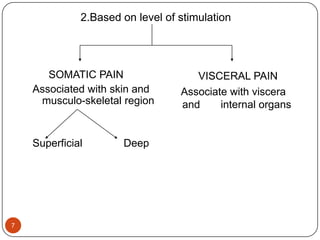
2.Based on level of stimulation


       SOMATIC PAIN                  VISCERAL PAIN
    Associated with skin and      Associate with viscera
     musculo-skeletal region      and     internal organs


    Superficial       Deep


7
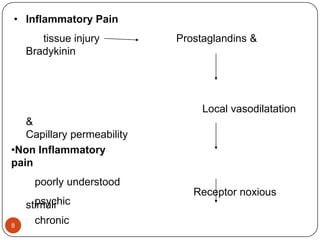
• Inflammatory Pain
       tissue injury        Prostaglandins &
    Bradykinin


                                 Local vasodilatation
   &
   Capillary permeability
•Non Inflammatory
pain
     poorly understood
                               Receptor noxious
      psychic
    stimuli
8
      chronic
Referred Pain
 Referred    pain (sometimes referred to as
  reflective pain) is a term used to describe the
  phenomenon of pain perceived at a site
  adjacent to or at a distance from the site of an
  injury's origin.
 One of the best examples of this is during
  ischemia brought on by a myocardial
  infarction (heart attack) where pain is often felt
  in the neck, shoulders, and back rather than in
  the chest, the site of the injury.
SPECIFIC PAINS
 Headache
  A headache or cephalgia is pain anywhere in the
  region of the head or neck. It can be a symptom of a
  number of different conditions of the head and neck.

 1- Headache of intracranial origin
  Meningitis     headache,   Migraine, Alcoholic
  headache, Headache due to low pressure of
  CSF, Constipation headache

 2- Headache of extracranial origin
  Headache due to muscular spasm, Headache due to
  nasal irritation, Headache due to eye disorders
     Toothache

     A toothache, also known as odontalgia or, less
    frequently, as odontalgy, is a pain in or around a tooth.
    In most cases toothaches are caused by problems in
    the tooth or jaw, such as cavities, gum disease, the
    emergence of wisdom teeth, infected dental pulp, jaw
    disease, or exposed tooth root.
     Trigeminal neuralgia

     Trigeminal neuralgia (TN), Tic Douloureux (also
    known as prosopalgia, the 'Suicide Disease' or
    'Fothergill‟s disease) is a neuropathic disorder
    characterized by episodes of intense pain in the
    face, originating from one of the three trigeminal
    nerves.
     It is, "one of the most painful conditions known to
    humans, yet remains an enigma to many health
    professionals."
     This pain may be felt in the ear, eye, lips, nose,
    scalp, forehead, cheeks, teeth, and/or jaw; some
    patients also experience pain in their left index
    finger.
ABNORMAL PAINS
 Hyperalgesia
   Hyperalgesia is an increased sensitivity to pain, which may be
  caused by damage to nociceptors or peripheral nerves.
 Allodynia
  Allodynia, meaning "other pain", is a pain due to a stimulus
  which does not normally provoke pain and can be either
  thermal or mechanical.
 Hyperpathia
   Hyperpathia is a clinical symptom of certain neurological
  disorders wherein nociceptive stimuli evoke exaggerated
  levels of pain.
 Phantom Limb Pain
  A phantom limb is the sensation that an amputated or missing
  limb is still attached to the body and is moving appropriately
  with other body parts.
Thanks for Your
Company

Classification of Pain

  • 1.
    CLASSIFICATION OF PAIN By: Dr. Vahid Nikoui Email:
  • 2.
    DEFINITIONS OF PAIN  International Association for the Study of Pain (IASP) (WHO) An unpleasant emotional experience associate with actual or potential tissue damage or described in terms of such damage.  Bell The subject‟s conscious perception of modulated nociceptive impulses that generate an unpleasant sensory and emotional experiences associated with actual or potential tissue damage or described in terms of such damage.  Monheim An unpleasant emotional experience usually initiated by noxious stimulus and transmitted over a specialized neural network to CNS where it is interpreted as such. 2  Mac bryde
  • 3.
    HISTORICAL NOTE  Greek - “Poin” meaning penalty.  Latin -“Poena” meaning punishment from God.  Homer - Thought pain was due to arrows shot by God.  Aristotle - was the first to distinguish five physical senses, and considered pain to be “passion of the soul” .  Plato - pain and pleasure arose from within the body, an idea that perhaps gave birth to 3 the concept that pain is an emotional experience more than a localized body
  • 4.
    Nociception  Nociception (synonym:nocioception or nociperception) is defined as "the neural processes of encoding and processing noxious stimuli. " Nociceptor  A nociceptor is a sensory receptor that responds to potentially damaging stimuli by sending nerve signals to the spinal cord and brain. Noxious  Noxious stimulus, an actually or potentially tissue damaging event, may be mechanical, chemical or thermal. Algesia  Algesia, from the Greek word algesis, is the sensitivity to pain.
  • 5.
    TYPES OF PAIN 1. Based on speed of onset, quality & duration (1) Experimental (2) Transient (3) Acute (4) Chronic 1. Experimental:  noxious stimuli causes a mild uncomfortable or painful sensation. 2. Transient pain:  Short duration  Severe 5  Self limiting
  • 6.
    3. Acute pathologicalpain: • Sharp, fast, pricking • Occurs very rapidly • Carried by large diameter myelinated Aδ fibers • Usually alleviated with the help of professional 4. Chronic pathological pain: • Burning, aching • Gradually increases • Carried by small diameter non-myelinated „C‟ fibers • Experience of persistent pain that lasts many months to years • Little apparent cause & not self limiting 6 • Pain often increases over time & is aggravated by
  • 7.
    2.Based on levelof stimulation SOMATIC PAIN VISCERAL PAIN Associated with skin and Associate with viscera musculo-skeletal region and internal organs Superficial Deep 7
  • 8.
    • Inflammatory Pain tissue injury Prostaglandins & Bradykinin Local vasodilatation & Capillary permeability •Non Inflammatory pain poorly understood Receptor noxious psychic stimuli 8 chronic
  • 9.
    Referred Pain  Referred pain (sometimes referred to as reflective pain) is a term used to describe the phenomenon of pain perceived at a site adjacent to or at a distance from the site of an injury's origin.  One of the best examples of this is during ischemia brought on by a myocardial infarction (heart attack) where pain is often felt in the neck, shoulders, and back rather than in the chest, the site of the injury.
  • 10.
    SPECIFIC PAINS  Headache A headache or cephalgia is pain anywhere in the region of the head or neck. It can be a symptom of a number of different conditions of the head and neck.  1- Headache of intracranial origin Meningitis headache, Migraine, Alcoholic headache, Headache due to low pressure of CSF, Constipation headache  2- Headache of extracranial origin Headache due to muscular spasm, Headache due to nasal irritation, Headache due to eye disorders
  • 11.
    Toothache A toothache, also known as odontalgia or, less frequently, as odontalgy, is a pain in or around a tooth. In most cases toothaches are caused by problems in the tooth or jaw, such as cavities, gum disease, the emergence of wisdom teeth, infected dental pulp, jaw disease, or exposed tooth root.
  • 12.
    Trigeminal neuralgia Trigeminal neuralgia (TN), Tic Douloureux (also known as prosopalgia, the 'Suicide Disease' or 'Fothergill‟s disease) is a neuropathic disorder characterized by episodes of intense pain in the face, originating from one of the three trigeminal nerves. It is, "one of the most painful conditions known to humans, yet remains an enigma to many health professionals." This pain may be felt in the ear, eye, lips, nose, scalp, forehead, cheeks, teeth, and/or jaw; some patients also experience pain in their left index finger.
  • 13.
    ABNORMAL PAINS  Hyperalgesia Hyperalgesia is an increased sensitivity to pain, which may be caused by damage to nociceptors or peripheral nerves.  Allodynia Allodynia, meaning "other pain", is a pain due to a stimulus which does not normally provoke pain and can be either thermal or mechanical.  Hyperpathia Hyperpathia is a clinical symptom of certain neurological disorders wherein nociceptive stimuli evoke exaggerated levels of pain.  Phantom Limb Pain A phantom limb is the sensation that an amputated or missing limb is still attached to the body and is moving appropriately with other body parts.
  • 14.