Al-Najah National university
Faculty of Graduate Studies
  Name: Malik Manasrah.
 Supervisor: Dr. Mahmoud
         kresheh.
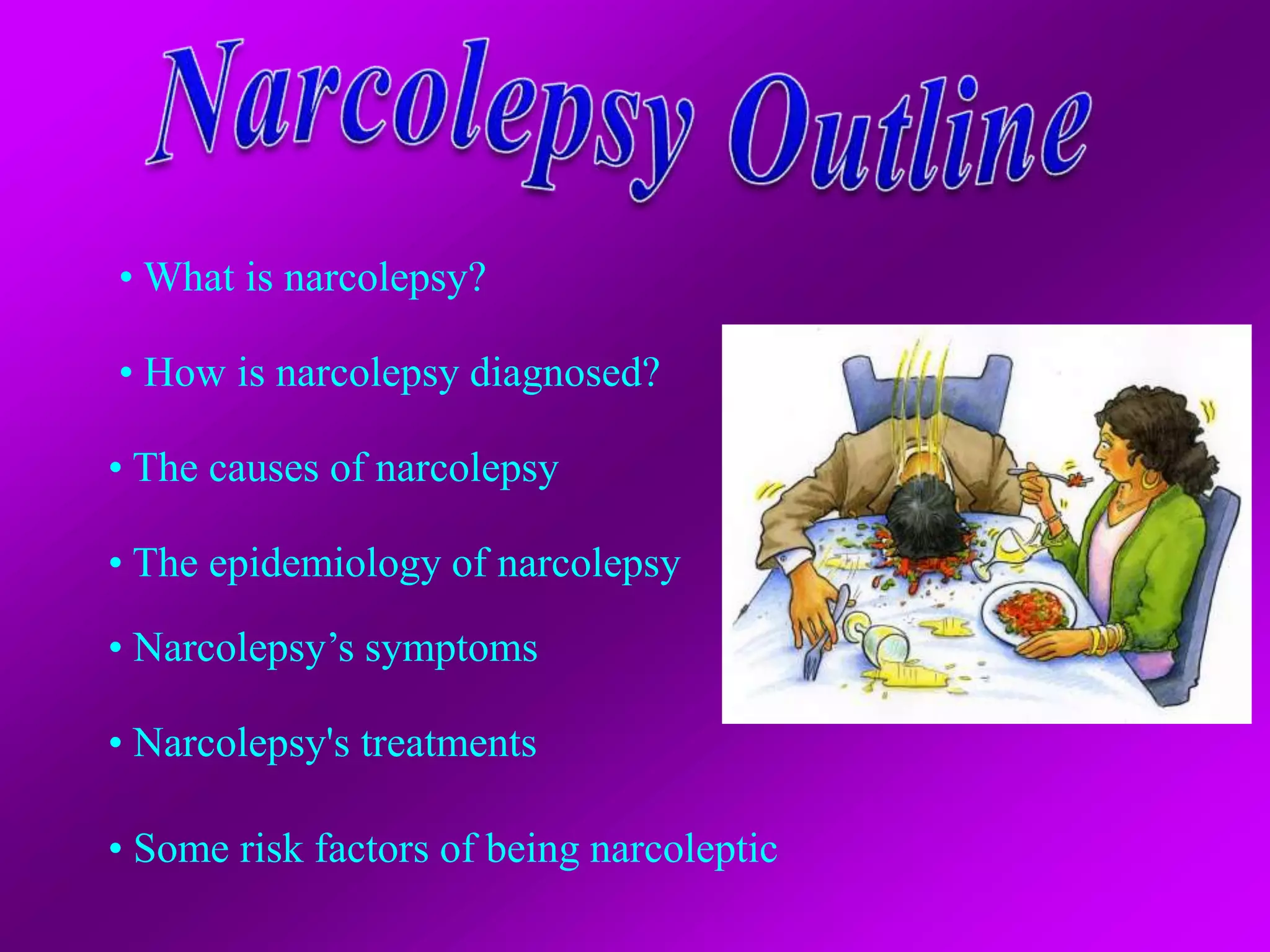
• What is narcolepsy?

• How is narcolepsy diagnosed?

• The causes of narcolepsy

• The epidemiology of narcolepsy

• Narcolepsy’s symptoms

• Narcolepsy's treatments

• Some risk factors of being narcoleptic
What is narcolepsy?
• Narcolepsy is a chronic sleep disorder that causes drowsiness
  and frequent nap attacks during the day.
• It is NOT related to depression, seizure disorders, fainting, or
  simple lack of sleep.
• The name narcolepsy comes from the French word
  narcolepsie, which is a combination of the Greek word narkē
  (“numbness”) and leptos (“seizure”).
Risk factor

•Family history

•Head trauma

•Infections, or drugs, that
affect the brain

•Anesthesia
What can cause narcolepsy?
• Narcolepsy is NOT a mental
  illness. It is a nervous system
  disorder.
• Evidence suggests that narcolepsy
  may run in families.
• Scientists believe that narcolepsy
  is caused by a decrease in the
  amount of hypocretin.
• Hypocretin, also known as orexin,
  is involved in controlling appetite
  and sleep patterns.
What is the major symptom?
         • The major symptom is excessive
           daytime sleepiness.
         • Sleep attacks occur with little warning
           and may often occur at inappropriate
           times and paces.
         • These naps are physically irresistible
           and take place several times per day,
           usually lasting for about 15 minutes
           each (can be longer).
What are the other symptoms?
Cataplexy
• The person suddenly loses
  muscle function while
  awake and cannot move.
• It can be a result of strong
  emotions, such as laughter
  or anger.                      Sleep paralysis
• The attacks can last from a    • The person temporarily
  few seconds to several            loses the ability to talk or
  minutes.                          move when he or she wakes
                                    up or first becomes drowsy.
Automatic behavior
                                  • A person continues to
                                    function, such as talking and
                                    putting objects in different
                                    places, during sleep, but he
                                    or she does not recall doing
                                    such activities after
Hypnagogic hallucinations           awakening.
• These are vivid, dreamlike
  experiences that take place
  when a person is sleeping,
  falling asleep, or awakening.
• The hallucinations involve
  seeing or hearing.
How many people are diagnosed
      with narcolepsy?
• Experts estimate that around
  3 million people worldwide
  have narcolepsy.
• In the United States, it is
  estimated that there are
  around 200,000 people
  affected by the disorder, but
  not even a quarter of them      • The usual onset of
  are diagnosed.                    narcolepsy is in
• The prevalence is about 1 per     adolescence and young
  2,000 people.                     adulthood.
How does one get diagnosed with
           narcolepsy?
• Two tests are commonly used to diagnose nacolepsy.
• One is the polysomnogram, which involves continuous
  recording of brain waves and nerve and muscle functions
  during sleep at night.
• Another is the multiple sleep latency test, or MSLT, which
  involves observations made of the time taken for a person to
  reach the different stages of sleep.
How does one get
   treated?
• There is no known cure for narcolepsy.
  There are only ways to control the
  symptoms.
• Modafinil, a stimulant drug, is a popular
  medicine for treating narcolepsy because it
  is less likely to be abused than other
  stimulants.
• Antidepressant drugs can reduce
  cataplexy, sleep paralysis, and
  hallucinations.
• Some patients also take sodium oxybate at
  night.
What are some lifestyle adjustments
that can help cope with narcolepsy?

• Eating light meals during the day
• Avoiding heavy meals before
  important events
• Napping after meals
• Planning naps ahead
• Informing teachers and
  employers about the disorder
What are some possible complications
             in daily life?
• May endanger life if sleep attacks occur while driving,
  operating machinery, etc.
• Impairment of functioning at work
• Impairment of social activities
• Side effects of medicines used to treat the disorder
Narcolepsy
Narcolepsy

Narcolepsy

  • 1.
    Al-Najah National university Facultyof Graduate Studies Name: Malik Manasrah. Supervisor: Dr. Mahmoud kresheh.
  • 2.
    • What isnarcolepsy? • How is narcolepsy diagnosed? • The causes of narcolepsy • The epidemiology of narcolepsy • Narcolepsy’s symptoms • Narcolepsy's treatments • Some risk factors of being narcoleptic
  • 3.
    What is narcolepsy? •Narcolepsy is a chronic sleep disorder that causes drowsiness and frequent nap attacks during the day. • It is NOT related to depression, seizure disorders, fainting, or simple lack of sleep. • The name narcolepsy comes from the French word narcolepsie, which is a combination of the Greek word narkē (“numbness”) and leptos (“seizure”).
  • 4.
    Risk factor •Family history •Headtrauma •Infections, or drugs, that affect the brain •Anesthesia
  • 5.
    What can causenarcolepsy? • Narcolepsy is NOT a mental illness. It is a nervous system disorder. • Evidence suggests that narcolepsy may run in families. • Scientists believe that narcolepsy is caused by a decrease in the amount of hypocretin. • Hypocretin, also known as orexin, is involved in controlling appetite and sleep patterns.
  • 6.
    What is themajor symptom? • The major symptom is excessive daytime sleepiness. • Sleep attacks occur with little warning and may often occur at inappropriate times and paces. • These naps are physically irresistible and take place several times per day, usually lasting for about 15 minutes each (can be longer).
  • 7.
    What are theother symptoms? Cataplexy • The person suddenly loses muscle function while awake and cannot move. • It can be a result of strong emotions, such as laughter or anger. Sleep paralysis • The attacks can last from a • The person temporarily few seconds to several loses the ability to talk or minutes. move when he or she wakes up or first becomes drowsy.
  • 8.
    Automatic behavior • A person continues to function, such as talking and putting objects in different places, during sleep, but he or she does not recall doing such activities after Hypnagogic hallucinations awakening. • These are vivid, dreamlike experiences that take place when a person is sleeping, falling asleep, or awakening. • The hallucinations involve seeing or hearing.
  • 9.
    How many peopleare diagnosed with narcolepsy? • Experts estimate that around 3 million people worldwide have narcolepsy. • In the United States, it is estimated that there are around 200,000 people affected by the disorder, but not even a quarter of them • The usual onset of are diagnosed. narcolepsy is in • The prevalence is about 1 per adolescence and young 2,000 people. adulthood.
  • 10.
    How does oneget diagnosed with narcolepsy? • Two tests are commonly used to diagnose nacolepsy. • One is the polysomnogram, which involves continuous recording of brain waves and nerve and muscle functions during sleep at night. • Another is the multiple sleep latency test, or MSLT, which involves observations made of the time taken for a person to reach the different stages of sleep.
  • 11.
    How does oneget treated? • There is no known cure for narcolepsy. There are only ways to control the symptoms. • Modafinil, a stimulant drug, is a popular medicine for treating narcolepsy because it is less likely to be abused than other stimulants. • Antidepressant drugs can reduce cataplexy, sleep paralysis, and hallucinations. • Some patients also take sodium oxybate at night.
  • 12.
    What are somelifestyle adjustments that can help cope with narcolepsy? • Eating light meals during the day • Avoiding heavy meals before important events • Napping after meals • Planning naps ahead • Informing teachers and employers about the disorder
  • 13.
    What are somepossible complications in daily life? • May endanger life if sleep attacks occur while driving, operating machinery, etc. • Impairment of functioning at work • Impairment of social activities • Side effects of medicines used to treat the disorder