Management of patient withManagement of patient with
EpilepsyEpilepsy
IntroductionIntroduction
Definition: seizure is a paroxysmal, uncontrolled
electrical discharge of neuron in the brain that interrupts
normal function
An epileptic seizure is electrophysiologically
characterized by abnormal transient and excessive
electrical discharge of cerebral neurons and clinically
characterized by paroxysmal episodes of loss or excess of
motor, sensory, autonomic or psychic functions with or
without alteration in consciousness.
Difference
seizure is a symptom and epilepsy is a syndrome. Though
epilepsy begins first with a seizure, not all first seizures
lead to epilepsy. Seizures may often occur in acute
systemic conditions such as metabolic disturbances
(hypoglycemia), drug toxicity (chloroquine) and drug
withdrawal (diazepam) but usually they do not constitute
epilepsy.
Historical BackgroundHistorical Background
Epilepsy derived from a Greek term:
Epilambanei -to posses, to take hold of, to grab
or to seize.
Vedic period of 4500-1500BC :Vedic period of 4500-1500BC :
Ancient Indian Medicine refined and developedAncient Indian Medicine refined and developed
the basic concept of epilepsythe basic concept of epilepsy
Charaka Samhita- The Ayurvedic literatureCharaka Samhita- The Ayurvedic literature
400 BC:400 BC: Describe epilepsy asDescribe epilepsy as ‘‘Apasmara’Apasmara’ meansmeans
loss of consciousness.loss of consciousness.
Historical BackgroundHistorical Backgroundcontdcontd
Hippocrates 400 BC:Hippocrates 400 BC: ‘This is not a sacred‘This is not a sacred
disease rather disorder of brain’disease rather disorder of brain’ . He. He
described some physical treatment of epilepsydescribed some physical treatment of epilepsy
and stated it is an incurable chronic illness.and stated it is an incurable chronic illness.
Ibn Sina 370 AH:Ibn Sina 370 AH:
describe epilepsy as adescribe epilepsy as a brainbrain
disease.disease.
Classification of Seizures
ILAE Classification (1981)
I.I. Partial (Focal)seizuresPartial (Focal)seizures
A. Simple partial seizuresA. Simple partial seizures
B. Complex Partial SeizuresB. Complex Partial Seizures
C. Partial Seizures evolving toC. Partial Seizures evolving to
secondary generalized seizuressecondary generalized seizures
(tonic-clonic, tonic or clonic)(tonic-clonic, tonic or clonic)
II.II. Generalized seizuresGeneralized seizures (Convulsive and(Convulsive and
non-convulsive)non-convulsive)
A. Absence seizuresA. Absence seizures
i) Typicali) Typical ii) Atypicalii) Atypical
B. Myoclonic seizuresB. Myoclonic seizures
C. Clonic seizuresC. Clonic seizures
D. Tonic seizuresD. Tonic seizures
E. Tonic-Clonic seizuresE. Tonic-Clonic seizures
F. Atonic seizuresF. Atonic seizures
(Combinations may occur: myoclonic and atonic or
myoclonic and tonic)
III.III. Unclassified epileptic seizuresUnclassified epileptic seizures
Seizure classification
Focal seizure Generalized seizure
consciousness probable altered brief altered
consciousness consciousness
Alert altered generalized absence myoclonic
tonic
Simple complex tonic-clonic seizure seizure
seizure
Causes of EpilepsyCauses of Epilepsy
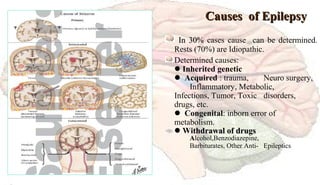
In 30%In 30% cases cause can be determined.
Rests (70%) are Idiopathic.
Determined causes:
Inherited genetic
 Acquired : trauma, Neuro surgery,
Inflammatory, Metabolic,
Infections, Tumor, Toxic disorders,
drugs, etc.
 Congenital: inborn error of
metabolism.
Withdrawal of drugsthdrawal of drugs
AAlcohol,Benzodiazepine,
Barbiturates, Other Anti- Epileptics
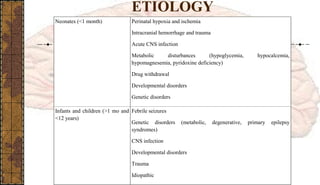
ETIOLOGY
Neonates (<1 month) Perinatal hypoxia and ischemia
Intracranial hemorrhage and trauma
Acute CNS infection
Metabolic disturbances (hypoglycemia, hypocalcemia,
hypomagnesemia, pyridoxine deficiency)
Drug withdrawal
Developmental disorders
Genetic disorders
Infants and children (>1 mo and
<12 years)
Febrile seizures
Genetic disorders (metabolic, degenerative, primary epilepsy
syndromes)
CNS infection
Developmental disorders
Trauma
Idiopathic
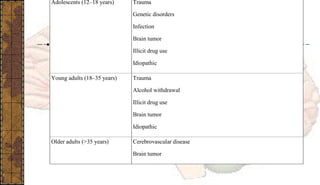
Adolescents (12–18 years) Trauma
Genetic disorders
Infection
Brain tumor
Illicit drug use
Idiopathic
Young adults (18–35 years) Trauma
Alcohol withdrawal
Illicit drug use
Brain tumor
Idiopathic
Older adults (>35 years) Cerebrovascular disease
Brain tumor
Pathophysiology
A seizure occurs when a portion of the brain becomes
overly excited or when nerves in the brain begin to fire
together in an abnormal fashion. Seizure activity can arise
in areas of the brain that are malformed from birth defects
or genetic disorders or disrupted from infection, injuries,
tumors, strokes, or inadequate oxygenation.
The seizures results from an abrupt imbalance between
the forces that excite and inhibit the nerve cells such that
the excitatory forces take precedence. This electrical
signal then spreads to the surrounding normal brain cells,
which begin to fire in concert with the abnormal cells.
Pathophysiology of EpilepsyPathophysiology of Epilepsy
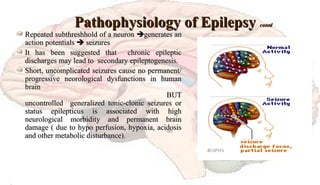
In normal brain inhibitory circuits limits synchronous discharge. GABA is
particularly play this role.
When GABA receptors blocked Rhythmic and repetitive
hypersynchronus discharge of neurons  seizures
Excitatory NT  Ach , Aspartate and Glutamate also involved to develop
seizures
Intracellular recording shows burst of rapid action potential firing with
reduction of transmembrane potential.
 inhibitory system +  excitation   genesis of seizures
Abnormalities in Ion Channel
(Na+
,K+
, Ca-
) may cause seizures.
(Prolongation of depolarization state)
Pathophysiology of EpilepsyPathophysiology of Epilepsy contdcontd
Repeated subthreshhold of a neuronRepeated subthreshhold of a neuron generates angenerates an
action potentialsaction potentials  seizuresseizures
It has been suggested that chronic epilepticIt has been suggested that chronic epileptic
discharges may lead to secondary epileptogenesis.discharges may lead to secondary epileptogenesis.
Short, uncomplicated seizures cause no permanent/Short, uncomplicated seizures cause no permanent/
progressive neorological dysfunctions in humanprogressive neorological dysfunctions in human
brainbrain
BUTBUT
uncontrolled generalized tonic-clonic seizures oruncontrolled generalized tonic-clonic seizures or
status epilepticus is associated with highstatus epilepticus is associated with high
neurological morbidity and permanent brainneurological morbidity and permanent brain
damage ( due to hypo perfusion, hypoxia, acidosisdamage ( due to hypo perfusion, hypoxia, acidosis
and other metabolic disturbance).and other metabolic disturbance).
Clinical manifestations
Partial seizures or focal seizures are due to a small
epileptic focus in the brain.
They are divided into two main categories.
a. simple partial seizure in which the seizure starts as a
focal discharge and remains focal throughout without
alteration of consciousness
b. complex partial seizure when a seizure starts as a
focal discharge, but consciousness is also altered or lost
Clinical PresentationsClinical Presentations
((Partial Seizures)Partial Seizures)
Simple Partial Seizures:Simple Partial Seizures:
Consciousness is fully preservedConsciousness is fully preserved
 Motor disturbance may involve any body partMotor disturbance may involve any body part
 Tingling , numbness, electrical shock like feelingsTingling , numbness, electrical shock like feelings
 Flashing light and colours,Flashing light and colours, Simple hallucinationsSimple hallucinations
 Changes in skin color, Blood pressure, Heart rate,Changes in skin color, Blood pressure, Heart rate, Pupil size,Pupil size,
Piloerection.Piloerection.
 Psychic manifestation: Dysphasic- when corticalPsychic manifestation: Dysphasic- when cortical speechspeech
area affected, Dysmnestic- disturbance ofarea affected, Dysmnestic- disturbance of memory,memory, CognitiveCognitive
symptoms- dreamy state,symptoms- dreamy state, AffectiveAffective symptoms- fear, depression, anger,symptoms- fear, depression, anger,
irritability, elation,irritability, elation, erotic thoughts, Illusion of size,erotic thoughts, Illusion of size, structured hallucinationstructured hallucination.
Clinical PresentationsClinical Presentations
Definition:
Clinical PresentationsClinical Presentations
((Partial Seizures)Partial Seizures)
Clinical PresentationsClinical Presentations
(Partial Seizures)(Partial Seizures)
Complex Partial SeizuresComplex Partial Seizures
(Psychomotor Seizures/Temporal lobe Epelepsy)(Psychomotor Seizures/Temporal lobe Epelepsy)
 Always involved impairment of consciousness.Always involved impairment of consciousness.
 Majority originate in Temporal lobe (60%); butMajority originate in Temporal lobe (60%); but alsoalso
originateoriginate another lobe –another lobe – particularlyparticularly Frontal(30%).Frontal(30%).
 May start as simple partial seizures then progress.May start as simple partial seizures then progress.
 Aura may be present-short live (few seconds)Aura may be present-short live (few seconds)
 Automatism: Oro-Alimentary, Mimicry, Gestural,Automatism: Oro-Alimentary, Mimicry, Gestural,
Ambulatory, Verbal, Responsive and Violent.Ambulatory, Verbal, Responsive and Violent.
Duration: < 3 minutes.
Clinical PresentationsClinical Presentations
(Complex Partial Seizures)(Complex Partial Seizures)
Definition:
Generalized seizure
These are seizures in which there is no evidence of an
epileptic focus, either clinically or on EEG, as opposed to
secondary generalised seizures. The epileptic discharge
involves both cerebral hemispheres simultaneously from the
onset of the seizures. Hence, consciousness is almost
invariably impaired or lost at the onset of the attack
Clinical PresentationsClinical Presentations
(Generalized Seizures)(Generalized Seizures)
Generalized Tonic-clonic (grand mal)
ConvulsiveConvulsive seizures
No Aura but have prodormal phase- general malaise
Tonic phase-Tonic phase- The tonic phase consists of rolling up of the eyes associated with
stiffening of the limbs followed by clenching of the jaws, often resulting in injury to
the tongue. Lasts 10 to 30 seconds
Clonic phase:Clonic phase: intermittent clonic movements of musclesstrenuous breathing,
sweating, frothing of the mouth and excess salivation lasts for 1-2 minutes
This is followed by a deep comatose state, which lasts for about 5 minutes
Post ictal period:Post ictal period: drowsiness, confusion, headache, deep sleep
Generalized Tonic-clonic (grand mal)
Definition:
Clinical PresentationsClinical Presentations
(Generalized Seizures)(Generalized Seizures)
Typical Absence Seizures (Petit mal):Typical Absence Seizures (Petit mal):
 Occur almost exclusively in childhood or early
adolescent.
Sudden loss of consciousness and cease all motor
only for a brief period often < 10 seconds.
Suddenly appears blank and stares, fluttering
of the
eyelids, swallowing, flopping of the head.
Attacks last only a few seconds (<10 sec) and
often pass un-recognized. About 100-200 attacks
may occur/day.
Characteristic EEG : 3 per sec generalized
spike and wave
Attacks precipitate by fatigue, drowsiness,
relaxation , photic stimulation or
hyperventilation.
Clinical PresentationsClinical Presentations
Typical Absence Seizures (Petit mal)Typical Absence Seizures (Petit mal)
Clinical PresentationsClinical Presentations
Myoclonic seizuresMyoclonic seizures
Abrupt , very brief, involuntery flexion movements.
Involve whole body or part of the body
Occur most commonly at morning, shortly after walking.
May occur in healthy people (physiological)
Atonic SeizuresAtonic Seizures
Brief loss of muscle tone.
Heavy fall , with or without loss of consciousness.
Diagnosis of EpilepsyDiagnosis of Epilepsy
Thorough History taking :Thorough History taking :
From patients
From reliable valid informants
From observer (who observed seizures)
Physical Examination:Physical Examination:
Specially neurological system
Higher Psychic function
Laboratory Investigation:Laboratory Investigation:
S. Electrolytes, S. Prolactin, Blood sugar, CBC, TFT, LFT, RFT, CSF
study
Imaging:Imaging:
EEG, Video EEG telemetry, CT Scan of Brain, MRI of Brain, MRS, PET,
SPECT.
PolysomnographyPolysomnography
MANAGEMENT OF EPILEPSY
This consists of
(i) treatment of the acute convulsions,
The latter consists of :
1. Removal of precipitating or causative factors.
2. Antiepileptic medication.
3. Social rehabilitation
Management of EpilepsyManagement of Epilepsy
Medical treatment:
Immediate care of seizuresImmediate care of seizures
Move persons away from danger
Recovery position (semi prone)
Ensure clear airway
Do not insert anything into mouth
Urgent medical attention- (patent airway, O2 ,
anticonvulsant, investigate cause)
Should not be left alone after recovery
Consider about regular AEDConsider about regular AED
Surgical treatment:
Indicated when seizures shown to be intractable to medical treatment.
Removal of epileptic focus (eg:mesial temporal sclerosis)
Anterior Temporal Lobectomy
Corpus callostomy
Subpial transection
Vagus Nerve stimulation
Ketogenic diet
Treatment of the acute convulsions
Convulsion is a medical emergency especially if
prolonged, which should be arrested without delay
Ensure patent airway
Protect from injury (do not restrain)
Remove or loosen tight clothing
Establish IV line
Suction as needed
Removal of precipitating or causative
factors
Reversal of metabolic disturbance such as an abnormality
of serum electrolytes or glucose
sleep deprivation should obviously be advised to maintain
a normal sleep schedule
Avoidance of illicit drug use,alcoholism etc
slow intravenous injection of 5-10 mg of diazepam
An alternate anticonvulsant drug is lorazepam 4 mg IV
given slowly over 5-10 minutes.
Other drug that must be given parenterally is phenytoin
sodium 100-200 mg IV
ANTIEPILEPTIC DRUG THERAPY
(AED)
AEDs are not curative in epilepsy, they help to control
seizures and give symptomatic relief
INDICATIONS
When more than one unprovoked seizure has occurred in
the preceding one to two years or when the risk of
recurrent convulsionis high as in head injury or
intracranial infections. AED should be started
AED: Indications and DosageAED: Indications and Dosage
AEDAED Seizure typeSeizure type Dose rangeDose range
(mg/day)(mg/day)
DosesDoses
per dayper day
TherapeuticTherapeutic
rangerange
((μmol/L)μmol/L)
Carbamazepine Partial,Secondary GTCS, 250-2000 2-3 30-50
Sodium
Valporate
Primary & Secondary GTCS,
Absence, Myoclonus
400-2500 1-2 NA
Phenytoin Partial, Secondary GTCS 150-350 1 40-80
Lamotrigine Partial, secondary GTCS 25-500 1-2 NA
Lorazepam Status Epilepticus 4 i.v. -- NA
Clonazepum Partial (adjunctive),
Myoclonus
1-8 2-4 NA
Ethosuximide Childhood Absence 500-1500 2 200-700
Topiramate Partial, secondary GTCS 200-600 1-2 NA
Phenobarbital Partial, secondary GTCS 60-100 1 50-150
Guidelines for Anticonvulsant TherapyGuidelines for Anticonvulsant Therapy
Start with one first line drugsStart with one first line drugs
Start with low dose: Gradually increase to effective dose or until sideStart with low dose: Gradually increase to effective dose or until side
effects.effects.
Check complianceCheck compliance
If first drug fails due to side effects or continue seizures, start second lineIf first drug fails due to side effects or continue seizures, start second line
drugs whilst gradually withdrawing first.drugs whilst gradually withdrawing first.
Try Three AED singly before using combinationsTry Three AED singly before using combinations
Beware about drug interactionsBeware about drug interactions
Do not use more than two drugs in combination at any one timeDo not use more than two drugs in combination at any one time
If above fails consider occult structural or metabolic lesion and whetherIf above fails consider occult structural or metabolic lesion and whether
seizures are truly epileptic.seizures are truly epileptic.
Withdrawal of AEDWithdrawal of AED
After complete control of seizures for 2-4 years, withdrawal of AntiAfter complete control of seizures for 2-4 years, withdrawal of Anti
Epileptic drugs may be considered. But in case of special professionalEpileptic drugs may be considered. But in case of special professional
group (car driver, machine man etc) withdraw the AED after keengroup (car driver, machine man etc) withdraw the AED after keen
follow-up.follow-up.
AED should be tapered during the stopping of medications.AED should be tapered during the stopping of medications.
Slow reduction by increments over at least 6 months.Slow reduction by increments over at least 6 months.
If the patient is taking two AEDs one drug should be slowlyIf the patient is taking two AEDs one drug should be slowly
withdrawn before the second is tapered.withdrawn before the second is tapered.
Surgical Management of Epilepsy
Lobe resection:Temporal lobe epilepsy, in which the
seizure focus is located within the temporal lobe, is the
most common type of epilepsy in teens and adults
Lesionectomy: This is surgery to remove isolated brain
lesions -- areas of injury or defect such as a tumor or
malformed blood vessel -- that are responsible for seizure
activity
Corpus callosotomy: The corpus callosum is a band of
nerve fibers connecting the two halves (hemispheres) of
the brain. A corpus callosotomy is an operation in which
all or part of this structure is cut, disabling communication
between the hemispheres and preventing the spread of
seizures from one side of the brain to the other.
Functional hemispherectomy: This is a variation of a
hemispherectomy, a radical procedure in which one entire
hemisphere, or one half of the brain, is removed. With a
functional hemispherectomy, one hemisphere is
disconnected from the rest of the brain, but only a limited
area of brain tissue is removed.
Vagus nerve stimulation (VNS): This is a device that
electronically stimulates the vagus nerve (which controls
activity between the brain and major internal organs) is
implanted under the skin
Responsive neurostimulation device (RNS): This device
consists of a small neurostimulator implanted within the
skull under the scalp. The neurostimulator is connected to
one or two wires (called electrodes) that are placed where
the seizures are suspected to originate within the brain or
on the surface of the brain. The device detects abnormal
electrical activity in the area and delivers electrical
stimulation to normalize brain activity before seizure
symptoms begin.
Complication
When recurrent seizures occur at a frequency which does
not allow consciousness to be regained in the interval
between seizures, it is called status epilepticus
prolonged or frequent seizures also lead to permanent
damage to the brain (hippocampus, Purkinje cells of
cerebellum and extrapyramidal system
Management
Time is a critical factor in the management of status
epilepticus
Benzodiazepines such as diazepam, lorazepam,
midazolam and clonazepam are all potent fast-acting
antiepileptic drugs, preferred for terminating the attack
immediately.
10 mg diazepam (0.3-0.5 mg/kg bw) should be given
slowly intravenously over a period of 2-5 minutes..
Lorazepam -0.1 mg/kg at 2 mg/minute is preferable to IV
Diazepam as it has longer duration of action (> 4 hrs) and
lesser respiratory depression
NURSING MANAGEMENT
Assessment
Physical examination
Emergency Management of seizure
Nursing diagnosis
1.Ineffective breathing pattern related to neuromuscular
impairment secondary to prolonged tonic phase of seizure
or during post ictal period as evidenced by abnormal
respiratory rate, rhythm and depth
2. Risk for injury related to seizure activity and
subsequent impaired physical mobility secondary to
postictal weakness
3.Ineffective coping related to perceived loss of control
and denial of diagnosis as evidenced by verbalization bout
not having epilepsy ,lack of truth telling regarding seizure
frequency ,non compliant behavior.
4.Ineffective therapeutic regimen management related to
lack of knowledge about management of seizure disorder
as evidenced by verbalization of lack of knowledge
,inaccurate perception of health status.
Famous Persons with Epilepsy
AristotleAristotle
SocratesSocrates
Julius CaesarJulius Caesar
Fyodor DostoyevskyFyodor Dostoyevsky
Lord ByronLord Byron
Vincent Van GoghVincent Van Gogh
Alfred NobelAlfred Nobel
Vlaldimir Illyich LeninVlaldimir Illyich Lenin
Naepoleon BonaparteNaepoleon Bonaparte
Tony GreigTony Greig
Famous Persons with Epilepsy
AristotleAristotle
SocratesSocrates
Julius CaesarJulius Caesar
Fyodor DostoyevskyFyodor Dostoyevsky
Lord ByronLord Byron
Vincent Van GoghVincent Van Gogh
Alfred NobelAlfred Nobel
Vlaldimir Illyich LeninVlaldimir Illyich Lenin
Naepoleon BonaparteNaepoleon Bonaparte
Tony GreigTony Greig
Famous Persons with Epilepsy
AristotleAristotle
SocratesSocrates
Julius CaesarJulius Caesar
Fyodor DostoyevskyFyodor Dostoyevsky
Lord ByronLord Byron
Vincent Van GoghVincent Van Gogh
Alfred NobelAlfred Nobel
Vlaldimir Illyich LeninVlaldimir Illyich Lenin
Naepoleon BonaparteNaepoleon Bonaparte
Tony GreigTony Greig
Famous Persons with Epilepsy
AristotleAristotle
SocratesSocrates
Julius CaesarJulius Caesar
Fyodor DostoyevskyFyodor Dostoyevsky
Lord ByronLord Byron
Vincent Van GoghVincent Van Gogh
Alfred NobelAlfred Nobel
Vlaldimir Illyich LeninVlaldimir Illyich Lenin
Naepoleon BonaparteNaepoleon Bonaparte
Tony GreigTony Greig
Famous Persons with Epilepsy
AristotleAristotle
SocratesSocrates
Julius CaesarJulius Caesar
Fyodor DostoyevskyFyodor Dostoyevsky
Lord ByronLord Byron
Vincent Van GoghVincent Van Gogh
Alfred NobelAlfred Nobel
Vlaldimir Illyich LeninVlaldimir Illyich Lenin
Naepoleon BonaparteNaepoleon Bonaparte
Tony GreigTony Greig
Famous Persons with Epilepsy
AristotleAristotle
SocratesSocrates
Julius CaesarJulius Caesar
Fyodor DostoyevskyFyodor Dostoyevsky
Lord ByronLord Byron
Vincent Van GoghVincent Van Gogh
Alfred NobelAlfred Nobel
Vlaldimir Illyich LeninVlaldimir Illyich Lenin
Naepoleon BonaparteNaepoleon Bonaparte
Tony GreigTony Greig
Famous Persons with Epilepsy
AristotleAristotle
SocratesSocrates
Julius CaesarJulius Caesar
Fyodor DostoyevskyFyodor Dostoyevsky
Lord ByronLord Byron
Vincent Van GoghVincent Van Gogh
Alfred NobelAlfred Nobel
Vlaldimir Illyich LeninVlaldimir Illyich Lenin
Naepoleon BonaparteNaepoleon Bonaparte
Tony GreigTony Greig
Famous Persons with Epilepsy
AristotleAristotle
SocratesSocrates
Julius CaesarJulius Caesar
Fyodor DostoyevskyFyodor Dostoyevsky
Lord ByronLord Byron
Vincent Van GoghVincent Van Gogh
Alfred NobelAlfred Nobel
Vlaldimir Illyich LeninVlaldimir Illyich Lenin
Naepoleon BonaparteNaepoleon Bonaparte
Tony GreigTony Greig
Famous Persons with Epilepsy
AristotleAristotle
SocratesSocrates
Julius CaesarJulius Caesar
Fyodor DostoyevskyFyodor Dostoyevsky
Lord ByronLord Byron
Vincent Van GoghVincent Van Gogh
Alfred NobelAlfred Nobel
Vlaldimir Illyich LeninVlaldimir Illyich Lenin
Naepoleon BonaparteNaepoleon Bonaparte
Tony GreigTony Greig
Famous Persons with Epilepsy
AristotleAristotle
SocratesSocrates
Julius CaesarJulius Caesar
Fyodor DostoyevskyFyodor Dostoyevsky
Lord ByronLord Byron
Vincent Van GoghVincent Van Gogh
Alfred NobelAlfred Nobel
Vlaldimir Illyich LeninVlaldimir Illyich Lenin
Naepoleon BonaparteNaepoleon Bonaparte
Tony GreigTony Greig
THANK YOUTHANK YOU

Epilepsy

  • 1.
    Management of patientwithManagement of patient with EpilepsyEpilepsy
  • 2.
    IntroductionIntroduction Definition: seizure isa paroxysmal, uncontrolled electrical discharge of neuron in the brain that interrupts normal function An epileptic seizure is electrophysiologically characterized by abnormal transient and excessive electrical discharge of cerebral neurons and clinically characterized by paroxysmal episodes of loss or excess of motor, sensory, autonomic or psychic functions with or without alteration in consciousness.
  • 3.
    Difference seizure is asymptom and epilepsy is a syndrome. Though epilepsy begins first with a seizure, not all first seizures lead to epilepsy. Seizures may often occur in acute systemic conditions such as metabolic disturbances (hypoglycemia), drug toxicity (chloroquine) and drug withdrawal (diazepam) but usually they do not constitute epilepsy.
  • 4.
    Historical BackgroundHistorical Background Epilepsyderived from a Greek term: Epilambanei -to posses, to take hold of, to grab or to seize. Vedic period of 4500-1500BC :Vedic period of 4500-1500BC : Ancient Indian Medicine refined and developedAncient Indian Medicine refined and developed the basic concept of epilepsythe basic concept of epilepsy Charaka Samhita- The Ayurvedic literatureCharaka Samhita- The Ayurvedic literature 400 BC:400 BC: Describe epilepsy asDescribe epilepsy as ‘‘Apasmara’Apasmara’ meansmeans loss of consciousness.loss of consciousness.
  • 5.
    Historical BackgroundHistorical Backgroundcontdcontd Hippocrates400 BC:Hippocrates 400 BC: ‘This is not a sacred‘This is not a sacred disease rather disorder of brain’disease rather disorder of brain’ . He. He described some physical treatment of epilepsydescribed some physical treatment of epilepsy and stated it is an incurable chronic illness.and stated it is an incurable chronic illness. Ibn Sina 370 AH:Ibn Sina 370 AH: describe epilepsy as adescribe epilepsy as a brainbrain disease.disease.
  • 6.
    Classification of Seizures ILAEClassification (1981) I.I. Partial (Focal)seizuresPartial (Focal)seizures A. Simple partial seizuresA. Simple partial seizures B. Complex Partial SeizuresB. Complex Partial Seizures C. Partial Seizures evolving toC. Partial Seizures evolving to secondary generalized seizuressecondary generalized seizures (tonic-clonic, tonic or clonic)(tonic-clonic, tonic or clonic) II.II. Generalized seizuresGeneralized seizures (Convulsive and(Convulsive and non-convulsive)non-convulsive) A. Absence seizuresA. Absence seizures i) Typicali) Typical ii) Atypicalii) Atypical B. Myoclonic seizuresB. Myoclonic seizures C. Clonic seizuresC. Clonic seizures D. Tonic seizuresD. Tonic seizures E. Tonic-Clonic seizuresE. Tonic-Clonic seizures F. Atonic seizuresF. Atonic seizures (Combinations may occur: myoclonic and atonic or myoclonic and tonic) III.III. Unclassified epileptic seizuresUnclassified epileptic seizures
  • 7.
    Seizure classification Focal seizureGeneralized seizure consciousness probable altered brief altered consciousness consciousness Alert altered generalized absence myoclonic tonic Simple complex tonic-clonic seizure seizure seizure
  • 8.
    Causes of EpilepsyCausesof Epilepsy In 30%In 30% cases cause can be determined. Rests (70%) are Idiopathic. Determined causes: Inherited genetic  Acquired : trauma, Neuro surgery, Inflammatory, Metabolic, Infections, Tumor, Toxic disorders, drugs, etc.  Congenital: inborn error of metabolism. Withdrawal of drugsthdrawal of drugs AAlcohol,Benzodiazepine, Barbiturates, Other Anti- Epileptics
  • 9.
    ETIOLOGY Neonates (<1 month)Perinatal hypoxia and ischemia Intracranial hemorrhage and trauma Acute CNS infection Metabolic disturbances (hypoglycemia, hypocalcemia, hypomagnesemia, pyridoxine deficiency) Drug withdrawal Developmental disorders Genetic disorders Infants and children (>1 mo and <12 years) Febrile seizures Genetic disorders (metabolic, degenerative, primary epilepsy syndromes) CNS infection Developmental disorders Trauma Idiopathic
  • 10.
    Adolescents (12–18 years)Trauma Genetic disorders Infection Brain tumor Illicit drug use Idiopathic Young adults (18–35 years) Trauma Alcohol withdrawal Illicit drug use Brain tumor Idiopathic Older adults (>35 years) Cerebrovascular disease Brain tumor
  • 11.
    Pathophysiology A seizure occurswhen a portion of the brain becomes overly excited or when nerves in the brain begin to fire together in an abnormal fashion. Seizure activity can arise in areas of the brain that are malformed from birth defects or genetic disorders or disrupted from infection, injuries, tumors, strokes, or inadequate oxygenation.
  • 12.
    The seizures resultsfrom an abrupt imbalance between the forces that excite and inhibit the nerve cells such that the excitatory forces take precedence. This electrical signal then spreads to the surrounding normal brain cells, which begin to fire in concert with the abnormal cells.
  • 13.
    Pathophysiology of EpilepsyPathophysiologyof Epilepsy In normal brain inhibitory circuits limits synchronous discharge. GABA is particularly play this role. When GABA receptors blocked Rhythmic and repetitive hypersynchronus discharge of neurons  seizures Excitatory NT  Ach , Aspartate and Glutamate also involved to develop seizures Intracellular recording shows burst of rapid action potential firing with reduction of transmembrane potential.  inhibitory system +  excitation   genesis of seizures Abnormalities in Ion Channel (Na+ ,K+ , Ca- ) may cause seizures. (Prolongation of depolarization state)
  • 14.
    Pathophysiology of EpilepsyPathophysiologyof Epilepsy contdcontd Repeated subthreshhold of a neuronRepeated subthreshhold of a neuron generates angenerates an action potentialsaction potentials  seizuresseizures It has been suggested that chronic epilepticIt has been suggested that chronic epileptic discharges may lead to secondary epileptogenesis.discharges may lead to secondary epileptogenesis. Short, uncomplicated seizures cause no permanent/Short, uncomplicated seizures cause no permanent/ progressive neorological dysfunctions in humanprogressive neorological dysfunctions in human brainbrain BUTBUT uncontrolled generalized tonic-clonic seizures oruncontrolled generalized tonic-clonic seizures or status epilepticus is associated with highstatus epilepticus is associated with high neurological morbidity and permanent brainneurological morbidity and permanent brain damage ( due to hypo perfusion, hypoxia, acidosisdamage ( due to hypo perfusion, hypoxia, acidosis and other metabolic disturbance).and other metabolic disturbance).
  • 15.
    Clinical manifestations Partial seizuresor focal seizures are due to a small epileptic focus in the brain. They are divided into two main categories. a. simple partial seizure in which the seizure starts as a focal discharge and remains focal throughout without alteration of consciousness b. complex partial seizure when a seizure starts as a focal discharge, but consciousness is also altered or lost
  • 16.
    Clinical PresentationsClinical Presentations ((PartialSeizures)Partial Seizures) Simple Partial Seizures:Simple Partial Seizures: Consciousness is fully preservedConsciousness is fully preserved  Motor disturbance may involve any body partMotor disturbance may involve any body part  Tingling , numbness, electrical shock like feelingsTingling , numbness, electrical shock like feelings  Flashing light and colours,Flashing light and colours, Simple hallucinationsSimple hallucinations  Changes in skin color, Blood pressure, Heart rate,Changes in skin color, Blood pressure, Heart rate, Pupil size,Pupil size, Piloerection.Piloerection.  Psychic manifestation: Dysphasic- when corticalPsychic manifestation: Dysphasic- when cortical speechspeech area affected, Dysmnestic- disturbance ofarea affected, Dysmnestic- disturbance of memory,memory, CognitiveCognitive symptoms- dreamy state,symptoms- dreamy state, AffectiveAffective symptoms- fear, depression, anger,symptoms- fear, depression, anger, irritability, elation,irritability, elation, erotic thoughts, Illusion of size,erotic thoughts, Illusion of size, structured hallucinationstructured hallucination.
  • 17.
    Clinical PresentationsClinical Presentations Definition: ClinicalPresentationsClinical Presentations ((Partial Seizures)Partial Seizures)
  • 18.
    Clinical PresentationsClinical Presentations (PartialSeizures)(Partial Seizures) Complex Partial SeizuresComplex Partial Seizures (Psychomotor Seizures/Temporal lobe Epelepsy)(Psychomotor Seizures/Temporal lobe Epelepsy)  Always involved impairment of consciousness.Always involved impairment of consciousness.  Majority originate in Temporal lobe (60%); butMajority originate in Temporal lobe (60%); but alsoalso originateoriginate another lobe –another lobe – particularlyparticularly Frontal(30%).Frontal(30%).  May start as simple partial seizures then progress.May start as simple partial seizures then progress.  Aura may be present-short live (few seconds)Aura may be present-short live (few seconds)  Automatism: Oro-Alimentary, Mimicry, Gestural,Automatism: Oro-Alimentary, Mimicry, Gestural, Ambulatory, Verbal, Responsive and Violent.Ambulatory, Verbal, Responsive and Violent. Duration: < 3 minutes.
  • 19.
    Clinical PresentationsClinical Presentations (ComplexPartial Seizures)(Complex Partial Seizures) Definition:
  • 20.
    Generalized seizure These areseizures in which there is no evidence of an epileptic focus, either clinically or on EEG, as opposed to secondary generalised seizures. The epileptic discharge involves both cerebral hemispheres simultaneously from the onset of the seizures. Hence, consciousness is almost invariably impaired or lost at the onset of the attack
  • 21.
    Clinical PresentationsClinical Presentations (GeneralizedSeizures)(Generalized Seizures) Generalized Tonic-clonic (grand mal) ConvulsiveConvulsive seizures No Aura but have prodormal phase- general malaise Tonic phase-Tonic phase- The tonic phase consists of rolling up of the eyes associated with stiffening of the limbs followed by clenching of the jaws, often resulting in injury to the tongue. Lasts 10 to 30 seconds Clonic phase:Clonic phase: intermittent clonic movements of musclesstrenuous breathing, sweating, frothing of the mouth and excess salivation lasts for 1-2 minutes This is followed by a deep comatose state, which lasts for about 5 minutes Post ictal period:Post ictal period: drowsiness, confusion, headache, deep sleep
  • 22.
  • 23.
    Clinical PresentationsClinical Presentations (GeneralizedSeizures)(Generalized Seizures) Typical Absence Seizures (Petit mal):Typical Absence Seizures (Petit mal):  Occur almost exclusively in childhood or early adolescent. Sudden loss of consciousness and cease all motor only for a brief period often < 10 seconds. Suddenly appears blank and stares, fluttering of the eyelids, swallowing, flopping of the head. Attacks last only a few seconds (<10 sec) and often pass un-recognized. About 100-200 attacks may occur/day. Characteristic EEG : 3 per sec generalized spike and wave Attacks precipitate by fatigue, drowsiness, relaxation , photic stimulation or hyperventilation.
  • 24.
    Clinical PresentationsClinical Presentations TypicalAbsence Seizures (Petit mal)Typical Absence Seizures (Petit mal)
  • 25.
    Clinical PresentationsClinical Presentations MyoclonicseizuresMyoclonic seizures Abrupt , very brief, involuntery flexion movements. Involve whole body or part of the body Occur most commonly at morning, shortly after walking. May occur in healthy people (physiological) Atonic SeizuresAtonic Seizures Brief loss of muscle tone. Heavy fall , with or without loss of consciousness.
  • 26.
    Diagnosis of EpilepsyDiagnosisof Epilepsy Thorough History taking :Thorough History taking : From patients From reliable valid informants From observer (who observed seizures) Physical Examination:Physical Examination: Specially neurological system Higher Psychic function Laboratory Investigation:Laboratory Investigation: S. Electrolytes, S. Prolactin, Blood sugar, CBC, TFT, LFT, RFT, CSF study Imaging:Imaging: EEG, Video EEG telemetry, CT Scan of Brain, MRI of Brain, MRS, PET, SPECT. PolysomnographyPolysomnography
  • 27.
    MANAGEMENT OF EPILEPSY Thisconsists of (i) treatment of the acute convulsions, The latter consists of : 1. Removal of precipitating or causative factors. 2. Antiepileptic medication. 3. Social rehabilitation
  • 28.
    Management of EpilepsyManagementof Epilepsy Medical treatment: Immediate care of seizuresImmediate care of seizures Move persons away from danger Recovery position (semi prone) Ensure clear airway Do not insert anything into mouth Urgent medical attention- (patent airway, O2 , anticonvulsant, investigate cause) Should not be left alone after recovery Consider about regular AEDConsider about regular AED Surgical treatment: Indicated when seizures shown to be intractable to medical treatment. Removal of epileptic focus (eg:mesial temporal sclerosis) Anterior Temporal Lobectomy Corpus callostomy Subpial transection Vagus Nerve stimulation Ketogenic diet
  • 29.
    Treatment of theacute convulsions Convulsion is a medical emergency especially if prolonged, which should be arrested without delay Ensure patent airway Protect from injury (do not restrain) Remove or loosen tight clothing Establish IV line Suction as needed
  • 30.
    Removal of precipitatingor causative factors Reversal of metabolic disturbance such as an abnormality of serum electrolytes or glucose sleep deprivation should obviously be advised to maintain a normal sleep schedule Avoidance of illicit drug use,alcoholism etc
  • 31.
    slow intravenous injectionof 5-10 mg of diazepam An alternate anticonvulsant drug is lorazepam 4 mg IV given slowly over 5-10 minutes. Other drug that must be given parenterally is phenytoin sodium 100-200 mg IV
  • 32.
    ANTIEPILEPTIC DRUG THERAPY (AED) AEDsare not curative in epilepsy, they help to control seizures and give symptomatic relief INDICATIONS When more than one unprovoked seizure has occurred in the preceding one to two years or when the risk of recurrent convulsionis high as in head injury or intracranial infections. AED should be started
  • 33.
    AED: Indications andDosageAED: Indications and Dosage AEDAED Seizure typeSeizure type Dose rangeDose range (mg/day)(mg/day) DosesDoses per dayper day TherapeuticTherapeutic rangerange ((μmol/L)μmol/L) Carbamazepine Partial,Secondary GTCS, 250-2000 2-3 30-50 Sodium Valporate Primary & Secondary GTCS, Absence, Myoclonus 400-2500 1-2 NA Phenytoin Partial, Secondary GTCS 150-350 1 40-80 Lamotrigine Partial, secondary GTCS 25-500 1-2 NA Lorazepam Status Epilepticus 4 i.v. -- NA Clonazepum Partial (adjunctive), Myoclonus 1-8 2-4 NA Ethosuximide Childhood Absence 500-1500 2 200-700 Topiramate Partial, secondary GTCS 200-600 1-2 NA Phenobarbital Partial, secondary GTCS 60-100 1 50-150
  • 34.
    Guidelines for AnticonvulsantTherapyGuidelines for Anticonvulsant Therapy Start with one first line drugsStart with one first line drugs Start with low dose: Gradually increase to effective dose or until sideStart with low dose: Gradually increase to effective dose or until side effects.effects. Check complianceCheck compliance If first drug fails due to side effects or continue seizures, start second lineIf first drug fails due to side effects or continue seizures, start second line drugs whilst gradually withdrawing first.drugs whilst gradually withdrawing first. Try Three AED singly before using combinationsTry Three AED singly before using combinations Beware about drug interactionsBeware about drug interactions Do not use more than two drugs in combination at any one timeDo not use more than two drugs in combination at any one time If above fails consider occult structural or metabolic lesion and whetherIf above fails consider occult structural or metabolic lesion and whether seizures are truly epileptic.seizures are truly epileptic.
  • 35.
    Withdrawal of AEDWithdrawalof AED After complete control of seizures for 2-4 years, withdrawal of AntiAfter complete control of seizures for 2-4 years, withdrawal of Anti Epileptic drugs may be considered. But in case of special professionalEpileptic drugs may be considered. But in case of special professional group (car driver, machine man etc) withdraw the AED after keengroup (car driver, machine man etc) withdraw the AED after keen follow-up.follow-up. AED should be tapered during the stopping of medications.AED should be tapered during the stopping of medications. Slow reduction by increments over at least 6 months.Slow reduction by increments over at least 6 months. If the patient is taking two AEDs one drug should be slowlyIf the patient is taking two AEDs one drug should be slowly withdrawn before the second is tapered.withdrawn before the second is tapered.
  • 36.
    Surgical Management ofEpilepsy Lobe resection:Temporal lobe epilepsy, in which the seizure focus is located within the temporal lobe, is the most common type of epilepsy in teens and adults Lesionectomy: This is surgery to remove isolated brain lesions -- areas of injury or defect such as a tumor or malformed blood vessel -- that are responsible for seizure activity
  • 37.
    Corpus callosotomy: Thecorpus callosum is a band of nerve fibers connecting the two halves (hemispheres) of the brain. A corpus callosotomy is an operation in which all or part of this structure is cut, disabling communication between the hemispheres and preventing the spread of seizures from one side of the brain to the other.
  • 38.
    Functional hemispherectomy: Thisis a variation of a hemispherectomy, a radical procedure in which one entire hemisphere, or one half of the brain, is removed. With a functional hemispherectomy, one hemisphere is disconnected from the rest of the brain, but only a limited area of brain tissue is removed.
  • 39.
    Vagus nerve stimulation(VNS): This is a device that electronically stimulates the vagus nerve (which controls activity between the brain and major internal organs) is implanted under the skin
  • 40.
    Responsive neurostimulation device(RNS): This device consists of a small neurostimulator implanted within the skull under the scalp. The neurostimulator is connected to one or two wires (called electrodes) that are placed where the seizures are suspected to originate within the brain or on the surface of the brain. The device detects abnormal electrical activity in the area and delivers electrical stimulation to normalize brain activity before seizure symptoms begin.
  • 41.
    Complication When recurrent seizuresoccur at a frequency which does not allow consciousness to be regained in the interval between seizures, it is called status epilepticus prolonged or frequent seizures also lead to permanent damage to the brain (hippocampus, Purkinje cells of cerebellum and extrapyramidal system
  • 42.
    Management Time is acritical factor in the management of status epilepticus Benzodiazepines such as diazepam, lorazepam, midazolam and clonazepam are all potent fast-acting antiepileptic drugs, preferred for terminating the attack immediately.
  • 43.
    10 mg diazepam(0.3-0.5 mg/kg bw) should be given slowly intravenously over a period of 2-5 minutes.. Lorazepam -0.1 mg/kg at 2 mg/minute is preferable to IV Diazepam as it has longer duration of action (> 4 hrs) and lesser respiratory depression
  • 44.
  • 45.
    Nursing diagnosis 1.Ineffective breathingpattern related to neuromuscular impairment secondary to prolonged tonic phase of seizure or during post ictal period as evidenced by abnormal respiratory rate, rhythm and depth 2. Risk for injury related to seizure activity and subsequent impaired physical mobility secondary to postictal weakness
  • 46.
    3.Ineffective coping relatedto perceived loss of control and denial of diagnosis as evidenced by verbalization bout not having epilepsy ,lack of truth telling regarding seizure frequency ,non compliant behavior. 4.Ineffective therapeutic regimen management related to lack of knowledge about management of seizure disorder as evidenced by verbalization of lack of knowledge ,inaccurate perception of health status.
  • 47.
    Famous Persons withEpilepsy AristotleAristotle SocratesSocrates Julius CaesarJulius Caesar Fyodor DostoyevskyFyodor Dostoyevsky Lord ByronLord Byron Vincent Van GoghVincent Van Gogh Alfred NobelAlfred Nobel Vlaldimir Illyich LeninVlaldimir Illyich Lenin Naepoleon BonaparteNaepoleon Bonaparte Tony GreigTony Greig
  • 48.
    Famous Persons withEpilepsy AristotleAristotle SocratesSocrates Julius CaesarJulius Caesar Fyodor DostoyevskyFyodor Dostoyevsky Lord ByronLord Byron Vincent Van GoghVincent Van Gogh Alfred NobelAlfred Nobel Vlaldimir Illyich LeninVlaldimir Illyich Lenin Naepoleon BonaparteNaepoleon Bonaparte Tony GreigTony Greig
  • 49.
    Famous Persons withEpilepsy AristotleAristotle SocratesSocrates Julius CaesarJulius Caesar Fyodor DostoyevskyFyodor Dostoyevsky Lord ByronLord Byron Vincent Van GoghVincent Van Gogh Alfred NobelAlfred Nobel Vlaldimir Illyich LeninVlaldimir Illyich Lenin Naepoleon BonaparteNaepoleon Bonaparte Tony GreigTony Greig
  • 50.
    Famous Persons withEpilepsy AristotleAristotle SocratesSocrates Julius CaesarJulius Caesar Fyodor DostoyevskyFyodor Dostoyevsky Lord ByronLord Byron Vincent Van GoghVincent Van Gogh Alfred NobelAlfred Nobel Vlaldimir Illyich LeninVlaldimir Illyich Lenin Naepoleon BonaparteNaepoleon Bonaparte Tony GreigTony Greig
  • 51.
    Famous Persons withEpilepsy AristotleAristotle SocratesSocrates Julius CaesarJulius Caesar Fyodor DostoyevskyFyodor Dostoyevsky Lord ByronLord Byron Vincent Van GoghVincent Van Gogh Alfred NobelAlfred Nobel Vlaldimir Illyich LeninVlaldimir Illyich Lenin Naepoleon BonaparteNaepoleon Bonaparte Tony GreigTony Greig
  • 52.
    Famous Persons withEpilepsy AristotleAristotle SocratesSocrates Julius CaesarJulius Caesar Fyodor DostoyevskyFyodor Dostoyevsky Lord ByronLord Byron Vincent Van GoghVincent Van Gogh Alfred NobelAlfred Nobel Vlaldimir Illyich LeninVlaldimir Illyich Lenin Naepoleon BonaparteNaepoleon Bonaparte Tony GreigTony Greig
  • 53.
    Famous Persons withEpilepsy AristotleAristotle SocratesSocrates Julius CaesarJulius Caesar Fyodor DostoyevskyFyodor Dostoyevsky Lord ByronLord Byron Vincent Van GoghVincent Van Gogh Alfred NobelAlfred Nobel Vlaldimir Illyich LeninVlaldimir Illyich Lenin Naepoleon BonaparteNaepoleon Bonaparte Tony GreigTony Greig
  • 54.
    Famous Persons withEpilepsy AristotleAristotle SocratesSocrates Julius CaesarJulius Caesar Fyodor DostoyevskyFyodor Dostoyevsky Lord ByronLord Byron Vincent Van GoghVincent Van Gogh Alfred NobelAlfred Nobel Vlaldimir Illyich LeninVlaldimir Illyich Lenin Naepoleon BonaparteNaepoleon Bonaparte Tony GreigTony Greig
  • 55.
    Famous Persons withEpilepsy AristotleAristotle SocratesSocrates Julius CaesarJulius Caesar Fyodor DostoyevskyFyodor Dostoyevsky Lord ByronLord Byron Vincent Van GoghVincent Van Gogh Alfred NobelAlfred Nobel Vlaldimir Illyich LeninVlaldimir Illyich Lenin Naepoleon BonaparteNaepoleon Bonaparte Tony GreigTony Greig
  • 56.
    Famous Persons withEpilepsy AristotleAristotle SocratesSocrates Julius CaesarJulius Caesar Fyodor DostoyevskyFyodor Dostoyevsky Lord ByronLord Byron Vincent Van GoghVincent Van Gogh Alfred NobelAlfred Nobel Vlaldimir Illyich LeninVlaldimir Illyich Lenin Naepoleon BonaparteNaepoleon Bonaparte Tony GreigTony Greig
  • 57.