1
Ataturk National Children
Hospital
Mohebullah Faqiri, MD
E-mail: mohabfaqiri@gmail.com
September 8, 2016
Seizures & Epilepsy: Update on Management
2
Outline
• Definition
• Etiology
• Classification
• Differential Diagnosis
• Treatment of Epilepsy
3
Definition of Seizures
• Time-limited paroxysmal events that result
from abnormal, involuntary, rhythmic neuronal
discharges in the brain
• Seizures are usually unpredictable
• Seizures usually brief ( < 5 minutes) and stop
spontaneously
• Convulsion, ictus, event, spell, attack and fit
are used to refer to seizures
4
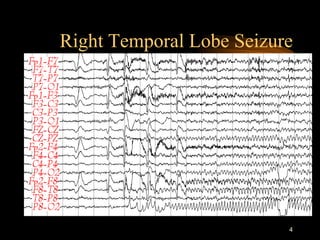
Right Temporal Lobe Seizure
5
Etiology of Seizures
• Seizures are either provoked or unprovoked
• Provoked Seizures: Triggered by certain
provoking factors in otherwise healthy brain
– Metabolic abnormalities (hypoglycemia and hyperglycemia,
hyponatremia, hypocalcemia)
– Alcohol withdrawal
– Acute neurological insult (infection, stroke, trauma)
– Illicit drug intoxication and withdrawal
– Prescribed medications that lower seizure threshold
(theophylline, TCA)
– High fever in children
• Unprovoked Seizures: Occur in the setting of
persistent brain pathology
6
Definition of Epilepsy
• A disease characterized by spontaneous recurrence
of unprovoked seizures (at least 2)
• Seizures are symptoms, while epilepsy is a disease,
so those terms should not be used interchangeably
• Epilepsy = “seizure disorder”
• Epilepsy is a syndromic disease
• Each epilepsy syndrome is determined based on;
Type of seizures, age at seizure onset, family history, physical exam,
EEG findings, and neuroimaging
7
Etiology of Epilepsy
• Any process that alters the structure (macroscopic
or microscopic) or the function of the brain
neurons can cause epilepsy
• Processes that lead to structural alteration include;
• Congenital malformation
• Degenerative disease
• Infectious disease
• Trauma
• Tumors
• Vascular process
• In majority of patients, the etiology is proposed
but not found
8
Classification of Seizures
• Traditionally divided into “ grand mal” and “petit
mal” seizures
• ILAE classification of epileptic seizures in 1981
based on clinical observation and EEG findings
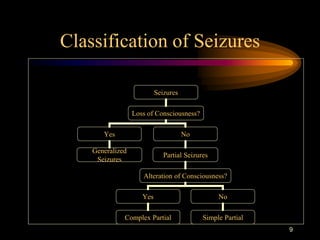
• Seizures were divided into partial and generalized
seizures based on loss of consciousness
• Partial seizures were divided into simple partial
and complex partial based on alteration of
consciousness
9
Classification of Seizures
Seizures
Loss of Consciousness?
Yes No
Generalized
Seizures
Partial Seizures
Alteration of Consciousness?
Yes No
Complex Partial Simple Partial
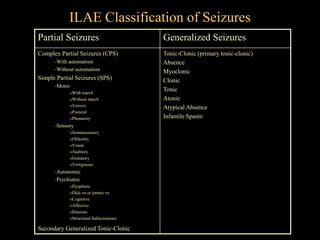
ILAE Classification of Seizures
Partial Seizures Generalized Seizures
Complex Partial Seizures (CPS)
–With automatism
–Without automatism
Simple Partial Seizures (SPS)
–Motor
oWith march
oWithout march
oVersive
oPostural
oPhonatory
–Sensory
oSomatosensory
oOlfactory
oVisual
oAuditory
oGustatory
oVertiginous
–Autonomic
–Psychiatric
oDysphasic
oDéjà vu or jamais vu
oCognitive
oAffective
oIllusions
oStructured hallucinations
Secondary Generalized Tonic-Clonic
Tonic-Clonic (primary tonic-clonic)
Absence
Myoclonic
Clonic
Tonic
Atonic
Atypical Absence
Infantile Spasm
11
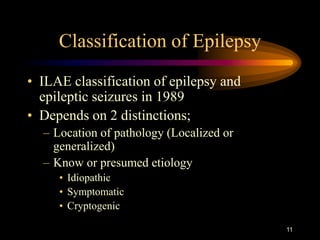
Classification of Epilepsy
• ILAE classification of epilepsy and
epileptic seizures in 1989
• Depends on 2 distinctions;
– Location of pathology (Localized or
generalized)
– Know or presumed etiology
• Idiopathic
• Symptomatic
• Cryptogenic
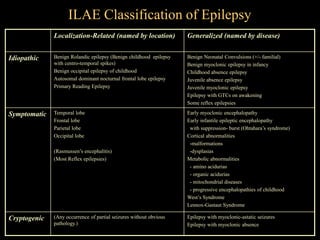
ILAE Classification of Epilepsy
Localization-Related (named by location) Generalized (named by disease)
Idiopathic Benign Rolandic epilepsy (Benign childhood epilepsy
with centro-temporal spikes)
Benign occipital epilepsy of childhood
Autosomal dominant nocturnal frontal lobe epilepsy
Primary Reading Epilepsy
Benign Neonatal Convulsions (+/- familial)
Benign myoclonic epilepsy in infancy
Childhood absence epilepsy
Juvenile absence epilepsy
Juvenile myoclonic epilepsy
Epilepsy with GTCs on awakening
Some reflex epilepsies
Symptomatic Temporal lobe
Frontal lobe
Parietal lobe
Occipital lobe
(Rasmussen’s encephalitis)
(Most Reflex epilepsies)
Early myoclonic encephalopathy
Early infantile epileptic encephalopathy
with suppression- burst (Ohtahara’s syndrome)
Cortical abnormalities
-malformations
-dysplasias
Metabolic abnormalities
- amino acidurias
- organic acidurias
- mitochondrial diseases
- progressive encephalopathies of childhood
West’s Syndrome
Lennox-Gastaut Syndrome
Cryptogenic (Any occurrence of partial seizures without obvious
pathology.)
Epilepsy with myoclonic-astatic seizures
Epilepsy with myoclonic absence
13
Evaluation - Differential Diagnosis
• When a paroxysmal event occurs, especially if
associated with loss of consciousness;
– Is this event (spell) a seizure ?
– If it is a seizure, is it provoked or unprovoked?
– If it is an unprovoked seizure, what is the chance of
recurrence? (making decision about treatment)
– Does this patient have epilepsy? What type?
– What is the appropriate treatment?
• “Diagnosis of epilepsy is a clinical one”
– History is the key
14
Differential Diagnosis of Seizures
“Events Mistaken for Seizures”
• Psychogenic non-epileptic spells (pseudoseizures)
• Syncope
• Migraine
• Transient ischemic attacks (TIA)
• Sleep behaviors and disorders
• Movement disorders
• Pheochromocytoma and carcinoid
15
Clinical Characteristics of
Pseudoseizures
• Strongly Suggest
o Prolonged duration of the event (10-30 minutes)
o Preservation of consciousness despite whole body
jerking
o Bizarre and asynchronous motor movements
o Pelvic thrusting movements
o Not stereotyped
• Strongly Against
o Injuries sustained during spells
o Tongue laceration (especially the sides of the tongue)
o Incontinence
16
Establishing a Diagnosis
• Could be very challenging
– Tests (EEG, MRI) may help
– Diagnosis is established clinically
• Consider seizures even if not sure
– Initiate treatment
• Consider confirmatory diagnosis (EMU)
– History suggests pseudoseizures
– Failure of more than 2 AEDs
17
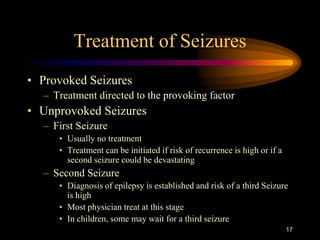
Treatment of Seizures
• Provoked Seizures
– Treatment directed to the provoking factor
• Unprovoked Seizures
– First Seizure
• Usually no treatment
• Treatment can be initiated if risk of recurrence is high or if a
second seizure could be devastating
– Second Seizure
• Diagnosis of epilepsy is established and risk of a third Seizure
is high
• Most physician treat at this stage
• In children, some may wait for a third seizure
18
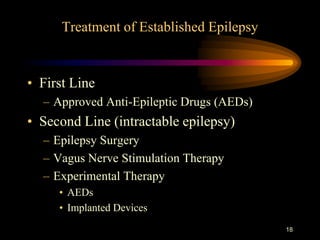
Treatment of Established Epilepsy
• First Line
– Approved Anti-Epileptic Drugs (AEDs)
• Second Line (intractable epilepsy)
– Epilepsy Surgery
– Vagus Nerve Stimulation Therapy
– Experimental Therapy
• AEDs
• Implanted Devices
19
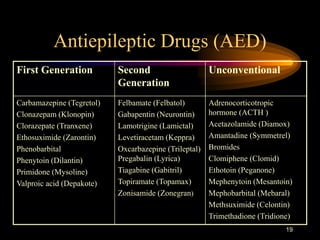
Antiepileptic Drugs (AED)
First Generation Second
Generation
Unconventional
Carbamazepine (Tegretol)
Clonazepam (Klonopin)
Clorazepate (Tranxene)
Ethosuximide (Zarontin)
Phenobarbital
Phenytoin (Dilantin)
Primidone (Mysoline)
Valproic acid (Depakote)
Felbamate (Felbatol)
Gabapentin (Neurontin)
Lamotrigine (Lamictal)
Levetiracetam (Keppra)
Oxcarbazepine (Trileptal)
Pregabalin (Lyrica)
Tiagabine (Gabitril)
Topiramate (Topamax)
Zonisamide (Zonegran)
Adrenocorticotropic
hormone (ACTH )
Acetazolamide (Diamox)
Amantadine (Symmetrel)
Bromides
Clomiphene (Clomid)
Ethotoin (Peganone)
Mephenytoin (Mesantoin)
Mephobarbital (Mebaral)
Methsuximide (Celontin)
Trimethadione (Tridione)
20
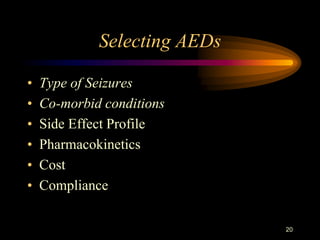
Selecting AEDs
• Type of Seizures
• Co-morbid conditions
• Side Effect Profile
• Pharmacokinetics
• Cost
• Compliance
21
Selecting AEDs- Type of Seizures
• Partial
– No difference in efficacy
• Generalized
– Broad Spectrum AEDs
22
Selecting AEDs – Comorbid
Conditions
• Migraine
• Depression
• Bipolar disorder
• Anxiety
23
Treatment of Medically Intractable
Epilepsy
• An epilepsy that is not responding well to
medical treatment
• Most expert agree if a patient fails adequate
trial of 2 AEDs, his/her epilepsy is
intractable
• 25-35% of all epilepsies are intractable
• Medical treatment should be continued and
other options should be explored
24
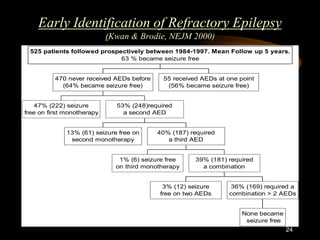
Early Identification of Refractory Epilepsy
(Kwan & Brodie, NEJM 2000)
47% (222) seizure
free on first monotherapy
13% (61) seizure free on
second monotherapy
1% (6) seizure free
on third monotherapy
3% (12) seizure
free on two AEDs
None became
seizure free
36% (169) required a
combination > 2 AEDs
39% (181) required
a combination
40% (187) required
a third AED
53% (248)required
a second AED
470 never received AEDs before
(64% became seizure free)
55 received AEDs at one point
(56% became seizure free)
525 patients followed prospectively between 1984-1997. Mean Follow up 5 years.
63 % became seizure free
25
Treatment of Intractable Epilepsy
“Other Options”
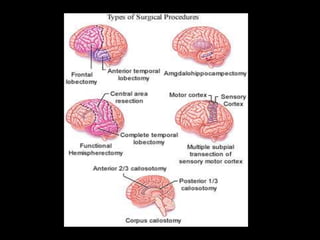
• Epilepsy Surgery
– Removal of seizure focus
– Requires extensive evaluation
– Results are superior to medical treatment in patients
who are good candidate
– Surgery is associated with a small risk; however, the
benefit justifies the risk
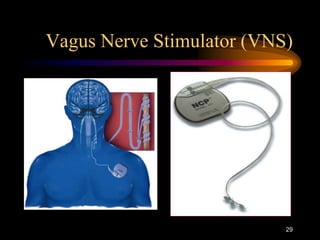
• Vagus Nerve Stimulator (VNS)
– Not superior to medical treatment
– Advantage: compliance, no side effects
– Disadvantage: expensive
27
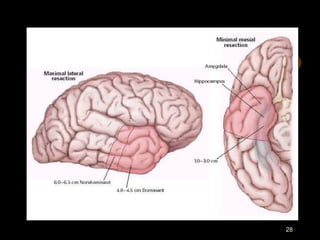
A Randomized Controlled Trial of Surgery in TLE
(Wiebe et al, NEJM 2001)
• 80 patients with TLE were randomized equally to medical
treatment or anterior temporal lobectomy (36/40 underwent
surgery) and followed for 1 year
• After one year; 58% (64%) of the surgical group patients were
free of seizures that alter awareness vs. 8% in the medical
group
• Complications related to surgery occur in 4 patients; 1 thalamic
infarct caused LT thigh sensory loss , 1 wound infection, 2 verbal
memory decline
• One patient in the medical group died (unexplained), none in the
surgical group
• Complications not related to surgery (depression, psychosis) were
similar in both groups
28
29
Vagus Nerve Stimulator (VNS)
30
Experimental Treatment - AEDs
• Brivaracetam
• E 2007
• GW 273225
• Retigabine
• Rufinamide
• RWJ-333369
• SPM 927
• Seletracetam
• Talampanel
31
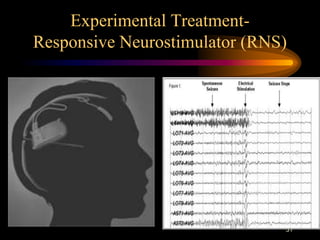
Experimental Treatment-
Responsive Neurostimulator (RNS)
32
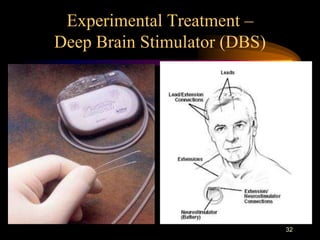
Experimental Treatment –
Deep Brain Stimulator (DBS)
33
Thank You

Seizures.epilepsy , update on management

  • 1.
    1 Ataturk National Children Hospital MohebullahFaqiri, MD E-mail: mohabfaqiri@gmail.com September 8, 2016 Seizures & Epilepsy: Update on Management
  • 2.
    2 Outline • Definition • Etiology •Classification • Differential Diagnosis • Treatment of Epilepsy
  • 3.
    3 Definition of Seizures •Time-limited paroxysmal events that result from abnormal, involuntary, rhythmic neuronal discharges in the brain • Seizures are usually unpredictable • Seizures usually brief ( < 5 minutes) and stop spontaneously • Convulsion, ictus, event, spell, attack and fit are used to refer to seizures
  • 4.
  • 5.
    5 Etiology of Seizures •Seizures are either provoked or unprovoked • Provoked Seizures: Triggered by certain provoking factors in otherwise healthy brain – Metabolic abnormalities (hypoglycemia and hyperglycemia, hyponatremia, hypocalcemia) – Alcohol withdrawal – Acute neurological insult (infection, stroke, trauma) – Illicit drug intoxication and withdrawal – Prescribed medications that lower seizure threshold (theophylline, TCA) – High fever in children • Unprovoked Seizures: Occur in the setting of persistent brain pathology
  • 6.
    6 Definition of Epilepsy •A disease characterized by spontaneous recurrence of unprovoked seizures (at least 2) • Seizures are symptoms, while epilepsy is a disease, so those terms should not be used interchangeably • Epilepsy = “seizure disorder” • Epilepsy is a syndromic disease • Each epilepsy syndrome is determined based on; Type of seizures, age at seizure onset, family history, physical exam, EEG findings, and neuroimaging
  • 7.
    7 Etiology of Epilepsy •Any process that alters the structure (macroscopic or microscopic) or the function of the brain neurons can cause epilepsy • Processes that lead to structural alteration include; • Congenital malformation • Degenerative disease • Infectious disease • Trauma • Tumors • Vascular process • In majority of patients, the etiology is proposed but not found
  • 8.
    8 Classification of Seizures •Traditionally divided into “ grand mal” and “petit mal” seizures • ILAE classification of epileptic seizures in 1981 based on clinical observation and EEG findings • Seizures were divided into partial and generalized seizures based on loss of consciousness • Partial seizures were divided into simple partial and complex partial based on alteration of consciousness
  • 9.
    9 Classification of Seizures Seizures Lossof Consciousness? Yes No Generalized Seizures Partial Seizures Alteration of Consciousness? Yes No Complex Partial Simple Partial
  • 10.
    ILAE Classification ofSeizures Partial Seizures Generalized Seizures Complex Partial Seizures (CPS) –With automatism –Without automatism Simple Partial Seizures (SPS) –Motor oWith march oWithout march oVersive oPostural oPhonatory –Sensory oSomatosensory oOlfactory oVisual oAuditory oGustatory oVertiginous –Autonomic –Psychiatric oDysphasic oDéjà vu or jamais vu oCognitive oAffective oIllusions oStructured hallucinations Secondary Generalized Tonic-Clonic Tonic-Clonic (primary tonic-clonic) Absence Myoclonic Clonic Tonic Atonic Atypical Absence Infantile Spasm
  • 11.
    11 Classification of Epilepsy •ILAE classification of epilepsy and epileptic seizures in 1989 • Depends on 2 distinctions; – Location of pathology (Localized or generalized) – Know or presumed etiology • Idiopathic • Symptomatic • Cryptogenic
  • 12.
    ILAE Classification ofEpilepsy Localization-Related (named by location) Generalized (named by disease) Idiopathic Benign Rolandic epilepsy (Benign childhood epilepsy with centro-temporal spikes) Benign occipital epilepsy of childhood Autosomal dominant nocturnal frontal lobe epilepsy Primary Reading Epilepsy Benign Neonatal Convulsions (+/- familial) Benign myoclonic epilepsy in infancy Childhood absence epilepsy Juvenile absence epilepsy Juvenile myoclonic epilepsy Epilepsy with GTCs on awakening Some reflex epilepsies Symptomatic Temporal lobe Frontal lobe Parietal lobe Occipital lobe (Rasmussen’s encephalitis) (Most Reflex epilepsies) Early myoclonic encephalopathy Early infantile epileptic encephalopathy with suppression- burst (Ohtahara’s syndrome) Cortical abnormalities -malformations -dysplasias Metabolic abnormalities - amino acidurias - organic acidurias - mitochondrial diseases - progressive encephalopathies of childhood West’s Syndrome Lennox-Gastaut Syndrome Cryptogenic (Any occurrence of partial seizures without obvious pathology.) Epilepsy with myoclonic-astatic seizures Epilepsy with myoclonic absence
  • 13.
    13 Evaluation - DifferentialDiagnosis • When a paroxysmal event occurs, especially if associated with loss of consciousness; – Is this event (spell) a seizure ? – If it is a seizure, is it provoked or unprovoked? – If it is an unprovoked seizure, what is the chance of recurrence? (making decision about treatment) – Does this patient have epilepsy? What type? – What is the appropriate treatment? • “Diagnosis of epilepsy is a clinical one” – History is the key
  • 14.
    14 Differential Diagnosis ofSeizures “Events Mistaken for Seizures” • Psychogenic non-epileptic spells (pseudoseizures) • Syncope • Migraine • Transient ischemic attacks (TIA) • Sleep behaviors and disorders • Movement disorders • Pheochromocytoma and carcinoid
  • 15.
    15 Clinical Characteristics of Pseudoseizures •Strongly Suggest o Prolonged duration of the event (10-30 minutes) o Preservation of consciousness despite whole body jerking o Bizarre and asynchronous motor movements o Pelvic thrusting movements o Not stereotyped • Strongly Against o Injuries sustained during spells o Tongue laceration (especially the sides of the tongue) o Incontinence
  • 16.
    16 Establishing a Diagnosis •Could be very challenging – Tests (EEG, MRI) may help – Diagnosis is established clinically • Consider seizures even if not sure – Initiate treatment • Consider confirmatory diagnosis (EMU) – History suggests pseudoseizures – Failure of more than 2 AEDs
  • 17.
    17 Treatment of Seizures •Provoked Seizures – Treatment directed to the provoking factor • Unprovoked Seizures – First Seizure • Usually no treatment • Treatment can be initiated if risk of recurrence is high or if a second seizure could be devastating – Second Seizure • Diagnosis of epilepsy is established and risk of a third Seizure is high • Most physician treat at this stage • In children, some may wait for a third seizure
  • 18.
    18 Treatment of EstablishedEpilepsy • First Line – Approved Anti-Epileptic Drugs (AEDs) • Second Line (intractable epilepsy) – Epilepsy Surgery – Vagus Nerve Stimulation Therapy – Experimental Therapy • AEDs • Implanted Devices
  • 19.
    19 Antiepileptic Drugs (AED) FirstGeneration Second Generation Unconventional Carbamazepine (Tegretol) Clonazepam (Klonopin) Clorazepate (Tranxene) Ethosuximide (Zarontin) Phenobarbital Phenytoin (Dilantin) Primidone (Mysoline) Valproic acid (Depakote) Felbamate (Felbatol) Gabapentin (Neurontin) Lamotrigine (Lamictal) Levetiracetam (Keppra) Oxcarbazepine (Trileptal) Pregabalin (Lyrica) Tiagabine (Gabitril) Topiramate (Topamax) Zonisamide (Zonegran) Adrenocorticotropic hormone (ACTH ) Acetazolamide (Diamox) Amantadine (Symmetrel) Bromides Clomiphene (Clomid) Ethotoin (Peganone) Mephenytoin (Mesantoin) Mephobarbital (Mebaral) Methsuximide (Celontin) Trimethadione (Tridione)
  • 20.
    20 Selecting AEDs • Typeof Seizures • Co-morbid conditions • Side Effect Profile • Pharmacokinetics • Cost • Compliance
  • 21.
    21 Selecting AEDs- Typeof Seizures • Partial – No difference in efficacy • Generalized – Broad Spectrum AEDs
  • 22.
    22 Selecting AEDs –Comorbid Conditions • Migraine • Depression • Bipolar disorder • Anxiety
  • 23.
    23 Treatment of MedicallyIntractable Epilepsy • An epilepsy that is not responding well to medical treatment • Most expert agree if a patient fails adequate trial of 2 AEDs, his/her epilepsy is intractable • 25-35% of all epilepsies are intractable • Medical treatment should be continued and other options should be explored
  • 24.
    24 Early Identification ofRefractory Epilepsy (Kwan & Brodie, NEJM 2000) 47% (222) seizure free on first monotherapy 13% (61) seizure free on second monotherapy 1% (6) seizure free on third monotherapy 3% (12) seizure free on two AEDs None became seizure free 36% (169) required a combination > 2 AEDs 39% (181) required a combination 40% (187) required a third AED 53% (248)required a second AED 470 never received AEDs before (64% became seizure free) 55 received AEDs at one point (56% became seizure free) 525 patients followed prospectively between 1984-1997. Mean Follow up 5 years. 63 % became seizure free
  • 25.
    25 Treatment of IntractableEpilepsy “Other Options” • Epilepsy Surgery – Removal of seizure focus – Requires extensive evaluation – Results are superior to medical treatment in patients who are good candidate – Surgery is associated with a small risk; however, the benefit justifies the risk • Vagus Nerve Stimulator (VNS) – Not superior to medical treatment – Advantage: compliance, no side effects – Disadvantage: expensive
  • 27.
    27 A Randomized ControlledTrial of Surgery in TLE (Wiebe et al, NEJM 2001) • 80 patients with TLE were randomized equally to medical treatment or anterior temporal lobectomy (36/40 underwent surgery) and followed for 1 year • After one year; 58% (64%) of the surgical group patients were free of seizures that alter awareness vs. 8% in the medical group • Complications related to surgery occur in 4 patients; 1 thalamic infarct caused LT thigh sensory loss , 1 wound infection, 2 verbal memory decline • One patient in the medical group died (unexplained), none in the surgical group • Complications not related to surgery (depression, psychosis) were similar in both groups
  • 28.
  • 29.
  • 30.
    30 Experimental Treatment -AEDs • Brivaracetam • E 2007 • GW 273225 • Retigabine • Rufinamide • RWJ-333369 • SPM 927 • Seletracetam • Talampanel
  • 31.
  • 32.
    32 Experimental Treatment – DeepBrain Stimulator (DBS)
  • 33.