Epilepsy
Joel Kapenda
Definition
 A chronic neurologic disorder manifesting by
repeated epileptic seizures (attacks or fits)
which result from paroxysmal uncontrolled
discharges of neurons within the central
nervous system (grey matter disease).
 The clinical manifestations range from a
major motor convulsion to a brief period of
lack of awareness. The stereotyped and
uncontrollable nature of the attacks is
characteristic of epilepsy.
Pathogenesis
 The 19th century neurologist Hughlings
Jackson suggested “a sudden excessive
disorderly discharge of cerebral neurons“ as
the causation of epileptic seizures.
 Recent studies in animal models of focal
epilepsy suggest a central role for the
excitatory neurotransmiter glutamate
(increased in epi) and inhibitory gamma
amino butyric acid (GABA) (decreased)
Epidemiology and course
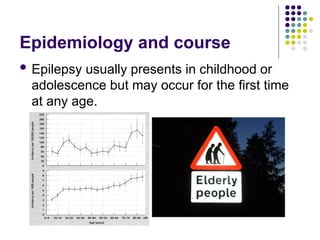
 Epilepsy usually presents in childhood or
adolescence but may occur for the first time
at any age.
Epidemiology and course
 5% of the population suffer a single sz at
some time
 0.5-1% of the population have recurrent sz =
EPILEPSY
 70% = well controlled with drugs (prolonged
remissions); 30% epilepsy at least partially
resistant to drug treatments = INTRACTABLE
EPILEPSY.
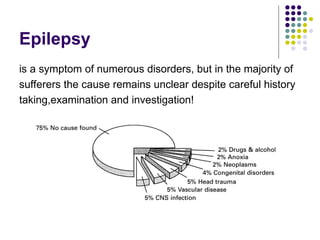
Epilepsy
is a symptom of numerous disorders, but in the majority of
sufferers the cause remains unclear despite careful history
taking,examination and investigation!
Epilepsy - Classification
 The modern classification of the epilepsies is
based upon the nature of the seizures rather
than the presence or absence of an
underlying cause.
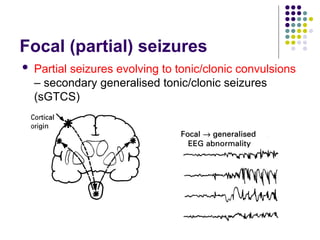
 Seizures which begin focally from a single
location within one hemisphere are thus
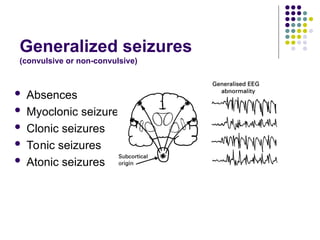
distinguished from those of a generalised
nature which probably commence in a
deeper structures (brainstem? thalami) and
project to both hemispheres simultaneously.
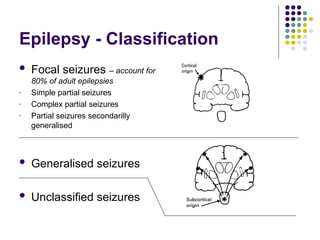
Epilepsy - Classification
 Focal seizures – account for
80% of adult epilepsies
- Simple partial seizures
- Complex partial seizures
- Partial seizures secondarilly
generalised
 Generalised seizures
 Unclassified seizures
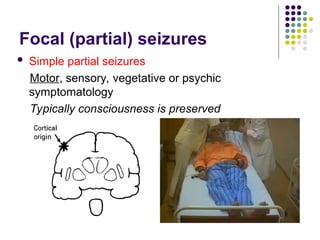
Focal (partial) seizures
 Simple partial seizures
Motor, sensory, vegetative or psychic
symptomatology
Typically consciousness is preserved
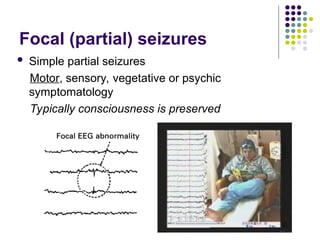
Focal (partial) seizures
 Simple partial seizures
Motor, sensory, vegetative or psychic
symptomatology
Typically consciousness is preserved
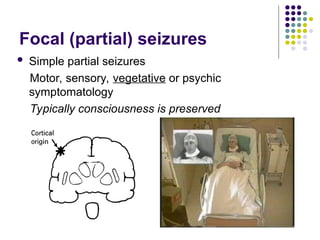
Focal (partial) seizures
 Simple partial seizures
Motor, sensory, vegetative or psychic
symptomatology
Typically consciousness is preserved
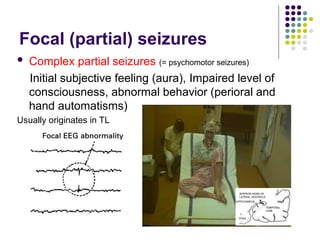
Focal (partial) seizures
 Complex partial seizures (= psychomotor seizures)
Initial subjective feeling (aura), Impaired level of
consciousness, abnormal behavior (perioral and
hand automatisms)
Usually originates in TL
Focal (partial) seizures
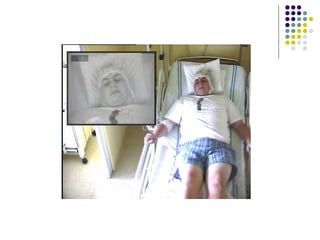
 Partial seizures evolving to tonic/clonic convulsions
– secondary generalised tonic/clonic seizures
(sGTCS)
Generalized seizures
(convulsive or non-convulsive)
 Absences
 Myoclonic seizures
 Clonic seizures
 Tonic seizures
 Atonic seizures
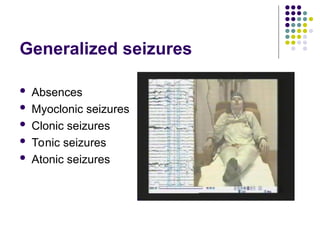
Generalized seizures
 Absences
 Myoclonic seizures
 Clonic seizures
 Tonic seizures
 Atonic seizures
Epilepsy
Differential Diagnosis
The following should be considered in the diff. dg. of epilepsy:
 Syncope attacks (when pt. is standing; results from global reduction
of cerebral blood flow; prodromal pallor, nausea, sweating; jerks!)
 Cardiac arrythmias (e.g. Adams-Stokes attacks). Prolonged arrest of
cardiac rate will progressively lead to loss of consciousness – jerks!
 Migraine (the slow evolution of focal hemisensory or hemimotor
symptomas in complicated migraine contrasts with more rapid
“spread“ of such manifestation in SPS. Basilar migraine may lead to
loss of consciousness!
 Hypoglycemia – seizures or intermittent behavioral disturbances may
occur.
 Narcolepsy – inappropriate sudden sleep episodes
 Panic attacks
 PSEUDOSEIZURES – psychosomatic and personality disorders
Epilepsy – Investigation
 The concern of the clinician is that epilepsy may be symptomatic of
a treatable cerebral lesion.
 Routine investigation: Haematology, biochemistry (electrolytes,
urea and calcium), chest X-ray, electroencephalogram (EEG).
Neuroimaging (CT/MRI) should be performed in all persons aged 25
or more presenting with first seizure and in those pts. with focal
epilepsy irrespective of age.
 Specialised neurophysiological investigations: Sleep deprived
EEG, video-EEG monitoring.
 Advanced investigations (in pts. with intractable focal epilepsy
where surgery is considered): Neuropsychology, Semiinvasive or
invasive EEG recordings, MR Spectroscopy, Positron emission
tomography (PET) and ictal Single photon emission computed
tomography (SPECT)
Epilepsy - Treatment
 The majority of pts respond to drug therapy
(anticonvulsants). In intractable cases surgery may
be necessary. The treatment target is seizure-
freedom and improvement in quality of life!
 Basic rules for drug treatment: Drug treatment
should be simple, preferably using one
anticonvulsant (monotherapy). “Start low, increase slow“.
Polytherapy is to be avoided especially as drug
interactions occur between major anticonvulsants.
 The commonest drugs used in clinical practice are:
Carbamazepine, Sodium valproate, Phenytoin (first line drugs)
Lamotrigine, Topiramate, Levetiracetam, Pregabaline (new AEDs)
Epilepsy – Treatment (cont.)
 If pt is seizure-free for three years, withdrawal of
pharmacotherapy should be considered. Withdrawal
should be carried out only if pt is satisfied that a further
attack would not ruin employment etc. (e.g. driving
licence). It should be performed very carefully and slowly!
20% of pts will suffer a further sz within 2 yrs.
 The risk of teratogenicity is well known (~5%), especially
with valproates, but withdrawing drug therapy in
pregnancy is more risky than continuation. Epileptic
females must be aware of this problem and thorough
family planning should be recommended. Over 90% of
pregnant women with epilepsy will deliver a normal child.
Epilepsy – Surgical Treatment
 A proportion of the pts with intractable epilepsy will
benefit from surgery.
 Epilepsy surgery procedures: Curative (removal of
epileptic focus) and palliative (seizure-related risk
decrease and improvement of the QOL)
 Curative (resective) procedures: Anteromesial temporal
resection, selective amygdalohippocampectomy,
extensive lesionectomy, cortical resection,
hemispherectomy.
 Palliative procedures: Corpus callosotomy and Vagal
nerve stimulation (VNS).
Status Epilepticus
 A condition when consciousness does not return
between seizures for more than 30 min. This state
may be life-threatening with the development of
pyrexia, deepening coma and circullatory collapse.
Death occurs in 5-10%.
 Status epilepticus may occur with frontal lobe lesions
(incl. strokes), following head injury, on reducing drug
therapy, with alcohol withdrawal, drug intoxication,
metabolic disturbances or pregnancy.
 Treatment: AEDs intravenously ASAP, event. general
anesthesia with propofol or thipentone should be
commenced immediately.

epilepsy.ppt contains information on epilepsy

  • 1.
  • 2.
    Definition  A chronicneurologic disorder manifesting by repeated epileptic seizures (attacks or fits) which result from paroxysmal uncontrolled discharges of neurons within the central nervous system (grey matter disease).  The clinical manifestations range from a major motor convulsion to a brief period of lack of awareness. The stereotyped and uncontrollable nature of the attacks is characteristic of epilepsy.
  • 3.
    Pathogenesis  The 19thcentury neurologist Hughlings Jackson suggested “a sudden excessive disorderly discharge of cerebral neurons“ as the causation of epileptic seizures.  Recent studies in animal models of focal epilepsy suggest a central role for the excitatory neurotransmiter glutamate (increased in epi) and inhibitory gamma amino butyric acid (GABA) (decreased)
  • 4.
    Epidemiology and course Epilepsy usually presents in childhood or adolescence but may occur for the first time at any age.
  • 5.
    Epidemiology and course 5% of the population suffer a single sz at some time  0.5-1% of the population have recurrent sz = EPILEPSY  70% = well controlled with drugs (prolonged remissions); 30% epilepsy at least partially resistant to drug treatments = INTRACTABLE EPILEPSY.
  • 6.
    Epilepsy is a symptomof numerous disorders, but in the majority of sufferers the cause remains unclear despite careful history taking,examination and investigation!
  • 7.
    Epilepsy - Classification The modern classification of the epilepsies is based upon the nature of the seizures rather than the presence or absence of an underlying cause.  Seizures which begin focally from a single location within one hemisphere are thus distinguished from those of a generalised nature which probably commence in a deeper structures (brainstem? thalami) and project to both hemispheres simultaneously.
  • 8.
    Epilepsy - Classification Focal seizures – account for 80% of adult epilepsies - Simple partial seizures - Complex partial seizures - Partial seizures secondarilly generalised  Generalised seizures  Unclassified seizures
  • 9.
    Focal (partial) seizures Simple partial seizures Motor, sensory, vegetative or psychic symptomatology Typically consciousness is preserved
  • 10.
    Focal (partial) seizures Simple partial seizures Motor, sensory, vegetative or psychic symptomatology Typically consciousness is preserved
  • 11.
    Focal (partial) seizures Simple partial seizures Motor, sensory, vegetative or psychic symptomatology Typically consciousness is preserved
  • 12.
    Focal (partial) seizures Complex partial seizures (= psychomotor seizures) Initial subjective feeling (aura), Impaired level of consciousness, abnormal behavior (perioral and hand automatisms) Usually originates in TL
  • 13.
    Focal (partial) seizures Partial seizures evolving to tonic/clonic convulsions – secondary generalised tonic/clonic seizures (sGTCS)
  • 15.
    Generalized seizures (convulsive ornon-convulsive)  Absences  Myoclonic seizures  Clonic seizures  Tonic seizures  Atonic seizures
  • 16.
    Generalized seizures  Absences Myoclonic seizures  Clonic seizures  Tonic seizures  Atonic seizures
  • 17.
    Epilepsy Differential Diagnosis The followingshould be considered in the diff. dg. of epilepsy:  Syncope attacks (when pt. is standing; results from global reduction of cerebral blood flow; prodromal pallor, nausea, sweating; jerks!)  Cardiac arrythmias (e.g. Adams-Stokes attacks). Prolonged arrest of cardiac rate will progressively lead to loss of consciousness – jerks!  Migraine (the slow evolution of focal hemisensory or hemimotor symptomas in complicated migraine contrasts with more rapid “spread“ of such manifestation in SPS. Basilar migraine may lead to loss of consciousness!  Hypoglycemia – seizures or intermittent behavioral disturbances may occur.  Narcolepsy – inappropriate sudden sleep episodes  Panic attacks  PSEUDOSEIZURES – psychosomatic and personality disorders
  • 18.
    Epilepsy – Investigation The concern of the clinician is that epilepsy may be symptomatic of a treatable cerebral lesion.  Routine investigation: Haematology, biochemistry (electrolytes, urea and calcium), chest X-ray, electroencephalogram (EEG). Neuroimaging (CT/MRI) should be performed in all persons aged 25 or more presenting with first seizure and in those pts. with focal epilepsy irrespective of age.  Specialised neurophysiological investigations: Sleep deprived EEG, video-EEG monitoring.  Advanced investigations (in pts. with intractable focal epilepsy where surgery is considered): Neuropsychology, Semiinvasive or invasive EEG recordings, MR Spectroscopy, Positron emission tomography (PET) and ictal Single photon emission computed tomography (SPECT)
  • 19.
    Epilepsy - Treatment The majority of pts respond to drug therapy (anticonvulsants). In intractable cases surgery may be necessary. The treatment target is seizure- freedom and improvement in quality of life!  Basic rules for drug treatment: Drug treatment should be simple, preferably using one anticonvulsant (monotherapy). “Start low, increase slow“. Polytherapy is to be avoided especially as drug interactions occur between major anticonvulsants.  The commonest drugs used in clinical practice are: Carbamazepine, Sodium valproate, Phenytoin (first line drugs) Lamotrigine, Topiramate, Levetiracetam, Pregabaline (new AEDs)
  • 20.
    Epilepsy – Treatment(cont.)  If pt is seizure-free for three years, withdrawal of pharmacotherapy should be considered. Withdrawal should be carried out only if pt is satisfied that a further attack would not ruin employment etc. (e.g. driving licence). It should be performed very carefully and slowly! 20% of pts will suffer a further sz within 2 yrs.  The risk of teratogenicity is well known (~5%), especially with valproates, but withdrawing drug therapy in pregnancy is more risky than continuation. Epileptic females must be aware of this problem and thorough family planning should be recommended. Over 90% of pregnant women with epilepsy will deliver a normal child.
  • 21.
    Epilepsy – SurgicalTreatment  A proportion of the pts with intractable epilepsy will benefit from surgery.  Epilepsy surgery procedures: Curative (removal of epileptic focus) and palliative (seizure-related risk decrease and improvement of the QOL)  Curative (resective) procedures: Anteromesial temporal resection, selective amygdalohippocampectomy, extensive lesionectomy, cortical resection, hemispherectomy.  Palliative procedures: Corpus callosotomy and Vagal nerve stimulation (VNS).
  • 22.
    Status Epilepticus  Acondition when consciousness does not return between seizures for more than 30 min. This state may be life-threatening with the development of pyrexia, deepening coma and circullatory collapse. Death occurs in 5-10%.  Status epilepticus may occur with frontal lobe lesions (incl. strokes), following head injury, on reducing drug therapy, with alcohol withdrawal, drug intoxication, metabolic disturbances or pregnancy.  Treatment: AEDs intravenously ASAP, event. general anesthesia with propofol or thipentone should be commenced immediately.