EPIDURAL HEMATOMA
Dr Shikhar Shrestha
MS 2nd year
Moderator : Dr Chandraman Prajapati(neurosurgeon)
• “ Reported incidences of epidural hematoma are a little more variable, ranging
from as low as 14% in a study by Paci and coworkers to 35% as reported by
Parzhuber and associates ”
• Paci GM, Sise MJ, Sise CB, et al. Preemptive craniectomy with craniotomy: what role in the
management of severe traumatic brain injury? J Trauma. 2009;67:531–536.
• 53. Parzhuber A, Wiedemann E, Richter-Turtur M, et al. [The contribution of the general and
trauma surgeon in neurotraumatology: experiences and results of 10 years]. Unfallchirurg.
• Traumatic coma data bank (TCDB)series,
• Incidence - 6% of patients with severe closed head injuries
• Cumulatively, the range varies significantly from as low as 6% to as high as 35%
percent
• Marshall LF, Becker DP, Bowers SA, et al. The national traumatic coma Data Bank. Part 1: design,
purpose, goals, and results. J Neurosurg
• Account for 5% to 15% of fatal head injuries
• The mortality rate : (at the time of surgery )
- 0% for patients who are not in a coma
- 9% for obtunded patients
- 20% for patients in a deep coma.
Maloney A. Clinical and pathological observations in fatal head injuries—a five-year study of 172
cases.
• Less common than subdural hematomas
• Better prognosis than other mass lesions
• Maas AI, Steyerberg EW, Butcher I, et al. Prognostic value of computerized tomography scan
characteristics in traumatic brain injury: results from the IMPACT study. J Neurotrauma.
2007;24:303–314.
• Only one-third of patients with an epidural hematoma are unconscious from the
time of injury, one-third have a lucid interval, and one-third are never
unconscious
• The classic lucid interval is most common in pure EDHs that are very large and
demonstrate CT signs of active bleeding
Rivas JJ, Lobato RD, Sarabia R, et al. Extradural hematoma: analysis of factors influencing the
courses of 161 patients. Neurosurgery.
• In fact, a review of 82 consecutive patients with EDH revealed lucid intervals in
only five patients (6.25%). Instead, patients with EDH may be unconscious from
the time of initial injury (23%to 44%), may regain consciousness after a brief
coma (20% to 28%), or may have no loss of consciousness (8% to 24%).
• Cordobes F, Lobato RD, Rivas JJ, et al. Observations on 82 patients with extradural hematoma.
Comparison of results before and after the advent of computerized tomography
• Reale F, Delfini R, Mencattini G. Epidural hematomas
Biomechanical mechanisms of TBI
1. Static or quasi-static loading
A static or quasi-static load involves a contact force, but the speed of impact is
minimal or zero. In this scenario, the contribution of inertial forces is negligible, and
damage is caused by gradually increasing contact forces trapping the head against a
rigid structure.
2. Dynamic loading
Dynamic loading is applied rapidly
<50ms
Three types: impulsive, impact, or blast overpressure
• Impulsive loading: head is set into motion indirectly by a blow to another body
region or by the sudden motion of another body region
• Causes inertial loading to head
• Impact loading: result of motor vehicle accidents, falls, or sports collisions
For objects larger than approximately 2 square inches, localized skull bending
occurs immediately beneath the impact point.
If the skull deformation exceeds the tolerance, skull fracture occurs.
• Blast overpressure loading: delivery of a rapid-onset, very short (<5 ms) pressure
wave to the brain that travels at the speed of sound within the tissue.
• “signature injury” in the Iraq and Afghanistan conflicts
The pressure wave may reflect at different interfaces in the brain (e.g.,
blood/tissue; cerebrospinal fluid/tissue) and cause microscopic damage at these
interfaces.
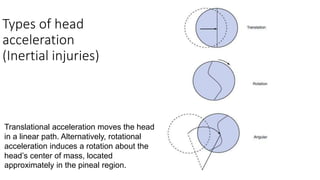
Types of head
acceleration
(Inertial injuries)
Translational acceleration moves the head
in a linear path. Alternatively, rotational
acceleration induces a rotation about the
head’s center of mass, located
approximately in the pineal region.
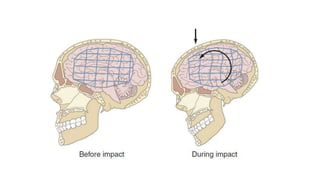
• Impact can cause local contact effects
• Two additional effects contribute to the lesions observed clinically
1. Brain slides in relation to the inner skull surface (circular arrow), and cortical
vessels connecting the brain to the dural membrane may tear.
2. Inertial loading delivered to the brain, coupled with its soft material properties,
leads to a deformation of the brain contents(straight arrow).
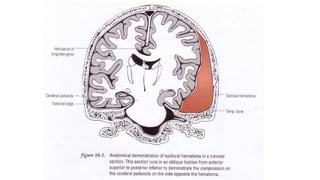
• An epidural hematoma is almost always associated with a skull fracture
(91% in adults and 75% in children)
• Epidural hematoma is an impact-based phenomenon(contact)
• No head motion or inertial effects cause an epidural hematoma.
• Bullock MR, Chesnut R, Ghajar J, et al. Surgical management ofacute epidural hematomas.
Neurosurgery. 2006;58(suppl 3):S7–S15; discussion Si–Siv.
• Typically occurs during the fracture initiation or propagation period
• Vessels in the underlying dural membrane are torn, and bleeding ensues in the
epidural space
• Rarely occur spontaneously, in patients with infections, vascular anomalies
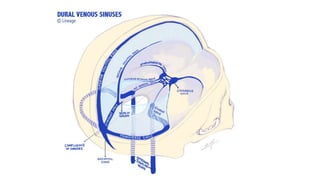
• 10% of EDHs are caused by venous bleeding, often from laceration of a dural
venous sinus
(1) along the anterior aspect of the middle cranial fossa, caused by laceration of
the sphenoparietal sinus or a fracture of the greater sphenoid wing
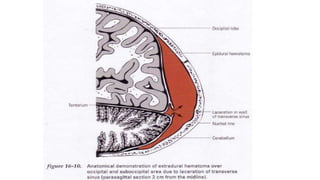
(2) superficial to the transverse sinus, often caused by laceration of the sinus by an
overlying occipital skull fracture
(3) at the vertex, caused by injury to the superior sagittal sinus resulting from
either skull fracture or diastasis of the sagittal suture, crossing the midline
because of the relatively weak attachment of the outer periosteal dural layer to
the sagittal suture
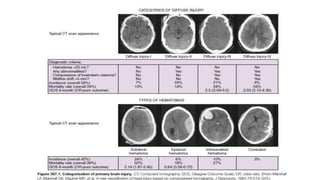
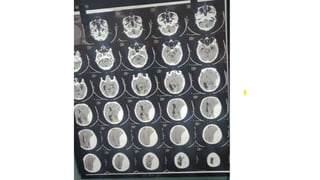
• On CT scan, an epidural hematoma is characterized by a biconvex, uniformly
hyperdense lesion
• Presence of low-density areas within EDH and/or evidence of contrast
extravasation into the hematoma on postcontrast head CT are indications of
hyperacute/active bleeding into the hematoma
Radiographic progression
• Type I (acute or hyperacute): day 1, associated with a “swirl” of unclotted blood)
• Type II (subacute): days 2 to 7, solid
• Type III (chronic): days 7 to 20, mixed or lucent with contrast enhancement
• Occur in 58%, 31%, and 11% of cases, respectively.
Zimmerman RA, Bilaniuk LT. Computed tomographic staging of traumatic epidural bleeding.
Classical clinical symptoms
• Hemiparesis (contralateral or ipsilateral because of the Kernohan notch
phenomenon)
• Decreased level of consciousness
• Dilation of the ipsilateral pupil (occurs in less than 50% of patients)
Rivas JJ, Lobato RD, Sarabia R, et al. Extradural hematoma: analysis of factors influencing the courses of
161 patients
Bricolo AP, Pasut LM. Extradural hematoma: toward zero mortality.A prospective study
• EDH generally does not cross suture lines. Exception: EDH at the vertex which,
can readily cross the midline sagittal suture
• In adults, approximately 75% occur in the temporal region
Primary treatment of the epidural hematoma is prompt surgical evacuation.
Indications of surgery:
• Volume greater than 30 cm3 regardless of the patient’s GCS score.
• >5mm midline shift
• Greater than 15 mm in thickness
• GCS score equal or less than 8
• Focal deficit
Brain trauma foundation guidelines 2020
42 who were treated nonoperatively. The factors
associated with surgery were volume of hematoma greater than 30
mL, MLS greater than 5 mm, and EDH thickness greater than 15mm.
Similar outcomes in both groups suggesting that asymptomatic patients with
small lesions can be
successfully managed with observation alone.
Non operative management
• Close neurological observation, preferably in the ICU
• A repeat CT scan should be obtained 6 to 8 hours after injury to rule out
expansion of the clot.
• 1 week of observation is indicated
Volume calculation
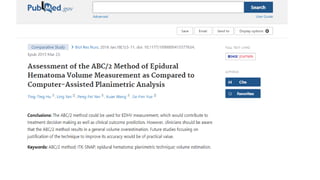
• For the bedside ,as suggested by kothari : ABC/2
• A: the largest area of hemorrhage on the slice
• B : the largest diameter 90 degree to A om same slice
• C : Approximate number of CT slices with hemorrhage multiplied by slice
thickness
• The ABCs of measuring intracerebral hemorrhage volumes R U kothari et al.1996 Aug
• C is calculated by a comparison of each CT slice with hemorrhage to the CT slice
with largest hemorrhage on that scan
• If the hemorrhage area > 75 %,slice is considered 1 hemorrhage slice
• If the hemorrhage area is approximately 25% to 75 % ,1/2 hemorrhage slice
• If the hemorrhage area < 25 % of the largest hemorrhage ,the slice is not
considered as hemorrhage slice
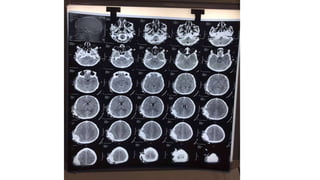
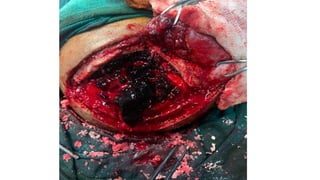
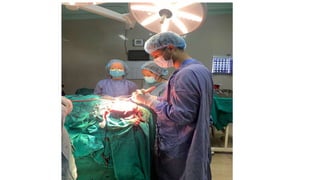
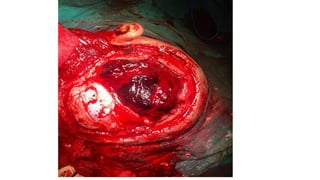
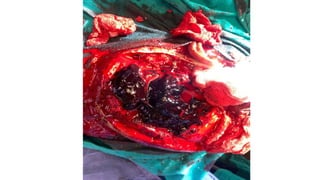
Some glimpse ,in our center
Operative approach
• “ It has been shown that patients who underwent surgery within 2 hours after
deterioration had a significantly lower mortality rate than patients operated on
later (17% versus 56%) ”
• The mortality in patients undergoing surgery for evacuation of an epidural
hematoma is approximately 10 %
• Epidural Hematoma Due to Arterial Bleeding
• Epidural Hematoma Due to Dural Sinus Laceration
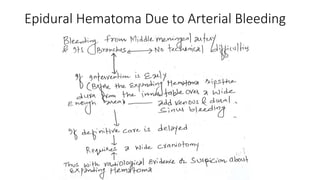
Epidural Hematoma Due to Arterial Bleeding
It is better not to do temporal burr holes in place of a craniotomy.
BECAUSE
“ The dura must be tented in many places to the pericranium, to the bone, or even
to the galea ”
To prevent postoperative accumulation of blood in the epidural space
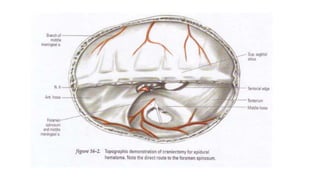
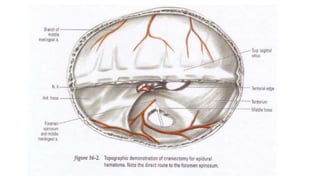
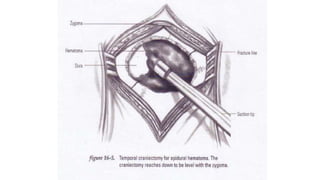
• The approach to the entrance of the middle meningeal artery into the intracranial
cavity, the foramen spinosum, is favorable and short one if the opening of the
temporal squama reaches down to the floor of the temporal fossa
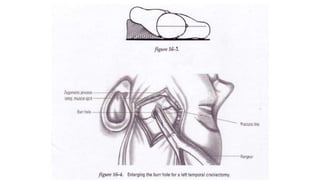
• Vertical skin incision is placed 1 inch anterior to the external acoustic meatus and
reaches down to the zygomatic process
• Temporalis muscle and fascia along their fibers are incised
• Retracted by a self retaining retractor
• Burr hole is made and enlarged with a rongeur
• Craniectomy carried down to the floor of the temporal fossa
• Hematoma removed by suction
• Diffuse bleeding from the floor of the middle fossa is controlled by bone wax
Epidural Hematoma Due to Dural Sinus Laceration
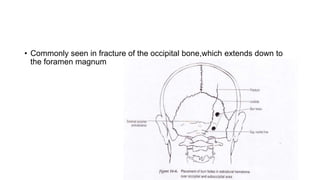
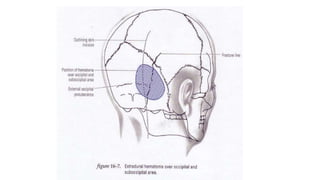
• Commonly seen in fracture of the occipital bone,which extends down to
the foramen magnum
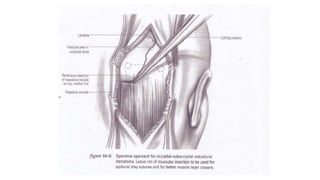
• Muscle is cut 1 cm below its insertion and parallel to the superior nuchal line,
separate it medially along its fibers
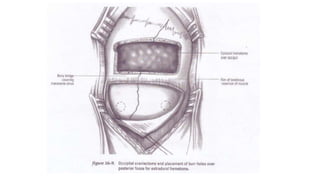
• Occipital bone is scrapped off with a periosteal elevator.
• Two Burr holes above and below the superior nuchal line, which means above
and below the transverse sinus or into the occipital and posterior fossae
• Burr holes are enlarged with a rongeur
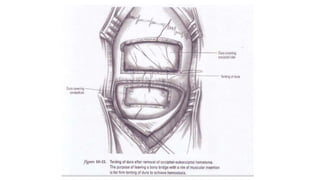
• Having removed the extradural hematoma by suction and irrigation,
• Stay sutures are placed and dura is tented along with sinus against the bony rim
left between the two craniectomies
• Youmans’s Neurosurgery ,8th edition
• Kampe’s Neurosurgery
• THANK YOU

EPIDURAL HEMATOMA

  • 1.
    EPIDURAL HEMATOMA Dr ShikharShrestha MS 2nd year Moderator : Dr Chandraman Prajapati(neurosurgeon)
  • 2.
    • “ Reportedincidences of epidural hematoma are a little more variable, ranging from as low as 14% in a study by Paci and coworkers to 35% as reported by Parzhuber and associates ” • Paci GM, Sise MJ, Sise CB, et al. Preemptive craniectomy with craniotomy: what role in the management of severe traumatic brain injury? J Trauma. 2009;67:531–536. • 53. Parzhuber A, Wiedemann E, Richter-Turtur M, et al. [The contribution of the general and trauma surgeon in neurotraumatology: experiences and results of 10 years]. Unfallchirurg.
  • 3.
    • Traumatic comadata bank (TCDB)series, • Incidence - 6% of patients with severe closed head injuries • Cumulatively, the range varies significantly from as low as 6% to as high as 35% percent • Marshall LF, Becker DP, Bowers SA, et al. The national traumatic coma Data Bank. Part 1: design, purpose, goals, and results. J Neurosurg
  • 4.
    • Account for5% to 15% of fatal head injuries • The mortality rate : (at the time of surgery ) - 0% for patients who are not in a coma - 9% for obtunded patients - 20% for patients in a deep coma. Maloney A. Clinical and pathological observations in fatal head injuries—a five-year study of 172 cases.
  • 5.
    • Less commonthan subdural hematomas • Better prognosis than other mass lesions • Maas AI, Steyerberg EW, Butcher I, et al. Prognostic value of computerized tomography scan characteristics in traumatic brain injury: results from the IMPACT study. J Neurotrauma. 2007;24:303–314.
  • 6.
    • Only one-thirdof patients with an epidural hematoma are unconscious from the time of injury, one-third have a lucid interval, and one-third are never unconscious • The classic lucid interval is most common in pure EDHs that are very large and demonstrate CT signs of active bleeding Rivas JJ, Lobato RD, Sarabia R, et al. Extradural hematoma: analysis of factors influencing the courses of 161 patients. Neurosurgery.
  • 7.
    • In fact,a review of 82 consecutive patients with EDH revealed lucid intervals in only five patients (6.25%). Instead, patients with EDH may be unconscious from the time of initial injury (23%to 44%), may regain consciousness after a brief coma (20% to 28%), or may have no loss of consciousness (8% to 24%). • Cordobes F, Lobato RD, Rivas JJ, et al. Observations on 82 patients with extradural hematoma. Comparison of results before and after the advent of computerized tomography • Reale F, Delfini R, Mencattini G. Epidural hematomas
  • 9.
    Biomechanical mechanisms ofTBI 1. Static or quasi-static loading A static or quasi-static load involves a contact force, but the speed of impact is minimal or zero. In this scenario, the contribution of inertial forces is negligible, and damage is caused by gradually increasing contact forces trapping the head against a rigid structure. 2. Dynamic loading Dynamic loading is applied rapidly <50ms Three types: impulsive, impact, or blast overpressure
  • 10.
    • Impulsive loading:head is set into motion indirectly by a blow to another body region or by the sudden motion of another body region • Causes inertial loading to head • Impact loading: result of motor vehicle accidents, falls, or sports collisions For objects larger than approximately 2 square inches, localized skull bending occurs immediately beneath the impact point. If the skull deformation exceeds the tolerance, skull fracture occurs.
  • 11.
    • Blast overpressureloading: delivery of a rapid-onset, very short (<5 ms) pressure wave to the brain that travels at the speed of sound within the tissue. • “signature injury” in the Iraq and Afghanistan conflicts The pressure wave may reflect at different interfaces in the brain (e.g., blood/tissue; cerebrospinal fluid/tissue) and cause microscopic damage at these interfaces.
  • 12.
    Types of head acceleration (Inertialinjuries) Translational acceleration moves the head in a linear path. Alternatively, rotational acceleration induces a rotation about the head’s center of mass, located approximately in the pineal region.
  • 14.
    • Impact cancause local contact effects • Two additional effects contribute to the lesions observed clinically 1. Brain slides in relation to the inner skull surface (circular arrow), and cortical vessels connecting the brain to the dural membrane may tear. 2. Inertial loading delivered to the brain, coupled with its soft material properties, leads to a deformation of the brain contents(straight arrow).
  • 15.
    • An epiduralhematoma is almost always associated with a skull fracture (91% in adults and 75% in children) • Epidural hematoma is an impact-based phenomenon(contact) • No head motion or inertial effects cause an epidural hematoma. • Bullock MR, Chesnut R, Ghajar J, et al. Surgical management ofacute epidural hematomas. Neurosurgery. 2006;58(suppl 3):S7–S15; discussion Si–Siv.
  • 16.
    • Typically occursduring the fracture initiation or propagation period • Vessels in the underlying dural membrane are torn, and bleeding ensues in the epidural space • Rarely occur spontaneously, in patients with infections, vascular anomalies
  • 18.
    • 10% ofEDHs are caused by venous bleeding, often from laceration of a dural venous sinus (1) along the anterior aspect of the middle cranial fossa, caused by laceration of the sphenoparietal sinus or a fracture of the greater sphenoid wing (2) superficial to the transverse sinus, often caused by laceration of the sinus by an overlying occipital skull fracture (3) at the vertex, caused by injury to the superior sagittal sinus resulting from either skull fracture or diastasis of the sagittal suture, crossing the midline because of the relatively weak attachment of the outer periosteal dural layer to the sagittal suture
  • 20.
    • On CTscan, an epidural hematoma is characterized by a biconvex, uniformly hyperdense lesion • Presence of low-density areas within EDH and/or evidence of contrast extravasation into the hematoma on postcontrast head CT are indications of hyperacute/active bleeding into the hematoma
  • 21.
    Radiographic progression • TypeI (acute or hyperacute): day 1, associated with a “swirl” of unclotted blood) • Type II (subacute): days 2 to 7, solid • Type III (chronic): days 7 to 20, mixed or lucent with contrast enhancement • Occur in 58%, 31%, and 11% of cases, respectively. Zimmerman RA, Bilaniuk LT. Computed tomographic staging of traumatic epidural bleeding.
  • 22.
    Classical clinical symptoms •Hemiparesis (contralateral or ipsilateral because of the Kernohan notch phenomenon) • Decreased level of consciousness • Dilation of the ipsilateral pupil (occurs in less than 50% of patients) Rivas JJ, Lobato RD, Sarabia R, et al. Extradural hematoma: analysis of factors influencing the courses of 161 patients Bricolo AP, Pasut LM. Extradural hematoma: toward zero mortality.A prospective study
  • 23.
    • EDH generallydoes not cross suture lines. Exception: EDH at the vertex which, can readily cross the midline sagittal suture • In adults, approximately 75% occur in the temporal region
  • 24.
    Primary treatment ofthe epidural hematoma is prompt surgical evacuation. Indications of surgery: • Volume greater than 30 cm3 regardless of the patient’s GCS score. • >5mm midline shift • Greater than 15 mm in thickness • GCS score equal or less than 8 • Focal deficit Brain trauma foundation guidelines 2020
  • 25.
    42 who weretreated nonoperatively. The factors associated with surgery were volume of hematoma greater than 30 mL, MLS greater than 5 mm, and EDH thickness greater than 15mm. Similar outcomes in both groups suggesting that asymptomatic patients with small lesions can be successfully managed with observation alone.
  • 26.
    Non operative management •Close neurological observation, preferably in the ICU • A repeat CT scan should be obtained 6 to 8 hours after injury to rule out expansion of the clot. • 1 week of observation is indicated
  • 27.
  • 28.
    • For thebedside ,as suggested by kothari : ABC/2 • A: the largest area of hemorrhage on the slice • B : the largest diameter 90 degree to A om same slice • C : Approximate number of CT slices with hemorrhage multiplied by slice thickness • The ABCs of measuring intracerebral hemorrhage volumes R U kothari et al.1996 Aug
  • 29.
    • C iscalculated by a comparison of each CT slice with hemorrhage to the CT slice with largest hemorrhage on that scan • If the hemorrhage area > 75 %,slice is considered 1 hemorrhage slice • If the hemorrhage area is approximately 25% to 75 % ,1/2 hemorrhage slice • If the hemorrhage area < 25 % of the largest hemorrhage ,the slice is not considered as hemorrhage slice
  • 31.
    Some glimpse ,inour center
  • 39.
    Operative approach • “It has been shown that patients who underwent surgery within 2 hours after deterioration had a significantly lower mortality rate than patients operated on later (17% versus 56%) ” • The mortality in patients undergoing surgery for evacuation of an epidural hematoma is approximately 10 %
  • 40.
    • Epidural HematomaDue to Arterial Bleeding • Epidural Hematoma Due to Dural Sinus Laceration
  • 41.
    Epidural Hematoma Dueto Arterial Bleeding
  • 42.
    It is betternot to do temporal burr holes in place of a craniotomy. BECAUSE “ The dura must be tented in many places to the pericranium, to the bone, or even to the galea ” To prevent postoperative accumulation of blood in the epidural space
  • 44.
    • The approachto the entrance of the middle meningeal artery into the intracranial cavity, the foramen spinosum, is favorable and short one if the opening of the temporal squama reaches down to the floor of the temporal fossa
  • 46.
    • Vertical skinincision is placed 1 inch anterior to the external acoustic meatus and reaches down to the zygomatic process • Temporalis muscle and fascia along their fibers are incised • Retracted by a self retaining retractor • Burr hole is made and enlarged with a rongeur
  • 48.
    • Craniectomy carrieddown to the floor of the temporal fossa • Hematoma removed by suction • Diffuse bleeding from the floor of the middle fossa is controlled by bone wax
  • 50.
    Epidural Hematoma Dueto Dural Sinus Laceration
  • 52.
    • Commonly seenin fracture of the occipital bone,which extends down to the foramen magnum
  • 54.
    • Muscle iscut 1 cm below its insertion and parallel to the superior nuchal line, separate it medially along its fibers
  • 56.
    • Occipital boneis scrapped off with a periosteal elevator. • Two Burr holes above and below the superior nuchal line, which means above and below the transverse sinus or into the occipital and posterior fossae • Burr holes are enlarged with a rongeur
  • 58.
    • Having removedthe extradural hematoma by suction and irrigation, • Stay sutures are placed and dura is tented along with sinus against the bony rim left between the two craniectomies
  • 61.
    • Youmans’s Neurosurgery,8th edition • Kampe’s Neurosurgery
  • 62.