Pathophysiology
of subdural hematomas
Pathophysiology of
the development of CSDH
• Clear yellow to dark, thin liquid to semisolid
• Gardner 1932,Osmotic gradient theory
– Increase protein content  increase oncotic
pressure
• Weir
– CSDH fluid to be isosmotic to blood and CSF
• Microscopic examination of fluid from CSDHs of
any age reveals fresh erythrocytes
• CSDH membrane
Pathophysiology of
the development of CSDH
• Neovasculature at outer membrane of CSDH
• Abnormal sinusoidal dilate
• Both vessel types are composed of
endothelial cells
• Erythrocytes and platelets found in perivascular
space
• Gap junction 8 um  leakage of plasma and RBC
into hematoma cavity
Pathophysiology of
the development of CSDH
• Kallikrein, bradykinin, and platelet-activating factor
(PAF)  vasodilatation, increase vascular
permeability, prolong the clotting time, release t-PA
• Eosinophil degranulation in the outer membrane 
fibrinolytic factor, inflammatory mediator  local
coagulopathy and cell destruction
Evolution of
chronic subdural hematomas
Evolution of
chronic subdural hematomas
Surgical Treatment of
chronic subdural hematomas
• 1925, Putnam and Cushing : craniotomy with
complete removal of the outer membrane and
hematoma contents
• 1964, Svien and Gelety : bur hole better outcome
than craniotomy (lower reoperation)
• 1977, Tabaddor and Shulmon : study comparing 
craniotomy had the highest mortality rate
Surgical Treatment of
chronic subdural hematomas
• Suzuki and associates : closed system drainage
without irrigation to be as effective as closed system
drainage with irrigation
• Smely and coauthors : twist drill drainage without
irrigation was superior to bur hole drainage with
irrigation
Medical Treatment of
chronic subdural hematomas
• Corticosteroid : decreases leukocyte chemotaxis,
inhibits degranulation, inhibit neomembrane
formation, prevent clot enlargement
• Bender and Christoff : more rapid neurologic
improvement after introducing corticosteroids to the
treatment regimen, thereby allowing shorter
hospitalization
• ACEI : interrupt neovascularization by inhibiting
endothelial vascular growth factor
Medical and Surgical Management
of Chronic Subdural Hematomas
Definition
• Fluid collection within the layers of dura matter
• DDx : subdural hygroma (subdural hydroma,
external hydrocephalus)
• Subdural hygroma can transform into CSDH
Epidemiology
• Peak incidence , 80th
• Male
• Trauma most important risk factor
• Postsurgical communication of the subarachnoid
space
• CSF shunting
• Primart coagulopathy in children
• Anticoagulant treatment in adult
• Chronic alcoholism
Patient history
• No pathognomonic sign and symptoms
• Asymptomatic
• Coma from increase ICP
• Refractory headache
• Lack of concentration
Imaging
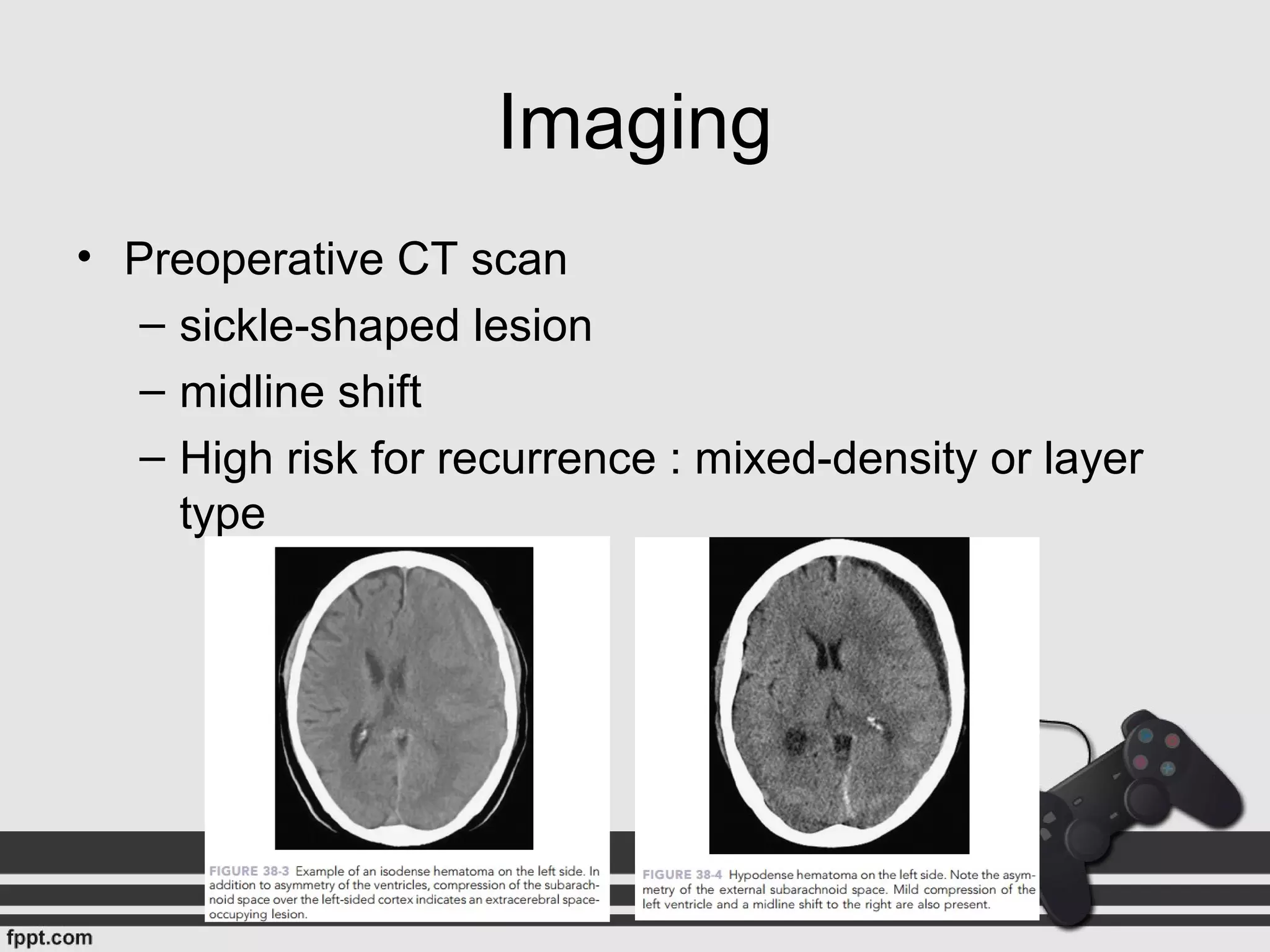
• Preoperative CT scan
– sickle-shaped lesion
– midline shift
– High risk for recurrence : mixed-density or layer
type
Imaging
• Postoperative CT scan
– Recurrence : BHC 29 %, TDC 76 %
– Residual fluid : 78% of case on day 10, 15% in
the 6th
week
– Intracranial air : tension pneumocephalus
– Bilateral CSDH : Mount Fuji sign
Imaging
• MRI
– Hyperintense on T2 , proton-weightes image
– Variability in signal intensity on T1 : 50 %
hyperintense
– DDx : Subdural hygroma : Hypointense on
proton-weightes image
Contemporary treatment
• Corticosteroid : anti-inflammatory, antiangiogenic
• Mannitol
• ACEI : antiangiogenic
• Anticonvulsant : posttraumatic and postoperative
epilepsy have low incidence in Pt c CSDH
• Patient posture after surgey : RDCT,flat position in
the first 3 day after surgery for reduce recurrence
• Hydration : increase brain volume
• Postoperative hyperemia
Surgical treatment
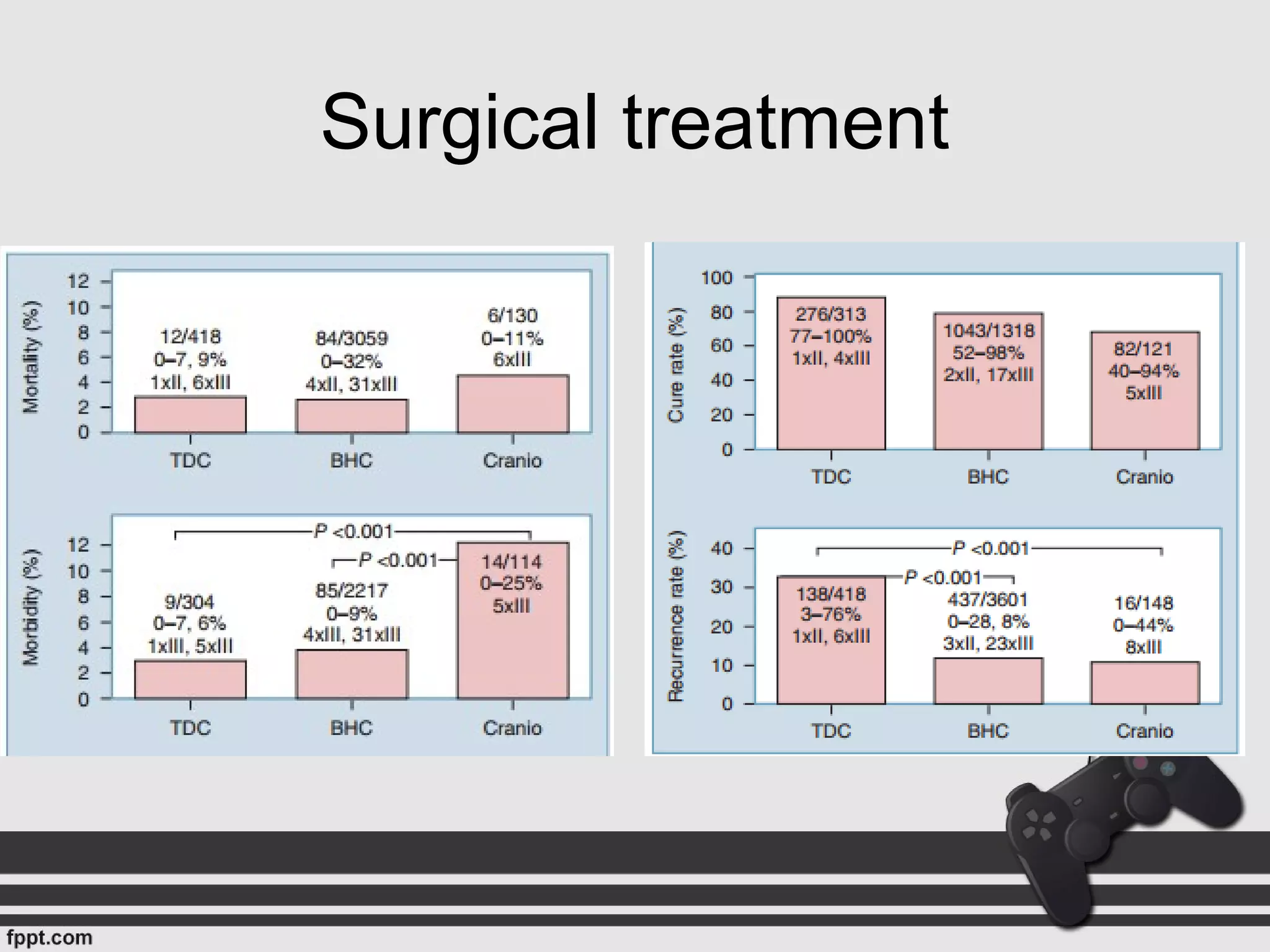
• Gold standard
• TDC : up to diameter 5 mm
• BHC : 5-30 mm diameter
• Craniotomay : larger than 30 mm diameter
• Hematoma cavity be filled with 100% Oxygen or
carbon dioxide
Twist drill craniotomy : TDC
• Decompress brain slowly and avoid the presume
rapid pressure shift that occur  ICH
• 0.5 cm incision
• Twist drill hole is place 45 angle,aim direction in
longitudinal axis of the collection
• Ventricular catherter insert to subdural space
Surgical treatment
Surgical treatment
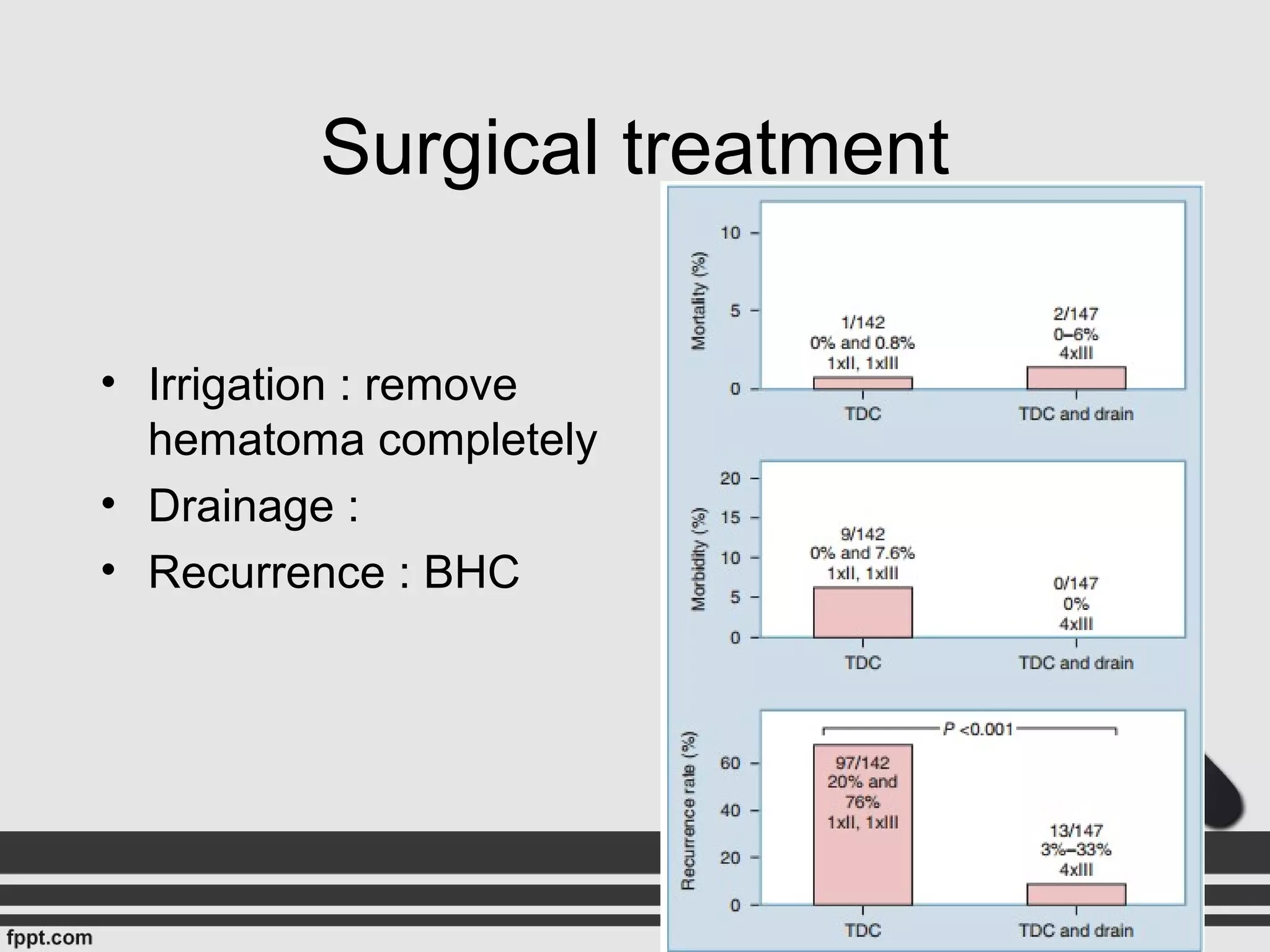
• Irrigation : remove
hematoma completely
• Drainage :
• Recurrence : BHC
Thank you

037 Pathophysiology of subdural hematoma

  • 1.
  • 2.
    Pathophysiology of the developmentof CSDH • Clear yellow to dark, thin liquid to semisolid • Gardner 1932,Osmotic gradient theory – Increase protein content  increase oncotic pressure • Weir – CSDH fluid to be isosmotic to blood and CSF • Microscopic examination of fluid from CSDHs of any age reveals fresh erythrocytes • CSDH membrane
  • 3.
    Pathophysiology of the developmentof CSDH • Neovasculature at outer membrane of CSDH • Abnormal sinusoidal dilate • Both vessel types are composed of endothelial cells • Erythrocytes and platelets found in perivascular space • Gap junction 8 um  leakage of plasma and RBC into hematoma cavity
  • 4.
    Pathophysiology of the developmentof CSDH • Kallikrein, bradykinin, and platelet-activating factor (PAF)  vasodilatation, increase vascular permeability, prolong the clotting time, release t-PA • Eosinophil degranulation in the outer membrane  fibrinolytic factor, inflammatory mediator  local coagulopathy and cell destruction
  • 5.
  • 6.
  • 7.
    Surgical Treatment of chronicsubdural hematomas • 1925, Putnam and Cushing : craniotomy with complete removal of the outer membrane and hematoma contents • 1964, Svien and Gelety : bur hole better outcome than craniotomy (lower reoperation) • 1977, Tabaddor and Shulmon : study comparing  craniotomy had the highest mortality rate
  • 8.
    Surgical Treatment of chronicsubdural hematomas • Suzuki and associates : closed system drainage without irrigation to be as effective as closed system drainage with irrigation • Smely and coauthors : twist drill drainage without irrigation was superior to bur hole drainage with irrigation
  • 9.
    Medical Treatment of chronicsubdural hematomas • Corticosteroid : decreases leukocyte chemotaxis, inhibits degranulation, inhibit neomembrane formation, prevent clot enlargement • Bender and Christoff : more rapid neurologic improvement after introducing corticosteroids to the treatment regimen, thereby allowing shorter hospitalization • ACEI : interrupt neovascularization by inhibiting endothelial vascular growth factor
  • 10.
    Medical and SurgicalManagement of Chronic Subdural Hematomas
  • 11.
    Definition • Fluid collectionwithin the layers of dura matter • DDx : subdural hygroma (subdural hydroma, external hydrocephalus) • Subdural hygroma can transform into CSDH
  • 12.
    Epidemiology • Peak incidence, 80th • Male • Trauma most important risk factor • Postsurgical communication of the subarachnoid space • CSF shunting • Primart coagulopathy in children • Anticoagulant treatment in adult • Chronic alcoholism
  • 13.
    Patient history • Nopathognomonic sign and symptoms • Asymptomatic • Coma from increase ICP • Refractory headache • Lack of concentration
  • 14.
    Imaging • Preoperative CTscan – sickle-shaped lesion – midline shift – High risk for recurrence : mixed-density or layer type
  • 15.
    Imaging • Postoperative CTscan – Recurrence : BHC 29 %, TDC 76 % – Residual fluid : 78% of case on day 10, 15% in the 6th week – Intracranial air : tension pneumocephalus – Bilateral CSDH : Mount Fuji sign
  • 16.
    Imaging • MRI – Hyperintenseon T2 , proton-weightes image – Variability in signal intensity on T1 : 50 % hyperintense – DDx : Subdural hygroma : Hypointense on proton-weightes image
  • 17.
    Contemporary treatment • Corticosteroid: anti-inflammatory, antiangiogenic • Mannitol • ACEI : antiangiogenic • Anticonvulsant : posttraumatic and postoperative epilepsy have low incidence in Pt c CSDH • Patient posture after surgey : RDCT,flat position in the first 3 day after surgery for reduce recurrence • Hydration : increase brain volume • Postoperative hyperemia
  • 18.
    Surgical treatment • Goldstandard • TDC : up to diameter 5 mm • BHC : 5-30 mm diameter • Craniotomay : larger than 30 mm diameter • Hematoma cavity be filled with 100% Oxygen or carbon dioxide
  • 19.
    Twist drill craniotomy: TDC • Decompress brain slowly and avoid the presume rapid pressure shift that occur  ICH • 0.5 cm incision • Twist drill hole is place 45 angle,aim direction in longitudinal axis of the collection • Ventricular catherter insert to subdural space
  • 20.
  • 21.
    Surgical treatment • Irrigation: remove hematoma completely • Drainage : • Recurrence : BHC
  • 22.

Editor's Notes

  • #3 Microscopic exam พบ fresh erythrocyrte พบว่าเกิด progress leakage CSDH membrane เป้น source ของ rebleeding
  • #4 เกิดเส้นเลือดใหม่ขึ้นที่ด้านนอกของ CSDH Sinusoidal ขยาย เส้นเลือดทั้งสองมี endothelial cell Gap ที่กว้างทำให้ RBC และ plasma เข้าไปใน hematoma cavity
  • #5 Inflammatory mediator ทำให้ เกิด chronic bleeing เพราะทำให้ vessel fragile Eosinophil degranulation มี fibrinolytic and inflammatory เกิด local coagulopathe และ cell destruciton
  • #6 t-PA ไปกระตุ้นให้ plasminogen กายเป็น plasminplasmin ไปทำให้ fibrin factoe V VII XI กลายเป็น fibrin degraduatiob ตัว t- PA พบมากใน outer membrane ของ chroic subdural
  • #7 เริ่มจาก bleeding ทำใหเกิด defective clot formation เกิด fibrinolysis เกิด inflammation เกิด defective neovasularization
  • #15 A : isodense hematoma on Lt side asymmetrical of ventricle C : hypodentisy lesion
  • #17 GB, WW, BB
  • #18 สาเหตุการชัก เกิดขึ้นที่ cortical injury แต่ CSDH จะมี membrane ทำให้ epileptogenic ไม่ไปโดน cerebral cortex
  • #21 Mortality , cure rate ไม่มีความแตกต่างกัย Morbidity ใน Cranio จะเกิดมากที่สุด, Recurrence rate สูงที่สุดใน TDC, BHC และ craniotomy RR ต่ำ
  • #22 Irrigation ใน BHC not decrease recuurent rate แต้ใน TDC สามารถลดได้ Drainae : ลดการเกิด recurrence ได้ ถ้าเกิด Recurrence ให้ทำ BHC