Mumtaz Ali
JPMC KARACHI
Outlines
 Anatomy of CPA
 Possible lesions of CPA
 Clinical features
 Differential diagnosis
 Radiology
 Diagnostic elements
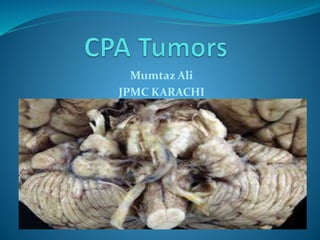
CPA anatomy
CP angle:
 Irregularly shaped
 extra-axial
 potential space
 Between cerebellum & pons in posterior fossa
 lateral to pre-pontine cisterns
BORDERS
 Medial: lateral surface of the brainstem
 Lateral : petrous bone
 Superior : middle cerebellar peduncle & cerebellum
 Inferior : arachnoid tissue of lower cranial nerves
 Posterior : cerbellar peduncle
CONTENTS
 CSF
 arachnoid tissue
 cranial nerves
 vessels
POSSIBLE LESIONS OF CP ANGLE
 Nerve structure: schwanoma
 Meninges : Meningioma ,arachnoid cyst & metastasis
 Cisternal space :epidermoid cyst ,dermoid cyst &
lipoma
 Vascular : aneurysms , AVM & paraganglioma
 Cerebellar ventricles : epindymoma ,lymphoma &
glioma
 Skull base : chondroma ,pituitary adenoma &
cholestrol granuloma
Clinical features
 Chochlear CN-VIII : asymmetric sensorineural
hearing loss & tinnitus
 Vestibular CN-VIII : dysequilibrium & vertigo
 CN-VII : facial weakness
 CN-VI : lateral rectus palsy
 CN-IX : dysphagia
 CN-X : hoarsness & aspiration
 CN-XI : shoulder weakness
 Brainstem : headache ,visual loss & ataxia
Continue…
 Cerebellum:
 Nystagmus
 Finger-nose test
 Dysdiodokinesia
 Intentional Tremor
 Scanning Speech
 Wide gait
 Falling on ipsilateral side
 Romberg sign
Differential Diagnosis
 Accoustic neuroma/Vestibular schwanoma
 Meningioma
 Epidermoid
 Arachnoid cyst
 Dermoid cyst
 Trigeminal neuroma
 Metastasis
Accoustic neuroma
 In 1777, Eduard Sandidort
 Most common CPA tumor
 60-92% of CPA lesions
 benign & encapsulated tumor
 Schwann cells
 rubbery tissue with nodular surface
Continue….
 yellow and gray areas with interspersed foci of
hemorrhage and cyst
 Vestibular division of CN-VIII
 Inferior vestibular nerve > superior vestibular nerve
Histopathological types
 Antonie A:
spindle-shaped cells with rod-shaped nuclie,
dense reticulin arranged in fascicles
 Antonie B:
stellate cells
smaller hyperchromatic nuclei
Less reticulin
prominent cytoplasmic processes
large myxoid stroma
Radiology
 CT scan
 Non-contrast: isodense ,no calcification
 IV contrast : inhance homogenously
 Gas cisternogram : no longer used
 MRI
T1 : isointense to brain & hyperintense to CSF
T2 : hyperintense to brain & iso/hypointense to CSF
Gadolinium : enhancement of tumor on T1
Diagnostic elements
• Centered on Porus Acousticus
• "Ice cream on cone" pattern (intracanalicular
extension)
• Acute angles to petrous bone
• Often involves the IAC
• Homogeneous enhancement
• No dural tail
• No calcifications
 S-100 & vimentin
Auditory brain response(ABR)
 Stimulus =chochlear nerve + auditory pathway
 sensitivity = 92% to 98%
 Specificity = 80% to 90%
Meningioma
 2nd most common CPA tumor (3-7%)
 well-circumscribed
 globular or lobulated
 non-glial tumor
 arachnoidal cells:CN foramina , venous sinuses
Continue….
 clearly demarcated from the brain
 Usually arise : posterior surface of petrous
 Usually do not extend : IAC
 Vimentin & EMA
Diagnostic elements
 Arise : petrous bone (broad base)
 Obtuse angles to petrous bone
 Uncommonly involves the IAC
 "dural tail" sign (50-75%)
 Calcifications common (25%)
 Pial vessel flow voids
 Psammoma body
 Herniate into middle fossa (50%)
Continue…..
 Hyperstosis
 Homogenous signal
 Homogenous enhancement
 Extension:small ,internal auditory canal
Epidermoid cyst
 Accounts for 2-6 % of CPA masses
 Congenital lesions that present in adulthood
 Rests of ectodermal tissue containing stratified
squamous lining and keratin
 May arise within the temporal bone or in the CPA
Continue….
 Extra-axial lesions
 spread along the basal surface
 Rupture : aseptic meningitis
 Overwhelmingly benign
Diagnostic Elements
 Dumb bell : middle fossa or contralateral cistern
 Non-enhancing (25% mild peripheral enhancement)
 CT usually shows a mass hypodense to CSF
 Inhomogeneous lesion
 cauliflower surface appearance
 T1 - hypo-isointense
Continue….
 T2 - hyperintense
 (high protein,high signal=T1 & low signal=T2)
 FLAIR : iso-hyperintensity
 Diffusion weighting:characteristic moderate intensity
(restriction of diffusion)
Arachnoid cyst
 Loculated collections of CSF
 reduplication of arachnoidal membrane
 Erosion of the adjacent calvarium is often present
Diagnostic elements
 Avascular cystic mass
 Nonenhancing
 Smooth regular shape
 Homogeneous
 identical signal to CSF in all weighting
continue
 No calcifications
 FLAIR :intense signal suppresion
 Diffusion weighting : hypointensity (no restriction of
diffusion
Dermoid cyst
 Midline lesions
 rarely invade the CPA laterally
 elements from all layers of the skin
 FLAIR, CISS and DWI:diagnostic
 MR appearance depends : amount of fat
 increased signal : T1 & T2
Trigeminal neuroma
 Similar to vestibular neuoma
 arises from the trigeminal nerve
Thank You

Cp angle tumors

  • 1.
  • 2.
    Outlines  Anatomy ofCPA  Possible lesions of CPA  Clinical features  Differential diagnosis  Radiology  Diagnostic elements
  • 3.
    CPA anatomy CP angle: Irregularly shaped  extra-axial  potential space  Between cerebellum & pons in posterior fossa  lateral to pre-pontine cisterns
  • 4.
    BORDERS  Medial: lateralsurface of the brainstem  Lateral : petrous bone  Superior : middle cerebellar peduncle & cerebellum  Inferior : arachnoid tissue of lower cranial nerves  Posterior : cerbellar peduncle
  • 5.
    CONTENTS  CSF  arachnoidtissue  cranial nerves  vessels
  • 8.
    POSSIBLE LESIONS OFCP ANGLE  Nerve structure: schwanoma  Meninges : Meningioma ,arachnoid cyst & metastasis  Cisternal space :epidermoid cyst ,dermoid cyst & lipoma  Vascular : aneurysms , AVM & paraganglioma  Cerebellar ventricles : epindymoma ,lymphoma & glioma  Skull base : chondroma ,pituitary adenoma & cholestrol granuloma
  • 9.
    Clinical features  ChochlearCN-VIII : asymmetric sensorineural hearing loss & tinnitus  Vestibular CN-VIII : dysequilibrium & vertigo  CN-VII : facial weakness  CN-VI : lateral rectus palsy  CN-IX : dysphagia  CN-X : hoarsness & aspiration  CN-XI : shoulder weakness  Brainstem : headache ,visual loss & ataxia
  • 10.
    Continue…  Cerebellum:  Nystagmus Finger-nose test  Dysdiodokinesia  Intentional Tremor  Scanning Speech  Wide gait  Falling on ipsilateral side  Romberg sign
  • 11.
    Differential Diagnosis  Accousticneuroma/Vestibular schwanoma  Meningioma  Epidermoid  Arachnoid cyst  Dermoid cyst  Trigeminal neuroma  Metastasis
  • 12.
    Accoustic neuroma  In1777, Eduard Sandidort  Most common CPA tumor  60-92% of CPA lesions  benign & encapsulated tumor  Schwann cells  rubbery tissue with nodular surface
  • 13.
    Continue….  yellow andgray areas with interspersed foci of hemorrhage and cyst  Vestibular division of CN-VIII  Inferior vestibular nerve > superior vestibular nerve
  • 14.
    Histopathological types  AntonieA: spindle-shaped cells with rod-shaped nuclie, dense reticulin arranged in fascicles  Antonie B: stellate cells smaller hyperchromatic nuclei Less reticulin prominent cytoplasmic processes large myxoid stroma
  • 17.
    Radiology  CT scan Non-contrast: isodense ,no calcification  IV contrast : inhance homogenously  Gas cisternogram : no longer used  MRI T1 : isointense to brain & hyperintense to CSF T2 : hyperintense to brain & iso/hypointense to CSF Gadolinium : enhancement of tumor on T1
  • 18.
    Diagnostic elements • Centeredon Porus Acousticus • "Ice cream on cone" pattern (intracanalicular extension) • Acute angles to petrous bone • Often involves the IAC • Homogeneous enhancement • No dural tail • No calcifications  S-100 & vimentin
  • 22.
    Auditory brain response(ABR) Stimulus =chochlear nerve + auditory pathway  sensitivity = 92% to 98%  Specificity = 80% to 90%
  • 24.
    Meningioma  2nd mostcommon CPA tumor (3-7%)  well-circumscribed  globular or lobulated  non-glial tumor  arachnoidal cells:CN foramina , venous sinuses
  • 25.
    Continue….  clearly demarcatedfrom the brain  Usually arise : posterior surface of petrous  Usually do not extend : IAC  Vimentin & EMA
  • 26.
    Diagnostic elements  Arise: petrous bone (broad base)  Obtuse angles to petrous bone  Uncommonly involves the IAC  "dural tail" sign (50-75%)  Calcifications common (25%)  Pial vessel flow voids  Psammoma body  Herniate into middle fossa (50%)
  • 27.
    Continue…..  Hyperstosis  Homogenoussignal  Homogenous enhancement  Extension:small ,internal auditory canal
  • 30.
    Epidermoid cyst  Accountsfor 2-6 % of CPA masses  Congenital lesions that present in adulthood  Rests of ectodermal tissue containing stratified squamous lining and keratin  May arise within the temporal bone or in the CPA
  • 31.
    Continue….  Extra-axial lesions spread along the basal surface  Rupture : aseptic meningitis  Overwhelmingly benign
  • 32.
    Diagnostic Elements  Dumbbell : middle fossa or contralateral cistern  Non-enhancing (25% mild peripheral enhancement)  CT usually shows a mass hypodense to CSF  Inhomogeneous lesion  cauliflower surface appearance  T1 - hypo-isointense
  • 33.
    Continue….  T2 -hyperintense  (high protein,high signal=T1 & low signal=T2)  FLAIR : iso-hyperintensity  Diffusion weighting:characteristic moderate intensity (restriction of diffusion)
  • 35.
    Arachnoid cyst  Loculatedcollections of CSF  reduplication of arachnoidal membrane  Erosion of the adjacent calvarium is often present
  • 36.
    Diagnostic elements  Avascularcystic mass  Nonenhancing  Smooth regular shape  Homogeneous  identical signal to CSF in all weighting
  • 37.
    continue  No calcifications FLAIR :intense signal suppresion  Diffusion weighting : hypointensity (no restriction of diffusion
  • 39.
    Dermoid cyst  Midlinelesions  rarely invade the CPA laterally  elements from all layers of the skin  FLAIR, CISS and DWI:diagnostic  MR appearance depends : amount of fat  increased signal : T1 & T2
  • 41.
    Trigeminal neuroma  Similarto vestibular neuoma  arises from the trigeminal nerve
  • 43.