Monopolies & Restrictive Trade Practices and Competition Law -- Legal Aspects of Business – EPGP 09-10
Laws in India Constitution of India Section 38 and 39 – “State shall ensure equitable distribution and control of material resources that best serve the needs of the common man and that the operation of the economic system does not result in concentration of wealth and means of production to common detriment” MRTP - 1969 Restrict formation of monopolies Restrict concentration of economic power Prohibit restrictive trade practices MRTP (Addition) – 1984 Unfair trade practices brought under the purview
Laws in India MRTP (Amendment) – 1991 Removed section on controlling concentration of economic power No pre-approvals required for enhancing production capabilities High Level Commission – 1999 Relook at Competition Laws Relevant to modern industrial framework Amend MRTP or create a new law Competition Act – 2002 Competition (Amendment) Act – 2009 Sunset clause for MRTP, August 31, 2011
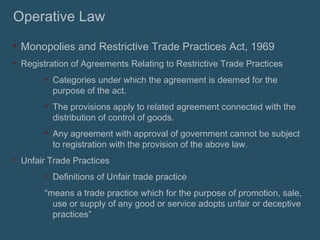
Operative Law Monopolies and Restrictive Trade Practices Act, 1969 Registration of Agreements Relating to Restrictive Trade Practices Categories under which the agreement is deemed for the purpose of the act.  The provisions apply to related agreement connected with the distribution of control of goods.  Any agreement with approval of government cannot be subject to registration with the provision of the above law.  Unfair Trade Practices Definitions of Unfair trade practice “ means a trade practice which for the purpose of promotion, sale, use or supply of any good or service adopts unfair or deceptive practices”
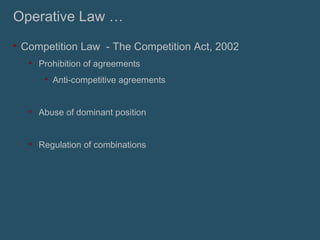
Operative Law … Competition Law  - The Competition Act, 2002  Prohibition of agreements  Anti-competitive agreements  Abuse of dominant position Regulation of combinations
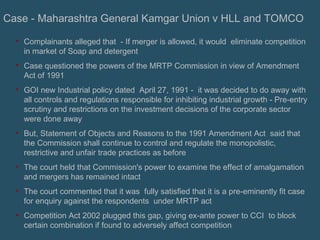
Case - Maharashtra General Kamgar Union v HLL and TOMCO  Complainants alleged that  - If merger is allowed, it would  eliminate competition in market of Soap and detergent Case questioned the powers of the MRTP Commission in view of Amendment Act of 1991 GOI new Industrial policy dated  April 27, 1991 -  it was decided to do away with all controls and regulations responsible for inhibiting industrial growth - Pre-entry scrutiny and restrictions on the investment decisions of the corporate sector were done away  But, Statement of Objects and Reasons to the 1991 Amendment Act  said that the Commission shall continue to control and regulate the monopolistic, restrictive and unfair trade practices as before The court held that Commission's power to examine the effect of amalgamation and mergers has remained intact  The court commented that it was  fully satisfied that it is a pre-eminently fit case for enquiry against the respondents  under MRTP act Competition Act 2002 plugged this gap, giving ex-ante power to CCI  to block certain combination if found to adversely affect competition
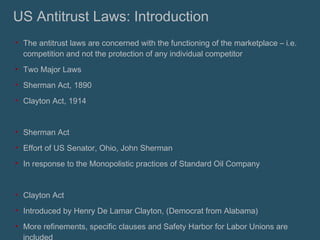
US Antitrust Laws: Introduction The antitrust laws are concerned with the functioning of the marketplace – i.e. competition and not the protection of any individual competitor Two Major Laws Sherman Act, 1890 Clayton Act, 1914 Sherman Act Effort of US Senator, Ohio, John Sherman In response to the Monopolistic practices of Standard Oil Company Clayton Act Introduced by Henry De Lamar Clayton, (Democrat from Alabama) More refinements, specific clauses and Safety Harbor for Labor Unions are included
Enforcing Entities Federal antitrust laws are enforced by the following authorities: U.S. Department of Justice (DOJ) Federal Trade Commission (FTC) Private Enforcement
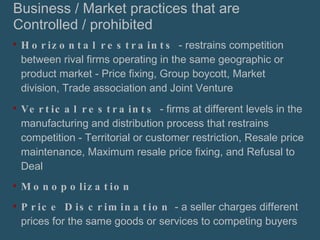
Business / Market practices that are Controlled / prohibited Horizontal restraints  - restrains competition between rival firms operating in the same geographic or product market - Price fixing, Group boycott, Market division, Trade association and Joint Venture Vertical restraints  - firms at different levels in the manufacturing and distribution process that restrains competition - Territorial or customer restriction, Resale price maintenance, Maximum resale price fixing, and Refusal to Deal Monopolization Price Discrimination  - a seller charges different prices for the same goods or services to competing buyers
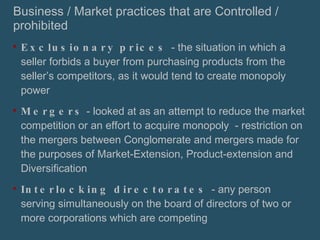
Business / Market practices that are Controlled / prohibited Exclusionary prices  - the situation in which a seller forbids a buyer from purchasing products from the seller’s competitors, as it would tend to create monopoly power Mergers  - looked at as an attempt to reduce the market competition or an effort to acquire monopoly  - restriction on the mergers between Conglomerate and mergers made for the purposes of Market-Extension, Product-extension and Diversification Interlocking directorates  - any person serving simultaneously on the board of directors of two or more corporations which are competing
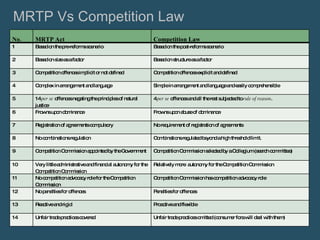
MRTP Vs Competition Law No. MRTP Act Competition Law 1 Based on the pre-reforms scenario Based on the post-reforms scenario 2 Based on size as a factor  Based on structure as a factor 3 Competition offences implicit or not defined Competition offences explicit and defined 4 Complex in arrangement and language Simple in arrangement and language and easily comprehensible 5 14  per se  offences negating the principles of natural justice  4  per se  offences and all the rest subjected to  rule of reason .  6 Frowns upon dominance  Frowns upon abuse of dominance 7 Registration of agreements compulsory No requirement of registration of agreements  8 No combinations regulation  Combinations regulated beyond a high threshold limit.  9 Competition Commission appointed by the Government  Competition Commission selected by a Collegium (search committee)  10 Very little administrative and financial autonomy for the Competition Commission Relatively more  autonomy for the Competition Commission 11 No competition advocacy role for the Competition Commission Competition Commission has competition advocacy role  12 No penalties for offences  Penalties for offences 13 Reactive and rigid Proactive and flexible 14 Unfair trade practices covered Unfair trade practices omitted (consumer fora will deal with them)
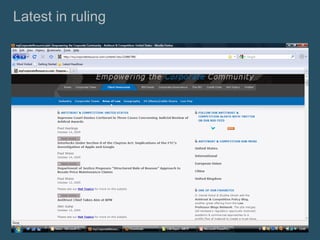
Latest in ruling
Thank You

Epgp 09 10 - lab - mrtp and cl - raj

  • 1.
    Monopolies & RestrictiveTrade Practices and Competition Law -- Legal Aspects of Business – EPGP 09-10
  • 2.
    Laws in IndiaConstitution of India Section 38 and 39 – “State shall ensure equitable distribution and control of material resources that best serve the needs of the common man and that the operation of the economic system does not result in concentration of wealth and means of production to common detriment” MRTP - 1969 Restrict formation of monopolies Restrict concentration of economic power Prohibit restrictive trade practices MRTP (Addition) – 1984 Unfair trade practices brought under the purview
  • 3.
    Laws in IndiaMRTP (Amendment) – 1991 Removed section on controlling concentration of economic power No pre-approvals required for enhancing production capabilities High Level Commission – 1999 Relook at Competition Laws Relevant to modern industrial framework Amend MRTP or create a new law Competition Act – 2002 Competition (Amendment) Act – 2009 Sunset clause for MRTP, August 31, 2011
  • 4.
    Operative Law Monopoliesand Restrictive Trade Practices Act, 1969 Registration of Agreements Relating to Restrictive Trade Practices Categories under which the agreement is deemed for the purpose of the act. The provisions apply to related agreement connected with the distribution of control of goods. Any agreement with approval of government cannot be subject to registration with the provision of the above law. Unfair Trade Practices Definitions of Unfair trade practice “ means a trade practice which for the purpose of promotion, sale, use or supply of any good or service adopts unfair or deceptive practices”
  • 5.
    Operative Law …Competition Law - The Competition Act, 2002 Prohibition of agreements Anti-competitive agreements Abuse of dominant position Regulation of combinations
  • 6.
    Case - MaharashtraGeneral Kamgar Union v HLL and TOMCO Complainants alleged that - If merger is allowed, it would eliminate competition in market of Soap and detergent Case questioned the powers of the MRTP Commission in view of Amendment Act of 1991 GOI new Industrial policy dated April 27, 1991 - it was decided to do away with all controls and regulations responsible for inhibiting industrial growth - Pre-entry scrutiny and restrictions on the investment decisions of the corporate sector were done away But, Statement of Objects and Reasons to the 1991 Amendment Act said that the Commission shall continue to control and regulate the monopolistic, restrictive and unfair trade practices as before The court held that Commission's power to examine the effect of amalgamation and mergers has remained intact The court commented that it was fully satisfied that it is a pre-eminently fit case for enquiry against the respondents under MRTP act Competition Act 2002 plugged this gap, giving ex-ante power to CCI to block certain combination if found to adversely affect competition
  • 7.
    US Antitrust Laws:Introduction The antitrust laws are concerned with the functioning of the marketplace – i.e. competition and not the protection of any individual competitor Two Major Laws Sherman Act, 1890 Clayton Act, 1914 Sherman Act Effort of US Senator, Ohio, John Sherman In response to the Monopolistic practices of Standard Oil Company Clayton Act Introduced by Henry De Lamar Clayton, (Democrat from Alabama) More refinements, specific clauses and Safety Harbor for Labor Unions are included
  • 8.
    Enforcing Entities Federalantitrust laws are enforced by the following authorities: U.S. Department of Justice (DOJ) Federal Trade Commission (FTC) Private Enforcement
  • 9.
    Business / Marketpractices that are Controlled / prohibited Horizontal restraints - restrains competition between rival firms operating in the same geographic or product market - Price fixing, Group boycott, Market division, Trade association and Joint Venture Vertical restraints - firms at different levels in the manufacturing and distribution process that restrains competition - Territorial or customer restriction, Resale price maintenance, Maximum resale price fixing, and Refusal to Deal Monopolization Price Discrimination - a seller charges different prices for the same goods or services to competing buyers
  • 10.
    Business / Marketpractices that are Controlled / prohibited Exclusionary prices - the situation in which a seller forbids a buyer from purchasing products from the seller’s competitors, as it would tend to create monopoly power Mergers - looked at as an attempt to reduce the market competition or an effort to acquire monopoly - restriction on the mergers between Conglomerate and mergers made for the purposes of Market-Extension, Product-extension and Diversification Interlocking directorates - any person serving simultaneously on the board of directors of two or more corporations which are competing
  • 11.
    MRTP Vs CompetitionLaw No. MRTP Act Competition Law 1 Based on the pre-reforms scenario Based on the post-reforms scenario 2 Based on size as a factor Based on structure as a factor 3 Competition offences implicit or not defined Competition offences explicit and defined 4 Complex in arrangement and language Simple in arrangement and language and easily comprehensible 5 14 per se offences negating the principles of natural justice 4 per se offences and all the rest subjected to rule of reason . 6 Frowns upon dominance Frowns upon abuse of dominance 7 Registration of agreements compulsory No requirement of registration of agreements 8 No combinations regulation Combinations regulated beyond a high threshold limit. 9 Competition Commission appointed by the Government Competition Commission selected by a Collegium (search committee) 10 Very little administrative and financial autonomy for the Competition Commission Relatively more autonomy for the Competition Commission 11 No competition advocacy role for the Competition Commission Competition Commission has competition advocacy role 12 No penalties for offences Penalties for offences 13 Reactive and rigid Proactive and flexible 14 Unfair trade practices covered Unfair trade practices omitted (consumer fora will deal with them)
  • 12.
  • 13.