P R E S E N TE D B Y

D I P U TH O M A S JO Y
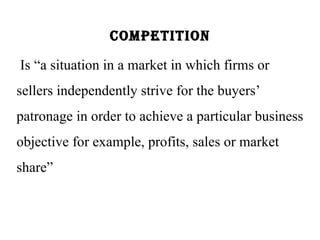
Competition

Is “a situation in a market in which firms or
sellers independently strive for the buyers’
patronage in order to achieve a particular business
objective for example, profits, sales or market
share”
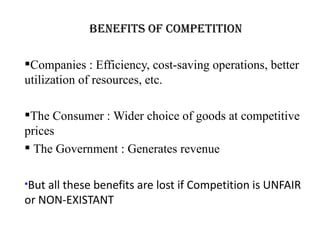
Benefits of Competition

Companies : Efficiency, cost-saving operations, better
utilization of resources, etc.

The Consumer : Wider choice of goods at competitive
prices
 The Government : Generates revenue

But all these benefits are lost if Competition is UNFAIR
or NON-EXISTANT
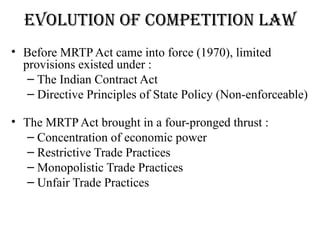
evolution of Competition law
• Before MRTP Act came into force (1970), limited
  provisions existed under :
   – The Indian Contract Act
   – Directive Principles of State Policy (Non-enforceable)

• The MRTP Act brought in a four-pronged thrust :
   – Concentration of economic power
   – Restrictive Trade Practices
   – Monopolistic Trade Practices
   – Unfair Trade Practices
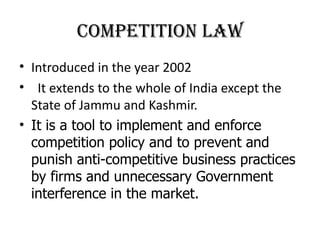
Competition law
• Introduced in the year 2002
• It extends to the whole of India except the
  State of Jammu and Kashmir.
• It is a tool to implement and enforce
  competition policy and to prevent and
  punish anti-competitive business practices
  by firms and unnecessary Government
  interference in the market.
Competition law

• Competition Law generally covers 3 areas:

  – Anti - Competitive Agreements, e.g., cartels,

  – Abuse of Dominant Position by enterprises, e.g.,
  predatory pricing, barriers to entry and

  – Regulation of Mergers and Acquisitions (M&As).
oBJeCtives of Competition law

 Promoting economic efficiency in both static and
  dynamic sense
 Protecting consumers from the undue exercise of
  market power
 Facilitating economic liberalization, including
  privatization. Deregulation and reduction of external
  trade barriers
 Preserving and promoting the sound development of a
  market economy
Cont…

 Ensuring fairness and equity in market place
  transactions

 Protecting the ‘public interest’ including in some
  cases    considerations   relating    to   industrial
  competitiveness and employment

 Protecting opportunities for small and medium
  business
anti-Competitive
         agreements
• No enterprise or association of enterprises or
  person or association of persons shall enter
  into any agreement in respect of production,
  supply, distribution, storage, acquisition or
  control of goods or provision of services,
  which causes or is likely to cause an
  appreciable adverse effect on competition
  within India.
aBuse of dominant
             position
• "dominant position" means a position of strength, enjoyed by
   an enterprise, in the relevant market, in India, which enables
   it to—
• (i)    operate independently of competitive forces prevailing
   in the relevant market; or
• (ii)   affect its competitors or consumers or the relevant
   market in its favour.
ComBinations

Regulation of combinations
No person or enterprise shall enter into a
combination which causes or is likely to
cause an appreciable adverse effect on
competition
eXemptions

 GOVERNMENT BY NOTIFICATION MAY EXEMPT FROM THE COMPETITION

  LAW

 ANY CLASS OF ENTERPRISES IN THE INTEREST OF NATIONAL

  SECURITY/PUBLIC INTEREST.

 ANY PRACTICE/AGREEMENT ARISING OUT OF INTERNATIONAL

  TREATY/AGREEMENT

 ANY ENTERPRISE PERFORMING A SOVEREIGN FUNCTION ON BEHALF OF

  GOVERNMENT

 DIFFERENT PROVISIONS FROM DIFFERENT DATES IF, NEED BE.
status of the Competition
         Commission

• It is a body corporate

• It has Regulatory and quasi-judicial powers;
   functions through Benches

• Each Bench shall consist of at least two
  Members and one of such Members must be a
  judicial Member
power of the Competition
            Commission

After inquiry into abuse of dominant position, the
Competition Commission can order:

  • discontinuance of abuse of dominant position

  • impose a penalty upto 10% of the average
    turnover of the enterprise
Cont..

• Cease and desist order

• Impose penalty up to 10% of turnover.

• In case of cartel, penalty can be 10% of
   turnover or 3 times of profit illegally gained
   from cartel activity, whichever is higher.
Cont..

• Recommend to Government the division of
  dominant Enterprise

• Various penalties ranging from Rs.1 lac upto
  Rs.1 crore are also provided for failure to
  comply with direction/order of Commission.
old wine or new wine ?

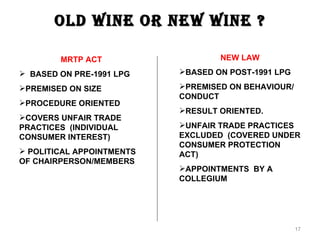
        MRTP ACT                   NEW LAW

 BASED ON PRE-1991 LPG    BASED ON POST-1991 LPG

PREMISED ON SIZE          PREMISED ON BEHAVIOUR/
                           CONDUCT
PROCEDURE ORIENTED
                           RESULT ORIENTED.
COVERS UNFAIR TRADE
PRACTICES (INDIVIDUAL      UNFAIR TRADE PRACTICES
CONSUMER INTEREST)         EXCLUDED (COVERED UNDER
                           CONSUMER PROTECTION
 POLITICAL APPOINTMENTS   ACT)
OF CHAIRPERSON/MEMBERS
                           APPOINTMENTS BY A
                           COLLEGIUM


                                                     17
Competition act

Competition act

  • 1.
    P R ES E N TE D B Y D I P U TH O M A S JO Y
  • 2.
    Competition Is “a situationin a market in which firms or sellers independently strive for the buyers’ patronage in order to achieve a particular business objective for example, profits, sales or market share”
  • 3.
    Benefits of Competition Companies: Efficiency, cost-saving operations, better utilization of resources, etc. The Consumer : Wider choice of goods at competitive prices  The Government : Generates revenue But all these benefits are lost if Competition is UNFAIR or NON-EXISTANT
  • 4.
    evolution of Competitionlaw • Before MRTP Act came into force (1970), limited provisions existed under : – The Indian Contract Act – Directive Principles of State Policy (Non-enforceable) • The MRTP Act brought in a four-pronged thrust : – Concentration of economic power – Restrictive Trade Practices – Monopolistic Trade Practices – Unfair Trade Practices
  • 5.
    Competition law • Introducedin the year 2002 • It extends to the whole of India except the State of Jammu and Kashmir. • It is a tool to implement and enforce competition policy and to prevent and punish anti-competitive business practices by firms and unnecessary Government interference in the market.
  • 6.
    Competition law • CompetitionLaw generally covers 3 areas: – Anti - Competitive Agreements, e.g., cartels, – Abuse of Dominant Position by enterprises, e.g., predatory pricing, barriers to entry and – Regulation of Mergers and Acquisitions (M&As).
  • 7.
    oBJeCtives of Competitionlaw  Promoting economic efficiency in both static and dynamic sense  Protecting consumers from the undue exercise of market power  Facilitating economic liberalization, including privatization. Deregulation and reduction of external trade barriers  Preserving and promoting the sound development of a market economy
  • 8.
    Cont…  Ensuring fairnessand equity in market place transactions  Protecting the ‘public interest’ including in some cases considerations relating to industrial competitiveness and employment  Protecting opportunities for small and medium business
  • 9.
    anti-Competitive agreements • No enterprise or association of enterprises or person or association of persons shall enter into any agreement in respect of production, supply, distribution, storage, acquisition or control of goods or provision of services, which causes or is likely to cause an appreciable adverse effect on competition within India.
  • 10.
    aBuse of dominant position • "dominant position" means a position of strength, enjoyed by an enterprise, in the relevant market, in India, which enables it to— • (i) operate independently of competitive forces prevailing in the relevant market; or • (ii) affect its competitors or consumers or the relevant market in its favour.
  • 11.
    ComBinations Regulation of combinations Noperson or enterprise shall enter into a combination which causes or is likely to cause an appreciable adverse effect on competition
  • 12.
    eXemptions GOVERNMENT BYNOTIFICATION MAY EXEMPT FROM THE COMPETITION LAW  ANY CLASS OF ENTERPRISES IN THE INTEREST OF NATIONAL SECURITY/PUBLIC INTEREST.  ANY PRACTICE/AGREEMENT ARISING OUT OF INTERNATIONAL TREATY/AGREEMENT  ANY ENTERPRISE PERFORMING A SOVEREIGN FUNCTION ON BEHALF OF GOVERNMENT  DIFFERENT PROVISIONS FROM DIFFERENT DATES IF, NEED BE.
  • 13.
    status of theCompetition Commission • It is a body corporate • It has Regulatory and quasi-judicial powers; functions through Benches • Each Bench shall consist of at least two Members and one of such Members must be a judicial Member
  • 14.
    power of theCompetition Commission After inquiry into abuse of dominant position, the Competition Commission can order: • discontinuance of abuse of dominant position • impose a penalty upto 10% of the average turnover of the enterprise
  • 15.
    Cont.. • Cease anddesist order • Impose penalty up to 10% of turnover. • In case of cartel, penalty can be 10% of turnover or 3 times of profit illegally gained from cartel activity, whichever is higher.
  • 16.
    Cont.. • Recommend toGovernment the division of dominant Enterprise • Various penalties ranging from Rs.1 lac upto Rs.1 crore are also provided for failure to comply with direction/order of Commission.
  • 17.
    old wine ornew wine ? MRTP ACT NEW LAW  BASED ON PRE-1991 LPG BASED ON POST-1991 LPG PREMISED ON SIZE PREMISED ON BEHAVIOUR/ CONDUCT PROCEDURE ORIENTED RESULT ORIENTED. COVERS UNFAIR TRADE PRACTICES (INDIVIDUAL UNFAIR TRADE PRACTICES CONSUMER INTEREST) EXCLUDED (COVERED UNDER CONSUMER PROTECTION  POLITICAL APPOINTMENTS ACT) OF CHAIRPERSON/MEMBERS APPOINTMENTS BY A COLLEGIUM 17