BRAND EXTENSIONS Participants Mandeepak Singh Nitin Fernandes Rajendra Inani Vijay Anand Rajendran Strategic Brand Management – Prof Ashish Sadh
Brand extension :  application of a popular brand name to a new product in an unrelated product category Line extensions  refers to new sizes, styles, or related products Brand licensing :  practice allowing other companies to use a brand name in exchange for a payment 12-
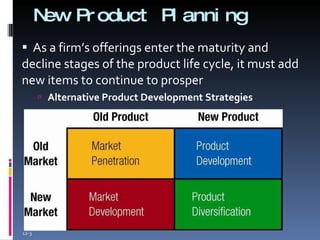
New Product Planning As a firm’s offerings enter the maturity and decline stages of the product life cycle, it must add new items to continue to prosper Alternative Product Development Strategies 12-
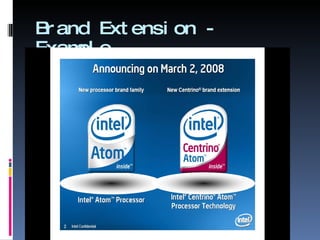
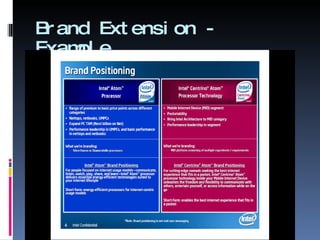
What is a Brand Extension? Established brands are assets Marketers try and leverage these assets The process of using the brand name on another product is known as extension Line Extensions (Lifebuoy Liquid Soap) Category Extensions (Nokia Laptops) Stretch Extensions (Intel Celeron)
Why Brand Extensions? New products a driver of growth for a company Developing and launching requires millions Yet 9 out of 10 new products FAIL Can be perceived as old and staid if no new launches Overdependence on any one brand could be dangerous Parent brand may only appeal to a segment Brand is seen as boring and lacking variety Allows the competition to flank
Why Brand Extensions? Helps cut down costs Can enhance customer’s positive brand  perception Rejuvenates parent brand Reduces overdependence on a single product Category/Stretch extensions help bring in new users Cater to different needs of segments / existing users Can also be a tool for blocking competition
How do consumers evaluate? Fit between Parent & Extension Fit in terms of ‘Core Differentiation’ FIT: Coke & Diet Coke (Taste) MISFIT: Pepsi & Crystal Pepsi (Color) Extension must remain true to the core values of the parent brand
How much to extend? Equal borrow & build with the parent brand Harley: Clothing, Tatoos but not Energy Drink FAL: FAL for Men but not Perfect Radiance Pepsodent: Cavity, Plaque but not Fresh Breath Drivers Frame of Reference (McDonald’s – Fast Food) POD (Oral-B Toffee) RTB (Gits – Pasta)
Moving Down Why? Competition Private Labels Challenge Protecting the Brand Distinguish the Extension Sub-Branding Product
Moving Up Why? Potential User Base Higher Margins Challenge Managing Credibility Sub-Brand with a Descriptor (Kodak GOLD)
Risks in Extension Line Extension: Over choice & Confusion Dilution of Parent Equity: New Maggi, Coke Vanilla Use of Sub-Brand gives cushion: Sony Walkman Cannibalization of Parent (Space & SOM)
Extensions in Portfolio Cannibalization Distinct Role Incremental Share Different Needs
Key Questions Positioning of Parent Brand? What am I using from the positioning? Is that valued by the consumer in the new category in which I am extending? Does the consumer see a connect with the parent? What will be the impact on the parent?
LINE EXTENSIONS The product line is now far more representative of customers’ varying quantity needs.  It suggests the presence of usage segmentation.  Customers differs in terms of their usage quantities.  The brand has to fill the whole spectrum with products as per the needs of various segments.
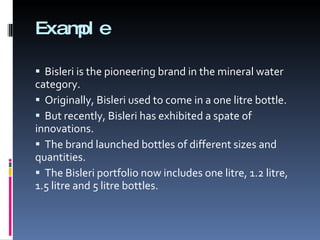
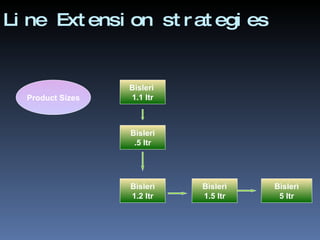
Example  Bisleri is the pioneering brand in the mineral water category. Originally, Bisleri used to come in a one litre bottle. But recently, Bisleri has exhibited a spate of innovations. The brand launched bottles of different sizes and quantities.  The Bisleri portfolio now includes one litre, 1.2 litre, 1.5 litre and 5 litre bottles.
Line Extension strategies Product Sizes Bisleri  1.1 ltr Bisleri 5 ltr Bisleri 1.5 ltr Bisleri 1.2 ltr Bisleri .5 ltr
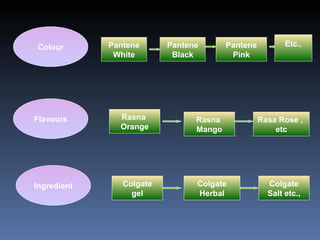
Colour Etc., Pantene Pink Pantene Black Pantene White Flavours Ingredient Rasna  Orange Rasna  Mango Rasa Rose ,  etc Colgate gel Colgate Herbal Colgate Salt etc.,
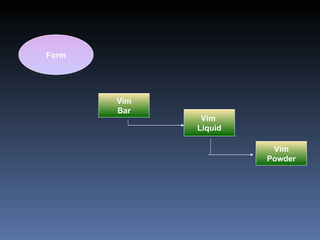
Form Vim  Liquid Vim Powder Vim Bar
Why Line Extensions? In most of the product categories including fast moving consumer goods, consumer durables and services, line extension has been the name of the game. It is an expansionist move. The firms seem to seek growth more vigorously.
Nine prominent reasons Customer Segmentation Customer need for variety Pricing Breadth Capacity Utilization Quick gains Competitive Reasons Trade Demands Counter Competition Image Benefits
Line Extension Risks There are several dangers associated with line extensions. Line Confusion   - Marketers sometimes add products to their line without sound logic and reasoning, without any clear role and goal. This may confuse the customers and the retailers and will affect the brand’s owner company in the long run.
Line Extension Risks… Encourage Variety seeking  – Brand loyalty is every marketers dream.  By line extension, customers practice and become the habitant of variety seeking.  Hence it influence brand switching behaviors. The loyalty is thus weakened.
Line Extension Risks Success Myopia  – An idea may be a grand enough to be converted into a full-fledged independent brand.  But the lure of extension seems to be so strong that the ideas are brought into the market as line extensions.  This implies loss of a winning asset in the long-term.
Line Extension Risks… Strained relations  -  When the lines expand, marketers tend to pressurize their trade partners such as wholesalers and retailers to carry the complete line in accordance with their wishes. The pressure appears to be applied more intensely at the retail level.  The marketers seek adequate shelf space, promotion and information. But at the retailers end, it brings confusion and chaos.  The result is the strained relations between the marketer and the retailer.
Line Extension Trap Why do firms jump on to line extension bandwagon? When customers prefer a brand, they would be just as willing to buy a different product carrying the  same name. What appears to be logical to the managers performing these adventures tends to be illogical in the perception of customers. This is the reason why line extensions do not create mega successes.
Line Extension Trap Line extensions do not work because they tend to go against the fundamental aspect of positioning. The core brand holds a strong position inside the prospect’s mind. Line extensions tend to educate customers that product and brand are two different things. It is a fallacy that a brand is just a name that can be put on any product. This is a great mistake. It undermines and destroys the brand in a prospect’s mind.
BRAND EXTENSIONS Using an existing brand name to promote a product in a different category, is Brand Extension. The key difference between line and brand extension is the product category. In line extension the product category remains constant whereas in brand extensions product category is a variable.
EXAMPLE Ponds -  Cold cream, Toilet soap Shampoo, Tooth paste, Moisturizing lotion, Talc & Face wash. LG – Television, Refrigerators, Computer monitors, Microwaves, Air Conditioners, Washing Machines & Mobile phones. Park Avenue – Shirts, Shaving cream, Jeans, Belts, Perfumes, Soap & Razor.
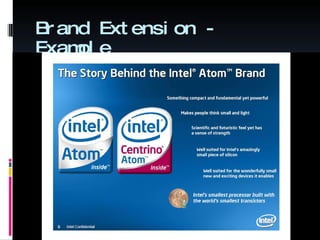
Brand Extension - Example
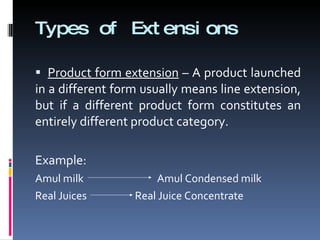
Types of Extensions Product form extension  – A product launched in a different form usually means line extension, but if a different product form constitutes an entirely different product category. Example: Amul milk  Amul Condensed milk Real Juices  Real Juice Concentrate
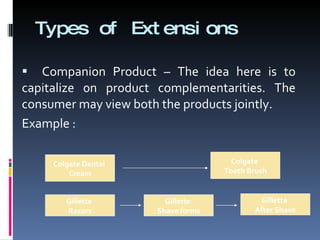
Types of Extensions Companion Product – The idea here is to capitalize 0n product complementarities. The consumer may view both the products jointly. Example : Colgate Dental  Cream Colgate  Tooth Brush Gillette  Razors Gillette  Shave forms Gillette  After Shave
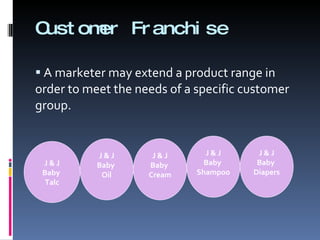
Customer Franchise A marketer may extend a product range in order to meet the needs of a specific customer group. J & J Baby  Talc J & J Baby  Oil J & J Baby  Cream J & J Baby  Shampoo J & J Baby  Diapers
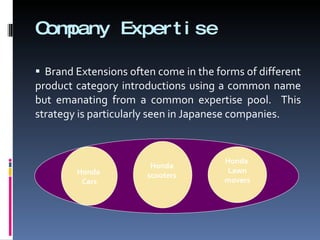
Company Expertise Brand Extensions often come in the forms of different product category introductions using a common name but emanating from a common expertise pool.  This strategy is particularly seen in Japanese companies. Honda  Cars Honda  Lawn movers Honda  scooters
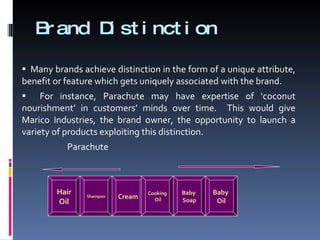
Brand Distinction Many brands achieve distinction in the form of a unique attribute, benefit or feature which gets uniquely associated with the brand. For instance, Parachute may have expertise of ‘coconut nourishment’ in customers’ minds over time.  This would give Marico Industries, the brand owner, the opportunity to launch a variety of products exploiting this distinction. Parachute Hair Oil Shampoo Cream Cooking Oil Baby  Soap Baby  Oil
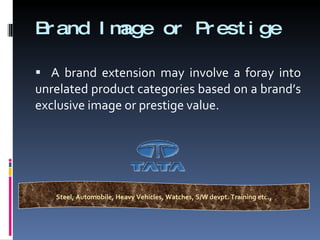
Brand Image or Prestige A brand extension may involve a foray into unrelated product categories based on a brand’s exclusive image or prestige value. Steel, Automobile, Heavy Vehicles, Watches, S/W devpt. Training etc .,
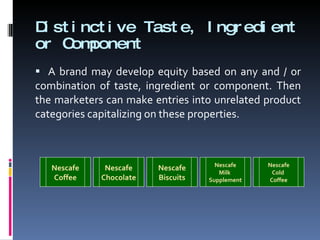
Distinctive Taste, Ingredient or Component A brand may develop equity based on any and / or combination of taste, ingredient or component. Then the marketers can make entries into unrelated product categories capitalizing on these properties. Nescafe Coffee Nescafe Chocolate Nescafe Biscuits Nescafe Milk  Supplement Nescafe Cold  Coffee
Brand Extendibility
Extensions………………. Extensions are not simple as they appear to a layman. Consumers reject extensions when they do not make sense. Brand extension is not a physical act of merging two products. It is a tough process involving marrying two cognitive or perceptual concepts in order to create a consistent entity. Therefore, it must begin with exploring the brand in a prospect’s mind.
Exploring the brand involves seeking answers to the following questions……. What is a brand’s awareness level? What are its recall and recognition levels? What are different attributes associated with a brand? What benefit associations are connected with a brand? What are a brand’s personality associations? What are the symbols associated with the brand? What are a brand’s user associations? What is the perceived essence of the brand? What is a brand’s philosophy?
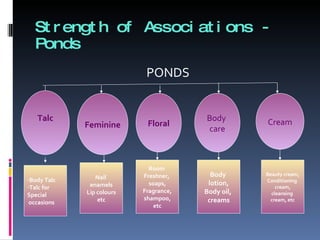
Strength of Associations - Ponds PONDS Talc Feminine Floral Body  care Cream Body Talc Talc for  Special occasions Nail  enamels Lip colours etc Room  Freshner,  soaps, Fragrance, shampoo,  etc Body  lotion, Body oil,  creams Beauty cream, Conditioning  cream, cleansing  cream, etc
Making an Extension successful Aaker & Keller proposed certain assumptions about consumer behavior which are fundamentally responsible for the success of a brand extension. The parent brand enjoys positive beliefs and favorable attitude in customers memory. It is these pre-existing beliefs and attitudes which help in the formation of positive beliefs and favorable attitude toward the brand extension. The negative associations are not transferred to the brand extensions, also these are not created by the brand extension.
 

Epgp bm brand_extensions_ppt

  • 1.
    BRAND EXTENSIONS ParticipantsMandeepak Singh Nitin Fernandes Rajendra Inani Vijay Anand Rajendran Strategic Brand Management – Prof Ashish Sadh
  • 2.
    Brand extension : application of a popular brand name to a new product in an unrelated product category Line extensions refers to new sizes, styles, or related products Brand licensing : practice allowing other companies to use a brand name in exchange for a payment 12-
  • 3.
    New Product PlanningAs a firm’s offerings enter the maturity and decline stages of the product life cycle, it must add new items to continue to prosper Alternative Product Development Strategies 12-
  • 4.
    What is aBrand Extension? Established brands are assets Marketers try and leverage these assets The process of using the brand name on another product is known as extension Line Extensions (Lifebuoy Liquid Soap) Category Extensions (Nokia Laptops) Stretch Extensions (Intel Celeron)
  • 5.
    Why Brand Extensions?New products a driver of growth for a company Developing and launching requires millions Yet 9 out of 10 new products FAIL Can be perceived as old and staid if no new launches Overdependence on any one brand could be dangerous Parent brand may only appeal to a segment Brand is seen as boring and lacking variety Allows the competition to flank
  • 6.
    Why Brand Extensions?Helps cut down costs Can enhance customer’s positive brand perception Rejuvenates parent brand Reduces overdependence on a single product Category/Stretch extensions help bring in new users Cater to different needs of segments / existing users Can also be a tool for blocking competition
  • 7.
    How do consumersevaluate? Fit between Parent & Extension Fit in terms of ‘Core Differentiation’ FIT: Coke & Diet Coke (Taste) MISFIT: Pepsi & Crystal Pepsi (Color) Extension must remain true to the core values of the parent brand
  • 8.
    How much toextend? Equal borrow & build with the parent brand Harley: Clothing, Tatoos but not Energy Drink FAL: FAL for Men but not Perfect Radiance Pepsodent: Cavity, Plaque but not Fresh Breath Drivers Frame of Reference (McDonald’s – Fast Food) POD (Oral-B Toffee) RTB (Gits – Pasta)
  • 9.
    Moving Down Why?Competition Private Labels Challenge Protecting the Brand Distinguish the Extension Sub-Branding Product
  • 10.
    Moving Up Why?Potential User Base Higher Margins Challenge Managing Credibility Sub-Brand with a Descriptor (Kodak GOLD)
  • 11.
    Risks in ExtensionLine Extension: Over choice & Confusion Dilution of Parent Equity: New Maggi, Coke Vanilla Use of Sub-Brand gives cushion: Sony Walkman Cannibalization of Parent (Space & SOM)
  • 12.
    Extensions in PortfolioCannibalization Distinct Role Incremental Share Different Needs
  • 13.
    Key Questions Positioningof Parent Brand? What am I using from the positioning? Is that valued by the consumer in the new category in which I am extending? Does the consumer see a connect with the parent? What will be the impact on the parent?
  • 14.
    LINE EXTENSIONS Theproduct line is now far more representative of customers’ varying quantity needs. It suggests the presence of usage segmentation. Customers differs in terms of their usage quantities. The brand has to fill the whole spectrum with products as per the needs of various segments.
  • 15.
    Example Bisleriis the pioneering brand in the mineral water category. Originally, Bisleri used to come in a one litre bottle. But recently, Bisleri has exhibited a spate of innovations. The brand launched bottles of different sizes and quantities. The Bisleri portfolio now includes one litre, 1.2 litre, 1.5 litre and 5 litre bottles.
  • 16.
    Line Extension strategiesProduct Sizes Bisleri 1.1 ltr Bisleri 5 ltr Bisleri 1.5 ltr Bisleri 1.2 ltr Bisleri .5 ltr
  • 17.
    Colour Etc., PantenePink Pantene Black Pantene White Flavours Ingredient Rasna Orange Rasna Mango Rasa Rose , etc Colgate gel Colgate Herbal Colgate Salt etc.,
  • 18.
    Form Vim Liquid Vim Powder Vim Bar
  • 19.
    Why Line Extensions?In most of the product categories including fast moving consumer goods, consumer durables and services, line extension has been the name of the game. It is an expansionist move. The firms seem to seek growth more vigorously.
  • 20.
    Nine prominent reasonsCustomer Segmentation Customer need for variety Pricing Breadth Capacity Utilization Quick gains Competitive Reasons Trade Demands Counter Competition Image Benefits
  • 21.
    Line Extension RisksThere are several dangers associated with line extensions. Line Confusion - Marketers sometimes add products to their line without sound logic and reasoning, without any clear role and goal. This may confuse the customers and the retailers and will affect the brand’s owner company in the long run.
  • 22.
    Line Extension Risks…Encourage Variety seeking – Brand loyalty is every marketers dream. By line extension, customers practice and become the habitant of variety seeking. Hence it influence brand switching behaviors. The loyalty is thus weakened.
  • 23.
    Line Extension RisksSuccess Myopia – An idea may be a grand enough to be converted into a full-fledged independent brand. But the lure of extension seems to be so strong that the ideas are brought into the market as line extensions. This implies loss of a winning asset in the long-term.
  • 24.
    Line Extension Risks…Strained relations - When the lines expand, marketers tend to pressurize their trade partners such as wholesalers and retailers to carry the complete line in accordance with their wishes. The pressure appears to be applied more intensely at the retail level. The marketers seek adequate shelf space, promotion and information. But at the retailers end, it brings confusion and chaos. The result is the strained relations between the marketer and the retailer.
  • 25.
    Line Extension TrapWhy do firms jump on to line extension bandwagon? When customers prefer a brand, they would be just as willing to buy a different product carrying the same name. What appears to be logical to the managers performing these adventures tends to be illogical in the perception of customers. This is the reason why line extensions do not create mega successes.
  • 26.
    Line Extension TrapLine extensions do not work because they tend to go against the fundamental aspect of positioning. The core brand holds a strong position inside the prospect’s mind. Line extensions tend to educate customers that product and brand are two different things. It is a fallacy that a brand is just a name that can be put on any product. This is a great mistake. It undermines and destroys the brand in a prospect’s mind.
  • 27.
    BRAND EXTENSIONS Usingan existing brand name to promote a product in a different category, is Brand Extension. The key difference between line and brand extension is the product category. In line extension the product category remains constant whereas in brand extensions product category is a variable.
  • 28.
    EXAMPLE Ponds - Cold cream, Toilet soap Shampoo, Tooth paste, Moisturizing lotion, Talc & Face wash. LG – Television, Refrigerators, Computer monitors, Microwaves, Air Conditioners, Washing Machines & Mobile phones. Park Avenue – Shirts, Shaving cream, Jeans, Belts, Perfumes, Soap & Razor.
  • 29.
  • 30.
  • 31.
  • 32.
    Types of ExtensionsProduct form extension – A product launched in a different form usually means line extension, but if a different product form constitutes an entirely different product category. Example: Amul milk Amul Condensed milk Real Juices Real Juice Concentrate
  • 33.
    Types of ExtensionsCompanion Product – The idea here is to capitalize 0n product complementarities. The consumer may view both the products jointly. Example : Colgate Dental Cream Colgate Tooth Brush Gillette Razors Gillette Shave forms Gillette After Shave
  • 34.
    Customer Franchise Amarketer may extend a product range in order to meet the needs of a specific customer group. J & J Baby Talc J & J Baby Oil J & J Baby Cream J & J Baby Shampoo J & J Baby Diapers
  • 35.
    Company Expertise BrandExtensions often come in the forms of different product category introductions using a common name but emanating from a common expertise pool. This strategy is particularly seen in Japanese companies. Honda Cars Honda Lawn movers Honda scooters
  • 36.
    Brand Distinction Manybrands achieve distinction in the form of a unique attribute, benefit or feature which gets uniquely associated with the brand. For instance, Parachute may have expertise of ‘coconut nourishment’ in customers’ minds over time. This would give Marico Industries, the brand owner, the opportunity to launch a variety of products exploiting this distinction. Parachute Hair Oil Shampoo Cream Cooking Oil Baby Soap Baby Oil
  • 37.
    Brand Image orPrestige A brand extension may involve a foray into unrelated product categories based on a brand’s exclusive image or prestige value. Steel, Automobile, Heavy Vehicles, Watches, S/W devpt. Training etc .,
  • 38.
    Distinctive Taste, Ingredientor Component A brand may develop equity based on any and / or combination of taste, ingredient or component. Then the marketers can make entries into unrelated product categories capitalizing on these properties. Nescafe Coffee Nescafe Chocolate Nescafe Biscuits Nescafe Milk Supplement Nescafe Cold Coffee
  • 39.
  • 40.
    Extensions………………. Extensions arenot simple as they appear to a layman. Consumers reject extensions when they do not make sense. Brand extension is not a physical act of merging two products. It is a tough process involving marrying two cognitive or perceptual concepts in order to create a consistent entity. Therefore, it must begin with exploring the brand in a prospect’s mind.
  • 41.
    Exploring the brandinvolves seeking answers to the following questions……. What is a brand’s awareness level? What are its recall and recognition levels? What are different attributes associated with a brand? What benefit associations are connected with a brand? What are a brand’s personality associations? What are the symbols associated with the brand? What are a brand’s user associations? What is the perceived essence of the brand? What is a brand’s philosophy?
  • 42.
    Strength of Associations- Ponds PONDS Talc Feminine Floral Body care Cream Body Talc Talc for Special occasions Nail enamels Lip colours etc Room Freshner, soaps, Fragrance, shampoo, etc Body lotion, Body oil, creams Beauty cream, Conditioning cream, cleansing cream, etc
  • 43.
    Making an Extensionsuccessful Aaker & Keller proposed certain assumptions about consumer behavior which are fundamentally responsible for the success of a brand extension. The parent brand enjoys positive beliefs and favorable attitude in customers memory. It is these pre-existing beliefs and attitudes which help in the formation of positive beliefs and favorable attitude toward the brand extension. The negative associations are not transferred to the brand extensions, also these are not created by the brand extension.
  • 44.