CHAPTER 22 Antitrust Law
What is a monopoly? What is market power? How do these concepts relate to each other? What type of activity is prohibited by  §§ 1 and 2 of the Sherman Act? What are the four major provisions of the Clayton Act and what types of activities do these provisions prohibit? What federal agencies enforce the federal antitrust laws? What are four activities that are exempt from antitrust laws? Learning Objectives
Introduction Common law actions intended to limit restraints on trade and regulate economic competition. Embodied almost entirely in: The Sherman Antitrust Act of 1890. The Clayton Act of 1914.
The Sherman Antitrust Act Section 1 and 2 contain the main provisions of the Sherman Act. Section 1:  Requires two or more persons, as a person cannot contract, combine, or conspire alone. Concerned with finding an agreement. Section 2:  Applies both to an individual person and to several people, because it refers to every person. Deals with the structure of monopolies in the marketplace.
Section 1 of the Sherman Act   Section 1 regulates what are called “horizontal” and “vertical” restraints.  Per se  violations vs. the Rule of Reason. Per se are blatant and substantially anticompetitive. Rule of reason agreements do not  unreasonably  restrain trade.
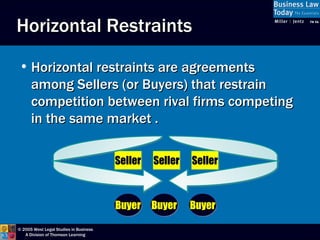
Horizontal Restraints Horizontal restraints are agreements among Sellers (or Buyers) that restrain competition between rival firms competing in the same market . Seller Buyer Seller Seller Buyer Buyer
Price Fixing An agreement between competing firms in the market to set an established price for the goods or services they offer. Price fixing is a per se violation of the Act. In re Cardizem CD Antitrust Litigation  (2003).
Group Boycotts Agreement between two or more sellers to refuse to deal with a particular person or firm. Group boycotts are  per se  violations of the Act.
Trade Associations are industry specific organizations created to provide for the exchange of information, representation of the business interests before governmental bodies, advertising campaigns, and setting of regulatory standards to govern their industry or profession. Rule of reason is applied to determine if a violation of the Act has occurred.  Trade Associations
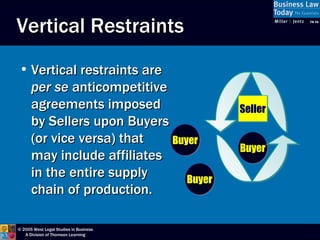
Vertical Restraints Vertical restraints are  per se  anticompetitive agreements imposed by Sellers upon Buyers (or vice versa) that may include affiliates in the entire supply chain of production. Buyer Seller Buyer Buyer
Vertical Restraints Agreements between firms at different levels of the manufacturing and distribution process. Vertical restraints may restrain competition among firms that occupy the same level in chain. Vertical restraints that significantly affect competition may be  per se  violations.
Territorial and Customer Restrictions Imposed by manufacturers on the sellers of the products, to insulate dealers from direct competition with each other. Territorial and customer restrictions are judged under the rule of reason.
Resale Price  Maintenance Agreements An agreements between a manufacturer and a  distributor or retailer in which the manufacturer specifies the retail price at which retailers must sell products furnished by the manufacturer or distributor. This is a type of vertical restraint and is normally a per se violation.
Refusals to Deal Unlike a group boycott, a refusal to deal is an action by one firm against another, and this is usually legal, unless: the firm refusing to deal has, or is likely to acquire, monopoly power,  and the refusal is likely to have an anticompetitive effect on a particular market.
Section 2 of the Sherman Antitrust Act deals with: Monopolization. Attempts to monopolize. Predatory pricing. Attempt by a firm to drive its competitor from the market by selling its product at prices substantially  below  the normal costs of production. Section 2 of the  Sherman Antitrust Act
Monopolization Monopolization in violation of the act requires two elements: The possession of monopoly power  and The willful acquisition and maintenance of the power.
Monopoly Power Exists when one firm has sufficient market power to control prices and exclude competition. Market power is often assessed by the use of the Market-Share Test. As a rule of thumb, if a firm has 70% or more of a relevant market, it is regarded as having monopoly power.
The Intent Requirement The intent to monopolize is difficult to prove. Intent may be inferred from evidence that the firm had monopoly power and engaged in anticompetitive behavior. United States v. Microsoft   Corp.  (2001).
Attempts to Monopolize Firm actions are scrutinized to determine whether they were intended to exclude competitors and garner monopoly power and had a “dangerous” probability of success.
The Clayton Act The Clayton Act deals with: Price Discrimination. Exclusionary Practices. Mergers. Interlocking Directorates.
Price discrimination is the charging of different prices to competing buyers for identical goods. Exceptions: Charge of lower price was temporary and in good faith to meet another seller’s equally low price to the buyer’s competitor. A particular buyer’s purchases saved the seller costs in producing and selling the good. Section 2--Price Discrimination
Exclusive Dealing Contracts. A contract under which a seller forbids a buyer to purchase products from the seller’s competitors.  Prohibited if the effect of the contract is to  “substantially lessen competition or tend to create a monopoly.” Tying Arrangements. The conditioning of the sale of a product on the buyer’s agreement to purchase another product produced or distributed by the same seller. Section 3--Exclusionary Practices
Horizontal  Mergers occur between firms at the same level in the production and distribution chain. Vertical  Mergers occur between firms at different levels in the production and distribution chain. Section 7--Mergers
Mergers Conglomerate  Mergers occur when a firm seeks to: Extend its product into a new market by merging with a firm in that market. Extend its product line by merging with a firm already producing that product. Diversify by acquiring a firm that deals in unrelated products.
Interlocking Directorates Occurs when an individual serves on the board of directors of two or more competing companies simultaneously. These are prohibited if the two firms meet certain size requirements.
U.S. Department of Justice. The  Federal Trade Commission  enforces the FTCA. FTCA provides that: “Unfair methods of competition in or affecting commerce, and unfair or deceptive acts or practices in or affecting commerce are hereby declared illegal.” Enforcement of Antitrust Laws
Private Actions Private party injured under the Sherman or Clayton Act can: Sue for damages and attorneys fees. Plaintiff must prove: Antitrust violation either caused or was a substantial factor in plaintiff’s injury, and the unlawful actions of Defendant affected Plaintiff’s business protected by antitrust laws. Treble Damages. Paper Systems v. Nippon Paper  (2002).
Most statutory exemptions to the antitrust laws apply to the following areas: Labor. Agricultural associations and fisheries. Insurance. Foreign trade. Professional baseball. Cooperative research and production Joint efforts y businesspersons to obtain legislative or executive action. And Others. Exemptions from Antitrust Laws

Chapter 22

  • 1.
  • 2.
    What is amonopoly? What is market power? How do these concepts relate to each other? What type of activity is prohibited by §§ 1 and 2 of the Sherman Act? What are the four major provisions of the Clayton Act and what types of activities do these provisions prohibit? What federal agencies enforce the federal antitrust laws? What are four activities that are exempt from antitrust laws? Learning Objectives
  • 3.
    Introduction Common lawactions intended to limit restraints on trade and regulate economic competition. Embodied almost entirely in: The Sherman Antitrust Act of 1890. The Clayton Act of 1914.
  • 4.
    The Sherman AntitrustAct Section 1 and 2 contain the main provisions of the Sherman Act. Section 1: Requires two or more persons, as a person cannot contract, combine, or conspire alone. Concerned with finding an agreement. Section 2: Applies both to an individual person and to several people, because it refers to every person. Deals with the structure of monopolies in the marketplace.
  • 5.
    Section 1 ofthe Sherman Act Section 1 regulates what are called “horizontal” and “vertical” restraints. Per se violations vs. the Rule of Reason. Per se are blatant and substantially anticompetitive. Rule of reason agreements do not unreasonably restrain trade.
  • 6.
    Horizontal Restraints Horizontalrestraints are agreements among Sellers (or Buyers) that restrain competition between rival firms competing in the same market . Seller Buyer Seller Seller Buyer Buyer
  • 7.
    Price Fixing Anagreement between competing firms in the market to set an established price for the goods or services they offer. Price fixing is a per se violation of the Act. In re Cardizem CD Antitrust Litigation (2003).
  • 8.
    Group Boycotts Agreementbetween two or more sellers to refuse to deal with a particular person or firm. Group boycotts are per se violations of the Act.
  • 9.
    Trade Associations areindustry specific organizations created to provide for the exchange of information, representation of the business interests before governmental bodies, advertising campaigns, and setting of regulatory standards to govern their industry or profession. Rule of reason is applied to determine if a violation of the Act has occurred. Trade Associations
  • 10.
    Vertical Restraints Verticalrestraints are per se anticompetitive agreements imposed by Sellers upon Buyers (or vice versa) that may include affiliates in the entire supply chain of production. Buyer Seller Buyer Buyer
  • 11.
    Vertical Restraints Agreementsbetween firms at different levels of the manufacturing and distribution process. Vertical restraints may restrain competition among firms that occupy the same level in chain. Vertical restraints that significantly affect competition may be per se violations.
  • 12.
    Territorial and CustomerRestrictions Imposed by manufacturers on the sellers of the products, to insulate dealers from direct competition with each other. Territorial and customer restrictions are judged under the rule of reason.
  • 13.
    Resale Price Maintenance Agreements An agreements between a manufacturer and a distributor or retailer in which the manufacturer specifies the retail price at which retailers must sell products furnished by the manufacturer or distributor. This is a type of vertical restraint and is normally a per se violation.
  • 14.
    Refusals to DealUnlike a group boycott, a refusal to deal is an action by one firm against another, and this is usually legal, unless: the firm refusing to deal has, or is likely to acquire, monopoly power, and the refusal is likely to have an anticompetitive effect on a particular market.
  • 15.
    Section 2 ofthe Sherman Antitrust Act deals with: Monopolization. Attempts to monopolize. Predatory pricing. Attempt by a firm to drive its competitor from the market by selling its product at prices substantially below the normal costs of production. Section 2 of the Sherman Antitrust Act
  • 16.
    Monopolization Monopolization inviolation of the act requires two elements: The possession of monopoly power and The willful acquisition and maintenance of the power.
  • 17.
    Monopoly Power Existswhen one firm has sufficient market power to control prices and exclude competition. Market power is often assessed by the use of the Market-Share Test. As a rule of thumb, if a firm has 70% or more of a relevant market, it is regarded as having monopoly power.
  • 18.
    The Intent RequirementThe intent to monopolize is difficult to prove. Intent may be inferred from evidence that the firm had monopoly power and engaged in anticompetitive behavior. United States v. Microsoft Corp. (2001).
  • 19.
    Attempts to MonopolizeFirm actions are scrutinized to determine whether they were intended to exclude competitors and garner monopoly power and had a “dangerous” probability of success.
  • 20.
    The Clayton ActThe Clayton Act deals with: Price Discrimination. Exclusionary Practices. Mergers. Interlocking Directorates.
  • 21.
    Price discrimination isthe charging of different prices to competing buyers for identical goods. Exceptions: Charge of lower price was temporary and in good faith to meet another seller’s equally low price to the buyer’s competitor. A particular buyer’s purchases saved the seller costs in producing and selling the good. Section 2--Price Discrimination
  • 22.
    Exclusive Dealing Contracts.A contract under which a seller forbids a buyer to purchase products from the seller’s competitors. Prohibited if the effect of the contract is to “substantially lessen competition or tend to create a monopoly.” Tying Arrangements. The conditioning of the sale of a product on the buyer’s agreement to purchase another product produced or distributed by the same seller. Section 3--Exclusionary Practices
  • 23.
    Horizontal Mergersoccur between firms at the same level in the production and distribution chain. Vertical Mergers occur between firms at different levels in the production and distribution chain. Section 7--Mergers
  • 24.
    Mergers Conglomerate Mergers occur when a firm seeks to: Extend its product into a new market by merging with a firm in that market. Extend its product line by merging with a firm already producing that product. Diversify by acquiring a firm that deals in unrelated products.
  • 25.
    Interlocking Directorates Occurswhen an individual serves on the board of directors of two or more competing companies simultaneously. These are prohibited if the two firms meet certain size requirements.
  • 26.
    U.S. Department ofJustice. The Federal Trade Commission enforces the FTCA. FTCA provides that: “Unfair methods of competition in or affecting commerce, and unfair or deceptive acts or practices in or affecting commerce are hereby declared illegal.” Enforcement of Antitrust Laws
  • 27.
    Private Actions Privateparty injured under the Sherman or Clayton Act can: Sue for damages and attorneys fees. Plaintiff must prove: Antitrust violation either caused or was a substantial factor in plaintiff’s injury, and the unlawful actions of Defendant affected Plaintiff’s business protected by antitrust laws. Treble Damages. Paper Systems v. Nippon Paper (2002).
  • 28.
    Most statutory exemptionsto the antitrust laws apply to the following areas: Labor. Agricultural associations and fisheries. Insurance. Foreign trade. Professional baseball. Cooperative research and production Joint efforts y businesspersons to obtain legislative or executive action. And Others. Exemptions from Antitrust Laws