



COMPETITION LAW Geetika Anand 26.02.2008
RUNTHROUGH OF CONTENTS INTRODUCTION  COMPETITION ACT 2002  COMPETITION (AMENDMENT) ACT 2007
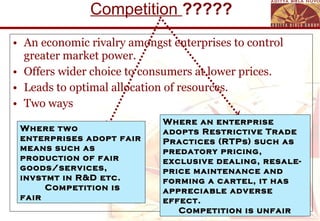
Competition  ????? An economic rivalry amongst enterprises to control greater market power. Offers wider choice to consumers at lower prices. Leads to optimal allocation of resources. Two ways Where two enterprises adopt fair means such as production of fair goods/services, invstmt in R&D etc. Competition is fair Where an enterprise adopts Restrictive Trade Practices (RTPs) such as predatory pricing, exclusive dealing, resale-price maintenance and forming a cartel, it has appreciable adverse effect. Competition is unfair
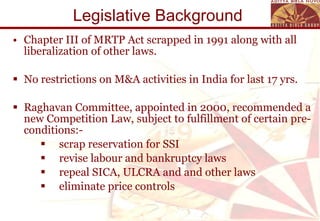
Legislative Background  Chapter III of MRTP Act scrapped in 1991 along with all liberalization of other laws. No restrictions on M&A activities in India for last 17 yrs. Raghavan Committee, appointed in 2000, recommended a new Competition Law, subject to fulfillment of certain pre-conditions:- scrap reservation for SSI revise labour and bankruptcy laws  repeal SICA, ULCRA and and other laws eliminate price controls
COMPETITION ACT 2002
Background Objectives : Prevention of  practices having adverse effect on competition Promotion & sustaining competition in markets Protect the interest of the consumers Ensure freedom of trade carried on by the other participants in markets, in India.
IMPORTANT PROVISIONS Prohibition on : Anti-competitive agreements  (Section 3) Abuse of dominant position  (Section 4) Regulation of Combinations  (Sections 5 & 6)
Anti Competition Agreements (S. 3) Act prohibits all such agreements which cause or are likely to cause an appreciable adverse effect on competition Adverse Effect, which : Determines purchase or sales prices Limits or controls production, supply, markets,  Shares the market or source of production or provision of services  Bid rigging or collusive bidding
ABUSE OF DOMINANCE (S. 4) Dominance is a position of strength which enables an enterprise to operate independently of competitive pressure and to appreciably affect the relevant market, competition and consumers in its favour.  Dominance per se is not bad, but the abuse of dominance is prohibited. Abuse of Dominance arises if an enterprise: 1) Imposes unfair/Discriminatory purchase or sale prices  2) Limits production, mkts or technical dvlpmnt 3) Denies mkt access 4) Concludes contracts, subject to obligations having no connection 5) Uses dominance to move into or protect other mkts.
PREDATORY PRICING Predatory pricing is seen as an aspect of abuse of dominance. “ Predatory Pricing” means the sale of goods or provision of services, at a price which is below the cost,, with a view to reduce competition or eliminate the competitors. This narrow definition may hamper all introductory pricing initiatives. The distinction between predatory behavior and competitive pricing is very thin and not easily ascertainable. The yardstick for determination of cost is unclear. Average variable cost is frequently used as an indicator , which is not conclusive. Whether the cost audit report under Section 209 of the Co’s Act or the industry average or the break even cost of an enterprise or economies of scale is to be taken as the yardstick in determination of ‘cost’ is not clear in the regulations. Group synergy and operational efficiency should not get penalized.
Regulation of combinations (S. 5 & 6) Combination prohibited if it causes or is likely to cause appreciable adverse effect on competition within the relevant market in India Mandatory pre-merger scrutiny  – introduced vide Amendment  Act of 2007 Notify details of proposed combination within 30 days of: BOD approval of merger/amalgamation; Execution of agreements for acquisition of shares, voting rights, assets or control
Regulation of combinations (S. 5 & 6) Definition: very wide - includes Direct or indirect acquisition of shares, voting rights or assets Acquisition of control Mergers or amalgamations Size of Acquisition immaterial. Mandatory notification subject to asset value/turnover thresholds; prescribed for  Parties (individual enterprise) to the combination and  ‘ Group’ to which acquired entity would belong after combination
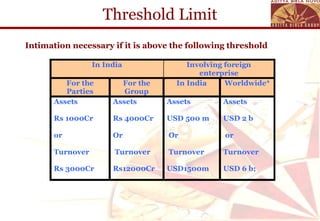
Threshold Limit Intimation necessary if it is above the following threshold
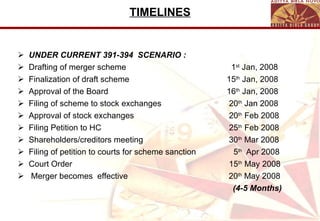
TIMELINES UNDER CURRENT 391-394  SCENARIO : Drafting of merger scheme    1 st  Jan, 2008 Finalization of draft scheme  15 th  Jan, 2008 Approval of the Board  16 th  Jan, 2008 Filing of scheme to stock exchanges   20 th  Jan 2008 Approval of stock exchanges    20 th  Feb 2008 Filing Petition to HC   25 th  Feb 2008 Shareholders/creditors meeting   30 th  Mar 2008 Filing of petition to courts for scheme sanction   5 th   Apr 2008 Court Order   15 th  May 2008 Merger becomes  effective   20 th  May 2008 (4-5 Months)
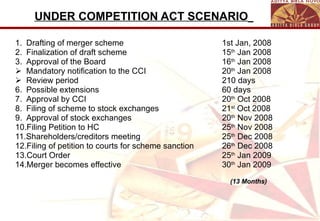
UNDER COMPETITION ACT SCENARIO   Drafting of merger scheme  1st Jan, 2008 2. Finalization of draft scheme 15 th  Jan 2008 3. Approval of the Board 16 th  Jan 2008 Mandatory notification to the CCI 20 th  Jan 2008  Review period 210 days 6. Possible extensions  60 days 7. Approval by CCI  20 th  Oct 2008 8. Filing of scheme to stock exchanges 21 st  Oct 2008 9. Approval of stock exchanges  20 th  Nov 2008 10.Filing Petition to HC 25 th  Nov 2008 11.Shareholders/creditors meeting 25 th  Dec 2008 12.Filing of petition to courts for scheme sanction 26 th  Dec 2008 13.Court Order 25 th  Jan 2009 14.Merger becomes effective 30 th  Jan 2009 (13 Months)
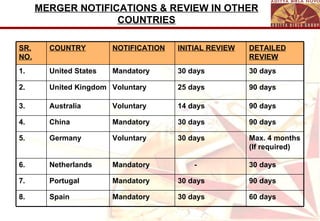
MERGER NOTIFICATIONS & REVIEW IN OTHER COUNTRIES 90 days 14 days Voluntary Australia 3. 60 days 30 days  Mandatory Spain 8. 90 days 30 days Mandatory Portugal 7. 30 days - Mandatory Netherlands 6. Max. 4 months (If required) 30 days Voluntary Germany 5. 90 days 30 days Mandatory China 4. 90 days 25 days Voluntary United Kingdom 2. 30 days 30 days Mandatory United States 1. DETAILED REVIEW INITIAL REVIEW NOTIFICATION COUNTRY SR. NO.
THE COMPETITION (AMENDMENT) ACT 2007
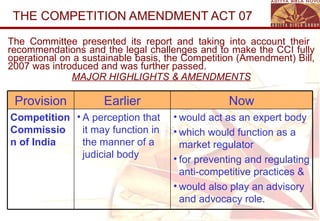
THE COMPETITION AMENDMENT ACT 07 The Committee presented its report and taking into account their  recommendations and the legal challenges and to make the CCI fully operational on a sustainable basis, the Competition (Amendment) Bill, 2007 was introduced and was further passed.  MAJOR HIGHLIGHTS & AMENDMENTS would act as an expert body which would function as a market regulator  for preventing and regulating anti-competitive practices &  would also play an advisory and advocacy role. A perception that it may function in the manner of a judicial body Competition Commission of India Now Earlier Provision
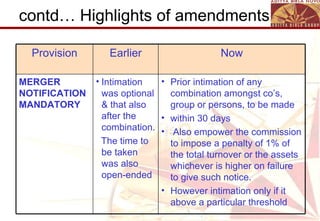
contd… Highlights of amendments Prior intimation of any combination amongst co’s, group or persons, to be made  within 30 days  Also empower the commission to impose a penalty of 1% of the total turnover or the assets whichever is higher on failure to give such notice. However intimation only if it above a particular threshold  Intimation was optional & that also after the combination.  The time to be taken was also open-ended MERGER NOTIFICATION MANDATORY Now Earlier Provision
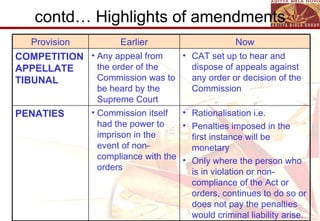
contd… Highlights of amendments CAT set up to hear and dispose of appeals against any order or decision of the Commission Any appeal from the order of the Commission was to be heard by the Supreme Court COMPETITION APPELLATE TIBUNAL Rationalisation i.e. Penalties imposed in the first instance will be monetary Only where the person who is in violation or non-compliance of the Act or orders, continues to do so or does not pay the penalties would criminal liability arise.  Commission itself had the power to imprison in the event of non-compliance with the orders PENATIES Now Earlier Provision
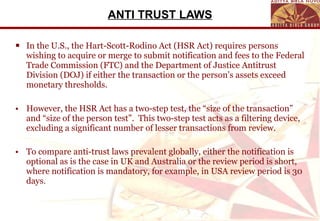
ANTI TRUST LAWS In the U.S., the Hart-Scott-Rodino Act (HSR Act) requires persons wishing to acquire or merge to submit notification and fees to the Federal Trade Commission (FTC) and the Department of Justice Antitrust Division (DOJ) if either the transaction or the person’s assets exceed monetary thresholds.   However, the HSR Act has a two-step test, the “size of the transaction” and “size of the person test”.  This two-step test acts as a filtering device, excluding a significant number of lesser transactions from review. To compare anti-trust laws prevalent globally, either the notification is optional as is the case in UK and Australia or the review period is short, where notification is mandatory, for example, in USA review period is 30 days .
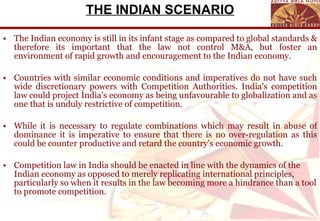
THE INDIAN SCENARIO The Indian economy is still in its infant stage as compared to global standards & therefore its important that the law not control M&A, but foster an environment of rapid growth and encouragement to the Indian economy. Countries with similar economic conditions and imperatives do not have such wide discretionary powers with Competition Authorities.  India’s competition law could project India’s economy as being unfavourable to globalization and as one that is unduly restrictive of competition. While it is necessary to regulate combinations which may result in abuse of dominance it is imperative to ensure that there is no over-regulation as this could be counter productive and retard the country’s economic growth. Competition law in India should be enacted in line with the dynamics of the Indian economy as opposed to merely replicating international principles, particularly so when it results in the law becoming more a hindrance than a tool to promote competition.
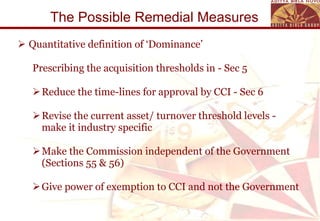
The Possible Remedial Measures  Quantitative definition of ‘Dominance’ Prescribing the acquisition thresholds in - Sec 5 Reduce the time-lines for approval by CCI - Sec 6  Revise the current asset/ turnover threshold levels - make it industry specific  Make the Commission independent of the Government (Sections 55 & 56) Give power of exemption to CCI and not the Government
The Possible Remedial Measures  Notify Sections 5 & 6 only after the law is amended and CCI is well equipped  Exempt cross-border M&A with no economic impact in the Indian Market Provide a ‘negative list’ of industrial sectors for mandatory notification, other industries to be exempted
THANK YOU

Competition Law - status quo

  • 1.
    COMPETITION LAW GeetikaAnand 26.02.2008
  • 2.
    RUNTHROUGH OF CONTENTSINTRODUCTION COMPETITION ACT 2002 COMPETITION (AMENDMENT) ACT 2007
  • 3.
    Competition ?????An economic rivalry amongst enterprises to control greater market power. Offers wider choice to consumers at lower prices. Leads to optimal allocation of resources. Two ways Where two enterprises adopt fair means such as production of fair goods/services, invstmt in R&D etc. Competition is fair Where an enterprise adopts Restrictive Trade Practices (RTPs) such as predatory pricing, exclusive dealing, resale-price maintenance and forming a cartel, it has appreciable adverse effect. Competition is unfair
  • 4.
    Legislative Background Chapter III of MRTP Act scrapped in 1991 along with all liberalization of other laws. No restrictions on M&A activities in India for last 17 yrs. Raghavan Committee, appointed in 2000, recommended a new Competition Law, subject to fulfillment of certain pre-conditions:- scrap reservation for SSI revise labour and bankruptcy laws repeal SICA, ULCRA and and other laws eliminate price controls
  • 5.
  • 6.
    Background Objectives :Prevention of practices having adverse effect on competition Promotion & sustaining competition in markets Protect the interest of the consumers Ensure freedom of trade carried on by the other participants in markets, in India.
  • 7.
    IMPORTANT PROVISIONS Prohibitionon : Anti-competitive agreements (Section 3) Abuse of dominant position (Section 4) Regulation of Combinations (Sections 5 & 6)
  • 8.
    Anti Competition Agreements(S. 3) Act prohibits all such agreements which cause or are likely to cause an appreciable adverse effect on competition Adverse Effect, which : Determines purchase or sales prices Limits or controls production, supply, markets, Shares the market or source of production or provision of services Bid rigging or collusive bidding
  • 9.
    ABUSE OF DOMINANCE(S. 4) Dominance is a position of strength which enables an enterprise to operate independently of competitive pressure and to appreciably affect the relevant market, competition and consumers in its favour. Dominance per se is not bad, but the abuse of dominance is prohibited. Abuse of Dominance arises if an enterprise: 1) Imposes unfair/Discriminatory purchase or sale prices 2) Limits production, mkts or technical dvlpmnt 3) Denies mkt access 4) Concludes contracts, subject to obligations having no connection 5) Uses dominance to move into or protect other mkts.
  • 10.
    PREDATORY PRICING Predatorypricing is seen as an aspect of abuse of dominance. “ Predatory Pricing” means the sale of goods or provision of services, at a price which is below the cost,, with a view to reduce competition or eliminate the competitors. This narrow definition may hamper all introductory pricing initiatives. The distinction between predatory behavior and competitive pricing is very thin and not easily ascertainable. The yardstick for determination of cost is unclear. Average variable cost is frequently used as an indicator , which is not conclusive. Whether the cost audit report under Section 209 of the Co’s Act or the industry average or the break even cost of an enterprise or economies of scale is to be taken as the yardstick in determination of ‘cost’ is not clear in the regulations. Group synergy and operational efficiency should not get penalized.
  • 11.
    Regulation of combinations(S. 5 & 6) Combination prohibited if it causes or is likely to cause appreciable adverse effect on competition within the relevant market in India Mandatory pre-merger scrutiny – introduced vide Amendment Act of 2007 Notify details of proposed combination within 30 days of: BOD approval of merger/amalgamation; Execution of agreements for acquisition of shares, voting rights, assets or control
  • 12.
    Regulation of combinations(S. 5 & 6) Definition: very wide - includes Direct or indirect acquisition of shares, voting rights or assets Acquisition of control Mergers or amalgamations Size of Acquisition immaterial. Mandatory notification subject to asset value/turnover thresholds; prescribed for Parties (individual enterprise) to the combination and ‘ Group’ to which acquired entity would belong after combination
  • 13.
    Threshold Limit Intimationnecessary if it is above the following threshold
  • 14.
    TIMELINES UNDER CURRENT391-394 SCENARIO : Drafting of merger scheme 1 st Jan, 2008 Finalization of draft scheme 15 th Jan, 2008 Approval of the Board 16 th Jan, 2008 Filing of scheme to stock exchanges 20 th Jan 2008 Approval of stock exchanges 20 th Feb 2008 Filing Petition to HC 25 th Feb 2008 Shareholders/creditors meeting 30 th Mar 2008 Filing of petition to courts for scheme sanction 5 th Apr 2008 Court Order 15 th May 2008 Merger becomes effective 20 th May 2008 (4-5 Months)
  • 15.
    UNDER COMPETITION ACTSCENARIO Drafting of merger scheme 1st Jan, 2008 2. Finalization of draft scheme 15 th Jan 2008 3. Approval of the Board 16 th Jan 2008 Mandatory notification to the CCI 20 th Jan 2008 Review period 210 days 6. Possible extensions 60 days 7. Approval by CCI 20 th Oct 2008 8. Filing of scheme to stock exchanges 21 st Oct 2008 9. Approval of stock exchanges 20 th Nov 2008 10.Filing Petition to HC 25 th Nov 2008 11.Shareholders/creditors meeting 25 th Dec 2008 12.Filing of petition to courts for scheme sanction 26 th Dec 2008 13.Court Order 25 th Jan 2009 14.Merger becomes effective 30 th Jan 2009 (13 Months)
  • 16.
    MERGER NOTIFICATIONS &REVIEW IN OTHER COUNTRIES 90 days 14 days Voluntary Australia 3. 60 days 30 days Mandatory Spain 8. 90 days 30 days Mandatory Portugal 7. 30 days - Mandatory Netherlands 6. Max. 4 months (If required) 30 days Voluntary Germany 5. 90 days 30 days Mandatory China 4. 90 days 25 days Voluntary United Kingdom 2. 30 days 30 days Mandatory United States 1. DETAILED REVIEW INITIAL REVIEW NOTIFICATION COUNTRY SR. NO.
  • 17.
  • 18.
    THE COMPETITION AMENDMENTACT 07 The Committee presented its report and taking into account their recommendations and the legal challenges and to make the CCI fully operational on a sustainable basis, the Competition (Amendment) Bill, 2007 was introduced and was further passed. MAJOR HIGHLIGHTS & AMENDMENTS would act as an expert body which would function as a market regulator for preventing and regulating anti-competitive practices & would also play an advisory and advocacy role. A perception that it may function in the manner of a judicial body Competition Commission of India Now Earlier Provision
  • 19.
    contd… Highlights ofamendments Prior intimation of any combination amongst co’s, group or persons, to be made within 30 days Also empower the commission to impose a penalty of 1% of the total turnover or the assets whichever is higher on failure to give such notice. However intimation only if it above a particular threshold Intimation was optional & that also after the combination. The time to be taken was also open-ended MERGER NOTIFICATION MANDATORY Now Earlier Provision
  • 20.
    contd… Highlights ofamendments CAT set up to hear and dispose of appeals against any order or decision of the Commission Any appeal from the order of the Commission was to be heard by the Supreme Court COMPETITION APPELLATE TIBUNAL Rationalisation i.e. Penalties imposed in the first instance will be monetary Only where the person who is in violation or non-compliance of the Act or orders, continues to do so or does not pay the penalties would criminal liability arise. Commission itself had the power to imprison in the event of non-compliance with the orders PENATIES Now Earlier Provision
  • 21.
    ANTI TRUST LAWSIn the U.S., the Hart-Scott-Rodino Act (HSR Act) requires persons wishing to acquire or merge to submit notification and fees to the Federal Trade Commission (FTC) and the Department of Justice Antitrust Division (DOJ) if either the transaction or the person’s assets exceed monetary thresholds.  However, the HSR Act has a two-step test, the “size of the transaction” and “size of the person test”.  This two-step test acts as a filtering device, excluding a significant number of lesser transactions from review. To compare anti-trust laws prevalent globally, either the notification is optional as is the case in UK and Australia or the review period is short, where notification is mandatory, for example, in USA review period is 30 days .
  • 22.
    THE INDIAN SCENARIOThe Indian economy is still in its infant stage as compared to global standards & therefore its important that the law not control M&A, but foster an environment of rapid growth and encouragement to the Indian economy. Countries with similar economic conditions and imperatives do not have such wide discretionary powers with Competition Authorities. India’s competition law could project India’s economy as being unfavourable to globalization and as one that is unduly restrictive of competition. While it is necessary to regulate combinations which may result in abuse of dominance it is imperative to ensure that there is no over-regulation as this could be counter productive and retard the country’s economic growth. Competition law in India should be enacted in line with the dynamics of the Indian economy as opposed to merely replicating international principles, particularly so when it results in the law becoming more a hindrance than a tool to promote competition.
  • 23.
    The Possible RemedialMeasures Quantitative definition of ‘Dominance’ Prescribing the acquisition thresholds in - Sec 5 Reduce the time-lines for approval by CCI - Sec 6 Revise the current asset/ turnover threshold levels - make it industry specific Make the Commission independent of the Government (Sections 55 & 56) Give power of exemption to CCI and not the Government
  • 24.
    The Possible RemedialMeasures Notify Sections 5 & 6 only after the law is amended and CCI is well equipped Exempt cross-border M&A with no economic impact in the Indian Market Provide a ‘negative list’ of industrial sectors for mandatory notification, other industries to be exempted
  • 25.