COMPETITION
        ACT
CONTENT
• MRTP Act
• Competition Act 2002
   • Anti-competitive agreements
   • Regulation of combinations
   • Abuse of dominant position
• Competitive commission of India (CCI)
• MRTP vs Competition Act
• Recent Events
• Other similar acts/laws:
   • US Antitrust
   • UK Competition Law
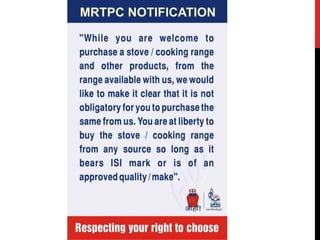
MRTP
THE MONOPOLIES AND RESTRICTIVE TRADE PRACTICES
ACT, 1969
The MRTP Act, 1969 has its genesis in the Directive Principles of
State Policy embodied in the Constitution of India. Clauses (b) and
(c) of Article 39 of the Constitution lay down that the State shall
direct its policy towards ensuring:
•   that the ownership and control of material resources of the
    community are so distributed as to best serve the common good;
    and
•   that the operation of the economic system does not result in the
    concentration of wealth and means of production to the common
    detriment.
Provisions of the Monopolies and Restrictive Trade Practices Act,
1969 (MRTP Act) were inadequate to effectively deal with antitrust
issues in India and post-1991 (when the Indian government initiated
economic reforms and open market policies), substantial portions of
the MRTP Act had more or less become redundant.
WHAT IS COMPETITION
ACT 2002 ?
The Act prohibits anti-competitive agreements, abuse of
dominant position by enterprises and regulates
combinations (acquisition, acquiring of control and Merger
and acquisition), which causes or likely to cause an
appreciable adverse effect on competition within India.
ANTI-COMPETITIVE
AGREEMENTS
No enterprise or association of enterprises or person or
association of persons shall enter into any agreement in
respect of production, supply, distribution, storage,
acquisition or control of goods or provision of services,
which causes or is likely to cause an appreciable adverse
effect on competition within India.


REGULATION OF
COMBINATIONS
No person or enterprise shall enter into a combination which
causes or is likely to cause an appreciable adverse effect on
competition within the relevant market in India and such a
combination shall be void.
ABUSE OF DOMINANT
POSITION
There shall be an abuse of dominant position if an enterprise or a group:
•   Directly or indirectly, imposes unfair or discriminatory-
     •   condition in purchase or sale of goods or service
     •   price in purchase or sale (including predatory price) of goods or service.

•   Limits or restricts-
     •   production of goods or provision of services or market therefor
     •   technical or scientific development relating to goods or services to the
         prejudice of consumers

•   Indulges in practice or practices resulting in denial of market access in
    any manner
•   Makes conclusion of contracts subject to acceptance by other parties of
    supplementary obligations which, by their nature or according to
    commercial usage, have no connection with the subject of such
    contracts
•   Uses its dominant position in one relevant market to enter into, or
    protect, other relevant market.
COMPETITION
COMMISSION OF INDIA
(CCI)
The objectives of the Competition Act are sought to be achieved
through the Competition Commission of India (CCI), which has
been established by the Central Government with effect from
14th October 2003. CCI consists of a Chairperson and 6
Members appointed by the Central Government.
It is the duty of the Commission to eliminate practices having
adverse effect on competition, promote and sustain competition,
protect the interests of consumers and ensure freedom of trade
in the markets of India.
The Commission is also required to give opinion on competition
issues on a reference received from a statutory authority
established under any law and to undertake competition
advocacy, create public awareness and impart training on
competition issues.
MRTP VS COMPETITION ACT
                   2002
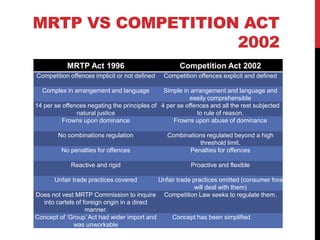
           MRTP Act 1996                             Competition Act 2002
Competition offences implicit or not defined   Competition offences explicit and defined

  Complex in arrangement and language          Simple in arrangement and language and
                                                         easily comprehensible
14 per se offences negating the principles of 4 per se offences and all the rest subjected
               natural justice                             to rule of reason.
          Frowns upon dominance                   Frowns upon abuse of dominance

        No combinations regulation              Combinations regulated beyond a high
                                                          threshold limit.
         No penalties for offences                     Penalties for offences

             Reactive and rigid                          Proactive and flexible

       Unfair trade practices covered        Unfair trade practices omitted (consumer fora
                                                           will deal with them)
Does not vest MRTP Commission to inquire Competition Law seeks to regulate them.
  into cartels of foreign origin in a direct
                   manner.
Concept of ‘Group’ Act had wider import and       Concept has been simplified
              was unworkable
FEW CASES

Competition Commission of India (CCI) has received a total
number of 304 cases up to March 31, 2012 under various
sections of the Competition Act. Out of these, 227 cases have
been disposed off.
CCI PENALIZES CHEMISTS &
DRUGGISTS ASSOCIATION, GOA
(CDAG)
Anti-competitive practices followed:
•   Supply of medicines to common man not at an affordable rate.
•   Controls the supply of drugs in the market through a system of
    seeking mandatory Product Information Service (PIS) approvals
•   The number of players is limited and controlled by insisting on
    obtaining its "No Objection Certificate (NOC)


The Commission imposed a penalty of Rs. 2 lakhs on
CDAG.(2008-2010)
On similar grounds, the Commission also found Chemists and
Druggists Association, Baroda (CDAB) and a penalty of 54,000 was
imposed.(2006-2009
THE CEMENT CASE
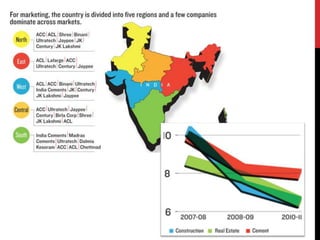
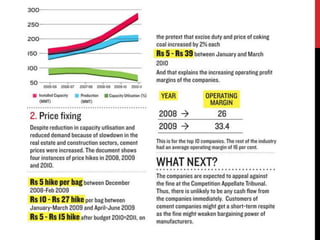
• The Competition Commission of India (CCI) has slapped
  11 cement companies with a fine of Rs 6,304 crore for
  price cartelization, the highest penalty ever imposed
• The Commission in its order observed the existence of
  price parallelism, controlled and limited supply with a view
  of maximizing profits.
• Cement Manufacturers Association asked
  COMPAT(Competition Appellate Tribunal) to relook into
  the penalty imposed by CCI.
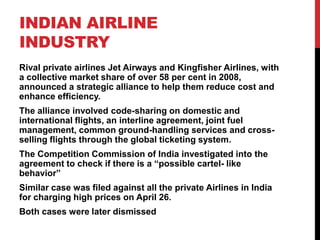
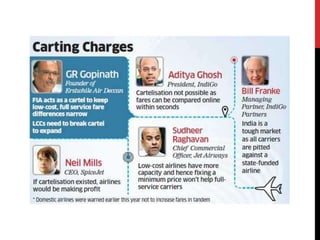
INDIAN AIRLINE
INDUSTRY
Rival private airlines Jet Airways and Kingfisher Airlines, with
a collective market share of over 58 per cent in 2008,
announced a strategic alliance to help them reduce cost and
enhance efficiency.
The alliance involved code-sharing on domestic and
international flights, an interline agreement, joint fuel
management, common ground-handling services and cross-
selling flights through the global ticketing system.
The Competition Commission of India investigated into the
agreement to check if there is a “possible cartel- like
behavior”
Similar case was filed against all the private Airlines in India
for charging high prices on April 26.
Both cases were later dismissed
AUTOMOBILE
INDUSTRY INDIA
International car makers, Honda, Hyundai and Volkswagen,
have come under the scanner of the competition watchdog
Competition Commission of India (CCI) for abusing their
dominant market position by selling auto parts to customers
at high prices.
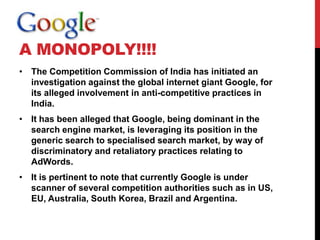
A MONOPOLY!!!!
• The Competition Commission of India has initiated an
  investigation against the global internet giant Google, for
  its alleged involvement in anti-competitive practices in
  India.
• It has been alleged that Google, being dominant in the
  search engine market, is leveraging its position in the
  generic search to specialised search market, by way of
  discriminatory and retaliatory practices relating to
  AdWords.
• It is pertinent to note that currently Google is under
  scanner of several competition authorities such as in US,
  EU, Australia, South Korea, Brazil and Argentina.
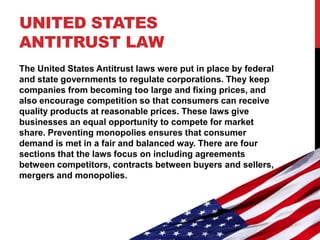
UNITED STATES
ANTITRUST LAW
The United States Antitrust laws were put in place by federal
and state governments to regulate corporations. They keep
companies from becoming too large and fixing prices, and
also encourage competition so that consumers can receive
quality products at reasonable prices. These laws give
businesses an equal opportunity to compete for market
share. Preventing monopolies ensures that consumer
demand is met in a fair and balanced way. There are four
sections that the laws focus on including agreements
between competitors, contracts between buyers and sellers,
mergers and monopolies.
UNITED KINGDOM
                             COMPETITION LAW
United Kingdom competition law is affected by both British and European elements. The
Competition Act 1998 and the Enterprise Act 2002 are the most important statutes for cases
with a purely national dimension. However if the effect of a business' conduct would reach
across borders, the European Union has competence to deal with the problems, and
exclusively EU law would apply. Even so, the section 59 of the Competition Act 1998 provides
that UK rules are to be applied in line with European jurisprudence. Like all competition law,
that in the UK has three main tasks.
•   Prohibiting agreements or practices that restrict free trading and competition between
    business entities. This includes in particular the repression of cartels.
•   Banning abusive behavior by a firm dominating a market, or anti-competitive practices that
    tend to lead to such a dominant position. Practices controlled in this way may
    include predatory pricing, tying, price gouging, refusal to deal and many others.
•   Supervising the mergers and acquisitions of large corporations, including some joint
    ventures. Transactions that are considered to threaten the competitive process can be
    prohibited altogether, or approved subject to "remedies" such as an obligation to divest
    part of the merged business or to offer licenses or access to facilities to enable other
    businesses to continue competing.

Eco pres

  • 1.
  • 2.
    CONTENT • MRTP Act •Competition Act 2002 • Anti-competitive agreements • Regulation of combinations • Abuse of dominant position • Competitive commission of India (CCI) • MRTP vs Competition Act • Recent Events • Other similar acts/laws: • US Antitrust • UK Competition Law
  • 3.
    MRTP THE MONOPOLIES ANDRESTRICTIVE TRADE PRACTICES ACT, 1969 The MRTP Act, 1969 has its genesis in the Directive Principles of State Policy embodied in the Constitution of India. Clauses (b) and (c) of Article 39 of the Constitution lay down that the State shall direct its policy towards ensuring: • that the ownership and control of material resources of the community are so distributed as to best serve the common good; and • that the operation of the economic system does not result in the concentration of wealth and means of production to the common detriment. Provisions of the Monopolies and Restrictive Trade Practices Act, 1969 (MRTP Act) were inadequate to effectively deal with antitrust issues in India and post-1991 (when the Indian government initiated economic reforms and open market policies), substantial portions of the MRTP Act had more or less become redundant.
  • 4.
    WHAT IS COMPETITION ACT2002 ? The Act prohibits anti-competitive agreements, abuse of dominant position by enterprises and regulates combinations (acquisition, acquiring of control and Merger and acquisition), which causes or likely to cause an appreciable adverse effect on competition within India.
  • 5.
    ANTI-COMPETITIVE AGREEMENTS No enterprise orassociation of enterprises or person or association of persons shall enter into any agreement in respect of production, supply, distribution, storage, acquisition or control of goods or provision of services, which causes or is likely to cause an appreciable adverse effect on competition within India. REGULATION OF COMBINATIONS No person or enterprise shall enter into a combination which causes or is likely to cause an appreciable adverse effect on competition within the relevant market in India and such a combination shall be void.
  • 6.
    ABUSE OF DOMINANT POSITION Thereshall be an abuse of dominant position if an enterprise or a group: • Directly or indirectly, imposes unfair or discriminatory- • condition in purchase or sale of goods or service • price in purchase or sale (including predatory price) of goods or service. • Limits or restricts- • production of goods or provision of services or market therefor • technical or scientific development relating to goods or services to the prejudice of consumers • Indulges in practice or practices resulting in denial of market access in any manner • Makes conclusion of contracts subject to acceptance by other parties of supplementary obligations which, by their nature or according to commercial usage, have no connection with the subject of such contracts • Uses its dominant position in one relevant market to enter into, or protect, other relevant market.
  • 7.
    COMPETITION COMMISSION OF INDIA (CCI) Theobjectives of the Competition Act are sought to be achieved through the Competition Commission of India (CCI), which has been established by the Central Government with effect from 14th October 2003. CCI consists of a Chairperson and 6 Members appointed by the Central Government. It is the duty of the Commission to eliminate practices having adverse effect on competition, promote and sustain competition, protect the interests of consumers and ensure freedom of trade in the markets of India. The Commission is also required to give opinion on competition issues on a reference received from a statutory authority established under any law and to undertake competition advocacy, create public awareness and impart training on competition issues.
  • 8.
    MRTP VS COMPETITIONACT 2002 MRTP Act 1996 Competition Act 2002 Competition offences implicit or not defined Competition offences explicit and defined Complex in arrangement and language Simple in arrangement and language and easily comprehensible 14 per se offences negating the principles of 4 per se offences and all the rest subjected natural justice to rule of reason. Frowns upon dominance Frowns upon abuse of dominance No combinations regulation Combinations regulated beyond a high threshold limit. No penalties for offences Penalties for offences Reactive and rigid Proactive and flexible Unfair trade practices covered Unfair trade practices omitted (consumer fora will deal with them) Does not vest MRTP Commission to inquire Competition Law seeks to regulate them. into cartels of foreign origin in a direct manner. Concept of ‘Group’ Act had wider import and Concept has been simplified was unworkable
  • 9.
    FEW CASES Competition Commissionof India (CCI) has received a total number of 304 cases up to March 31, 2012 under various sections of the Competition Act. Out of these, 227 cases have been disposed off.
  • 10.
    CCI PENALIZES CHEMISTS& DRUGGISTS ASSOCIATION, GOA (CDAG) Anti-competitive practices followed: • Supply of medicines to common man not at an affordable rate. • Controls the supply of drugs in the market through a system of seeking mandatory Product Information Service (PIS) approvals • The number of players is limited and controlled by insisting on obtaining its "No Objection Certificate (NOC) The Commission imposed a penalty of Rs. 2 lakhs on CDAG.(2008-2010) On similar grounds, the Commission also found Chemists and Druggists Association, Baroda (CDAB) and a penalty of 54,000 was imposed.(2006-2009
  • 11.
    THE CEMENT CASE •The Competition Commission of India (CCI) has slapped 11 cement companies with a fine of Rs 6,304 crore for price cartelization, the highest penalty ever imposed • The Commission in its order observed the existence of price parallelism, controlled and limited supply with a view of maximizing profits. • Cement Manufacturers Association asked COMPAT(Competition Appellate Tribunal) to relook into the penalty imposed by CCI.
  • 14.
    INDIAN AIRLINE INDUSTRY Rival privateairlines Jet Airways and Kingfisher Airlines, with a collective market share of over 58 per cent in 2008, announced a strategic alliance to help them reduce cost and enhance efficiency. The alliance involved code-sharing on domestic and international flights, an interline agreement, joint fuel management, common ground-handling services and cross- selling flights through the global ticketing system. The Competition Commission of India investigated into the agreement to check if there is a “possible cartel- like behavior” Similar case was filed against all the private Airlines in India for charging high prices on April 26. Both cases were later dismissed
  • 16.
    AUTOMOBILE INDUSTRY INDIA International carmakers, Honda, Hyundai and Volkswagen, have come under the scanner of the competition watchdog Competition Commission of India (CCI) for abusing their dominant market position by selling auto parts to customers at high prices.
  • 17.
    A MONOPOLY!!!! • TheCompetition Commission of India has initiated an investigation against the global internet giant Google, for its alleged involvement in anti-competitive practices in India. • It has been alleged that Google, being dominant in the search engine market, is leveraging its position in the generic search to specialised search market, by way of discriminatory and retaliatory practices relating to AdWords. • It is pertinent to note that currently Google is under scanner of several competition authorities such as in US, EU, Australia, South Korea, Brazil and Argentina.
  • 19.
    UNITED STATES ANTITRUST LAW TheUnited States Antitrust laws were put in place by federal and state governments to regulate corporations. They keep companies from becoming too large and fixing prices, and also encourage competition so that consumers can receive quality products at reasonable prices. These laws give businesses an equal opportunity to compete for market share. Preventing monopolies ensures that consumer demand is met in a fair and balanced way. There are four sections that the laws focus on including agreements between competitors, contracts between buyers and sellers, mergers and monopolies.
  • 20.
    UNITED KINGDOM COMPETITION LAW United Kingdom competition law is affected by both British and European elements. The Competition Act 1998 and the Enterprise Act 2002 are the most important statutes for cases with a purely national dimension. However if the effect of a business' conduct would reach across borders, the European Union has competence to deal with the problems, and exclusively EU law would apply. Even so, the section 59 of the Competition Act 1998 provides that UK rules are to be applied in line with European jurisprudence. Like all competition law, that in the UK has three main tasks. • Prohibiting agreements or practices that restrict free trading and competition between business entities. This includes in particular the repression of cartels. • Banning abusive behavior by a firm dominating a market, or anti-competitive practices that tend to lead to such a dominant position. Practices controlled in this way may include predatory pricing, tying, price gouging, refusal to deal and many others. • Supervising the mergers and acquisitions of large corporations, including some joint ventures. Transactions that are considered to threaten the competitive process can be prohibited altogether, or approved subject to "remedies" such as an obligation to divest part of the merged business or to offer licenses or access to facilities to enable other businesses to continue competing.

Editor's Notes

  • #9 http://www.legalserviceindia.com/articles/compet.htm