Unit -4th
MRTP ACT 1969
Monopolistic and Restrictive trade
Practices Act
Brought into force in 1970
Introduction: the MRTP Act 1969, was
enacted to ensure that the operation of the
economic system does not result in the
concentration of economic power in hands of
few.
Objectives of the act:
•Prevention and concentration of economic power in a
few hands.
•Control and regulation of monopolies in certain
sectors.
•Prevention of unfair trade practices.
•Prevention of restrictive trade practices.
•To control MRTP practices.
•To regulate restrictive trade practices
Applicability of the act
•The act extends to the whole of India except
Jammu and Kashmir.
•Unless the Central govt. otherwise directs, this act
Shall apply to:
•Any undertaking owned or controlled by a govt.
company.
•Any undertaking owned or controlled by the
govt.
•Any undertaking owned or controlled by a
corporation .
Regulation of MTP,
•Regulation of production and fixing the term of
sale.
•Prohibiting any action that restricts competition.
•Fixing standards for goods produced.
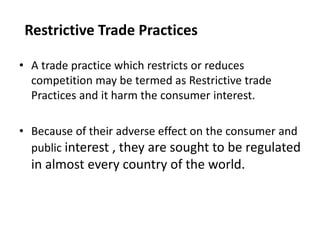
Restrictive Trade Practices
• A trade practice which restricts or reduces
competition may be termed as Restrictive trade
Practices and it harm the consumer interest.
• Because of their adverse effect on the consumer and
public interest , they are sought to be regulated
in almost every country of the world.
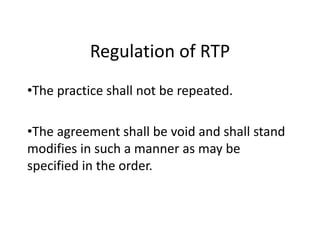
Regulation of RTP
•The practice shall not be repeated.
•The agreement shall be void and shall stand
modifies in such a manner as may be
specified in the order.
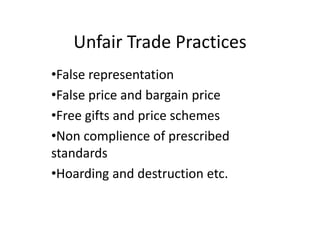
Unfair Trade Practices
•False representation
•False price and bargain price
•Free gifts and price schemes
•Non complience of prescribed
standards
•Hoarding and destruction etc.
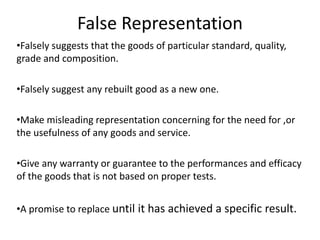
False Representation
•Falsely suggests that the goods of particular standard, quality,
grade and composition.
•Falsely suggest any rebuilt good as a new one.
•Make misleading representation concerning for the need for ,or
the usefulness of any goods and service.
•Give any warranty or guarantee to the performances and efficacy
of the goods that is not based on proper tests.
•A promise to replace until it has achieved a specific result.
Drawbacks of MRTP Act
•Poorly resourced commission
•Inadequacy in dealing effectively with anti-
competitive practices, due to lack of definitions,
cumbersome procedures and scarce resources
•Absence of specification of identifiable anti-
competition practices
•Anti- competition practices like cartels , predatory
pricing, rigging etc are not clearly defined.
Relief available
1. The practice shall be discounted or shall
not be repeated
2. The agreement relating thereto shall be
void
3. information relating to such UTP shall
be disclosed
Remedies under the act
• Temporary Injunction
• Compensation
The MRTP Act 1969

The MRTP Act 1969

  • 1.
    Unit -4th MRTP ACT1969 Monopolistic and Restrictive trade Practices Act
  • 2.
    Brought into forcein 1970 Introduction: the MRTP Act 1969, was enacted to ensure that the operation of the economic system does not result in the concentration of economic power in hands of few.
  • 3.
    Objectives of theact: •Prevention and concentration of economic power in a few hands. •Control and regulation of monopolies in certain sectors. •Prevention of unfair trade practices. •Prevention of restrictive trade practices. •To control MRTP practices. •To regulate restrictive trade practices
  • 4.
    Applicability of theact •The act extends to the whole of India except Jammu and Kashmir. •Unless the Central govt. otherwise directs, this act Shall apply to: •Any undertaking owned or controlled by a govt. company. •Any undertaking owned or controlled by the govt. •Any undertaking owned or controlled by a corporation .
  • 5.
    Regulation of MTP, •Regulationof production and fixing the term of sale. •Prohibiting any action that restricts competition. •Fixing standards for goods produced.
  • 6.
    Restrictive Trade Practices •A trade practice which restricts or reduces competition may be termed as Restrictive trade Practices and it harm the consumer interest. • Because of their adverse effect on the consumer and public interest , they are sought to be regulated in almost every country of the world.
  • 7.
    Regulation of RTP •Thepractice shall not be repeated. •The agreement shall be void and shall stand modifies in such a manner as may be specified in the order.
  • 8.
    Unfair Trade Practices •Falserepresentation •False price and bargain price •Free gifts and price schemes •Non complience of prescribed standards •Hoarding and destruction etc.
  • 9.
    False Representation •Falsely suggeststhat the goods of particular standard, quality, grade and composition. •Falsely suggest any rebuilt good as a new one. •Make misleading representation concerning for the need for ,or the usefulness of any goods and service. •Give any warranty or guarantee to the performances and efficacy of the goods that is not based on proper tests. •A promise to replace until it has achieved a specific result.
  • 10.
    Drawbacks of MRTPAct •Poorly resourced commission •Inadequacy in dealing effectively with anti- competitive practices, due to lack of definitions, cumbersome procedures and scarce resources •Absence of specification of identifiable anti- competition practices •Anti- competition practices like cartels , predatory pricing, rigging etc are not clearly defined.
  • 11.
    Relief available 1. Thepractice shall be discounted or shall not be repeated 2. The agreement relating thereto shall be void 3. information relating to such UTP shall be disclosed
  • 12.
    Remedies under theact • Temporary Injunction • Compensation