 MRTP ACT 1969
 OBJECTIVE
 COMPETITION ACT 2002
 HISTORY
 OBJECTIVE
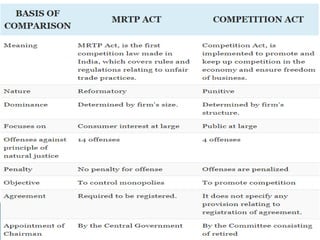
 DIFFERENCE B/W BOTH
The Monopolies and Restrictive Trade
Practices Act (MRTP Act) was passed by
Parliament of India on 18 Dec. 1969 and
got president’s assent on Dec. 27,1969.
But it came into force from June 1,1970.
To ensure that the operation of the
economic system does not result in
the concentration of economic power
in hands of few rich.
To provide for the control of
monopolies.
To prohibit monopolistic and
restrictive trade practices.
 Government Company and undertaking
owned by Government.
 Company established by a Central or State
Act.
 Trade Unions
 Companies which have been taken over by
the central Government.
 Companies owned by registered
Cooperative Societies.
 Any financial institution.
• The firms with assets of Rs. 25 Crore or more
were put under the obligation of taking
permission from the government of India and
they were called MRTP companies.
• This upper limit of Rs. 25 Crore was known
as MRTP limit.
• It was later relaxed to Rs. 50 crore in 1980,
Rs. 100 Crore in 1985 and in 1991this limit
was removed.
Now only companies having more than 25%
market share were called Monopolies.
• This act is not in force in India
currently as it was repealed and was
replaced by Competition Act 2002
with effect from September 1, 2009.
• The MRTP commission was replaced
by Competition Commission of India.
 The Competition Act, 2002 was enacted by
the Parliament of India and governs Indian
competition law.
 It replaced the The Monopolies and Restrictive Trade
Practices Act, 1969.
 Under this legislation, the Competition Commission
of India was established to prevent the activities that
have an adverse effect on competition in India.
 This act extends to whole of India except the State of
Jammu and Kashmir.
An Act, keeping in view of the economic development
of the country, was laid down to provide for an
establishment of a commission with the following
object:
 To prevent practices having adverse effect on
competition,
 To promote and sustain competition in markets.
 To protect the interests of consumers.
 To ensure freedom of trade carried on by other
participants in markets in India.
The Government of India in April 2001 appointed the
Monopolies Inquiry Commission under the
Chairmanship of Justice K. C Das Gupta, a judge of the
Supreme Court, to inquire into the extent and effect of
concentration of economic power in private hands and
prevalence of monopolistic and restrictive trade
practices in important sectors of economic activity other
than agriculture.
 To regulate advertising, in 1984, Parliament
inserted a chapter on unfair trade practices in
the Monopolies and Restrictive Trade
Practices Act, 1969.
 Acquisition: Acquisition means, directly or
indirectly, acquiring or agreeing to acquire
shares, voting rights or assets of any
enterprise or control over management or
assets of any enterprise.
EX. facebook's acquisition of whatsapp...
 Cartel: Cartel includes an association of
producers, sellers, distributors, traders or
service providers who, by agreement among
themselves, limit control or attempt to
control the production, distribution, sale or
price of goods or provision of services.
Ex. onion
 A cartel is an organisation created from a formal
agreement between a group of producers of a
goods/services to regulate the supply in an effort
to manipulate the prices.
 CCI often impose penalties on companies for
cartelisation.
 Dominant position: It means a position of
strength, enjoyed by an enterprise, in the
relevant market which enables it to operate
independently of competitive forces
prevailing in the market or affect its
competitors or consumers in its favour.
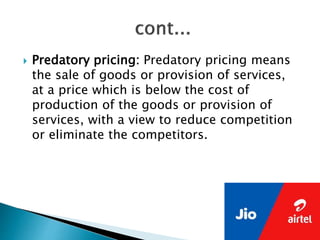
 Predatory pricing: Predatory pricing means
the sale of goods or provision of services,
at a price which is below the cost of
production of the goods or provision of
services, with a view to reduce competition
or eliminate the competitors.
 Rule of reason: A legal approach by
competition authorities or the courts where
an attempt is made to evaluate the pro-
competitive features of a restrictive business
practice against its anticompetitive effects in
order to decide whether or not the practice
should be prohibited.
 Some market restrictions which give rise to
competition issues may or further
examination be found to have valid
efficiency-enhancing benefits.
Anti Agreements
 Enterprises, persons or associations of enterprises
or persons, including cartels, shall not enter into
agreements in respect of production, supply,
distribution, storage, acquisition or control of
goods or provision of services, which cause or are
likely to cause an "appreciable adverse impact" on
competition in India.
 Such agreements would consequently be
considered void.
 Agreements which would be considered to have an
appreciable adverse impact would be those
agreements which-
 Directly or indirectly determine sale or
purchase prices,
 Limit or control production, supply, markets,
technical development, investment or
provision of services,
 Share the market or source of production or
provision of services by allocation of inter alia
geographical area of market, nature of goods
or number of customers or any other similar
way,
 Directly or indirectly result in bid rigging or
collusive bidding.
 'horizontal agreement' is an agreement for co-
operation between two or more competing
businesses operating at the same level in the
market.
 'vertical agreement' is an agreement between firms
at different levels of the supply chain. For instance, a
manufacturer of consumer electronics might have a
vertical agreement with a retailer according to which
the latter would promote their products in return for
lower prices.
 There shall be an abuse of dominant position if
an enterprise imposes directly or indirectly
unfair or discriminatory conditions in purchase
or sale of goods or services or restricts
production or technical development or create
hindrance in entry of new operators to the
prejudice of consumers.
 The provisions relating to abuse of dominant
position require determination of dominance in
the relevant market. Dominant position enables
an enterprise to operate independently or
effect competitors by action
 Quasi- judicial statutory body(Competition
Act,2002 as amended in 2007)
 Established in 2003.became fully functional in
2009.
 Predecesser was MRTPC which was functional prior
to 1991 Economic reforms.
 Chairperson(till 65 years of age) + 6 members
appointed by central Govt.
 To eliminate practices having adverse effect
on competition.
 Promote and sustain competition.
 Protect the interests of consumers.
 Ensure freedom of trade in the markets of
India.
 To eliminate practices that adversely affect
competition in different industries.
 To inspire businesses to be fair, competitive &
innovative.
 Protect interests of consumers;enhance consumer
welfare.
 Ensure freedom of trade.
 support economic growth.
 Give opinion on competition issues on a reference
received from a statutory authority.
 To undertake competition advocacy, create
public awareness & import training on
competition issues.
 Advice & give suggestions to Competition
Appeallate Tribunal(CAT).
 Competition Act covers acqisitions, mergers
etc.
 Any person aggrieved by any decision
or order of the Commission may file
an appeal to the Supreme Court within
sixty days from the date of
communication of the decision or
order of the Commission.
 No appeal shall lie against any
decision or order of the Commission
made with the consent of the parties
 If any person fails to comply with the orders
or directions of the Commission shall be
punishable with fine which may extend to ₹ 1
lakh for each day during which such non
compliance occurs, subject to a maximum of
₹ 10 crore.
 If any person does not comply with the orders
or directions issued, or fails to pay the fine
imposed under this section, he shall be
punishable with imprisonment for a term
which will extend to three years, or with fine
which may extend to ₹ 25 crores or with
both.
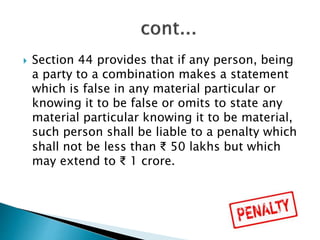
 Section 44 provides that if any person, being
a party to a combination makes a statement
which is false in any material particular or
knowing it to be false or omits to state any
material particular knowing it to be material,
such person shall be liable to a penalty which
shall not be less than ₹ 50 lakhs but which
may extend to ₹ 1 crore.
 The objective of MRTP act 1969 is promoting fair play
& fairdeal in market.
 The competition act 2002, was passed to benefit the
consumer,
 business houses as well as government.
 The main aim of this act was to encourage healthy
and free competition in the market.
 World is not a free platform for trade and commerce.
Competition act 2002

Competition act 2002

  • 2.
     MRTP ACT1969  OBJECTIVE  COMPETITION ACT 2002  HISTORY  OBJECTIVE  DIFFERENCE B/W BOTH
  • 3.
    The Monopolies andRestrictive Trade Practices Act (MRTP Act) was passed by Parliament of India on 18 Dec. 1969 and got president’s assent on Dec. 27,1969. But it came into force from June 1,1970.
  • 5.
    To ensure thatthe operation of the economic system does not result in the concentration of economic power in hands of few rich. To provide for the control of monopolies. To prohibit monopolistic and restrictive trade practices.
  • 6.
     Government Companyand undertaking owned by Government.  Company established by a Central or State Act.  Trade Unions  Companies which have been taken over by the central Government.  Companies owned by registered Cooperative Societies.  Any financial institution.
  • 7.
    • The firmswith assets of Rs. 25 Crore or more were put under the obligation of taking permission from the government of India and they were called MRTP companies. • This upper limit of Rs. 25 Crore was known as MRTP limit. • It was later relaxed to Rs. 50 crore in 1980, Rs. 100 Crore in 1985 and in 1991this limit was removed. Now only companies having more than 25% market share were called Monopolies.
  • 8.
    • This actis not in force in India currently as it was repealed and was replaced by Competition Act 2002 with effect from September 1, 2009. • The MRTP commission was replaced by Competition Commission of India.
  • 9.
     The CompetitionAct, 2002 was enacted by the Parliament of India and governs Indian competition law.  It replaced the The Monopolies and Restrictive Trade Practices Act, 1969.  Under this legislation, the Competition Commission of India was established to prevent the activities that have an adverse effect on competition in India.  This act extends to whole of India except the State of Jammu and Kashmir.
  • 10.
    An Act, keepingin view of the economic development of the country, was laid down to provide for an establishment of a commission with the following object:  To prevent practices having adverse effect on competition,  To promote and sustain competition in markets.  To protect the interests of consumers.  To ensure freedom of trade carried on by other participants in markets in India.
  • 11.
    The Government ofIndia in April 2001 appointed the Monopolies Inquiry Commission under the Chairmanship of Justice K. C Das Gupta, a judge of the Supreme Court, to inquire into the extent and effect of concentration of economic power in private hands and prevalence of monopolistic and restrictive trade practices in important sectors of economic activity other than agriculture.
  • 12.
     To regulateadvertising, in 1984, Parliament inserted a chapter on unfair trade practices in the Monopolies and Restrictive Trade Practices Act, 1969.
  • 13.
     Acquisition: Acquisitionmeans, directly or indirectly, acquiring or agreeing to acquire shares, voting rights or assets of any enterprise or control over management or assets of any enterprise. EX. facebook's acquisition of whatsapp...
  • 14.
     Cartel: Cartelincludes an association of producers, sellers, distributors, traders or service providers who, by agreement among themselves, limit control or attempt to control the production, distribution, sale or price of goods or provision of services. Ex. onion  A cartel is an organisation created from a formal agreement between a group of producers of a goods/services to regulate the supply in an effort to manipulate the prices.  CCI often impose penalties on companies for cartelisation.
  • 15.
     Dominant position:It means a position of strength, enjoyed by an enterprise, in the relevant market which enables it to operate independently of competitive forces prevailing in the market or affect its competitors or consumers in its favour.
  • 16.
     Predatory pricing:Predatory pricing means the sale of goods or provision of services, at a price which is below the cost of production of the goods or provision of services, with a view to reduce competition or eliminate the competitors.
  • 17.
     Rule ofreason: A legal approach by competition authorities or the courts where an attempt is made to evaluate the pro- competitive features of a restrictive business practice against its anticompetitive effects in order to decide whether or not the practice should be prohibited.  Some market restrictions which give rise to competition issues may or further examination be found to have valid efficiency-enhancing benefits.
  • 18.
    Anti Agreements  Enterprises,persons or associations of enterprises or persons, including cartels, shall not enter into agreements in respect of production, supply, distribution, storage, acquisition or control of goods or provision of services, which cause or are likely to cause an "appreciable adverse impact" on competition in India.  Such agreements would consequently be considered void.  Agreements which would be considered to have an appreciable adverse impact would be those agreements which-
  • 19.
     Directly orindirectly determine sale or purchase prices,  Limit or control production, supply, markets, technical development, investment or provision of services,  Share the market or source of production or provision of services by allocation of inter alia geographical area of market, nature of goods or number of customers or any other similar way,  Directly or indirectly result in bid rigging or collusive bidding.
  • 20.
     'horizontal agreement'is an agreement for co- operation between two or more competing businesses operating at the same level in the market.  'vertical agreement' is an agreement between firms at different levels of the supply chain. For instance, a manufacturer of consumer electronics might have a vertical agreement with a retailer according to which the latter would promote their products in return for lower prices.
  • 21.
     There shallbe an abuse of dominant position if an enterprise imposes directly or indirectly unfair or discriminatory conditions in purchase or sale of goods or services or restricts production or technical development or create hindrance in entry of new operators to the prejudice of consumers.  The provisions relating to abuse of dominant position require determination of dominance in the relevant market. Dominant position enables an enterprise to operate independently or effect competitors by action
  • 22.
     Quasi- judicialstatutory body(Competition Act,2002 as amended in 2007)  Established in 2003.became fully functional in 2009.  Predecesser was MRTPC which was functional prior to 1991 Economic reforms.  Chairperson(till 65 years of age) + 6 members appointed by central Govt.
  • 23.
     To eliminatepractices having adverse effect on competition.  Promote and sustain competition.  Protect the interests of consumers.  Ensure freedom of trade in the markets of India.
  • 24.
     To eliminatepractices that adversely affect competition in different industries.  To inspire businesses to be fair, competitive & innovative.  Protect interests of consumers;enhance consumer welfare.  Ensure freedom of trade.  support economic growth.  Give opinion on competition issues on a reference received from a statutory authority.
  • 25.
     To undertakecompetition advocacy, create public awareness & import training on competition issues.  Advice & give suggestions to Competition Appeallate Tribunal(CAT).  Competition Act covers acqisitions, mergers etc.
  • 26.
     Any personaggrieved by any decision or order of the Commission may file an appeal to the Supreme Court within sixty days from the date of communication of the decision or order of the Commission.  No appeal shall lie against any decision or order of the Commission made with the consent of the parties
  • 27.
     If anyperson fails to comply with the orders or directions of the Commission shall be punishable with fine which may extend to ₹ 1 lakh for each day during which such non compliance occurs, subject to a maximum of ₹ 10 crore.
  • 28.
     If anyperson does not comply with the orders or directions issued, or fails to pay the fine imposed under this section, he shall be punishable with imprisonment for a term which will extend to three years, or with fine which may extend to ₹ 25 crores or with both.
  • 29.
     Section 44provides that if any person, being a party to a combination makes a statement which is false in any material particular or knowing it to be false or omits to state any material particular knowing it to be material, such person shall be liable to a penalty which shall not be less than ₹ 50 lakhs but which may extend to ₹ 1 crore.
  • 31.
     The objectiveof MRTP act 1969 is promoting fair play & fairdeal in market.  The competition act 2002, was passed to benefit the consumer,  business houses as well as government.  The main aim of this act was to encourage healthy and free competition in the market.  World is not a free platform for trade and commerce.

Editor's Notes

  • #5  to ensure that concentration of economic power in hands of few rich. The act was there to prohibit monopolistic and restrictive trade practices.
  • #14 an asset or object bought or obtained, typically by a library or museum.( the purchase of one business enterprise by another) an acuisition is when a company wants to buy another company ,it buys all the most of the target firm's shares...in order to control of it. when the target company wants to be bought... is a friendly acquisitionor a friendly takeover .when it does not want to be bought... is a hostile acquisition or a hostile takeover.
  • #15 secretly agree to decrease production at the same time.
  • #16 Ex. Google
  • #17 Ex. HP bag
  • #18 Evaluation of appreciable adverse effect on competition
  • #19 which are hampering the competition
  • #24 cement , airlines
  • #33 SOURCE:- https://en.wikipedia.org/wiki/The_Competition_Act,_2002