Case Study – The Coca-Cola Company (A)

Case Study                                              The Coca-Cola Company (A)

Submission Date                                         6-Oct-2009

Class                                                   EPGP– 09-10

Subject                                                 Financial Reporting and Analysis


Submitted by
                                                                  Abhishek Pangaria
                                                                  Mandeepak Singh
                                                                  Rajendra Inani
                                                                  Saravanan Logu
                                                                  Tarandeep Singh
                                                                  Vivek Edlabadkar


                                                        Table of contents


Question – 1: ...................................................................................................................................2
Question – 2: ...................................................................................................................................3
Question – 3: ...................................................................................................................................5
  Balance Sheet for Company, Enterprises and consolidated firm.................................................7

  Income Statement.........................................................................................................................7
  Ratios for Company, Enterprises and consolidated firm.............................................................9
Question – 4: ...................................................................................................................................9
Question – 5: ...................................................................................................................................9


                                                                 Page 1 of 10
Case Study – The Coca-Cola Company (A)


Question – 1:
What role does Coca-Cola’s various ownership interests in its bottler companies play in the company’s
global strategy?

   Coca-Cola has business relationships with three types of bottlers:

       1. Independently owned bottlers

       2. Coca-Cola invested with non-controlling ownership interests

       3. Coca-Cola invested with controlling ownership interests


   Interest Type               Independently            Non-controlling          Controlling
                               owned bottlers           ownership                ownership
                                                        interests                interests
   Year 1998 Business               34%                      55%                      11%
   Interest distribution
   worldwide
   (Unit case volume)


   Coca-Cola makes equity investments in selected bottling operations with the intention of
   maximizing the strength and efficiency of the Coca-Cola business system’s production, distribution,
   and marketing systems around the world.


   Coca-Cola’s primary long term business strategy is not to own a controlling interest. Coca-Cola’s
   prime intention is to provide expertise and resources to strength the business of bottlers to ensure
   its sale of concentrate and syrup.


                                             Page 2 of 10
Case Study – The Coca-Cola Company (A)


Question – 2:
How are the following transactions accounted for by Coca-Cola?

   a. Sale of Concentrate and syrup to Enterprises?

   It is recorded as a sale. The data shown are as following

       Year                        1998                        1997               1996

       Concentrate / Syrup            $ 3.1 bln                  $ 2.5 bln           $ 1.6 bln
       sale to Enterprises
       Net Operating                      16%                         13%                9%
       Revenue % of
       Company


   b. Enterprises’ purchase of sweeteners through Coca-Cola?

       Any sweeteners purchased by Enterprise are done through the company, but its collection from
       Enterprises and payment to supplier is not recorded in company’s income statement.

       Year                        1998                        1997               1996

       Transaction Amount             $ 252 mln                  $ 223 mln          $ 247 mln


   c. Receipt of cooperative advertising payments from Enterprises?

       This would be reduced from the expenses done by Company on supporting marketing activities
       of Coca-Cola Enterprises. Though, the given case study do not give data in detail as how much
       out of the expenses done by company on support of marketing activity were refunded by
       Enterprises.


                                                Page 3 of 10
Case Study – The Coca-Cola Company (A)


  d. Coca-Cola’s direct support marketing payments to Enterprises?

         This is treated as marketing expenses.

                      Year                           1998                 1997                  1996

       Company expenses on direct                 $ 899 mln             $ 604 mln             $ 448 mln
       support of marketing activities
       of Enterprises


  e. Fees received for administrative services provided to Enterprises?

         This would be treated as other earnings.

  f.     Infrastructure improvement payments made to Enterprises?

         This would be treated as other assets by Coca-Cola Company, which would be amortized over
         the useful life of asset. These are treated as revenue by Enterprises in the period it is received.

  g. Sales of bottler ownership investments to Enterprises?

         Gains are shown as other income after provision of deferred tax payment by Coca-Cola Co.

  h. Enterprises’ issuance of common stock to acquire bottlers?


         In cash flow of Enterprises, it is shown in “Cash flow from investing activities”.

         Stock issued are shown in Liabilities.


  i.     Coca-Cola’s equity investment in Enterprises?

         It is shown as Assets in Coca-Cola Company balance sheet using equity method investment.


                                                  Page 4 of 10
Case Study – The Coca-Cola Company (A)


Question – 3:
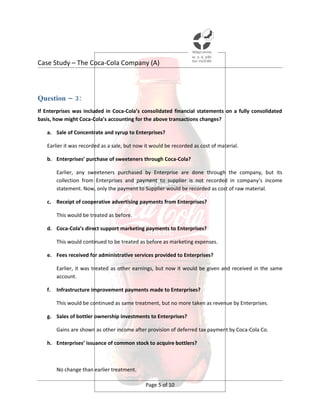
If Enterprises was included in Coca-Cola’s consolidated financial statements on a fully consolidated
basis, how might Coca-Cola’s accounting for the above transactions changes?

   a. Sale of Concentrate and syrup to Enterprises?

   Earlier it was recorded as a sale, but now it would be recorded as cost of material.

   b. Enterprises’ purchase of sweeteners through Coca-Cola?

        Earlier, any sweeteners purchased by Enterprise are done through the company, but its
        collection from Enterprises and payment to supplier is not recorded in company’s income
        statement. Now, only the payment to Supplier would be recorded as cost of raw material.

   c. Receipt of cooperative advertising payments from Enterprises?

        This would be treated as before.

   d. Coca-Cola’s direct support marketing payments to Enterprises?

        This would continued to be treated as before as marketing expenses.

   e. Fees received for administrative services provided to Enterprises?

        Earlier, it was treated as other earnings, but now it would be given and received in the same
        account.

   f.   Infrastructure improvement payments made to Enterprises?

        This would be continued as same treatment, but no more taken as revenue by Enterprises.

   g. Sales of bottler ownership investments to Enterprises?

        Gains are shown as other income after provision of deferred tax payment by Coca-Cola Co.

   h. Enterprises’ issuance of common stock to acquire bottlers?


        No change than earlier treatment.

                                              Page 5 of 10
Case Study – The Coca-Cola Company (A)

  i.   Coca-Cola’s equity investment in Enterprises?

       No change than earlier treatment.


                                           Page 6 of 10
Case Study – The Coca-Cola Company (A)


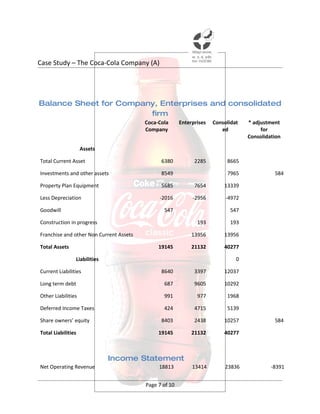
Balance Sheet for Company, Enterprises and consolidated
                        firm
                                         Coca-Cola      Enterprises   Consolidat   * adjustment
                                         Company                         ed             for
                                                                                   Consolidation

                    Assets

Total Current Asset                            6380           2285         8665

Investments and other assets                   8549                        7965              584

Property Plan Equipment                        5685           7654        13339

Less Depreciation                             -2016          -2956         -4972

Goodwill                                        547                         547

Construction in progress                                       193          193

Franchise and other Non Current Assets                       13956        13956

Total Assets                                  19145          21132        40277

                Liabilities                                                    0

Current Liabilities                            8640           3397        12037

Long term debt                                  687           9605        10292

Other Liabilities                               991            977         1968

Deferred Income Taxes                           424           4715         5139

Share owners’ equity                           8403           2438        10257              584

Total Liabilities                             19145          21132        40277


                              Income Statement
Net Operating Revenue                         18813          13414        23836             -8391


                                         Page 7 of 10
Case Study – The Coca-Cola Company (A)
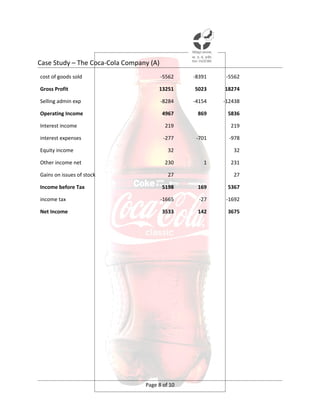
cost of goods sold                       -5562   -8391    -5562

Gross Profit                          13251      5023    18274

Selling admin exp                        -8284   -4154   -12438

Operating Income                         4967     869     5836

Interest income                           219              219

interest expenses                         -277    -701     -978

Equity income                              32               32

Other income net                          230       1      231

Gains on issues of stock                   27               27

Income before Tax                        5198     169     5367

income tax                               -1665     -27    -1692

Net Income                               3533     142     3675


                                 Page 8 of 10
Case Study – The Coca-Cola Company (A)


   Ratios for Company, Enterprises and consolidated firm
                                             Coca-Cola Company      Enterprises    Consolidated
 Asset Turnover ratio                               0.98               0.63            0.59
 (Sales / total assets)

 Comments: The Company has higher Asset Turnover ratio then the Enterprises. Consolidation
 would bring this ration down for the Company.

 Return on sales %                                  18.78               1.06          15.42
 (Net income / sales)

 Comments: The Enterprises have very low return on sales percentage. Consolidation would
 bring down Company’s return on sales %.

 Total Leverage ratio                                2.28               8.67           3.93
 ( Total Asset / Owner's equity)

 Comments: Enterprises have very good Leverage Ratio. Consolidation would improve
 Company’s Leverage Ratio.

 Return on Equity                                    0.42               0.06           0.36
 ( Net income / Owner's equity)

 Comments: Company is having better return on equity then the Enterprises. Consolidation
 would bring down this ratio for Company.


Question – 4:
Do you believe Coca-Cola should include Enterprises in its consolidated financial statements on a fully
consolidated basis?

As comments in the above analysis, it does not bring any valuable improvement in the Company’s
performance ratios, this it is better to keep the Enterprises separately. This would help analysis of
Balance Sheet of the two firms correctly and performance ratios would be correctly interpreted.


Question – 5:
How do you answer Wilson’s question?


                                             Page 9 of 10
Case Study – The Coca-Cola Company (A)
In order to fully appreciate Coca-Cola’s profitability, financial risk and operating risk, she should be
analyzing the Company and Enterprises financial statements separately and not with consolidation.


                                             Page 10 of 10

Fra coca - cola case study

  • 1.
    Case Study –The Coca-Cola Company (A) Case Study The Coca-Cola Company (A) Submission Date 6-Oct-2009 Class EPGP– 09-10 Subject Financial Reporting and Analysis Submitted by  Abhishek Pangaria  Mandeepak Singh  Rajendra Inani  Saravanan Logu  Tarandeep Singh  Vivek Edlabadkar Table of contents Question – 1: ...................................................................................................................................2 Question – 2: ...................................................................................................................................3 Question – 3: ...................................................................................................................................5 Balance Sheet for Company, Enterprises and consolidated firm.................................................7 Income Statement.........................................................................................................................7 Ratios for Company, Enterprises and consolidated firm.............................................................9 Question – 4: ...................................................................................................................................9 Question – 5: ...................................................................................................................................9 Page 1 of 10
  • 2.
    Case Study –The Coca-Cola Company (A) Question – 1: What role does Coca-Cola’s various ownership interests in its bottler companies play in the company’s global strategy? Coca-Cola has business relationships with three types of bottlers: 1. Independently owned bottlers 2. Coca-Cola invested with non-controlling ownership interests 3. Coca-Cola invested with controlling ownership interests Interest Type Independently Non-controlling Controlling owned bottlers ownership ownership interests interests Year 1998 Business 34% 55% 11% Interest distribution worldwide (Unit case volume) Coca-Cola makes equity investments in selected bottling operations with the intention of maximizing the strength and efficiency of the Coca-Cola business system’s production, distribution, and marketing systems around the world. Coca-Cola’s primary long term business strategy is not to own a controlling interest. Coca-Cola’s prime intention is to provide expertise and resources to strength the business of bottlers to ensure its sale of concentrate and syrup. Page 2 of 10
  • 3.
    Case Study –The Coca-Cola Company (A) Question – 2: How are the following transactions accounted for by Coca-Cola? a. Sale of Concentrate and syrup to Enterprises? It is recorded as a sale. The data shown are as following Year 1998 1997 1996 Concentrate / Syrup $ 3.1 bln $ 2.5 bln $ 1.6 bln sale to Enterprises Net Operating 16% 13% 9% Revenue % of Company b. Enterprises’ purchase of sweeteners through Coca-Cola? Any sweeteners purchased by Enterprise are done through the company, but its collection from Enterprises and payment to supplier is not recorded in company’s income statement. Year 1998 1997 1996 Transaction Amount $ 252 mln $ 223 mln $ 247 mln c. Receipt of cooperative advertising payments from Enterprises? This would be reduced from the expenses done by Company on supporting marketing activities of Coca-Cola Enterprises. Though, the given case study do not give data in detail as how much out of the expenses done by company on support of marketing activity were refunded by Enterprises. Page 3 of 10
  • 4.
    Case Study –The Coca-Cola Company (A) d. Coca-Cola’s direct support marketing payments to Enterprises? This is treated as marketing expenses. Year 1998 1997 1996 Company expenses on direct $ 899 mln $ 604 mln $ 448 mln support of marketing activities of Enterprises e. Fees received for administrative services provided to Enterprises? This would be treated as other earnings. f. Infrastructure improvement payments made to Enterprises? This would be treated as other assets by Coca-Cola Company, which would be amortized over the useful life of asset. These are treated as revenue by Enterprises in the period it is received. g. Sales of bottler ownership investments to Enterprises? Gains are shown as other income after provision of deferred tax payment by Coca-Cola Co. h. Enterprises’ issuance of common stock to acquire bottlers? In cash flow of Enterprises, it is shown in “Cash flow from investing activities”. Stock issued are shown in Liabilities. i. Coca-Cola’s equity investment in Enterprises? It is shown as Assets in Coca-Cola Company balance sheet using equity method investment. Page 4 of 10
  • 5.
    Case Study –The Coca-Cola Company (A) Question – 3: If Enterprises was included in Coca-Cola’s consolidated financial statements on a fully consolidated basis, how might Coca-Cola’s accounting for the above transactions changes? a. Sale of Concentrate and syrup to Enterprises? Earlier it was recorded as a sale, but now it would be recorded as cost of material. b. Enterprises’ purchase of sweeteners through Coca-Cola? Earlier, any sweeteners purchased by Enterprise are done through the company, but its collection from Enterprises and payment to supplier is not recorded in company’s income statement. Now, only the payment to Supplier would be recorded as cost of raw material. c. Receipt of cooperative advertising payments from Enterprises? This would be treated as before. d. Coca-Cola’s direct support marketing payments to Enterprises? This would continued to be treated as before as marketing expenses. e. Fees received for administrative services provided to Enterprises? Earlier, it was treated as other earnings, but now it would be given and received in the same account. f. Infrastructure improvement payments made to Enterprises? This would be continued as same treatment, but no more taken as revenue by Enterprises. g. Sales of bottler ownership investments to Enterprises? Gains are shown as other income after provision of deferred tax payment by Coca-Cola Co. h. Enterprises’ issuance of common stock to acquire bottlers? No change than earlier treatment. Page 5 of 10
  • 6.
    Case Study –The Coca-Cola Company (A) i. Coca-Cola’s equity investment in Enterprises? No change than earlier treatment. Page 6 of 10
  • 7.
    Case Study –The Coca-Cola Company (A) Balance Sheet for Company, Enterprises and consolidated firm Coca-Cola Enterprises Consolidat * adjustment Company ed for Consolidation Assets Total Current Asset 6380 2285 8665 Investments and other assets 8549 7965 584 Property Plan Equipment 5685 7654 13339 Less Depreciation -2016 -2956 -4972 Goodwill 547 547 Construction in progress 193 193 Franchise and other Non Current Assets 13956 13956 Total Assets 19145 21132 40277 Liabilities 0 Current Liabilities 8640 3397 12037 Long term debt 687 9605 10292 Other Liabilities 991 977 1968 Deferred Income Taxes 424 4715 5139 Share owners’ equity 8403 2438 10257 584 Total Liabilities 19145 21132 40277 Income Statement Net Operating Revenue 18813 13414 23836 -8391 Page 7 of 10
  • 8.
    Case Study –The Coca-Cola Company (A) cost of goods sold -5562 -8391 -5562 Gross Profit 13251 5023 18274 Selling admin exp -8284 -4154 -12438 Operating Income 4967 869 5836 Interest income 219 219 interest expenses -277 -701 -978 Equity income 32 32 Other income net 230 1 231 Gains on issues of stock 27 27 Income before Tax 5198 169 5367 income tax -1665 -27 -1692 Net Income 3533 142 3675 Page 8 of 10
  • 9.
    Case Study –The Coca-Cola Company (A) Ratios for Company, Enterprises and consolidated firm Coca-Cola Company Enterprises Consolidated Asset Turnover ratio 0.98 0.63 0.59 (Sales / total assets) Comments: The Company has higher Asset Turnover ratio then the Enterprises. Consolidation would bring this ration down for the Company. Return on sales % 18.78 1.06 15.42 (Net income / sales) Comments: The Enterprises have very low return on sales percentage. Consolidation would bring down Company’s return on sales %. Total Leverage ratio 2.28 8.67 3.93 ( Total Asset / Owner's equity) Comments: Enterprises have very good Leverage Ratio. Consolidation would improve Company’s Leverage Ratio. Return on Equity 0.42 0.06 0.36 ( Net income / Owner's equity) Comments: Company is having better return on equity then the Enterprises. Consolidation would bring down this ratio for Company. Question – 4: Do you believe Coca-Cola should include Enterprises in its consolidated financial statements on a fully consolidated basis? As comments in the above analysis, it does not bring any valuable improvement in the Company’s performance ratios, this it is better to keep the Enterprises separately. This would help analysis of Balance Sheet of the two firms correctly and performance ratios would be correctly interpreted. Question – 5: How do you answer Wilson’s question? Page 9 of 10
  • 10.
    Case Study –The Coca-Cola Company (A) In order to fully appreciate Coca-Cola’s profitability, financial risk and operating risk, she should be analyzing the Company and Enterprises financial statements separately and not with consolidation. Page 10 of 10