Monopolistic and restrictive trade practice act
Presented To :-
Mr. Shah Mohammad Sir
Faculty of I.B.M.
C.S.J.M. University
Kanpur
Presented By :-
Jai Prakash
MBA 1st SEM.
Batch: (2015-17)
EXTANTCOMPETITIONLAWOF INDIA
• MONOPOLIES AND
RESTRICTIVE TRADE PRACTICES
ACT,1969
• BROUGHT INTO FORCE IN 1970
INTRODUCTION
• THE MONOPOLISTIC AND RESTRICTIVE
TRADE PRACTICE ACT,1969, WAS ENACTED
TO ENSURE THAT THE OPERATION OF THE
ECONOMIC SYSTEM DOES NOT RESULT IN
THE CONCENTRATION OF ECONOMIC
POWER IN HANDS OF FEW.
• THE ACT CAME INTO FORCE FROM 1ST JUNE,
1970, AND HAS BEEN AMENDED IN 1991
HISTORY OF MRTP
• Constitution of India, Art. 39 (c) – “the
operation of the economic system does
not result in the concentration of wealth
and means of production to the common
detriment”
• 1947- 1969: Regimented and strict
system of government controls
• 1969: Monopolies and Restrictive Trade
Practices Act (MRTP Act) legislated
EVOLUTION
• 1999: Expert Group on interaction between
Trade and Competition Policy recommended
new competition law to “promote fair
competition and control (eliminate) anti-
competitive practices” in the market
• 2000: GOI High Level Committee on
Competition Law and Policy provided a
draft Competition law.
• 2002:The Competition Act legislated
EVOLUTION
• 2004: UPA government elected despite “India
Shining” belief
• NCMP commits to greater effort towards increasing
competition and a competitive environment – broad
basing development
• 2005: GOI asks CCI to develop consultation paper
on National Competition Policy
• 2005: CCI establishes Advisory Committee to
develop draft National Competition Policy
• 2006: Planning Commission establishes Working
Group on Competition Policy (for 11th Plan – 2007-
OBJECTIVES:
• Prevention of concentration of
economic power in a few hands
• Control and regulation of
monopolies in certain sectors
• Prevention of unfair trade
practices
• Prevention of restrictive trade
practices
APPLIABILITY
• The MRTP Act extends to the whole of India except
Jammu and Kashmir.
Unless the Central Government otherwise directs, this
act SHALL NOT apply to:
• Any undertaking owned or controlled by a
Government company
• Any undertaking owned or controlled by the
Government
• Any undertaking owned or controlled by a corporation
(not being a company established by or under any
Central, Provincial or State Act)
1991 AMENDMENTS TO MRTP ACT
1. SIZE CONCEPT GIVEN UP
2. CURBS ON GROWTH OF MONOPOLY
COMPANIES DELETED
3. MERGER CONTROL REMOVED
4. MORE EMPHASIS ON PROHIBITION
OF RTPs, UTPs AND MTPs
IN SUM, BIG BECOMING BIGGER IS NO
MORE UGLY
REGULATIONOF MTPs
• Regulation of production and
fixing the term of sale.
• Prohibiting any action that
restricts competition.
• Fixing standards for goods
produced.
RESTRICTIVE TRADE PRACTICES
 A trade practice which restricts or
reduces competition may be termed as
Restrictive Trade Practices and it
harm the consumer interest.
Because of their adverse effect on the
consumer and public interest, they are
sought to be regulated in almost every
country of the world.
REGULATIONOF RTPs
• The practice shall not be repeated.
• The agreement shall be void and shall
stand modified in such a manner as may
be specified in the order.
UNFAIRTRADE PRACTICE
A trade practice which, for the purpose of
promoting any sale, use or supply of any
goods or services, adopts unfair method.
These are categorized as:
 False Representation
 False Price or Bargain Price
 Free gifts offer and Prize Schemes
 Non-compliance of Prescribed Standards
 Hoarding, Destruction etc.
FALSE REPRESENTATION
• Falsely suggests that the goods are of particular
standard quality, grade and composition
• Falsely suggest any re-built good as new one
• Makes a misleading representation concerning for
the need for, or the usefulness of, any goods or
services
• Gives any warrantee or guarantee to the
performance and efficacy of the goods that is not
based on proper tests
• A promise to replace until it has achieved a
specified result
FALSE OFFER OR BARGAIN PRICE
When an advertisement is published in
newspaper, offering goods at a bargain
price when in fact there is no such
intention that the same may be offered
at the same price for reasonable period
FREE GIFTS OFFER AND PRIZE SCHEMES
 Offering any gifts along with some other
goods when the intention is different
Creating an impression that something
is offered free when in fact the price is
included in the price of article sold
Offering some prizes to the buyers by
the conduct of any contest with real
intention to promise sales
NON-COMPLIANCE OF
PRESCRIBED STANDARDS
Any sale or supply of goods, knowing or
having reason to believe that the goods do not
comply with the standards prescribed by some
competent authority
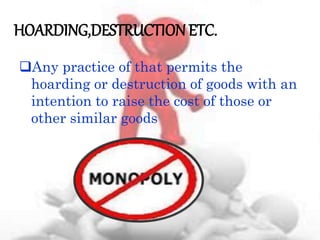
HOARDING,DESTRUCTION ETC.
Any practice of that permits the
hoarding or destruction of goods with an
intention to raise the cost of those or
other similar goods
DRAWBACKS OF MRTP ACT
• Poorly resourced commission.
• Inadequacy in dealing effectively with anti-
competitive practices, due to lack of
definitions, cumbersome procedures and
scarce resources.
• Absence of specification of identifiable anti-
competition practices.
• Anti-competition practices like cartels,
predatory pricing, rigging etc. are not
Procedure of action on complaint:
• Inquiry may be initiated through a complaint
by an individual or registered consumer
organisation.
• Fact finding investigation is carried on by the
Director General.
• If no prima facie case is made, the complaint
is dismissed, else an order is passed to that
effect.
• The commission may restrain the party
concerned from carrying on the trade
practices by granting temporary injunction.
• Final order is passed. Compensation may be
granted to the complaint.
Address-
• Complaints regarding monopolistic trade practice,
unfair trade practice and restrictive trade practice can
be made to the MRTP commission at the following
address:
Director General (Investigation & Registration)
MRTPC
Bikaner House Baracks
Shahjahan Road
New Delhi 110011
RELIEF AVAILABLE
• The practice shall be
discontinued or shall not be
repeated
• The agreement relating thereto,
shall be void
• Any information relating to such
unfair trade practice shall be
disclosed
REMEDIES UNDER THE ACT
 Temporary Injunction
 Compensation
CONCLUSION
• The MRTP Act, besides adversely
affecting economic growth, blunted
Indian companies’ ability to grow,
consolidate and improve
competitiveness. This has had a very
dampening effect on their global
competitiveness.
Conclusion
• It can be said that the MRTP Act was
successful to an extent.
• However, due to scarcity of resources, lack
of clearly defined procedures and
cumbersome rules and regulations, the Act
wasn’t as effective as it was supposed to be.
• Also, the changing economic and trade
environment (brought by the New Economic
Policy, 1991) made it necessary for a change
in the MRTP Act.
Mrtp act

Mrtp act

  • 1.
    Monopolistic and restrictivetrade practice act Presented To :- Mr. Shah Mohammad Sir Faculty of I.B.M. C.S.J.M. University Kanpur Presented By :- Jai Prakash MBA 1st SEM. Batch: (2015-17)
  • 2.
    EXTANTCOMPETITIONLAWOF INDIA • MONOPOLIESAND RESTRICTIVE TRADE PRACTICES ACT,1969 • BROUGHT INTO FORCE IN 1970
  • 3.
    INTRODUCTION • THE MONOPOLISTICAND RESTRICTIVE TRADE PRACTICE ACT,1969, WAS ENACTED TO ENSURE THAT THE OPERATION OF THE ECONOMIC SYSTEM DOES NOT RESULT IN THE CONCENTRATION OF ECONOMIC POWER IN HANDS OF FEW. • THE ACT CAME INTO FORCE FROM 1ST JUNE, 1970, AND HAS BEEN AMENDED IN 1991
  • 4.
    HISTORY OF MRTP •Constitution of India, Art. 39 (c) – “the operation of the economic system does not result in the concentration of wealth and means of production to the common detriment” • 1947- 1969: Regimented and strict system of government controls • 1969: Monopolies and Restrictive Trade Practices Act (MRTP Act) legislated
  • 5.
    EVOLUTION • 1999: ExpertGroup on interaction between Trade and Competition Policy recommended new competition law to “promote fair competition and control (eliminate) anti- competitive practices” in the market • 2000: GOI High Level Committee on Competition Law and Policy provided a draft Competition law. • 2002:The Competition Act legislated
  • 6.
    EVOLUTION • 2004: UPAgovernment elected despite “India Shining” belief • NCMP commits to greater effort towards increasing competition and a competitive environment – broad basing development • 2005: GOI asks CCI to develop consultation paper on National Competition Policy • 2005: CCI establishes Advisory Committee to develop draft National Competition Policy • 2006: Planning Commission establishes Working Group on Competition Policy (for 11th Plan – 2007-
  • 7.
    OBJECTIVES: • Prevention ofconcentration of economic power in a few hands • Control and regulation of monopolies in certain sectors • Prevention of unfair trade practices • Prevention of restrictive trade practices
  • 8.
    APPLIABILITY • The MRTPAct extends to the whole of India except Jammu and Kashmir. Unless the Central Government otherwise directs, this act SHALL NOT apply to: • Any undertaking owned or controlled by a Government company • Any undertaking owned or controlled by the Government • Any undertaking owned or controlled by a corporation (not being a company established by or under any Central, Provincial or State Act)
  • 9.
    1991 AMENDMENTS TOMRTP ACT 1. SIZE CONCEPT GIVEN UP 2. CURBS ON GROWTH OF MONOPOLY COMPANIES DELETED 3. MERGER CONTROL REMOVED 4. MORE EMPHASIS ON PROHIBITION OF RTPs, UTPs AND MTPs IN SUM, BIG BECOMING BIGGER IS NO MORE UGLY
  • 10.
    REGULATIONOF MTPs • Regulationof production and fixing the term of sale. • Prohibiting any action that restricts competition. • Fixing standards for goods produced.
  • 11.
    RESTRICTIVE TRADE PRACTICES A trade practice which restricts or reduces competition may be termed as Restrictive Trade Practices and it harm the consumer interest. Because of their adverse effect on the consumer and public interest, they are sought to be regulated in almost every country of the world.
  • 12.
    REGULATIONOF RTPs • Thepractice shall not be repeated. • The agreement shall be void and shall stand modified in such a manner as may be specified in the order.
  • 13.
    UNFAIRTRADE PRACTICE A tradepractice which, for the purpose of promoting any sale, use or supply of any goods or services, adopts unfair method. These are categorized as:  False Representation  False Price or Bargain Price  Free gifts offer and Prize Schemes  Non-compliance of Prescribed Standards  Hoarding, Destruction etc.
  • 14.
    FALSE REPRESENTATION • Falselysuggests that the goods are of particular standard quality, grade and composition • Falsely suggest any re-built good as new one • Makes a misleading representation concerning for the need for, or the usefulness of, any goods or services • Gives any warrantee or guarantee to the performance and efficacy of the goods that is not based on proper tests • A promise to replace until it has achieved a specified result
  • 15.
    FALSE OFFER ORBARGAIN PRICE When an advertisement is published in newspaper, offering goods at a bargain price when in fact there is no such intention that the same may be offered at the same price for reasonable period
  • 16.
    FREE GIFTS OFFERAND PRIZE SCHEMES  Offering any gifts along with some other goods when the intention is different Creating an impression that something is offered free when in fact the price is included in the price of article sold Offering some prizes to the buyers by the conduct of any contest with real intention to promise sales
  • 17.
    NON-COMPLIANCE OF PRESCRIBED STANDARDS Anysale or supply of goods, knowing or having reason to believe that the goods do not comply with the standards prescribed by some competent authority
  • 18.
    HOARDING,DESTRUCTION ETC. Any practiceof that permits the hoarding or destruction of goods with an intention to raise the cost of those or other similar goods
  • 19.
    DRAWBACKS OF MRTPACT • Poorly resourced commission. • Inadequacy in dealing effectively with anti- competitive practices, due to lack of definitions, cumbersome procedures and scarce resources. • Absence of specification of identifiable anti- competition practices. • Anti-competition practices like cartels, predatory pricing, rigging etc. are not
  • 20.
    Procedure of actionon complaint: • Inquiry may be initiated through a complaint by an individual or registered consumer organisation. • Fact finding investigation is carried on by the Director General. • If no prima facie case is made, the complaint is dismissed, else an order is passed to that effect. • The commission may restrain the party concerned from carrying on the trade practices by granting temporary injunction. • Final order is passed. Compensation may be granted to the complaint.
  • 21.
    Address- • Complaints regardingmonopolistic trade practice, unfair trade practice and restrictive trade practice can be made to the MRTP commission at the following address: Director General (Investigation & Registration) MRTPC Bikaner House Baracks Shahjahan Road New Delhi 110011
  • 22.
    RELIEF AVAILABLE • Thepractice shall be discontinued or shall not be repeated • The agreement relating thereto, shall be void • Any information relating to such unfair trade practice shall be disclosed
  • 23.
    REMEDIES UNDER THEACT  Temporary Injunction  Compensation
  • 24.
    CONCLUSION • The MRTPAct, besides adversely affecting economic growth, blunted Indian companies’ ability to grow, consolidate and improve competitiveness. This has had a very dampening effect on their global competitiveness.
  • 25.
    Conclusion • It canbe said that the MRTP Act was successful to an extent. • However, due to scarcity of resources, lack of clearly defined procedures and cumbersome rules and regulations, the Act wasn’t as effective as it was supposed to be. • Also, the changing economic and trade environment (brought by the New Economic Policy, 1991) made it necessary for a change in the MRTP Act.