Business Law assignment on 'Competition Laws in India and the
role of the watchdog 'Competition Commission of India' in
maintaining healthy business competition environment in the
subcontinent'
Submitted by:
Ms Isha Agarwal C-07
Ms Neha OJha C-17
Mr Ankur Kumar Tyagi- C-27
Mr Kannan Karthik M C-37
Mr Karan Malik C-57
Evaluating Faculty
Ms Shinu Vig
Contents
The Competition Act, 2002..........................................................................................................3
Background of Competition Law .................................................................................................3
Competition Commission of India...............................................................................................5
Objectives of the Competition Commission of India..............................................................5
Composition of the Competition Commission of India ..........................................................5
Duties of Commission ..............................................................................................................6
Penalties...................................................................................................................................7
The Competition Act, 2002 in detail............................................................................................8
Short title, extent and commencement..................................................................................8
Definitions................................................................................................................................8
Difference between MRTP Act 1969 and Competition Act 2002 .............................................12
Case Study 1: CCI Vs BCCI...........................................................................................................13
Abuse of Dominant Position-Section 4 of the Act ................................................................14
Case Study 2: CCI Vs Jet Airways ...............................................................................................17
The combination proposal.....................................................................................................18
The Competition Act, 2002
The Competition Act, 2002 was enacted by the Parliament of India and governs Indian
competition law. It replaced the archaic Monopoly and Restrictive Trade Practices
Act, 1969. Under this legislation, the Competition Commission of India was established
to prevent activities that have an adverse effect on competition in India
Background of Competition Law
Competition policy comprises of Government measures that affect the behavior of
enterprises and structure of the industry to promote efficiency and maximize welfare
Government constituted a committee in 1999 to examine MRTP Act, 1969 for shifting
the focus of the law from curbing monopolies to promoting competition and to
suggest a modern competition law in line with international developments to suit
Indian conditions.
Pursuant to the recommendations of the Committee, the Competition Act, 2002 was
enacted and notified in January, 2003.
Established by the Central Government in October 2003. Government has not notified
all provisions of the Act. It is important to make the Commission operational at the
earliest.India is the only major economy (other than China) that does not have a
functional, modern competition authority. This has serious adverse effects for the
economy and the consumers, and it is not in public interest.
Since attaining Independence in 1947, India, for the better part of half acentury
thereafter, adopted and followed policies comprising what areknown as ‘Command-
and-Control’ laws, rules, regulations and executiveorders. The competition law of India,
namely, the MRTP Act was onesuch. It was in 1991 that widespread economic reforms
were undertakenand consequently the march from ‘Command-and-Control economy
toone based more on free market principles commenced its stride. As istrue of many
countries, economic liberalisation has taken root in Indiaand the need for an effective
competition regime has also been recognised
There were essentially three enquiries/studies, which acted as the lodestarfor the
enactment of theMRTP Act.
 The first study was by a Committee chaired by Mr Hazari, which studied
the industrial licensing procedure under the Industries (Development and
Regulation) Act, 1951. The report of this Committee concluded that the
working of the licensing system had resulted in disproportionate growth
of some of the big business houses in India (Hazari, 1965).
 The second study was by a Committee set up in October 1960 under the
chairmanship of Professor Mahalonobis to study the distribution and levels
of income in the country. The Committee, in its report presented in
February 1964, noted that the top 10 percent of the population of India
cornered as much as 40 percent of the income (Mahalanobis, 1964). The
Committee further noted that big business houses were emerging because
of the ‘planned economy’ model practised by the Government in the
country and suggested the need to collect comprehensive information
relating to the various aspects of concentration of economic power.
 The third study was known as the Monopolies Inquiry Commission (MIC),
which was appointed by the Government in April, 1964 under the
Chairmanship of Mr Das Gupta. It was enjoined to enquire into the extent
and effects of concentration of economic power in private hands and the
prevalence of monopolistic and restrictive trade practices in important
sectors of economic activity (other than agriculture). The Monopolies
Enquiry Commission (1965) presented its report in October 1965, noting
therein that there was concentration of economic power in the form of
product-wise and industry-wise concentration. The Commission also noted
that a few industrial houses were controlling a large number of companies
and there existed in the country large-scale restrictive and monopolistic
trade practices.
As a corollary to its findings, the MIC drafted a Bill to provide for the
operation of the economic system so as not to result in the concentration
of economic power to the common detriment. The Bill provided for the
control of monopolies and prohibition of monopolistic and restrictive
trade practices, when prejudicial to public interest
One of the products of the planned and controlled economy was
the Monopolies and Restrictive Trade Practices Act, 1969 (MRTP Act). Its
cousin, to regulate, control and grant foreign exchange, was born in 1973,
christened the Foreign Exchange Regulation Act. In the planned and
controlled regime, the market suffered from little or no competition
resulting in detriment to economic efficiency and productivity. Self-
reliance was synonymous with import substitution and consequently,
indigenous availability criteria ensured automatic protection to domestic
producers, regardless of cost, efficiency, and comparative advantage.
Competition Commission of India
Competition Commission of India is a body of the Government of India responsible for
enforcing The Competition Act, 2002 throughout India and to prevent activities that have an
adverse effect on competition in India. It was established on 14 October 2003. It became fully
functional in May 2009
Headquarters
The headquarters of the Competition Commission Of India is in New Delhi
Objectives of the Competition Commission of India
 To achieve its objectives, the Competition Commission of India endeavours to
do the following:
 Make the markets work for the benefit and welfare of consumers.
 Ensure fair and healthy competition in economic activities in the country for
faster and inclusive growth and development of economy.
 Implement competition policies with an aim to effectuate the most efficient
utilization of economic resources.
 Develop and nurture effective relations and interactions with sectoral
regulators to ensure smooth alignment of sectoral regulatory laws in tandem
with the competition law.
 Effectively carry out competition advocacy and spread the information on
benefits of competition among all stakeholders to establish and nurture
competition culture in Indian economy.
Composition of the Competition Commission of India
The Commission comprises a Chairperson and six members. Ashok Chawla is the
current Chairperson of the CCI. The members of the Competition Commission of India
are:
 S.L. Bunker
 S.N. Dhingra
 Geeta Gouri
 Anurag Goel
 M.L. Tayal
Duties of Commission
According to the provisions of this Act, it shall be the duty of the Commission to:
 Eliminate practices having adverse effect on competition
 Promote and sustain competition
 Protect the interest of customers
 Ensures freedom of trade carried by other participants, in markets in India.
 The commission may inquire into any alleged contravention of the provisions
accompanied by such fee as may be determined by regulations.
 It includes Power to award compensation
 It includes power of commission to regulate its own procedure.
Inquiry into certain agreements and dominant position of enterprise
The Commission shall, while determining whether an agreement has an appreciable
adverse effect on competition under section 3, have due regard to all or any of the
following factors:
 Creation of barriers to new entrants in the market
 Driving existing competitors out of the market
 Foreclosure of competition by hindering entry into the market
 Accrual of benefits to consumers
 Improvements in production or distribution of goods or provision of services
 Promotion of technical, scientific and economic development by means of
production or distribution of goods or provision of services.
The Commission shall, while inquiring whether an enterprise enjoys a dominant
position have due regard to all or any of the following factors:
 Economic Power including commercial advantages over competitors /market
share/size/resources, Importance of the enterprise; vertical integration/ sale
or service network of such enterprises; dependence of consumers on the
enterprise
 Monopoly or dominant position whether acquired as a result of any statute or
by virtue of being a Government company or a public sector undertaking or
otherwise;
 Entry barriers including barriers such as regulatory barriers, financial risk, high
capital cost of entry, marketing entry barriers, technical entry barriers,
economies of scale, high cost of substitutable goods or service for consumers
 Countervailing buying power; market structure and size of market; social
obligations, social costs
 Relative advantage, by the way of the contribution to the economic
development, by the enterprise enjoying a dominant position having or likely
to have an appreciable adverse effect on competition; any other factor which
the Commission may consider relevant for the inquiry
Penalties
If any person, without reasonable clause, fails to comply with the orders or directions
of the act, he shall be punishable with fine which may extend to rupees 1 lakh for each
day during which such non-compliance occurs, subject to a maximum of rupees 10 Cr,
as the Commission may determine.
If any person does not comply with the orders or directions issued, or fails to pay the
fine imposed he shall be punishable with imprisonment for a term which may extend
to 3 years, or with fine which may extend to rupees 25 Cr, or with both, as the Chief
Metropolitan Magistrate, Delhi may deem fit.
Compensation in case of contravention of orders of Commission
The grieved party may make an application to the Appellate Tribunal for an order for
the recovery of compensation from any enterprise for any loss or damage shown to
have been suffered, by such party as a result of the said enterprise violating directions
issued by the Commission.
Penalty for failure to comply with directions of Commission and DirectorGeneral
If any person fails to comply, without reasonable cause, with a direction given by the
Commission or the Director General, such person shall be punishable with fine which
may extend to rupees one lakh for each day during which such failure continues
subject to a maximum of rupees one Cr, as may be determined by the Commission.
Power to impose penalty for non-furnishing of information on combinations
If any person or enterprise who fails to give notice to the Commission, the Commission
shall impose on such person or enterprise a penalty which may extend to one percent,
of the total turnover or the assets, whichever is higher, of such a combination.
Penalty for making false statement or omission to furnish material information
If any person, being a party to a combination, makes a statement which is false in any
material particular, or knowing it to be false; or omits to state any material particular
knowing it to be material, such person shall be liable to a penalty which shall not be
less than Rs 50 lakh but which may extend to rupees one Cr, as may be determined by
the Commission.
The Competition Act, 2002 in detail
An Act to provide, keeping in view of the economic development of the country, for
the establishment of a Commission to prevent practices having adverse effect on
competition, to promote and sustain competition in markets, to protect the interests
of consumers and to ensure freedom of trade carried on by other participants in
markets, in India, and for matters connected therewith or incidental thereto.
Short title, extent and commencement
1. (1) This Act is called the Competition Act, 2002.
(2) It extends to the whole of India except the State of Jammu and Kashmir.
Definitions
2. In this Act, unless the context otherwise requires,—
(a) "acquisition" means, directly or indirectly, acquiring or agreeing to
acquire—
(i) shares, voting rights or assets of any enterprise; or
(ii) control over management or control over assets of any
enterprise;
(iii) "agreement" includes any arrangement or understanding or
action in concert,—
(i) whether or not, such arrangement, understanding or action is
formal or in writing; or
(ii) whether or not such arrangement, understanding or action is
intended to be enforceable by legal proceedings;
“Appellate Tribunal” means the Competition Appellate Tribunal
established under sub-section (1) of Section 53A”]
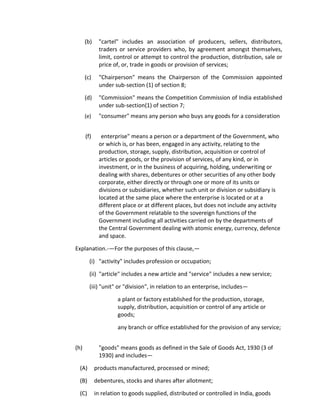
(b) "cartel" includes an association of producers, sellers, distributors,
traders or service providers who, by agreement amongst themselves,
limit, control or attempt to control the production, distribution, sale or
price of, or, trade in goods or provision of services;
(c) "Chairperson" means the Chairperson of the Commission appointed
under sub-section (1) of section 8;
(d) "Commission" means the Competition Commission of India established
under sub-section(1) of section 7;
(e) "consumer" means any person who buys any goods for a consideration
(f) enterprise" means a person or a department of the Government, who
or which is, or has been, engaged in any activity, relating to the
production, storage, supply, distribution, acquisition or control of
articles or goods, or the provision of services, of any kind, or in
investment, or in the business of acquiring, holding, underwriting or
dealing with shares, debentures or other securities of any other body
corporate, either directly or through one or more of its units or
divisions or subsidiaries, whether such unit or division or subsidiary is
located at the same place where the enterprise is located or at a
different place or at different places, but does not include any activity
of the Government relatable to the sovereign functions of the
Government including all activities carried on by the departments of
the Central Government dealing with atomic energy, currency, defence
and space.
Explanation.-—For the purposes of this clause,—
(i) "activity" includes profession or occupation;
(ii) "article" includes a new article and "service" includes a new service;
(iii) "unit" or "division", in relation to an enterprise, includes—
a plant or factory established for the production, storage,
supply, distribution, acquisition or control of any article or
goods;
any branch or office established for the provision of any service;
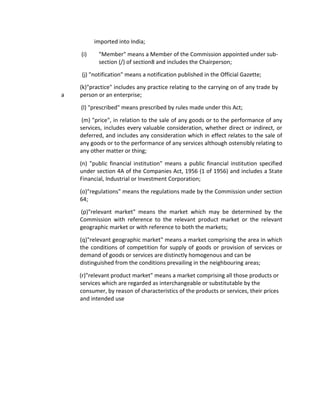
(h) "goods" means goods as defined in the Sale of Goods Act, 1930 (3 of
1930) and includes—
(A) products manufactured, processed or mined;
(B) debentures, stocks and shares after allotment;
(C) in relation to goods supplied, distributed or controlled in India, goods
imported into India;
(i) "Member" means a Member of the Commission appointed under sub-
section (/) of section8 and includes the Chairperson;
(j) "notification" means a notification published in the Official Gazette;
(k)"practice" includes any practice relating to the carrying on of any trade by
a person or an enterprise;
(l) "prescribed" means prescribed by rules made under this Act;
(m) "price", in relation to the sale of any goods or to the performance of any
services, includes every valuable consideration, whether direct or indirect, or
deferred, and includes any consideration which in effect relates to the sale of
any goods or to the performance of any services although ostensibly relating to
any other matter or thing;
(n) "public financial institution" means a public financial institution specified
under section 4A of the Companies Act, 1956 (1 of 1956) and includes a State
Financial, Industrial or Investment Corporation;
(o)"regulations" means the regulations made by the Commission under section
64;
(p)"relevant market" means the market which may be determined by the
Commission with reference to the relevant product market or the relevant
geographic market or with reference to both the markets;
(q)"relevant geographic market" means a market comprising the area in which
the conditions of competition for supply of goods or provision of services or
demand of goods or services are distinctly homogenous and can be
distinguished from the conditions prevailing in the neighbouring areas;
(r)"relevant product market" means a market comprising all those products or
services which are regarded as interchangeable or substitutable by the
consumer, by reason of characteristics of the products or services, their prices
and intended use
T
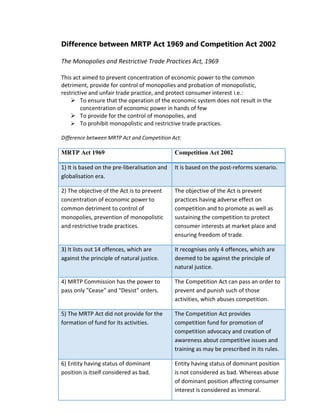
Difference between MRTP Act 1969 and Competition Act 2002
The Monopolies and Restrictive Trade Practices Act, 1969
This act aimed to prevent concentration of economic power to the common
detriment, provide for control of monopolies and probation of monopolistic,
restrictive and unfair trade practice, and protect consumer interest i.e.:
 To ensure that the operation of the economic system does not result in the
concentration of economic power in hands of few
 To provide for the control of monopolies, and
 To prohibit monopolistic and restrictive trade practices.
Difference between MRTP Act and Competition Act:
MRTP Act 1969 Competition Act 2002
1) It is based on the pre-liberalisation and
globalisation era.
It is based on the post-reforms scenario.
2) The objective of the Act is to prevent
concentration of economic power to
common detriment to control of
monopolies, prevention of monopolistic
and restrictive trade practices.
The objective of the Act is prevent
practices having adverse effect on
competition and to promote as well as
sustaining the competition to protect
consumer interests at market place and
ensuring freedom of trade.
3) It lists out 14 offences, which are
against the principle of natural justice.
It recognises only 4 offences, which are
deemed to be against the principle of
natural justice.
4) MRTP Commission has the power to
pass only "Cease" and "Desist" orders.
The Competition Act can pass an order to
prevent and punish such of those
activities, which abuses competition.
5) The MRTP Act did not provide for the
formation of fund for its activities.
The Competition Act provides
competition fund for promotion of
competition advocacy and creation of
awareness about competitive issues and
training as may be prescribed in its rules.
6) Entity having status of dominant
position is itself considered as bad.
Entity having status of dominant position
is not considered as bad. Whereas abuse
of dominant position affecting consumer
interest is considered as immoral.
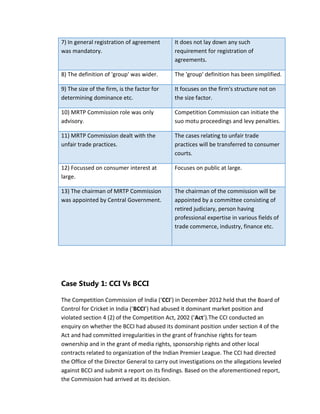
7) In general registration of agreement
was mandatory.
It does not lay down any such
requirement for registration of
agreements.
8) The definition of 'group' was wider. The 'group' definition has been simplified.
9) The size of the firm, is the factor for
determining dominance etc.
It focuses on the firm's structure not on
the size factor.
10) MRTP Commission role was only
advisory.
Competition Commission can initiate the
suo motu proceedings and levy penalties.
11) MRTP Commission dealt with the
unfair trade practices.
The cases relating to unfair trade
practices will be transferred to consumer
courts.
12) Focussed on consumer interest at
large.
Focuses on public at large.
13) The chairman of MRTP Commission
was appointed by Central Government.
The chairman of the commission will be
appointed by a committee consisting of
retired judiciary, person having
professional expertise in various fields of
trade commerce, industry, finance etc.
Case Study 1: CCI Vs BCCI
The Competition Commission of India (‘CCI’) in December 2012 held that the Board of
Control for Cricket in India (‘BCCI’) had abused it dominant market position and
violated section 4 (2) of the Competition Act, 2002 (‘Act’).The CCI conducted an
enquiry on whether the BCCI had abused its dominant position under section 4 of the
Act and had committed irregularities in the grant of franchise rights for team
ownership and in the grant of media rights, sponsorship rights and other local
contracts related to organization of the Indian Premier League. The CCI had directed
the Office of the Director General to carry out investigations on the allegations leveled
against BCCI and submit a report on its findings. Based on the aforementioned report,
the Commission had arrived at its decision.
Abuse of Dominant Position-Section 4 of the Act
Section 4 of the Act prohibits an enterprise or group from abusing its dominant
position. It must be noted that the prohibition is on abuse of dominant position and
not being in a dominating position. Section 4 of the Act also lays down what
constitutes a dominant position and also provides on what will be considered as an
abuse of dominant position.
Based on the reading of section 4, it is clear that restriction of abusing a dominant
position is on a group or an enterprise. The Act defines an enterprise as "a person or a
department of the Government, who or which is, or has been, engaged in any activity,
relating to the production, storage, supply, distribution, acquisition or control of
articles or goods, or the provision of services, of any kind, or in investment, or in the
business of acquiring, holding, underwriting or dealing with shares, debentures or
other securities of any other body corporate, either directly or through one or more of
its units or divisions or subsidiaries, whether such unit or division or subsidiary is
located at the same place where the enterprise is located or at a different place or at
different places, but does not include any activity of the Government relatable to the
sovereign functions of the Government including all activities carried on by the
departments of the Central Government dealing with atomic energy, currency, defense
and space."
A plain reading of this definition indicates that for an entity to be classified as an
enterprise for the purpose of this act, it needs to be engaged in the activities
mentioned in the section like production, storage, supply, distribution acquisition etc
or it needs engaged in the provision of services or in the business of acquiring, holding
or underwriting of shares. Hence from a reading of this definition it can be said that
the emphasis of the definition is more on the nature of the activity carried out by an
entity. The definition does not seem to provide importance to the nature and purpose
of an entity i.e. whether it is carried out for commercial, profit making or any other
purpose.
The Act defines the term group as "two or more enterprises which, directly or
indirectly, are in a position to exercise twenty-six per cent or more of the voting rights
in the other enterprise; or appoint more than fifty percent of the members of the board
of directors in the other enterprise, or control the management or affairs of the other
enterprise."
For the BCCI to be hit by section 4 of the Act it would have to be considered within the
ambit of the definition of enterprise or a group. Logically the BCCI cannot be
considered as a group and hence it can assume that the CCI considered the BCCI to be
an ‘enterprise’.
Whether the BCCI can be considered as an enterprise
The BCCI is a society registered under Tamil Nadu Societies Registration Act, 1975. Its
primary objective are of controlling the game of cricket in India, promoting the game
in India, framing the laws of cricket in India, selecting teams to represent India in Test
Matches, ODIs and Twenty 20 matches played in India or abroad. During the course of
investigation for the purpose of this matter, it was contended by the BCCI that it is a
‘not-for-profit’ society for the promotion of sport of cricket and its activities are
outside the purview of the Act, especially Section 3 and 4. It was also further
submitted by the BCCI that its commitments are neither driven by nor conditional
upon commercial considerations. Strictly going by the main objectives of the BCCI and
its contentions above, it is can be argued and established that the BCCI cannot be
considered as an enterprise for the purpose of the Act.
However the CCI cited the matter of Hemant Sharma vs Union Of India (WP(C)
5770/2011), in which the Delhi High Court had held that the All India Chess
Federation, a similar entity which was a regulator and organizer of a sport in the
country, was to be considered as an ‘enterprise’ within the meaning of the Act. The
CCI further observed that "The activities of BCCI centre both on ‘custodian and
‘organiser’ role. In this broad based objective, BCCI is involved in the selection of Team
India to represent India in international events, to work for development of cricket by
arranging training camps etc., as well as organizing the game. These activities fall
under the custodian function of BCCI, however, the aspect of ‘organization’ brings in
activities contributing to the revenues of BCCI such as grant of media rights, sale of
tickets etc. The activities of ‘organising events’ are definitely economic activities as
there is revenue dimension to the organizational activities of BCCI. Thus, it is conclusive
that all Sports Associations are to be regarded as an enterprise in so far as their
entrepreneurial conduct is concerned and treated at par with other business
establishments." The CCI thus concluded that since BCCI is engaged in revenue
generating activities, it had to be considered an enterprise for the purpose of the Act.
It is submitted that the classification of BCCI as an ‘enterprise’ can be disputed based
on the reading of the term under the Act. While the CCI has clearly laid down its
reasons for concluding that the BCCI is an enterprise, it must be noted that the plain
reading of the definition of the term ‘enterprise’ indicates that for an entity to be
considered as an enterprise, it is required to be engaged in the activities specified
under the definition of the term or engaged in the provision of services of any kind, or
in investment, or in the business of acquiring, holding, underwriting or dealing with
shares, debentures or other securities of any other body corporate. It is evident that
the BCCI is not engaged in any of the above mentioned activities.
The CCI in its decision has stressed on the commercial nature of the activities of the
BCCI. It has observed that since the BCCI conducts activities that contribute to its
revenue, it can be classified as enterprise. However it seems to have disregarded that
the definition of the term ‘enterprise’ focuses on the functional aspects of an entity.
The definition in its present form does not take into account factors regarding revenue
generation and commercial purpose of an entity. The CCI has relied on the fact that
there is revenue/economic dimension to the entity in this case (BCCI) and on that
basis concluded that it is an enterprise.
Abuse of dominant position
Once it was established by the CCI that the BCCI was an enterprise for the purpose of
the Act, the next question before it was whether the BCCI was abusing its dominant
position in its relevant market.
The explanation to section 4 provides that an entity is in a dominant position if it
enjoys a position of strength which allows it to operate independently of competitive
forces prevailing in the relevant market or affect its competitors or consumers or the
relevant market in its favor. As also indicated by the CCI in its order, in order to asses a
dominant position, it is first important to identify the exact relevant market. The Act
defines relevant market as "the market which may be determined by the Commission
with reference to the relevant product market or the relevant geographic market or
with reference to both the markets."
Hence the Act has given the discretion to the CCI to determine in each case what
constitutes a relevant market. For the purpose of this case, the CCI, after considering
various factors concluded that the relevant market was the Organization of Private
Professional Cricket Leagues/Events in India. Also in view of the fact that the BCCI is
the organizer and regulator of cricket in India and also that any private profession
league requires prior approval of BCCI as per the International Cricket Council
regulations, the CCI concluded that the BCCI was in a dominant position in the
relevant market.
The CCI held that the most significant source of dominance is the regulatory powers of
the BCCI. Further the CCI contended that since most of the infrastructure with respect
to cricket was owned by the BCCI, they were in a position to dominate. Dominance
also stemmed from the role of BCCI as an organizer of First Class/International Cricket
events. Thus, owing to regulatory role, monopoly status, control over infrastructure,
control over players, ability to control entry of other leagues, historical evidences,
BCCI was concluded to be in a dominant position in the market for organizing private
professional league cricket events in India.
The CCI concluded that the BCCI had used its dominant position in the market to
sabotage the Indian Cricket League (‘ICL’), depriving it of infrastructure and
suspending players who participated in the ICL from its activities. This according to the
CCI amounted to abuse of dominant position. The CCI ruled that the BCCI had abused
its dominant position in the relevant market and slapped a fine of Rs 52.24 crores.
This is an interesting conclusion from the CCI. By the very nature of the functions that
they perform, regulators need to be in a dominating position. It must be noted that
the BCCI is the regulator in the country for the game of cricket. Some the powers that
they exercise like owning infrastructure, approvals of leagues, tournaments etc come
with domain of being a regulator. In its order the CCI itself has admitted this by stating
"The Commission takes cognizance of the pyramid structure and notes that monopoly
of sports federations is a natural outcome of the structure". Also as per ICC
regulations, any cricket match/tournament to be conducted in India requires the prior
approval of the BCCI.
Hence the power of the BBCI of approving or not recognizing a cricket tournament
stems from the ICC, the global governing body of cricket. According to the CCI by
explicitly agreeing not to sanction any competitive league during the currency of a
media rights agreement that the BCCI had entered into, the BCCI has used its
regulatory powers in restricting competition. This according to the CCI was violation of
Section 4(2) (c) of the Act. It can however be argued that the BCCI refused to
recognize a competing event since that can lead to the erosion of the authority of the
BCCI as a regulator and promoter of the game of cricket in India. It can be argued that
this is not an abuse of its position as a regulator but a step taken to protect the
interest of the game of cricket.
Case Study 2: CCI Vs Jet Airways
The Jet Airways – Etihad Airways investment proposal is by far one of the biggest as
well as the most complex Combination Proposal which the Competition Commission
of India (CCI) has had to handle till date.
There is no doubt that whatever may be the compliments or the criticisms which the
Commission has received (and there have been plenty of both, not to mention the first
ever appeal to the Competition Appellate Tribunal (CAT) against a combination
order!), the much needed experience and insight which the Commission has gained
and will gain as its order now enters the corridors of litigation in assessing this
transaction, will aid in its growth and better understanding of the aviation market and
combination assessment in general in the future.
The emphasis of the author in this article is therefore not directly on the issue on the
merits of the case (i.e., whether the Combination should have or should have not been
approved) but on the ambiguities and vacuities which are prevalent in the majority
order of the Commission. The author has on earlier occasions also criticised past
orders of the CCI on these grounds, and continues to do so against the above
mentioned order as well.
The order indicates not only a lack of clarity, but also incomplete research on the part
of the Commission into the total corollary effects of the combination.
The combination proposal
The parties sought the Commission’s approval for the acquisition of 24 percent equity
interest in Jet Airways by Etihad Airways and in relation to all the rights and benefits,
which the parties had commercially agreed pursuant to a shareholder’s agreement
(SHA), a commercial cooperation agreement (CCA) and an investment agreement (IA),
all of which were executed on 24 April 2013. The above mentioned documents as well
as a corporate governance code (CGC) executed between the parties were further
amended on certain occasions, the most significant one being due to the conditions
imposed by the Foreign Investment Promotion Board (FIPB) while clearing the
investment into Jet Airways.
The most important document of all the above is the commercial cooperation
agreement (CCA), which, inter alia, created the following obligations between the
parties:
1. The parties would frame co-operative procedure in relation to
(i) joint route and schedule coordination;
(ii) joint pricing;
(iii) joint marketing, distribution, sales representation and cooperation;
(iv) joint/reciprocal airport representation and handling;
(v) joint/reciprocal technical handling and belly-hold cargo and dedicated
freight capacity on services (into and out of Abu Dhabi and India and beyond);
2. The parties would aim to establish centres of excellence either in India or Abu
Dhabi;
3. Etihad Airways would recommend candidates for the senior management of
Jet;
4. Jet Airways would use Abu Dhabi as its exclusive hub for scheduled services to
and from Africa, North and South America and UAE;
5. Jet would refrain from entering into any code sharing agreement with any
other airline that has the effect of:
(i) bypassing Abu Dhabi as the hub for traffic to and from the above said
locations, or
(ii) is detrimental to the co-operation contemplated by the CCA.
The last two conditions were obviously the most worrisome conditions from a
competition prospective.
At this juncture, the issue on the execution of agreements with potentially anti-
competitive effects before receiving a formal approval from the Commission, which is
regarding the agreements entered between the parties into on 26.02.2013 for the sale
of three landing/take-off slots at the London Heathrow Airport by Jet Airways to
Etihad Airways and the pursuant lease back of the same slots back to Jet Airways
(collectively called the “LHR Transaction”) has already been taken cognisance of by the
CCI and it suffices to say, the Commission has recently by its order dated 19 December
2013 imposed a penalty of Rs 1 crore for “consummating parts of the deal without
approval of the CCI”.
The merits of this order are outside the scope of the present article.

Competition Commission of India

  • 1.
    Business Law assignmenton 'Competition Laws in India and the role of the watchdog 'Competition Commission of India' in maintaining healthy business competition environment in the subcontinent' Submitted by: Ms Isha Agarwal C-07 Ms Neha OJha C-17 Mr Ankur Kumar Tyagi- C-27 Mr Kannan Karthik M C-37 Mr Karan Malik C-57 Evaluating Faculty Ms Shinu Vig
  • 2.
    Contents The Competition Act,2002..........................................................................................................3 Background of Competition Law .................................................................................................3 Competition Commission of India...............................................................................................5 Objectives of the Competition Commission of India..............................................................5 Composition of the Competition Commission of India ..........................................................5 Duties of Commission ..............................................................................................................6 Penalties...................................................................................................................................7 The Competition Act, 2002 in detail............................................................................................8 Short title, extent and commencement..................................................................................8 Definitions................................................................................................................................8 Difference between MRTP Act 1969 and Competition Act 2002 .............................................12 Case Study 1: CCI Vs BCCI...........................................................................................................13 Abuse of Dominant Position-Section 4 of the Act ................................................................14 Case Study 2: CCI Vs Jet Airways ...............................................................................................17 The combination proposal.....................................................................................................18
  • 3.
    The Competition Act,2002 The Competition Act, 2002 was enacted by the Parliament of India and governs Indian competition law. It replaced the archaic Monopoly and Restrictive Trade Practices Act, 1969. Under this legislation, the Competition Commission of India was established to prevent activities that have an adverse effect on competition in India Background of Competition Law Competition policy comprises of Government measures that affect the behavior of enterprises and structure of the industry to promote efficiency and maximize welfare Government constituted a committee in 1999 to examine MRTP Act, 1969 for shifting the focus of the law from curbing monopolies to promoting competition and to suggest a modern competition law in line with international developments to suit Indian conditions. Pursuant to the recommendations of the Committee, the Competition Act, 2002 was enacted and notified in January, 2003. Established by the Central Government in October 2003. Government has not notified all provisions of the Act. It is important to make the Commission operational at the earliest.India is the only major economy (other than China) that does not have a functional, modern competition authority. This has serious adverse effects for the economy and the consumers, and it is not in public interest. Since attaining Independence in 1947, India, for the better part of half acentury thereafter, adopted and followed policies comprising what areknown as ‘Command- and-Control’ laws, rules, regulations and executiveorders. The competition law of India, namely, the MRTP Act was onesuch. It was in 1991 that widespread economic reforms were undertakenand consequently the march from ‘Command-and-Control economy toone based more on free market principles commenced its stride. As istrue of many countries, economic liberalisation has taken root in Indiaand the need for an effective competition regime has also been recognised There were essentially three enquiries/studies, which acted as the lodestarfor the enactment of theMRTP Act.  The first study was by a Committee chaired by Mr Hazari, which studied the industrial licensing procedure under the Industries (Development and Regulation) Act, 1951. The report of this Committee concluded that the working of the licensing system had resulted in disproportionate growth
  • 4.
    of some ofthe big business houses in India (Hazari, 1965).  The second study was by a Committee set up in October 1960 under the chairmanship of Professor Mahalonobis to study the distribution and levels of income in the country. The Committee, in its report presented in February 1964, noted that the top 10 percent of the population of India cornered as much as 40 percent of the income (Mahalanobis, 1964). The Committee further noted that big business houses were emerging because of the ‘planned economy’ model practised by the Government in the country and suggested the need to collect comprehensive information relating to the various aspects of concentration of economic power.  The third study was known as the Monopolies Inquiry Commission (MIC), which was appointed by the Government in April, 1964 under the Chairmanship of Mr Das Gupta. It was enjoined to enquire into the extent and effects of concentration of economic power in private hands and the prevalence of monopolistic and restrictive trade practices in important sectors of economic activity (other than agriculture). The Monopolies Enquiry Commission (1965) presented its report in October 1965, noting therein that there was concentration of economic power in the form of product-wise and industry-wise concentration. The Commission also noted that a few industrial houses were controlling a large number of companies and there existed in the country large-scale restrictive and monopolistic trade practices. As a corollary to its findings, the MIC drafted a Bill to provide for the operation of the economic system so as not to result in the concentration of economic power to the common detriment. The Bill provided for the control of monopolies and prohibition of monopolistic and restrictive trade practices, when prejudicial to public interest One of the products of the planned and controlled economy was the Monopolies and Restrictive Trade Practices Act, 1969 (MRTP Act). Its cousin, to regulate, control and grant foreign exchange, was born in 1973, christened the Foreign Exchange Regulation Act. In the planned and controlled regime, the market suffered from little or no competition resulting in detriment to economic efficiency and productivity. Self- reliance was synonymous with import substitution and consequently, indigenous availability criteria ensured automatic protection to domestic producers, regardless of cost, efficiency, and comparative advantage.
  • 5.
    Competition Commission ofIndia Competition Commission of India is a body of the Government of India responsible for enforcing The Competition Act, 2002 throughout India and to prevent activities that have an adverse effect on competition in India. It was established on 14 October 2003. It became fully functional in May 2009 Headquarters The headquarters of the Competition Commission Of India is in New Delhi Objectives of the Competition Commission of India  To achieve its objectives, the Competition Commission of India endeavours to do the following:  Make the markets work for the benefit and welfare of consumers.  Ensure fair and healthy competition in economic activities in the country for faster and inclusive growth and development of economy.  Implement competition policies with an aim to effectuate the most efficient utilization of economic resources.  Develop and nurture effective relations and interactions with sectoral regulators to ensure smooth alignment of sectoral regulatory laws in tandem with the competition law.  Effectively carry out competition advocacy and spread the information on benefits of competition among all stakeholders to establish and nurture competition culture in Indian economy. Composition of the Competition Commission of India The Commission comprises a Chairperson and six members. Ashok Chawla is the current Chairperson of the CCI. The members of the Competition Commission of India
  • 6.
    are:  S.L. Bunker S.N. Dhingra  Geeta Gouri  Anurag Goel  M.L. Tayal Duties of Commission According to the provisions of this Act, it shall be the duty of the Commission to:  Eliminate practices having adverse effect on competition  Promote and sustain competition  Protect the interest of customers  Ensures freedom of trade carried by other participants, in markets in India.  The commission may inquire into any alleged contravention of the provisions accompanied by such fee as may be determined by regulations.  It includes Power to award compensation  It includes power of commission to regulate its own procedure. Inquiry into certain agreements and dominant position of enterprise The Commission shall, while determining whether an agreement has an appreciable adverse effect on competition under section 3, have due regard to all or any of the following factors:  Creation of barriers to new entrants in the market  Driving existing competitors out of the market  Foreclosure of competition by hindering entry into the market  Accrual of benefits to consumers  Improvements in production or distribution of goods or provision of services  Promotion of technical, scientific and economic development by means of production or distribution of goods or provision of services. The Commission shall, while inquiring whether an enterprise enjoys a dominant position have due regard to all or any of the following factors:  Economic Power including commercial advantages over competitors /market share/size/resources, Importance of the enterprise; vertical integration/ sale or service network of such enterprises; dependence of consumers on the enterprise  Monopoly or dominant position whether acquired as a result of any statute or by virtue of being a Government company or a public sector undertaking or otherwise;
  • 7.
     Entry barriersincluding barriers such as regulatory barriers, financial risk, high capital cost of entry, marketing entry barriers, technical entry barriers, economies of scale, high cost of substitutable goods or service for consumers  Countervailing buying power; market structure and size of market; social obligations, social costs  Relative advantage, by the way of the contribution to the economic development, by the enterprise enjoying a dominant position having or likely to have an appreciable adverse effect on competition; any other factor which the Commission may consider relevant for the inquiry Penalties If any person, without reasonable clause, fails to comply with the orders or directions of the act, he shall be punishable with fine which may extend to rupees 1 lakh for each day during which such non-compliance occurs, subject to a maximum of rupees 10 Cr, as the Commission may determine. If any person does not comply with the orders or directions issued, or fails to pay the fine imposed he shall be punishable with imprisonment for a term which may extend to 3 years, or with fine which may extend to rupees 25 Cr, or with both, as the Chief Metropolitan Magistrate, Delhi may deem fit. Compensation in case of contravention of orders of Commission The grieved party may make an application to the Appellate Tribunal for an order for the recovery of compensation from any enterprise for any loss or damage shown to have been suffered, by such party as a result of the said enterprise violating directions issued by the Commission. Penalty for failure to comply with directions of Commission and DirectorGeneral If any person fails to comply, without reasonable cause, with a direction given by the Commission or the Director General, such person shall be punishable with fine which may extend to rupees one lakh for each day during which such failure continues subject to a maximum of rupees one Cr, as may be determined by the Commission. Power to impose penalty for non-furnishing of information on combinations If any person or enterprise who fails to give notice to the Commission, the Commission shall impose on such person or enterprise a penalty which may extend to one percent, of the total turnover or the assets, whichever is higher, of such a combination. Penalty for making false statement or omission to furnish material information If any person, being a party to a combination, makes a statement which is false in any material particular, or knowing it to be false; or omits to state any material particular
  • 8.
    knowing it tobe material, such person shall be liable to a penalty which shall not be less than Rs 50 lakh but which may extend to rupees one Cr, as may be determined by the Commission. The Competition Act, 2002 in detail An Act to provide, keeping in view of the economic development of the country, for the establishment of a Commission to prevent practices having adverse effect on competition, to promote and sustain competition in markets, to protect the interests of consumers and to ensure freedom of trade carried on by other participants in markets, in India, and for matters connected therewith or incidental thereto. Short title, extent and commencement 1. (1) This Act is called the Competition Act, 2002. (2) It extends to the whole of India except the State of Jammu and Kashmir. Definitions 2. In this Act, unless the context otherwise requires,— (a) "acquisition" means, directly or indirectly, acquiring or agreeing to acquire— (i) shares, voting rights or assets of any enterprise; or (ii) control over management or control over assets of any enterprise; (iii) "agreement" includes any arrangement or understanding or action in concert,— (i) whether or not, such arrangement, understanding or action is formal or in writing; or (ii) whether or not such arrangement, understanding or action is intended to be enforceable by legal proceedings; “Appellate Tribunal” means the Competition Appellate Tribunal established under sub-section (1) of Section 53A”]
  • 9.
    (b) "cartel" includesan association of producers, sellers, distributors, traders or service providers who, by agreement amongst themselves, limit, control or attempt to control the production, distribution, sale or price of, or, trade in goods or provision of services; (c) "Chairperson" means the Chairperson of the Commission appointed under sub-section (1) of section 8; (d) "Commission" means the Competition Commission of India established under sub-section(1) of section 7; (e) "consumer" means any person who buys any goods for a consideration (f) enterprise" means a person or a department of the Government, who or which is, or has been, engaged in any activity, relating to the production, storage, supply, distribution, acquisition or control of articles or goods, or the provision of services, of any kind, or in investment, or in the business of acquiring, holding, underwriting or dealing with shares, debentures or other securities of any other body corporate, either directly or through one or more of its units or divisions or subsidiaries, whether such unit or division or subsidiary is located at the same place where the enterprise is located or at a different place or at different places, but does not include any activity of the Government relatable to the sovereign functions of the Government including all activities carried on by the departments of the Central Government dealing with atomic energy, currency, defence and space. Explanation.-—For the purposes of this clause,— (i) "activity" includes profession or occupation; (ii) "article" includes a new article and "service" includes a new service; (iii) "unit" or "division", in relation to an enterprise, includes— a plant or factory established for the production, storage, supply, distribution, acquisition or control of any article or goods; any branch or office established for the provision of any service; (h) "goods" means goods as defined in the Sale of Goods Act, 1930 (3 of 1930) and includes— (A) products manufactured, processed or mined; (B) debentures, stocks and shares after allotment; (C) in relation to goods supplied, distributed or controlled in India, goods
  • 10.
    imported into India; (i)"Member" means a Member of the Commission appointed under sub- section (/) of section8 and includes the Chairperson; (j) "notification" means a notification published in the Official Gazette; (k)"practice" includes any practice relating to the carrying on of any trade by a person or an enterprise; (l) "prescribed" means prescribed by rules made under this Act; (m) "price", in relation to the sale of any goods or to the performance of any services, includes every valuable consideration, whether direct or indirect, or deferred, and includes any consideration which in effect relates to the sale of any goods or to the performance of any services although ostensibly relating to any other matter or thing; (n) "public financial institution" means a public financial institution specified under section 4A of the Companies Act, 1956 (1 of 1956) and includes a State Financial, Industrial or Investment Corporation; (o)"regulations" means the regulations made by the Commission under section 64; (p)"relevant market" means the market which may be determined by the Commission with reference to the relevant product market or the relevant geographic market or with reference to both the markets; (q)"relevant geographic market" means a market comprising the area in which the conditions of competition for supply of goods or provision of services or demand of goods or services are distinctly homogenous and can be distinguished from the conditions prevailing in the neighbouring areas; (r)"relevant product market" means a market comprising all those products or services which are regarded as interchangeable or substitutable by the consumer, by reason of characteristics of the products or services, their prices and intended use
  • 11.
  • 12.
    Difference between MRTPAct 1969 and Competition Act 2002 The Monopolies and Restrictive Trade Practices Act, 1969 This act aimed to prevent concentration of economic power to the common detriment, provide for control of monopolies and probation of monopolistic, restrictive and unfair trade practice, and protect consumer interest i.e.:  To ensure that the operation of the economic system does not result in the concentration of economic power in hands of few  To provide for the control of monopolies, and  To prohibit monopolistic and restrictive trade practices. Difference between MRTP Act and Competition Act: MRTP Act 1969 Competition Act 2002 1) It is based on the pre-liberalisation and globalisation era. It is based on the post-reforms scenario. 2) The objective of the Act is to prevent concentration of economic power to common detriment to control of monopolies, prevention of monopolistic and restrictive trade practices. The objective of the Act is prevent practices having adverse effect on competition and to promote as well as sustaining the competition to protect consumer interests at market place and ensuring freedom of trade. 3) It lists out 14 offences, which are against the principle of natural justice. It recognises only 4 offences, which are deemed to be against the principle of natural justice. 4) MRTP Commission has the power to pass only "Cease" and "Desist" orders. The Competition Act can pass an order to prevent and punish such of those activities, which abuses competition. 5) The MRTP Act did not provide for the formation of fund for its activities. The Competition Act provides competition fund for promotion of competition advocacy and creation of awareness about competitive issues and training as may be prescribed in its rules. 6) Entity having status of dominant position is itself considered as bad. Entity having status of dominant position is not considered as bad. Whereas abuse of dominant position affecting consumer interest is considered as immoral.
  • 13.
    7) In generalregistration of agreement was mandatory. It does not lay down any such requirement for registration of agreements. 8) The definition of 'group' was wider. The 'group' definition has been simplified. 9) The size of the firm, is the factor for determining dominance etc. It focuses on the firm's structure not on the size factor. 10) MRTP Commission role was only advisory. Competition Commission can initiate the suo motu proceedings and levy penalties. 11) MRTP Commission dealt with the unfair trade practices. The cases relating to unfair trade practices will be transferred to consumer courts. 12) Focussed on consumer interest at large. Focuses on public at large. 13) The chairman of MRTP Commission was appointed by Central Government. The chairman of the commission will be appointed by a committee consisting of retired judiciary, person having professional expertise in various fields of trade commerce, industry, finance etc. Case Study 1: CCI Vs BCCI The Competition Commission of India (‘CCI’) in December 2012 held that the Board of Control for Cricket in India (‘BCCI’) had abused it dominant market position and violated section 4 (2) of the Competition Act, 2002 (‘Act’).The CCI conducted an enquiry on whether the BCCI had abused its dominant position under section 4 of the Act and had committed irregularities in the grant of franchise rights for team ownership and in the grant of media rights, sponsorship rights and other local contracts related to organization of the Indian Premier League. The CCI had directed the Office of the Director General to carry out investigations on the allegations leveled against BCCI and submit a report on its findings. Based on the aforementioned report, the Commission had arrived at its decision.
  • 14.
    Abuse of DominantPosition-Section 4 of the Act Section 4 of the Act prohibits an enterprise or group from abusing its dominant position. It must be noted that the prohibition is on abuse of dominant position and not being in a dominating position. Section 4 of the Act also lays down what constitutes a dominant position and also provides on what will be considered as an abuse of dominant position. Based on the reading of section 4, it is clear that restriction of abusing a dominant position is on a group or an enterprise. The Act defines an enterprise as "a person or a department of the Government, who or which is, or has been, engaged in any activity, relating to the production, storage, supply, distribution, acquisition or control of articles or goods, or the provision of services, of any kind, or in investment, or in the business of acquiring, holding, underwriting or dealing with shares, debentures or other securities of any other body corporate, either directly or through one or more of its units or divisions or subsidiaries, whether such unit or division or subsidiary is located at the same place where the enterprise is located or at a different place or at different places, but does not include any activity of the Government relatable to the sovereign functions of the Government including all activities carried on by the departments of the Central Government dealing with atomic energy, currency, defense and space." A plain reading of this definition indicates that for an entity to be classified as an enterprise for the purpose of this act, it needs to be engaged in the activities mentioned in the section like production, storage, supply, distribution acquisition etc or it needs engaged in the provision of services or in the business of acquiring, holding or underwriting of shares. Hence from a reading of this definition it can be said that the emphasis of the definition is more on the nature of the activity carried out by an entity. The definition does not seem to provide importance to the nature and purpose of an entity i.e. whether it is carried out for commercial, profit making or any other purpose. The Act defines the term group as "two or more enterprises which, directly or indirectly, are in a position to exercise twenty-six per cent or more of the voting rights in the other enterprise; or appoint more than fifty percent of the members of the board of directors in the other enterprise, or control the management or affairs of the other enterprise." For the BCCI to be hit by section 4 of the Act it would have to be considered within the ambit of the definition of enterprise or a group. Logically the BCCI cannot be considered as a group and hence it can assume that the CCI considered the BCCI to be
  • 15.
    an ‘enterprise’. Whether theBCCI can be considered as an enterprise The BCCI is a society registered under Tamil Nadu Societies Registration Act, 1975. Its primary objective are of controlling the game of cricket in India, promoting the game in India, framing the laws of cricket in India, selecting teams to represent India in Test Matches, ODIs and Twenty 20 matches played in India or abroad. During the course of investigation for the purpose of this matter, it was contended by the BCCI that it is a ‘not-for-profit’ society for the promotion of sport of cricket and its activities are outside the purview of the Act, especially Section 3 and 4. It was also further submitted by the BCCI that its commitments are neither driven by nor conditional upon commercial considerations. Strictly going by the main objectives of the BCCI and its contentions above, it is can be argued and established that the BCCI cannot be considered as an enterprise for the purpose of the Act. However the CCI cited the matter of Hemant Sharma vs Union Of India (WP(C) 5770/2011), in which the Delhi High Court had held that the All India Chess Federation, a similar entity which was a regulator and organizer of a sport in the country, was to be considered as an ‘enterprise’ within the meaning of the Act. The CCI further observed that "The activities of BCCI centre both on ‘custodian and ‘organiser’ role. In this broad based objective, BCCI is involved in the selection of Team India to represent India in international events, to work for development of cricket by arranging training camps etc., as well as organizing the game. These activities fall under the custodian function of BCCI, however, the aspect of ‘organization’ brings in activities contributing to the revenues of BCCI such as grant of media rights, sale of tickets etc. The activities of ‘organising events’ are definitely economic activities as there is revenue dimension to the organizational activities of BCCI. Thus, it is conclusive that all Sports Associations are to be regarded as an enterprise in so far as their entrepreneurial conduct is concerned and treated at par with other business establishments." The CCI thus concluded that since BCCI is engaged in revenue generating activities, it had to be considered an enterprise for the purpose of the Act. It is submitted that the classification of BCCI as an ‘enterprise’ can be disputed based on the reading of the term under the Act. While the CCI has clearly laid down its reasons for concluding that the BCCI is an enterprise, it must be noted that the plain reading of the definition of the term ‘enterprise’ indicates that for an entity to be considered as an enterprise, it is required to be engaged in the activities specified under the definition of the term or engaged in the provision of services of any kind, or in investment, or in the business of acquiring, holding, underwriting or dealing with shares, debentures or other securities of any other body corporate. It is evident that
  • 16.
    the BCCI isnot engaged in any of the above mentioned activities. The CCI in its decision has stressed on the commercial nature of the activities of the BCCI. It has observed that since the BCCI conducts activities that contribute to its revenue, it can be classified as enterprise. However it seems to have disregarded that the definition of the term ‘enterprise’ focuses on the functional aspects of an entity. The definition in its present form does not take into account factors regarding revenue generation and commercial purpose of an entity. The CCI has relied on the fact that there is revenue/economic dimension to the entity in this case (BCCI) and on that basis concluded that it is an enterprise. Abuse of dominant position Once it was established by the CCI that the BCCI was an enterprise for the purpose of the Act, the next question before it was whether the BCCI was abusing its dominant position in its relevant market. The explanation to section 4 provides that an entity is in a dominant position if it enjoys a position of strength which allows it to operate independently of competitive forces prevailing in the relevant market or affect its competitors or consumers or the relevant market in its favor. As also indicated by the CCI in its order, in order to asses a dominant position, it is first important to identify the exact relevant market. The Act defines relevant market as "the market which may be determined by the Commission with reference to the relevant product market or the relevant geographic market or with reference to both the markets." Hence the Act has given the discretion to the CCI to determine in each case what constitutes a relevant market. For the purpose of this case, the CCI, after considering various factors concluded that the relevant market was the Organization of Private Professional Cricket Leagues/Events in India. Also in view of the fact that the BCCI is the organizer and regulator of cricket in India and also that any private profession league requires prior approval of BCCI as per the International Cricket Council regulations, the CCI concluded that the BCCI was in a dominant position in the relevant market. The CCI held that the most significant source of dominance is the regulatory powers of the BCCI. Further the CCI contended that since most of the infrastructure with respect to cricket was owned by the BCCI, they were in a position to dominate. Dominance also stemmed from the role of BCCI as an organizer of First Class/International Cricket events. Thus, owing to regulatory role, monopoly status, control over infrastructure, control over players, ability to control entry of other leagues, historical evidences,
  • 17.
    BCCI was concludedto be in a dominant position in the market for organizing private professional league cricket events in India. The CCI concluded that the BCCI had used its dominant position in the market to sabotage the Indian Cricket League (‘ICL’), depriving it of infrastructure and suspending players who participated in the ICL from its activities. This according to the CCI amounted to abuse of dominant position. The CCI ruled that the BCCI had abused its dominant position in the relevant market and slapped a fine of Rs 52.24 crores. This is an interesting conclusion from the CCI. By the very nature of the functions that they perform, regulators need to be in a dominating position. It must be noted that the BCCI is the regulator in the country for the game of cricket. Some the powers that they exercise like owning infrastructure, approvals of leagues, tournaments etc come with domain of being a regulator. In its order the CCI itself has admitted this by stating "The Commission takes cognizance of the pyramid structure and notes that monopoly of sports federations is a natural outcome of the structure". Also as per ICC regulations, any cricket match/tournament to be conducted in India requires the prior approval of the BCCI. Hence the power of the BBCI of approving or not recognizing a cricket tournament stems from the ICC, the global governing body of cricket. According to the CCI by explicitly agreeing not to sanction any competitive league during the currency of a media rights agreement that the BCCI had entered into, the BCCI has used its regulatory powers in restricting competition. This according to the CCI was violation of Section 4(2) (c) of the Act. It can however be argued that the BCCI refused to recognize a competing event since that can lead to the erosion of the authority of the BCCI as a regulator and promoter of the game of cricket in India. It can be argued that this is not an abuse of its position as a regulator but a step taken to protect the interest of the game of cricket. Case Study 2: CCI Vs Jet Airways The Jet Airways – Etihad Airways investment proposal is by far one of the biggest as well as the most complex Combination Proposal which the Competition Commission of India (CCI) has had to handle till date. There is no doubt that whatever may be the compliments or the criticisms which the Commission has received (and there have been plenty of both, not to mention the first ever appeal to the Competition Appellate Tribunal (CAT) against a combination order!), the much needed experience and insight which the Commission has gained and will gain as its order now enters the corridors of litigation in assessing this
  • 18.
    transaction, will aidin its growth and better understanding of the aviation market and combination assessment in general in the future. The emphasis of the author in this article is therefore not directly on the issue on the merits of the case (i.e., whether the Combination should have or should have not been approved) but on the ambiguities and vacuities which are prevalent in the majority order of the Commission. The author has on earlier occasions also criticised past orders of the CCI on these grounds, and continues to do so against the above mentioned order as well. The order indicates not only a lack of clarity, but also incomplete research on the part of the Commission into the total corollary effects of the combination. The combination proposal The parties sought the Commission’s approval for the acquisition of 24 percent equity interest in Jet Airways by Etihad Airways and in relation to all the rights and benefits, which the parties had commercially agreed pursuant to a shareholder’s agreement (SHA), a commercial cooperation agreement (CCA) and an investment agreement (IA), all of which were executed on 24 April 2013. The above mentioned documents as well as a corporate governance code (CGC) executed between the parties were further amended on certain occasions, the most significant one being due to the conditions imposed by the Foreign Investment Promotion Board (FIPB) while clearing the investment into Jet Airways. The most important document of all the above is the commercial cooperation agreement (CCA), which, inter alia, created the following obligations between the parties: 1. The parties would frame co-operative procedure in relation to (i) joint route and schedule coordination; (ii) joint pricing; (iii) joint marketing, distribution, sales representation and cooperation; (iv) joint/reciprocal airport representation and handling; (v) joint/reciprocal technical handling and belly-hold cargo and dedicated freight capacity on services (into and out of Abu Dhabi and India and beyond); 2. The parties would aim to establish centres of excellence either in India or Abu Dhabi; 3. Etihad Airways would recommend candidates for the senior management of Jet; 4. Jet Airways would use Abu Dhabi as its exclusive hub for scheduled services to and from Africa, North and South America and UAE; 5. Jet would refrain from entering into any code sharing agreement with any other airline that has the effect of: (i) bypassing Abu Dhabi as the hub for traffic to and from the above said locations, or (ii) is detrimental to the co-operation contemplated by the CCA.
  • 19.
    The last twoconditions were obviously the most worrisome conditions from a competition prospective. At this juncture, the issue on the execution of agreements with potentially anti- competitive effects before receiving a formal approval from the Commission, which is regarding the agreements entered between the parties into on 26.02.2013 for the sale of three landing/take-off slots at the London Heathrow Airport by Jet Airways to Etihad Airways and the pursuant lease back of the same slots back to Jet Airways (collectively called the “LHR Transaction”) has already been taken cognisance of by the CCI and it suffices to say, the Commission has recently by its order dated 19 December 2013 imposed a penalty of Rs 1 crore for “consummating parts of the deal without approval of the CCI”. The merits of this order are outside the scope of the present article.