Competition Act
By: Bindu Kshtriya
CONTENTS
INTRO TO ECONOMIC POLICY
MRTP ACT,1969
COMPETITION Act, 2002
COMPETITION COMMISSION OF INDIA
Powers of CCI
EVOLUTION- How We Got Here
Constitution of India, Art. 39 (c) – “the
operation of the economic system does
not result in the concentration of wealth
and means of production to the common
detriment”
1947- 1969: Regimented and strict system
of government controls
1969: Monopolistic and Restrictive Trade
Practices Act (MRTP Act) legislated
Monopolies and Restrictive Trade Practices Act , 1969
OBJECTIVES:
Prevention of concentration of economic
power in a few hands
Control and regulation of monopolies in
certain sectors
Prevention of unfair trade practices
Prevention of restrictive trade practices
RESTRICTIVE TRADE PRACTICES
A Restrictive Trade Practice is one which has, or may have, the
effect of preventing, distorting or restricting competition in any
manner and in particular:
a. which tends to or obstructs flow of capital or resources for
production,
b. which tends to impose unjustified costs or restrictions on
consumers
c. Tie in sales
d. Restricts competition in any way.
UNFAIR TRADE PRACTICES
a. False representation
b. False Offer or Bargain Price
c. Offering of gifts, prize, etc., and
conducting promotional contests
d. Product Safety Standards
e. Hoarding or Destruction of Goods Act
MONOPOLISTIC PRACTICES
7Up2 Meeting, June 27-28, 2006, Bangkok.
A Monopolistic Trade Practice is one that has or is likely
to have any of following effects:
i. Limiting or controlling production, supply or distribution
of goods or services and thereby maintaining price of
goods or charge or service at an unreasonable price
ii. Limiting technical development or capital investment or
allowing quality of goods or services to deteriorate.
iii. Unreasonably increasing prices of goods or services.
EVOLUTION- How We Got Here - 2
1991: Widespread economic
reforms in India – Aimed at
Liberalisation, Privatisation and
Globalisation
Changes felt necessary in MRTP
Act.
Pre-entry restrictions (prior
approval of government)–
deleted from Act
NEED FOR A NEW LAW HAS ITS ORIGIN IN FINANCE
MINISTER’S BUDGET SPEECH IN FEBRUARY,1999 :
“ THE MRTP ACT HAS BECOME OBSOLETE IN CERTAIN
AREAS IN THE LIGHT OF INTERNATIONAL ECONOMIC
DEVELOPMENTS RELATING TO COMPETITION LAWS. WE
NEED TO SHIFT OUR FOCUS FROM CURBING
MONOPOLIES TO PROMOTING COMPETITION. THE
GOVERNMENT HAS DECIDED TO APPOINT A COMMITTEE
TO EXAMINE THIS RANGE OF ISSUES AND PROPOSE A
MODERN COMPETITION LAW SUITABLE FOR OUR
CONDITIONS.”
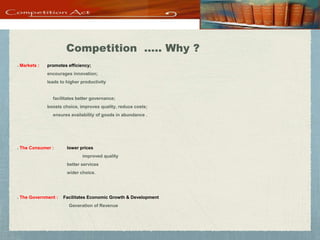
Markets : promotes efficiency;
encourages innovation;
leads to higher productivity
facilitates better governance;
boosts choice, improves quality, reduce costs;
ensures availability of goods in abundance .
The Consumer : lower prices
improved quality
better services
wider choice.
The Government : Facilitates Economic Growth & Development
Generation of Revenue
Competition ….. Why ?
❖ Prohibits Anticompetitive Agreements (Section 3)
❖ Prohibits Abuse of Dominant Position (Section 4)
❖ Provides for Regulation of Combinations (Sections 5
& 6)
❖Enjoins Competition Advocacy (Section 49)
Status of Indian Competition Law
Preamble of the Competition Act, 2002 States
“Keeping in view of the economic development of the country”
- to prevent practices having adverse effect on competition,
- to promote and sustain competition in markets,
- to protect the interests of consumers and
- to ensure freedom of trade carried on by other participants in markets, in India, and for
matters connected
therewith or incidental thereto.
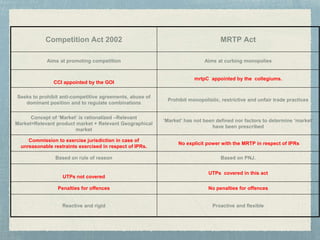
CCI appointed by the GOI
mrtpC appointed by the collegiums.
Commission to exercise jurisdiction in case of
unreasonable restraints exercised in respect of IPRs.
No explicit power with the MRTP in respect of IPRs
UTPs not covered
UTPs covered in this act
Penalties for offences No penalties for offences
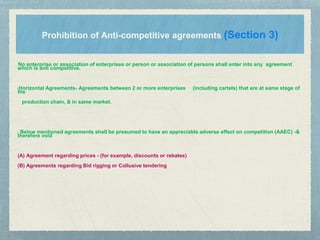
Prohibition of Anti-competitive agreements (Section 3)
No enterprise or association of enterprises or person or association of persons shall enter into any agreement
which is anti competitive.
Horizontal Agreements- Agreements between 2 or more enterprises (including cartels) that are at same stage of
the
production chain, & in same market.
Below mentioned agreements shall be presumed to have an appreciable adverse effect on competition (AAEC) -&
therefore void
(A) Agreement regarding prices - (for example, discounts or rebates)
(B) Agreements regarding Bid rigging or Collusive tendering
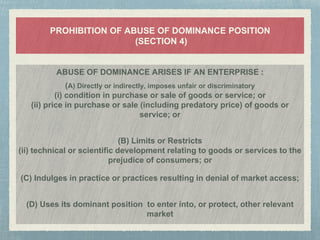
PROHIBITION OF ABUSE OF DOMINANCE POSITION
(SECTION 4)
ABUSE OF DOMINANCE ARISES IF AN ENTERPRISE :
(A) Directly or indirectly, imposes unfair or discriminatory
(i) condition in purchase or sale of goods or service; or
(ii) price in purchase or sale (including predatory price) of goods or
service; or
(B) Limits or Restricts
(ii) technical or scientific development relating to goods or services to the
prejudice of consumers; or
(C) Indulges in practice or practices resulting in denial of market access;
(D) Uses its dominant position to enter into, or protect, other relevant
market
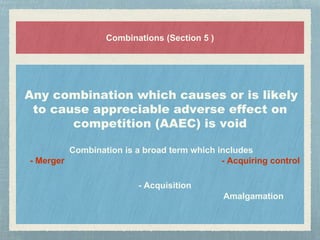
Combinations (Section 5 )
Any combination which causes or is likely
to cause appreciable adverse effect on
competition (AAEC) is void
Combination is a broad term which includes
- Merger - Acquiring control
- Acquisition
Amalgamation
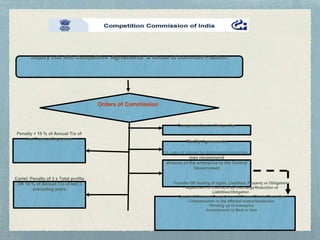
In case of abuse by dominant enterprise,
may recommend
division of the enterprise to the Central
Government
Compensation to the parties
Penalty < 10 % of Annual T/o of
last 3 preceding years
Orders of Commission
Modify Agreements
Inquiry into Anti Competitive Agreements & Abuse of Dominant Position
Cartel: Penalty of 3 x Total profits
OR 10 % of Annual T/o of last 3
preceding years
- Transfer OR Vesting of rights, Liabilities, Property or Obligations
- Adjustment of Contracts By Discharge/Reduction of
Liabilities/Obligation
- Creation/Allotment/Cancellation of Shares/Stocks/Securities
- Compensation to the affected enterprise/person
- Winding up of enterprise
- Amendments to MoA or AoA
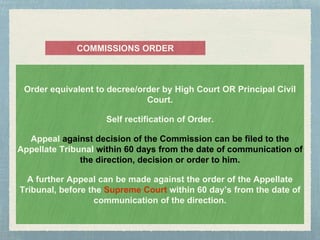
Order equivalent to decree/order by High Court OR Principal Civil
Court.
Self rectification of Order.
Appeal against decision of the Commission can be filed to the
Appellate Tribunal within 60 days from the date of communication of
the direction, decision or order to him.
A further Appeal can be made against the order of the Appellate
Tribunal, before the Supreme Court within 60 day’s from the date of
communication of the direction.
COMMISSIONS ORDER
Penalties for non-compliance with Commission’s orders:-
Penalty not less than Rs. 10 lacs [Section 42(1)]
For failure to comply with a direction of Commission or DG – Rs 1 lac
per day of failure
[Section 43]
If party to a combination makes a false statement or omits a material
particular – not
less than Rs. 50 lacs up to Rs. 1 crore [Section 44]
For willfully omitting to furnish information – penalty up to Rs. 10 lacs
[Section 45]
PENALTIES
With the enactment of the new law, the competition regime in India has
undergone a complete overhaul.
Though it is difficult at this early stage to tell how effective or efficient
the new legislation would be, it is certainly a sincere attempt to meet
the needs of the global business community.
CCI has been proactively carrying out the work of competition
advocacy since its establishment but now faces a huge challenge and
task ahead.
It is hoped that the CCI shall be able to overcome any shortcomings in
the Act and iron out any difficulties in enforcement.
Thus, many developments in this field are expected.
Conclusion

Competition act, 2002

  • 1.
  • 2.
    CONTENTS INTRO TO ECONOMICPOLICY MRTP ACT,1969 COMPETITION Act, 2002 COMPETITION COMMISSION OF INDIA Powers of CCI
  • 3.
    EVOLUTION- How WeGot Here Constitution of India, Art. 39 (c) – “the operation of the economic system does not result in the concentration of wealth and means of production to the common detriment” 1947- 1969: Regimented and strict system of government controls 1969: Monopolistic and Restrictive Trade Practices Act (MRTP Act) legislated
  • 4.
    Monopolies and RestrictiveTrade Practices Act , 1969 OBJECTIVES: Prevention of concentration of economic power in a few hands Control and regulation of monopolies in certain sectors Prevention of unfair trade practices Prevention of restrictive trade practices
  • 5.
    RESTRICTIVE TRADE PRACTICES ARestrictive Trade Practice is one which has, or may have, the effect of preventing, distorting or restricting competition in any manner and in particular: a. which tends to or obstructs flow of capital or resources for production, b. which tends to impose unjustified costs or restrictions on consumers c. Tie in sales d. Restricts competition in any way.
  • 6.
    UNFAIR TRADE PRACTICES a.False representation b. False Offer or Bargain Price c. Offering of gifts, prize, etc., and conducting promotional contests d. Product Safety Standards e. Hoarding or Destruction of Goods Act
  • 7.
    MONOPOLISTIC PRACTICES 7Up2 Meeting,June 27-28, 2006, Bangkok. A Monopolistic Trade Practice is one that has or is likely to have any of following effects: i. Limiting or controlling production, supply or distribution of goods or services and thereby maintaining price of goods or charge or service at an unreasonable price ii. Limiting technical development or capital investment or allowing quality of goods or services to deteriorate. iii. Unreasonably increasing prices of goods or services.
  • 8.
    EVOLUTION- How WeGot Here - 2 1991: Widespread economic reforms in India – Aimed at Liberalisation, Privatisation and Globalisation Changes felt necessary in MRTP Act. Pre-entry restrictions (prior approval of government)– deleted from Act
  • 9.
    NEED FOR ANEW LAW HAS ITS ORIGIN IN FINANCE MINISTER’S BUDGET SPEECH IN FEBRUARY,1999 : “ THE MRTP ACT HAS BECOME OBSOLETE IN CERTAIN AREAS IN THE LIGHT OF INTERNATIONAL ECONOMIC DEVELOPMENTS RELATING TO COMPETITION LAWS. WE NEED TO SHIFT OUR FOCUS FROM CURBING MONOPOLIES TO PROMOTING COMPETITION. THE GOVERNMENT HAS DECIDED TO APPOINT A COMMITTEE TO EXAMINE THIS RANGE OF ISSUES AND PROPOSE A MODERN COMPETITION LAW SUITABLE FOR OUR CONDITIONS.”
  • 10.
    Markets : promotesefficiency; encourages innovation; leads to higher productivity facilitates better governance; boosts choice, improves quality, reduce costs; ensures availability of goods in abundance . The Consumer : lower prices improved quality better services wider choice. The Government : Facilitates Economic Growth & Development Generation of Revenue Competition ….. Why ?
  • 11.
    ❖ Prohibits AnticompetitiveAgreements (Section 3) ❖ Prohibits Abuse of Dominant Position (Section 4) ❖ Provides for Regulation of Combinations (Sections 5 & 6) ❖Enjoins Competition Advocacy (Section 49)
  • 12.
    Status of IndianCompetition Law Preamble of the Competition Act, 2002 States “Keeping in view of the economic development of the country” - to prevent practices having adverse effect on competition, - to promote and sustain competition in markets, - to protect the interests of consumers and - to ensure freedom of trade carried on by other participants in markets, in India, and for matters connected therewith or incidental thereto.
  • 13.
    CCI appointed bythe GOI mrtpC appointed by the collegiums. Commission to exercise jurisdiction in case of unreasonable restraints exercised in respect of IPRs. No explicit power with the MRTP in respect of IPRs UTPs not covered UTPs covered in this act Penalties for offences No penalties for offences
  • 14.
    Prohibition of Anti-competitiveagreements (Section 3) No enterprise or association of enterprises or person or association of persons shall enter into any agreement which is anti competitive. Horizontal Agreements- Agreements between 2 or more enterprises (including cartels) that are at same stage of the production chain, & in same market. Below mentioned agreements shall be presumed to have an appreciable adverse effect on competition (AAEC) -& therefore void (A) Agreement regarding prices - (for example, discounts or rebates) (B) Agreements regarding Bid rigging or Collusive tendering
  • 15.
    PROHIBITION OF ABUSEOF DOMINANCE POSITION (SECTION 4) ABUSE OF DOMINANCE ARISES IF AN ENTERPRISE : (A) Directly or indirectly, imposes unfair or discriminatory (i) condition in purchase or sale of goods or service; or (ii) price in purchase or sale (including predatory price) of goods or service; or (B) Limits or Restricts (ii) technical or scientific development relating to goods or services to the prejudice of consumers; or (C) Indulges in practice or practices resulting in denial of market access; (D) Uses its dominant position to enter into, or protect, other relevant market
  • 16.
    Combinations (Section 5) Any combination which causes or is likely to cause appreciable adverse effect on competition (AAEC) is void Combination is a broad term which includes - Merger - Acquiring control - Acquisition Amalgamation
  • 17.
    In case ofabuse by dominant enterprise, may recommend division of the enterprise to the Central Government Compensation to the parties Penalty < 10 % of Annual T/o of last 3 preceding years Orders of Commission Modify Agreements Inquiry into Anti Competitive Agreements & Abuse of Dominant Position Cartel: Penalty of 3 x Total profits OR 10 % of Annual T/o of last 3 preceding years - Transfer OR Vesting of rights, Liabilities, Property or Obligations - Adjustment of Contracts By Discharge/Reduction of Liabilities/Obligation - Creation/Allotment/Cancellation of Shares/Stocks/Securities - Compensation to the affected enterprise/person - Winding up of enterprise - Amendments to MoA or AoA
  • 18.
    Order equivalent todecree/order by High Court OR Principal Civil Court. Self rectification of Order. Appeal against decision of the Commission can be filed to the Appellate Tribunal within 60 days from the date of communication of the direction, decision or order to him. A further Appeal can be made against the order of the Appellate Tribunal, before the Supreme Court within 60 day’s from the date of communication of the direction. COMMISSIONS ORDER
  • 19.
    Penalties for non-compliancewith Commission’s orders:- Penalty not less than Rs. 10 lacs [Section 42(1)] For failure to comply with a direction of Commission or DG – Rs 1 lac per day of failure [Section 43] If party to a combination makes a false statement or omits a material particular – not less than Rs. 50 lacs up to Rs. 1 crore [Section 44] For willfully omitting to furnish information – penalty up to Rs. 10 lacs [Section 45] PENALTIES
  • 20.
    With the enactmentof the new law, the competition regime in India has undergone a complete overhaul. Though it is difficult at this early stage to tell how effective or efficient the new legislation would be, it is certainly a sincere attempt to meet the needs of the global business community. CCI has been proactively carrying out the work of competition advocacy since its establishment but now faces a huge challenge and task ahead. It is hoped that the CCI shall be able to overcome any shortcomings in the Act and iron out any difficulties in enforcement. Thus, many developments in this field are expected. Conclusion

Editor's Notes

  • #18 The Bench over which the Chairperson presides shall be the Principal Bench and the other Benches shall be known as the Additional Benches. (5) There shall be constituted by the Chairperson one or more Benches to be called the Mergers Bench or Mergers Benches, as the case may be, exclusively to deal with matters referred to in sections 5 and 6.(6) The places at which the Principal Bench, other Additional Bench or Mergers Bench shall ordinarily sit, shall be such as the Central Government may, by notification, specify.