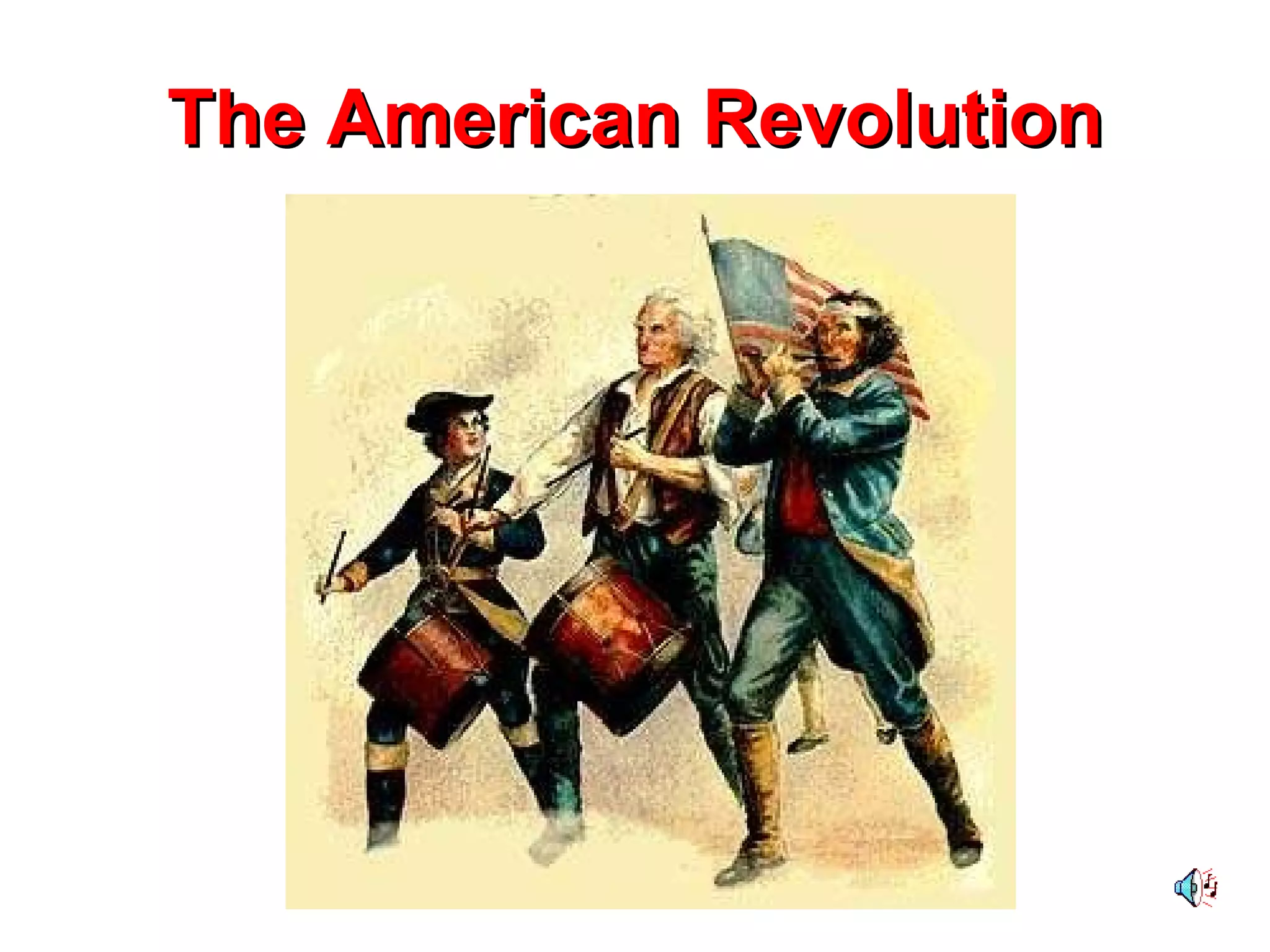
The American Revolution
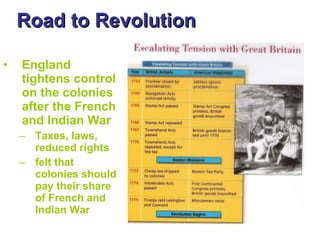
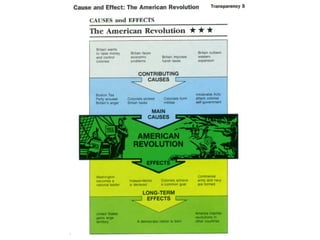
Road to Revolution England tightens control on the colonies after the French and Indian War Taxes, laws, reduced rights felt that colonies should pay their share of French and Indian War
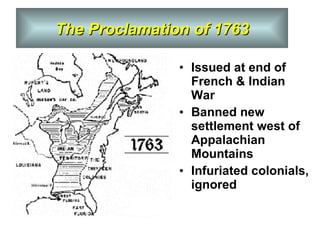
Issued at end of French & Indian War  Banned new settlement west of Appalachian Mountains Infuriated colonials, ignored The Proclamation of 1763
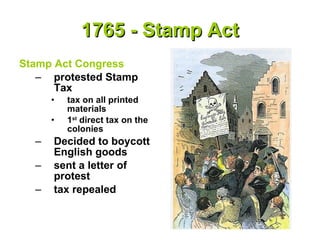
1765 - Stamp Act Stamp Act Congress protested Stamp Tax tax on all printed materials 1 st  direct tax on the colonies Decided to boycott English goods sent a letter of protest tax repealed
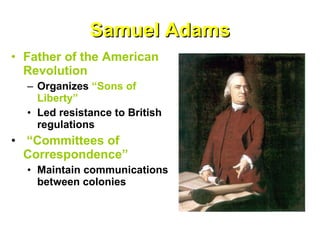
Samuel Adams Father of the American Revolution Organizes  “Sons of Liberty” Led resistance to British regulations “ Committees of Correspondence” Maintain communications between colonies
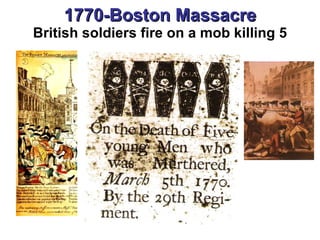
1770-Boston Massacre British soldiers fire on a mob killing 5
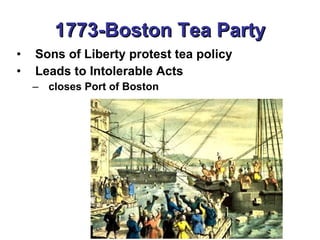
1773-Boston Tea Party Sons of Liberty protest tea policy Leads to Intolerable Acts  closes Port of Boston
1775 - 1 st  Continental Congress Protest the Intolerable Acts Boycott British Goods and send a letter of Protest (Stamp Tax Congress) British reply with tougher policies
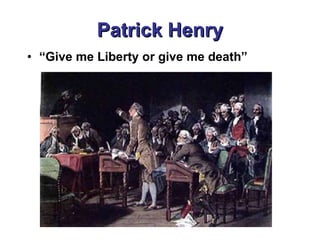
Patrick Henry “ Give me Liberty or give me death”
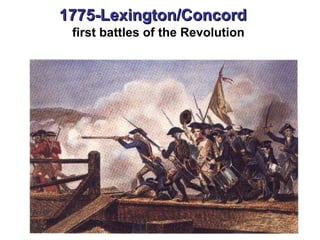
1775-Lexington/Concord     first battles of the Revolution
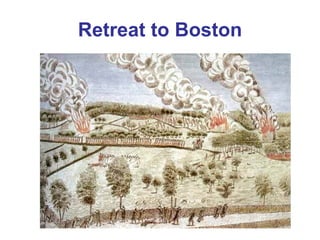
Retreat to Boston
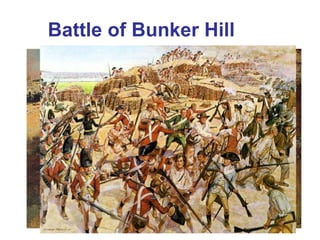
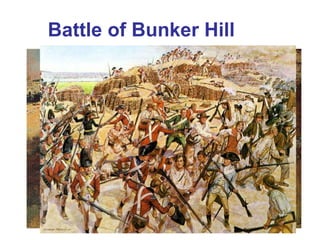
Battle of Bunker Hill
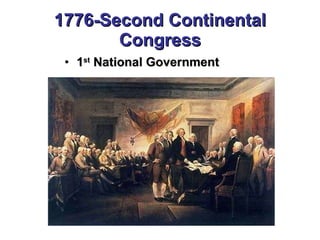
1776-Second Continental Congress 1 st  National Government
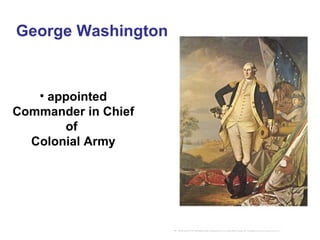
George Washington appointed Commander in Chief of  Colonial Army
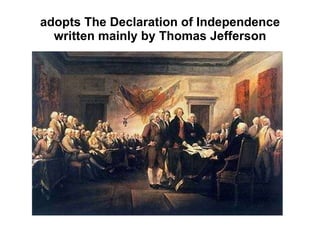
adopts The Declaration of Independence written mainly by Thomas Jefferson
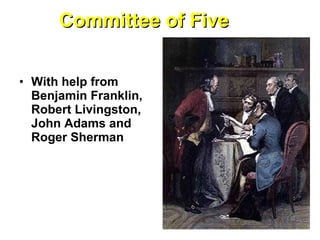
Committee of Five With help from Benjamin Franklin, Robert Livingston, John Adams and Roger Sherman
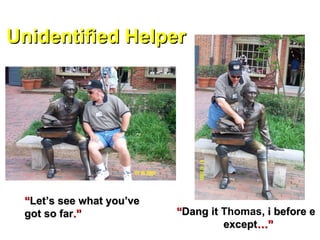
Unidentified Helper “ Dang it  Thomas , i before e    except …” “ Let’s see what you’ve got so far .”
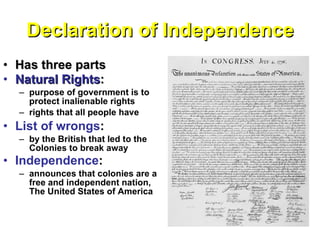
Declaration of Independence Has three parts Natural Rights :   purpose of government is to protect inalienable rights rights that all people have List of wrongs :  by the British that led to the Colonies to break away Independence :   announces that colonies are a free and independent nation, The United States of America
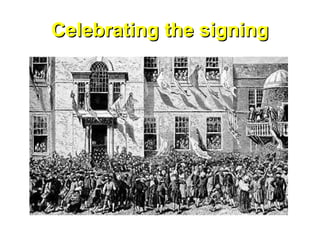
Celebrating the signing
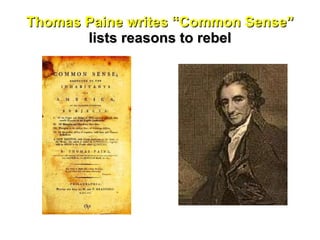
Thomas Paine writes “Common Sense”   lists reasons to rebel
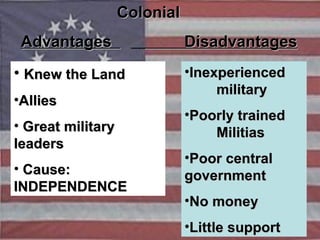
  Colonial   Advantages    Disadvantages Knew the Land  Allies  Great military  leaders Cause:  INDEPENDENCE Inexperienced  military Poorly trained  Militias Poor central  government No money Little support
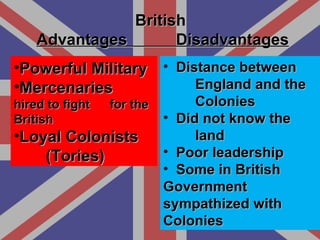
British  Advantages  Disadvantages Powerful Military Mercenaries  hired to fight  for the British Loyal Colonists (Tories) Distance between  England and the  Colonies Did not know the  land Poor leadership Some in British  Government  sympathized with  Colonies
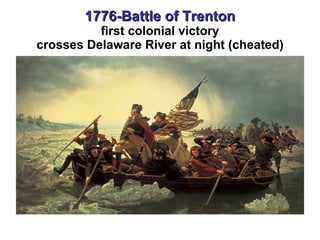
1776-Battle of Trenton first colonial victory crosses Delaware River at night (cheated)
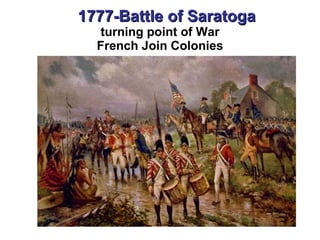
1777-Battle of Saratoga turning point of War French Join Colonies
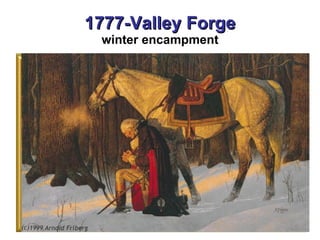
1777-Valley Forge winter encampment
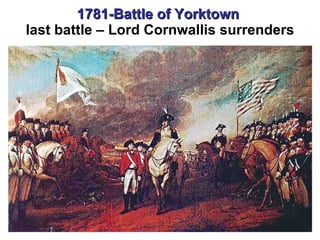
1781-Battle of Yorktown   last battle – Lord Cornwallis surrenders
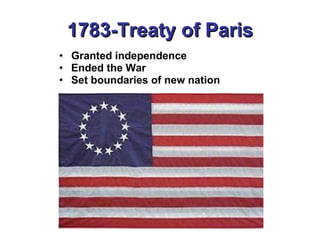
1783-Treaty of Paris Granted independence Ended the War Set boundaries of new nation
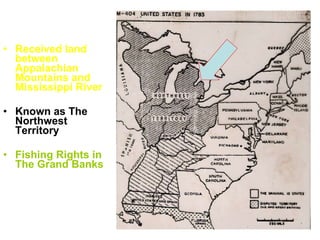
Received land between Appalachian Mountains and Mississippi River Known as The Northwest Territory Fishing Rights in The Grand Banks
 
THE EARLY REPUBLIC 1781-1801
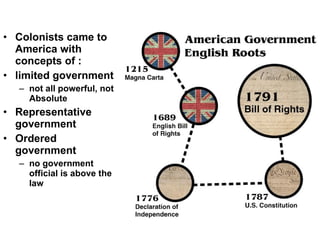
Colonists came to America with concepts of : limited government not all powerful, not Absolute  Representative government Ordered government no government official is above the law
Rights of Englishmen Magna Carta-1215 King cannot tax or declare war without permission of the Nobles cannot imprison without a jury trial/due process The Petition of Right-1628 protection of civil liberties  no taxation without consent   of Parliament The Habeas Corpus Act-1679 prevent arbitrary arrest and imprisonment English Bill of Rights-1689 prevents abuse by monarchs and guarantees citizens rights
The idea of guaranteeing individual rights developed over time, 1215 – 1689 Not just with the Bill of Rights
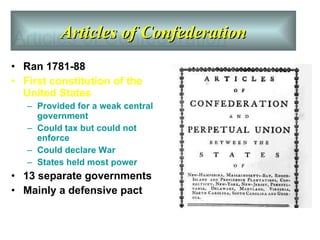
Articles of Confederation Ran 1781-88 First constitution of the United States  Provided for a weak central government  Could tax but could not enforce  Could declare War States held most power 13 separate governments Mainly a defensive pact Articles of Confederation
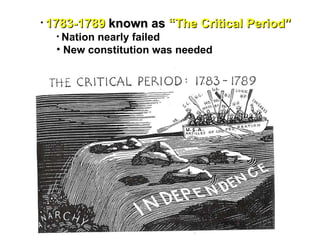
1783-1789  known as  “The Critical Period” Nation nearly failed New constitution was needed
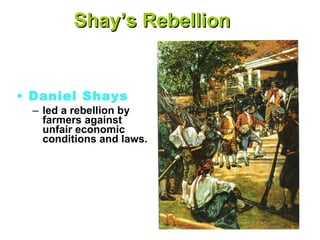
Shay’s Rebellion Daniel Shays led a rebellion by farmers against unfair economic conditions and laws.
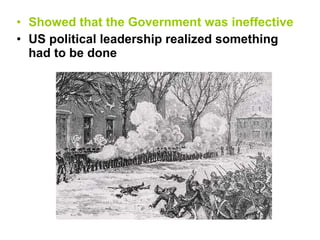
Showed that the Government was ineffective US political leadership realized something had to be done
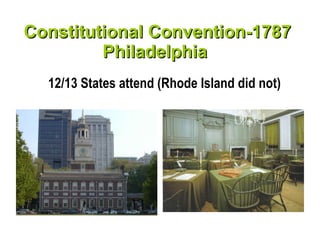
Constitutional Convention-1787 Philadelphia   12/13 States attend (Rhode Island did not)
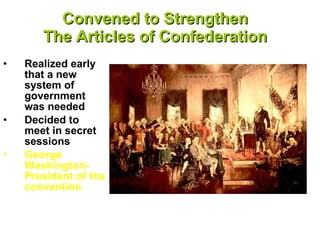
Convened to Strengthen  The Articles of Confederation   Realized early that a new system of government was needed Decided to meet in secret sessions George Washington-President of the convention
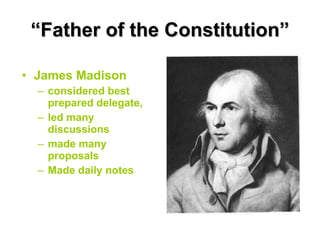
“ Father of the Constitution” James Madison considered best prepared delegate, led many discussions made many proposals Made daily notes
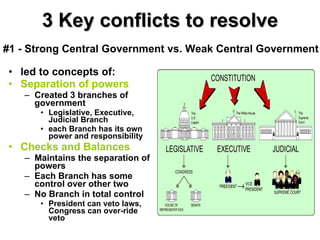
3 Key conflicts to resolve led to concepts of: Separation of powers Created 3 branches of government Legislative, Executive, Judicial Branch each Branch has its own power and responsibility Checks and Balances Maintains the separation of powers Each Branch has some control over other two No Branch in total control President can veto laws, Congress can over-ride veto #1 - Strong Central Government vs. Weak Central Government
#2 - How to decide representation Large States vs. Small States New Jersey Plan   each State represented equally, unicameral congress Virginia Plan   Representation by population, bicameral congress Resulted in the Great Compromise bicameral congress/lower house based on population/upper house equal representation Both houses had to agree before something is done.
#3 - North vs. South   The 3/5’s Compromise   three out of five slaves would be counted for representation and taxation Commerce and Slave Trade Compromise   congress could regulate trade  slave trade to be outlawed in 20 years (1808)
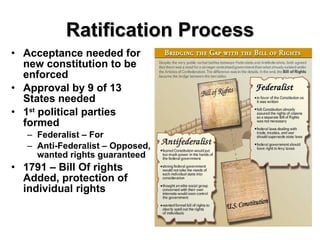
Ratification Process Acceptance needed for new constitution to be enforced Approval by 9 of 13 States needed   1 st  political parties formed Federalist – For Anti-Federalist – Opposed, wanted rights guaranteed 1791 – Bill Of rights Added, protection of individual rights
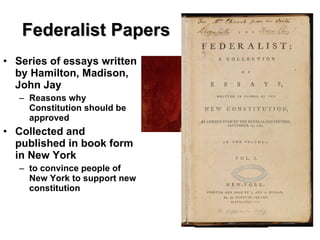
Federalist Papers Series of essays written by Hamilton, Madison, John Jay Reasons why Constitution should be approved Collected and published in book form in New York  to convince people of New York to support new constitution
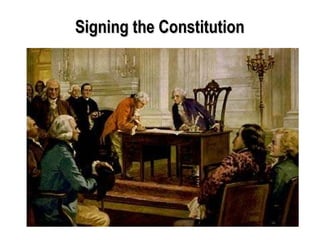
Signing the Constitution
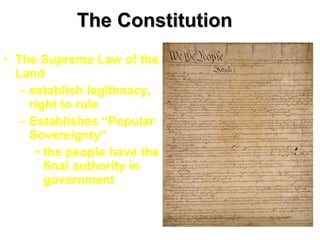
The Constitution   The Supreme Law of the Land establish legitimacy, right to rule Establishes “Popular Sovereignty” the people have the final authority in government
Structure Preamble  introduction/purpose of Constitution   Articles (7)  rules/powers   Amendments - 27   1-10 are the Bill of Rights 13-15 are the Civil War Amendments   16-27 are the 20th century amendments
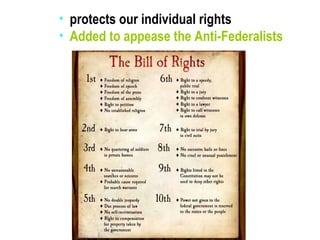
protects our individual rights Added to appease the Anti-Federalists
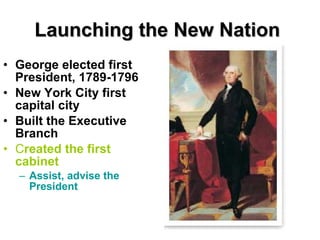
Launching the New Nation   George elected first President, 1789-1796 New York City first capital   city Built the Executive Branch   C reated the   first cabinet  Assist, advise the President
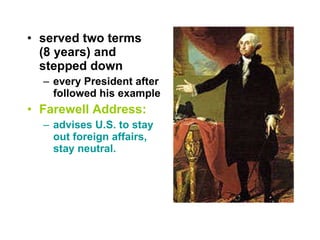
served two terms  (8 years) and stepped down every President after followed his example Farewell Address: advises U.S. to stay out foreign affairs, stay neutral.
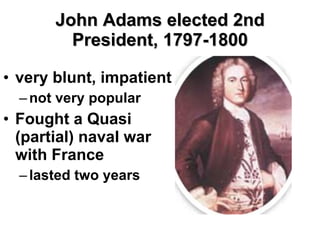
John Adams elected 2nd President, 1797-1800 very blunt, impatient not very popular   Fought a Quasi (partial) naval war with France lasted two years
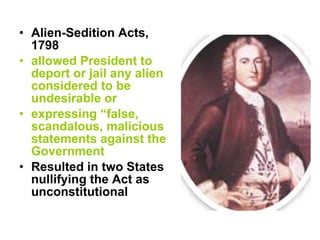
Alien-Sedition Acts, 1798 allowed President to deport or jail any alien considered to be undesirable or  expressing “false, scandalous, malicious statements against   the Government Resulted in two States nullifying the Act as   unconstitutional

Chapter2powerpoint

  • 1.
  • 2.
    Road to RevolutionEngland tightens control on the colonies after the French and Indian War Taxes, laws, reduced rights felt that colonies should pay their share of French and Indian War
  • 3.
    Issued at endof French & Indian War Banned new settlement west of Appalachian Mountains Infuriated colonials, ignored The Proclamation of 1763
  • 4.
    1765 - StampAct Stamp Act Congress protested Stamp Tax tax on all printed materials 1 st direct tax on the colonies Decided to boycott English goods sent a letter of protest tax repealed
  • 5.
    Samuel Adams Fatherof the American Revolution Organizes “Sons of Liberty” Led resistance to British regulations “ Committees of Correspondence” Maintain communications between colonies
  • 6.
    1770-Boston Massacre Britishsoldiers fire on a mob killing 5
  • 7.
    1773-Boston Tea PartySons of Liberty protest tea policy Leads to Intolerable Acts closes Port of Boston
  • 8.
    1775 - 1st Continental Congress Protest the Intolerable Acts Boycott British Goods and send a letter of Protest (Stamp Tax Congress) British reply with tougher policies
  • 9.
    Patrick Henry “Give me Liberty or give me death”
  • 10.
    1775-Lexington/Concord first battles of the Revolution
  • 11.
  • 12.
  • 13.
  • 14.
    1776-Second Continental Congress1 st National Government
  • 15.
    George Washington appointedCommander in Chief of Colonial Army
  • 16.
    adopts The Declarationof Independence written mainly by Thomas Jefferson
  • 17.
    Committee of FiveWith help from Benjamin Franklin, Robert Livingston, John Adams and Roger Sherman
  • 18.
    Unidentified Helper “Dang it Thomas , i before e except …” “ Let’s see what you’ve got so far .”
  • 19.
    Declaration of IndependenceHas three parts Natural Rights : purpose of government is to protect inalienable rights rights that all people have List of wrongs : by the British that led to the Colonies to break away Independence : announces that colonies are a free and independent nation, The United States of America
  • 20.
  • 21.
    Thomas Paine writes“Common Sense” lists reasons to rebel
  • 22.
    Colonial Advantages Disadvantages Knew the Land Allies Great military leaders Cause: INDEPENDENCE Inexperienced military Poorly trained Militias Poor central government No money Little support
  • 23.
    British Advantages Disadvantages Powerful Military Mercenaries hired to fight for the British Loyal Colonists (Tories) Distance between England and the Colonies Did not know the land Poor leadership Some in British Government sympathized with Colonies
  • 24.
    1776-Battle of Trentonfirst colonial victory crosses Delaware River at night (cheated)
  • 25.
    1777-Battle of Saratogaturning point of War French Join Colonies
  • 26.
  • 27.
    1781-Battle of Yorktown last battle – Lord Cornwallis surrenders
  • 28.
    1783-Treaty of ParisGranted independence Ended the War Set boundaries of new nation
  • 29.
    Received land betweenAppalachian Mountains and Mississippi River Known as The Northwest Territory Fishing Rights in The Grand Banks
  • 30.
  • 31.
  • 32.
    Colonists came toAmerica with concepts of : limited government not all powerful, not Absolute Representative government Ordered government no government official is above the law
  • 33.
    Rights of EnglishmenMagna Carta-1215 King cannot tax or declare war without permission of the Nobles cannot imprison without a jury trial/due process The Petition of Right-1628 protection of civil liberties no taxation without consent of Parliament The Habeas Corpus Act-1679 prevent arbitrary arrest and imprisonment English Bill of Rights-1689 prevents abuse by monarchs and guarantees citizens rights
  • 34.
    The idea ofguaranteeing individual rights developed over time, 1215 – 1689 Not just with the Bill of Rights
  • 35.
    Articles of ConfederationRan 1781-88 First constitution of the United States Provided for a weak central government Could tax but could not enforce Could declare War States held most power 13 separate governments Mainly a defensive pact Articles of Confederation
  • 36.
    1783-1789 knownas “The Critical Period” Nation nearly failed New constitution was needed
  • 37.
    Shay’s Rebellion DanielShays led a rebellion by farmers against unfair economic conditions and laws.
  • 38.
    Showed that theGovernment was ineffective US political leadership realized something had to be done
  • 39.
    Constitutional Convention-1787 Philadelphia 12/13 States attend (Rhode Island did not)
  • 40.
    Convened to Strengthen The Articles of Confederation Realized early that a new system of government was needed Decided to meet in secret sessions George Washington-President of the convention
  • 41.
    “ Father ofthe Constitution” James Madison considered best prepared delegate, led many discussions made many proposals Made daily notes
  • 42.
    3 Key conflictsto resolve led to concepts of: Separation of powers Created 3 branches of government Legislative, Executive, Judicial Branch each Branch has its own power and responsibility Checks and Balances Maintains the separation of powers Each Branch has some control over other two No Branch in total control President can veto laws, Congress can over-ride veto #1 - Strong Central Government vs. Weak Central Government
  • 43.
    #2 - Howto decide representation Large States vs. Small States New Jersey Plan each State represented equally, unicameral congress Virginia Plan Representation by population, bicameral congress Resulted in the Great Compromise bicameral congress/lower house based on population/upper house equal representation Both houses had to agree before something is done.
  • 44.
    #3 - Northvs. South The 3/5’s Compromise three out of five slaves would be counted for representation and taxation Commerce and Slave Trade Compromise congress could regulate trade slave trade to be outlawed in 20 years (1808)
  • 45.
    Ratification Process Acceptanceneeded for new constitution to be enforced Approval by 9 of 13 States needed 1 st political parties formed Federalist – For Anti-Federalist – Opposed, wanted rights guaranteed 1791 – Bill Of rights Added, protection of individual rights
  • 46.
    Federalist Papers Seriesof essays written by Hamilton, Madison, John Jay Reasons why Constitution should be approved Collected and published in book form in New York to convince people of New York to support new constitution
  • 47.
  • 48.
    The Constitution The Supreme Law of the Land establish legitimacy, right to rule Establishes “Popular Sovereignty” the people have the final authority in government
  • 49.
    Structure Preamble introduction/purpose of Constitution Articles (7) rules/powers Amendments - 27 1-10 are the Bill of Rights 13-15 are the Civil War Amendments 16-27 are the 20th century amendments
  • 50.
    protects our individualrights Added to appease the Anti-Federalists
  • 51.
    Launching the NewNation George elected first President, 1789-1796 New York City first capital city Built the Executive Branch C reated the first cabinet Assist, advise the President
  • 52.
    served two terms (8 years) and stepped down every President after followed his example Farewell Address: advises U.S. to stay out foreign affairs, stay neutral.
  • 53.
    John Adams elected2nd President, 1797-1800 very blunt, impatient not very popular Fought a Quasi (partial) naval war with France lasted two years
  • 54.
    Alien-Sedition Acts, 1798allowed President to deport or jail any alien considered to be undesirable or expressing “false, scandalous, malicious statements against the Government Resulted in two States nullifying the Act as unconstitutional