Enzyme Labeling
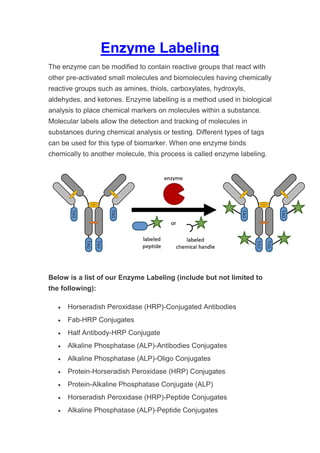
The enzyme can be modified to contain reactive groups that react with
other pre-activated small molecules and biomolecules having chemically
reactive groups such as amines, thiols, carboxylates, hydroxyls,
aldehydes, and ketones. Enzyme labelling is a method used in biological
analysis to place chemical markers on molecules within a substance.
Molecular labels allow the detection and tracking of molecules in
substances during chemical analysis or testing. Different types of tags
can be used for this type of biomarker. When one enzyme binds
chemically to another molecule, this process is called enzyme labeling.
Below is a list of our Enzyme Labeling (include but not limited to
the following):
 Horseradish Peroxidase (HRP)-Conjugated Antibodies
 Fab-HRP Conjugates
 Half Antibody-HRP Conjugate
 Alkaline Phosphatase (ALP)-Antibodies Conjugates
 Alkaline Phosphatase (ALP)-Oligo Conjugates
 Protein-Horseradish Peroxidase (HRP) Conjugates
 Protein-Alkaline Phosphatase Conjugate (ALP)
 Horseradish Peroxidase (HRP)-Peptide Conjugates
 Alkaline Phosphatase (ALP)-Peptide Conjugates
 Enzyme-Biotin Labeling
 Enzyme-Nanoparticle Bioconjugates
 Sample Submission Requirement
Procedure of Enzyme Labeling
The biomolecules provided by customers should be sufficiently pure.
Please provide 1-3 mg of starting material with the necessary data for
purity assessment. After labeling of enzyme with the crosslinking
reagent, final conjugates must first be isolated from excess or unreacted
reagent by gel filtration or dialysis. In many cases, simple dialysis may
suffice to remove unreacted reagent from the reaction solution.
Additional purification techniques such as stirred cell filtration, tangential
flow filtration (TFF), and gel filtration chromatography may also be used
to either remove excess reagent or isolate and characterize the
cross-linked product. For reagents (mostly protein and other biological
molecules) that are similar in size or larger than the antibody, one must
resort to other purification techniques such as affinity chromatography,
ion-exchange chromatography, and hydrophobic interaction
chromatography. Cross-linked target molecules may then be further
characterized by biochemical or biophysical techniques. After
purification, the product may be subject to many different types of
studies including spectroscopic (MALDI-TOF, ESI, LC-MS
Fluorescence), electrophoresis, immunochemical biochemical, and
enzymatical analysis.
Why Choose BOC Sciences?
BOC Sciences is proud to provide you enzyme labeling service. Our
experts and chemists are professional at enzyme labeling to help you to
make progress in your research. Moreover, our dedicated technical
account managers will guide your project through every step of the
process and constantly keep you informed of the latest project progress.
References
1. Ishikawa, E., Imagawa, M., Hashida, S., Yoshitake, S., Hamaguchi, Y., &
Ueno, T. (1983). Enzyme-labeling of antibodies and their fragments for
enzyme immunoassay and immunohistochemical staining. Journal of
Immunoassay and Immunochemistry, 4(3), 209-327.
2. Estelmann, S., Hügler, M., Eisenreich, W., Werner, K., Berg, I. A.,
Ramos-Vera, W. H., ... & Fuchs, G. (2011). Labeling and enzyme studies
of the central carbon metabolism in Metallosphaera sedula. Journal of
bacteriology, 193(5), 1191-1200.

Enzyme labeling

  • 1.
    Enzyme Labeling The enzymecan be modified to contain reactive groups that react with other pre-activated small molecules and biomolecules having chemically reactive groups such as amines, thiols, carboxylates, hydroxyls, aldehydes, and ketones. Enzyme labelling is a method used in biological analysis to place chemical markers on molecules within a substance. Molecular labels allow the detection and tracking of molecules in substances during chemical analysis or testing. Different types of tags can be used for this type of biomarker. When one enzyme binds chemically to another molecule, this process is called enzyme labeling. Below is a list of our Enzyme Labeling (include but not limited to the following):  Horseradish Peroxidase (HRP)-Conjugated Antibodies  Fab-HRP Conjugates  Half Antibody-HRP Conjugate  Alkaline Phosphatase (ALP)-Antibodies Conjugates  Alkaline Phosphatase (ALP)-Oligo Conjugates  Protein-Horseradish Peroxidase (HRP) Conjugates  Protein-Alkaline Phosphatase Conjugate (ALP)  Horseradish Peroxidase (HRP)-Peptide Conjugates  Alkaline Phosphatase (ALP)-Peptide Conjugates
  • 2.
     Enzyme-Biotin Labeling Enzyme-Nanoparticle Bioconjugates  Sample Submission Requirement Procedure of Enzyme Labeling The biomolecules provided by customers should be sufficiently pure. Please provide 1-3 mg of starting material with the necessary data for purity assessment. After labeling of enzyme with the crosslinking reagent, final conjugates must first be isolated from excess or unreacted reagent by gel filtration or dialysis. In many cases, simple dialysis may suffice to remove unreacted reagent from the reaction solution. Additional purification techniques such as stirred cell filtration, tangential flow filtration (TFF), and gel filtration chromatography may also be used to either remove excess reagent or isolate and characterize the cross-linked product. For reagents (mostly protein and other biological molecules) that are similar in size or larger than the antibody, one must resort to other purification techniques such as affinity chromatography, ion-exchange chromatography, and hydrophobic interaction chromatography. Cross-linked target molecules may then be further characterized by biochemical or biophysical techniques. After purification, the product may be subject to many different types of studies including spectroscopic (MALDI-TOF, ESI, LC-MS Fluorescence), electrophoresis, immunochemical biochemical, and enzymatical analysis. Why Choose BOC Sciences? BOC Sciences is proud to provide you enzyme labeling service. Our experts and chemists are professional at enzyme labeling to help you to make progress in your research. Moreover, our dedicated technical account managers will guide your project through every step of the process and constantly keep you informed of the latest project progress. References
  • 3.
    1. Ishikawa, E.,Imagawa, M., Hashida, S., Yoshitake, S., Hamaguchi, Y., & Ueno, T. (1983). Enzyme-labeling of antibodies and their fragments for enzyme immunoassay and immunohistochemical staining. Journal of Immunoassay and Immunochemistry, 4(3), 209-327. 2. Estelmann, S., Hügler, M., Eisenreich, W., Werner, K., Berg, I. A., Ramos-Vera, W. H., ... & Fuchs, G. (2011). Labeling and enzyme studies of the central carbon metabolism in Metallosphaera sedula. Journal of bacteriology, 193(5), 1191-1200.