Enzyme Labelling
Creative Enzymes Inc.
Introduction of Enzyme Labelling
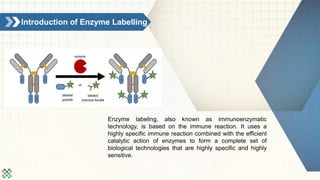
Enzyme labeling, also known as immunoenzymatic
technology, is based on the immune reaction. It uses a
highly specific immune reaction combined with the efficient
catalytic action of enzymes to form a complete set of
biological technologies that are highly specific and highly
sensitive.
Development of enzyme labeling
The development of enzyme labeling mainly has two
directions, one is enzyme immunoassay technology, the
other is enzyme immunohistochemical staining
technology. It is used to detect soluble antigen and
antibody components in body fluids and to locate antigen
or antibody components on cells and tissues. The reaction
results of the enzyme labeling technology are easy to
observe.
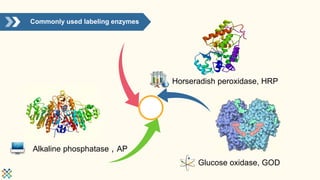
Alkaline phosphatase,AP
Horseradish peroxidase, HRP
Glucose oxidase, GOD
Commonly used labeling enzymes
Horseradish peroxidase, HRP
Cyanide, sulfide, fluoride and azide have inhibitory effect
on HRP activity.
The molecular weight is small (40kD), and the marker can
easily penetrate into the cell.
Good solubility. 5g HRP can dissolve in 100ml buffered
salt solution, it can also be dissolved in ammonium sulfate
solution below 62% saturation.
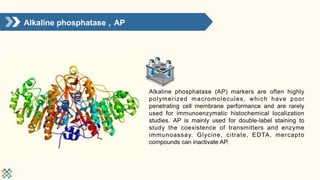
Alkaline phosphatase,AP
Alkaline phosphatase (AP) markers are often highly
polymerized macromolecules, which have poor
penetrating cell membrane performance and are rarely
used for immunoenzymatic histochemical localization
studies. AP is mainly used for double-label staining to
study the coexistence of transmitters and enzyme
immunoassay. Glycine, citrate, EDTA, mercapto
compounds can inactivate AP.
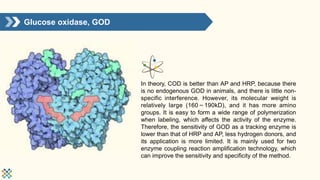
Glucose oxidase, GOD
In theory, COD is better than AP and HRP, because there
is no endogenous GOD in animals, and there is little non-
specific interference. However, its molecular weight is
relatively large (160~190kD), and it has more amino
groups. It is easy to form a wide range of polymerization
when labeling, which affects the activity of the enzyme.
Therefore, the sensitivity of GOD as a tracking enzyme is
lower than that of HRP and AP, less hydrogen donors, and
its application is more limited. It is mainly used for two
enzyme coupling reaction amplification technology, which
can improve the sensitivity and specificity of the method.
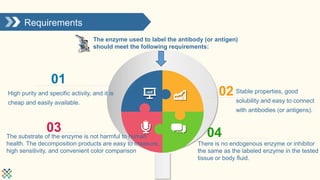
Requirements
Stable properties, good
solubility and easy to connect
with antibodies (or antigens).
High purity and specific activity, and it is
cheap and easily available.
01
02
0403
There is no endogenous enzyme or inhibitor
the same as the labeled enzyme in the tested
tissue or body fluid.
The substrate of the enzyme is not harmful to human
health. The decomposition products are easy to measure,
high sensitivity, and convenient color comparison
The enzyme used to label the antibody (or antigen)
should meet the following requirements:
Featured Enzyme Labeling Categories
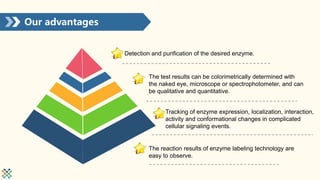
Our advantages
The reaction results of enzyme labeling technology are
easy to observe.
The test results can be colorimetrically determined with
the naked eye, microscope or spectrophotometer, and can
be qualitative and quantitative.
Tracking of enzyme expression, localization, interaction,
activity and conformational changes in complicated
cellular signaling events.
Detection and purification of the desired enzyme.
Our services
Creative Enzymes offers enzyme labeling services both in
vitro and in vivo. We have developed the enzyme labeling
techniques to accommodate virtually any need for all types of
biomolecular probes. With decades of experiences and unique
technologies, Creative Enzymes makes commitment to
providing customers with the highest quality enzyme labeling
services.
Creative Enzymes has developed a series of enzyme
labeling techniques and reagents to meet various
research requirements. Enzyme labeling leads to the
covalent attachment of different molecules, including
biotin, reporter enzymes, fluorophores and radioactive
isotopes, to the target enzyme. While multiple types of
labels are available, their versatile uses are preferable for
specific applications.
Contact Us
Address: 45-1 Ramsey Road, Shirley, NY 11967, USA
Email: info@creative-enzymes.com
Tel: 1-631-562-8517 1-516-512-3133
Fax: 1-631-938-8127
www.creative-enzymes.com
THANKS
Creative Enzymes Inc.

Enzyme labelling

  • 1.
  • 2.
    Introduction of EnzymeLabelling Enzyme labeling, also known as immunoenzymatic technology, is based on the immune reaction. It uses a highly specific immune reaction combined with the efficient catalytic action of enzymes to form a complete set of biological technologies that are highly specific and highly sensitive.
  • 3.
    Development of enzymelabeling The development of enzyme labeling mainly has two directions, one is enzyme immunoassay technology, the other is enzyme immunohistochemical staining technology. It is used to detect soluble antigen and antibody components in body fluids and to locate antigen or antibody components on cells and tissues. The reaction results of the enzyme labeling technology are easy to observe.
  • 4.
    Alkaline phosphatase,AP Horseradish peroxidase,HRP Glucose oxidase, GOD Commonly used labeling enzymes
  • 5.
    Horseradish peroxidase, HRP Cyanide,sulfide, fluoride and azide have inhibitory effect on HRP activity. The molecular weight is small (40kD), and the marker can easily penetrate into the cell. Good solubility. 5g HRP can dissolve in 100ml buffered salt solution, it can also be dissolved in ammonium sulfate solution below 62% saturation.
  • 6.
    Alkaline phosphatase,AP Alkaline phosphatase(AP) markers are often highly polymerized macromolecules, which have poor penetrating cell membrane performance and are rarely used for immunoenzymatic histochemical localization studies. AP is mainly used for double-label staining to study the coexistence of transmitters and enzyme immunoassay. Glycine, citrate, EDTA, mercapto compounds can inactivate AP.
  • 7.
    Glucose oxidase, GOD Intheory, COD is better than AP and HRP, because there is no endogenous GOD in animals, and there is little non- specific interference. However, its molecular weight is relatively large (160~190kD), and it has more amino groups. It is easy to form a wide range of polymerization when labeling, which affects the activity of the enzyme. Therefore, the sensitivity of GOD as a tracking enzyme is lower than that of HRP and AP, less hydrogen donors, and its application is more limited. It is mainly used for two enzyme coupling reaction amplification technology, which can improve the sensitivity and specificity of the method.
  • 8.
    Requirements Stable properties, good solubilityand easy to connect with antibodies (or antigens). High purity and specific activity, and it is cheap and easily available. 01 02 0403 There is no endogenous enzyme or inhibitor the same as the labeled enzyme in the tested tissue or body fluid. The substrate of the enzyme is not harmful to human health. The decomposition products are easy to measure, high sensitivity, and convenient color comparison The enzyme used to label the antibody (or antigen) should meet the following requirements:
  • 9.
  • 10.
  • 11.
    Our advantages The reactionresults of enzyme labeling technology are easy to observe. The test results can be colorimetrically determined with the naked eye, microscope or spectrophotometer, and can be qualitative and quantitative. Tracking of enzyme expression, localization, interaction, activity and conformational changes in complicated cellular signaling events. Detection and purification of the desired enzyme.
  • 12.
    Our services Creative Enzymesoffers enzyme labeling services both in vitro and in vivo. We have developed the enzyme labeling techniques to accommodate virtually any need for all types of biomolecular probes. With decades of experiences and unique technologies, Creative Enzymes makes commitment to providing customers with the highest quality enzyme labeling services. Creative Enzymes has developed a series of enzyme labeling techniques and reagents to meet various research requirements. Enzyme labeling leads to the covalent attachment of different molecules, including biotin, reporter enzymes, fluorophores and radioactive isotopes, to the target enzyme. While multiple types of labels are available, their versatile uses are preferable for specific applications.
  • 13.
    Contact Us Address: 45-1Ramsey Road, Shirley, NY 11967, USA Email: info@creative-enzymes.com Tel: 1-631-562-8517 1-516-512-3133 Fax: 1-631-938-8127 www.creative-enzymes.com
  • 14.