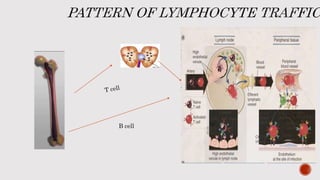

 Lymphocytes continuously recirculate between the vascular system and tissues
 These migratory properties of lymphocytes and dendritic cells, which are
essential for the homeostasis and function of the immune system.
 Regulated by various cell-adhesion molecules and by a group of chemokines
collectively called “immune chemokines.
 Immune chemokines are thus key elements in the genesis, maintenance, and
function of the immune system.
Definitio
n
The process whereby lymphocytes adhere to and migrate across vascular
endothelium into an organ or site of inflammation
WHY LYMPHOCYTES TRAFFICKING IS ESSENTIAL
 Its necessary for Lymphocyte developmen and differentiation.
 For immune response
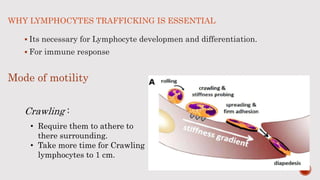
Mode of motility
Crawling :
• Require them to athere to
there surrounding.
• Take more time for Crawling
lymphocytes to 1 cm.
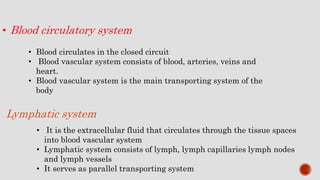
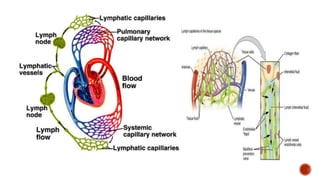
• Blood circulatory system
• Blood circulates in the closed circuit
• Blood vascular system consists of blood, arteries, veins and
heart.
• Blood vascular system is the main transporting system of the
body
Lymphatic system
• It is the extracellular fluid that circulates through the tissue spaces
into blood vascular system
• Lymphatic system consists of lymph, lymph capillaries lymph nodes
and lymph vessels
• It serves as parallel transporting system
B cell
ROLE OF HEVS IN CELL
MIGRATION
High endothelial venules (HEVs) are specialized blood vessels which
support the migration of naive lymphocytes from the blood stream into
secondary lymphoid organs.
 Lymphocyte extravasation can be regulated by high-endothelial
venules.
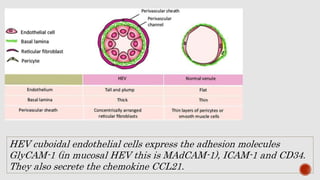
HEV cuboidal endothelial cells express the adhesion molecules.
HEV cuboidal endothelial cells express the adhesion molecules
GlyCAM-1 (in mucosal HEV this is MAdCAM-1), ICAM-1 and CD34.
They also secrete the chemokine CCL21.
LYMPHOCYTE
EXTRAVASATION
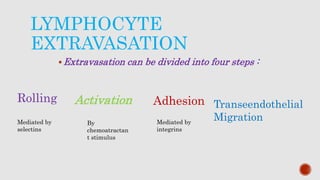
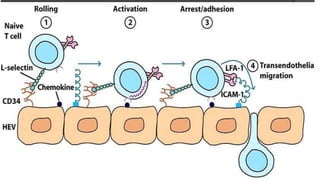
Extravasation can be divided into four steps :
Rolling Activation Adhesion Transeendothelial
MigrationMediated by
selectins
By
chemoatractan
t stimulus
Mediated by
integrins
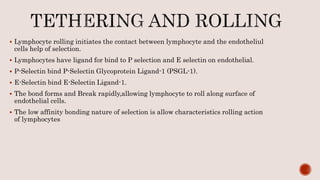
 Lymphocyte rolling initiates the contact between lymphocyte and the endotheliul
cells help of selection.
 Lymphocytes have ligand for bind to P selection and E selectin on endothelial.
 P-Selectin bind P-Selectin Glycoprotein Ligand-1 (PSGL-1).
 E-Selectin bind E-Selectin Ligand-1.
 The bond forms and Break rapidly,allowing lymphocyte to roll along surface of
endothelial cells.
 The low affinity bonding nature of selection is allow characteristics rolling action
of lymphocytes
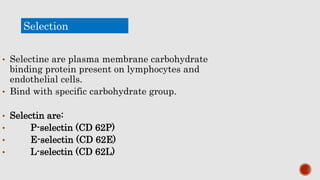
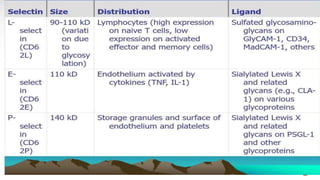
• Selectine are plasma membrane carbohydrate
binding protein present on lymphocytes and
endothelial cells.
• Bind with specific carbohydrate group.
• Selectin are:
• P-selectin (CD 62P)
• E-selectin (CD 62E)
• L-selectin (CD 62L)
Selection
ACTIVATION AND
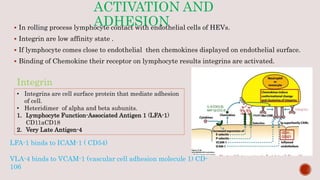
ADHESION In rolling process lymphocyte contact with endothelial cells of HEVs.
 Integrin are low affinity state .
 If lymphocyte comes close to endothelial then chemokines displayed on endothelial surface.
 Binding of Chemokine their receptor on lymphocyte results integrins are activated.
Integrin
• Integrins are cell surface protein that mediate adhesion
of cell.
• Heteridimer of alpha and beta subunits.
1. Lymphocyte Function-Associated Antigen 1 (LFA-1)
CD11aCD18
2. Very Late Antigen-4
LFA-1 binds to ICAM-1 ( CD54)
VLA-4 binds to VCAM-1 (vascular cell adhesion molecule 1) CD-
106
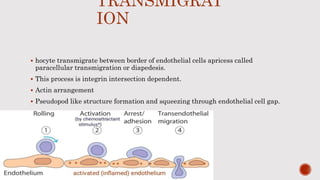
TRANSMIGRAT
ION
 hocyte transmigrate between border of endothelial cells apricess called
paracellular transmigration or diapedesis.
 This process is integrin intersection dependent.
 Actin arrangement
 Pseudopod like structure formation and squeezing through endothelial cell gap.
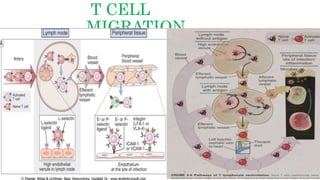
T CELL
MIGRATION
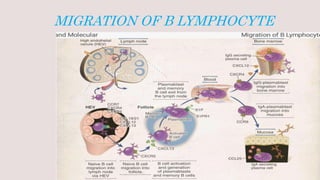
MIGRATION OF B LYMPHOCYTE
 Abbas, Abul K., Andrew HH Lichtman, and Shiv Pillai. Cellular and molecular
immunology E-book. Elsevier Health Sciences, 2014.
 Kindt, T. J., Goldsby, R. A., & Osborne, B. A. Kuby immunology. 6th ed2007.
 https://www.ncbi.nlm.nih.gov/m/pubmed/17202753/
Reference
Thank you

Lymphocyte traffic p.k.sonkar

  • 2.
     Lymphocytes continuouslyrecirculate between the vascular system and tissues  These migratory properties of lymphocytes and dendritic cells, which are essential for the homeostasis and function of the immune system.  Regulated by various cell-adhesion molecules and by a group of chemokines collectively called “immune chemokines.  Immune chemokines are thus key elements in the genesis, maintenance, and function of the immune system. Definitio n The process whereby lymphocytes adhere to and migrate across vascular endothelium into an organ or site of inflammation
  • 3.
    WHY LYMPHOCYTES TRAFFICKINGIS ESSENTIAL  Its necessary for Lymphocyte developmen and differentiation.  For immune response Mode of motility Crawling : • Require them to athere to there surrounding. • Take more time for Crawling lymphocytes to 1 cm.
  • 4.
    • Blood circulatorysystem • Blood circulates in the closed circuit • Blood vascular system consists of blood, arteries, veins and heart. • Blood vascular system is the main transporting system of the body Lymphatic system • It is the extracellular fluid that circulates through the tissue spaces into blood vascular system • Lymphatic system consists of lymph, lymph capillaries lymph nodes and lymph vessels • It serves as parallel transporting system
  • 6.
  • 7.
    ROLE OF HEVSIN CELL MIGRATION High endothelial venules (HEVs) are specialized blood vessels which support the migration of naive lymphocytes from the blood stream into secondary lymphoid organs.  Lymphocyte extravasation can be regulated by high-endothelial venules. HEV cuboidal endothelial cells express the adhesion molecules.
  • 8.
    HEV cuboidal endothelialcells express the adhesion molecules GlyCAM-1 (in mucosal HEV this is MAdCAM-1), ICAM-1 and CD34. They also secrete the chemokine CCL21.
  • 9.
    LYMPHOCYTE EXTRAVASATION Extravasation can bedivided into four steps : Rolling Activation Adhesion Transeendothelial MigrationMediated by selectins By chemoatractan t stimulus Mediated by integrins
  • 11.
     Lymphocyte rollinginitiates the contact between lymphocyte and the endotheliul cells help of selection.  Lymphocytes have ligand for bind to P selection and E selectin on endothelial.  P-Selectin bind P-Selectin Glycoprotein Ligand-1 (PSGL-1).  E-Selectin bind E-Selectin Ligand-1.  The bond forms and Break rapidly,allowing lymphocyte to roll along surface of endothelial cells.  The low affinity bonding nature of selection is allow characteristics rolling action of lymphocytes
  • 12.
    • Selectine areplasma membrane carbohydrate binding protein present on lymphocytes and endothelial cells. • Bind with specific carbohydrate group. • Selectin are: • P-selectin (CD 62P) • E-selectin (CD 62E) • L-selectin (CD 62L) Selection
  • 14.
    ACTIVATION AND ADHESION Inrolling process lymphocyte contact with endothelial cells of HEVs.  Integrin are low affinity state .  If lymphocyte comes close to endothelial then chemokines displayed on endothelial surface.  Binding of Chemokine their receptor on lymphocyte results integrins are activated. Integrin • Integrins are cell surface protein that mediate adhesion of cell. • Heteridimer of alpha and beta subunits. 1. Lymphocyte Function-Associated Antigen 1 (LFA-1) CD11aCD18 2. Very Late Antigen-4 LFA-1 binds to ICAM-1 ( CD54) VLA-4 binds to VCAM-1 (vascular cell adhesion molecule 1) CD- 106
  • 15.
    TRANSMIGRAT ION  hocyte transmigratebetween border of endothelial cells apricess called paracellular transmigration or diapedesis.  This process is integrin intersection dependent.  Actin arrangement  Pseudopod like structure formation and squeezing through endothelial cell gap.
  • 16.
  • 17.
    MIGRATION OF BLYMPHOCYTE
  • 18.
     Abbas, AbulK., Andrew HH Lichtman, and Shiv Pillai. Cellular and molecular immunology E-book. Elsevier Health Sciences, 2014.  Kindt, T. J., Goldsby, R. A., & Osborne, B. A. Kuby immunology. 6th ed2007.  https://www.ncbi.nlm.nih.gov/m/pubmed/17202753/ Reference
  • 19.