WELCOME TO OUR
PRESENTATION
Group no: 01
 Group members:
Rana Ahmed (PHA-14001)
Mahfujul Hasan (PHA-14002)
Shahida Yeasmin (PHA-14005)
Shamima Akter Sumi (PHA-14007)
Ruma Akter (PHA-14009)
Firuz Fatema Pria (PHA-14010)
Ratna Sarker (PHA-14011)
ENZYMES
IN
THERAPY
INTRODUCTION
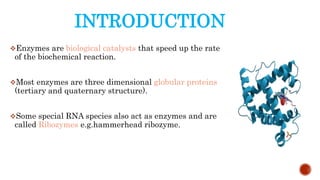
Enzymes are biological catalysts that speed up the rate
of the biochemical reaction.
Most enzymes are three dimensional globular proteins
(tertiary and quaternary structure).
Some special RNA species also act as enzymes and are
called Ribozymes e.g.hammerhead ribozyme.
CHARACTERISTICS
 Enzymes speed up the reaction by lowering the activation
energy of the reaction.
 Their presence does not affect the nature and properties
of end product.
 They are highly specific in their action that is each
enzyme can catalyze one kind of substrate.
 Small amount of enzymes can accelerate chemical
reactions.
 Enzymes are sensitive to change in pH, temperature and
substrate concentration.
ACTIVATION
Activation is defined as the conversion of an inactive form of an enzyme to active
form which processes the metabolic activity .
TYPES OF ACTIVATION
1. Activation by co-factors.
2. Conversion of an enzyme precursor.
ACTIVATION BY CO FACTORS
Many enzymes are activated by co-factors.
Examples:
DNA polymerase is a holo-enzyme that catalyzes the polymerization of de
-oxyribonucleotide into a DNA strand. It uses Mg ++ ion for catalytic
activity .
CONVERSION OF AN ENZYME PRECURSOR
Specific proteolysis is a common method of activating enzymes and other
proteins in biological system.
Example:
The generation of pepsin from pepsinogen by HCl acid leads to the
activation of other zymogens.
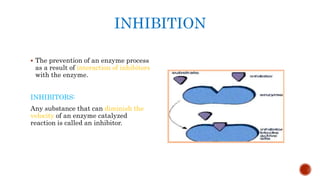
INHIBITION
 The prevention of an enzyme process
as a result of interaction of inhibitors
with the enzyme.
INHIBITORS:
Any substance that can diminish the
velocity of an enzyme catalyzed
reaction is called an inhibitor.
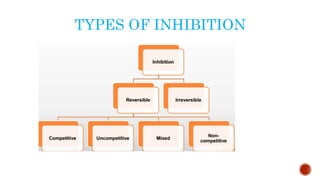
TYPES OF INHIBITION
REVERSIBLE INHIBITION
It is an inhibition of enzyme activity in which the inhibiting molecular entity can
associate and dissociate from the proteins binding site.
TYPES OF REVERSIBLE INHIBITION
There are four types:
1. Competitive inhibition.
2. Uncompetitive inhibition.
3. Mixed inhibition.
4. Non-competitive inhibition
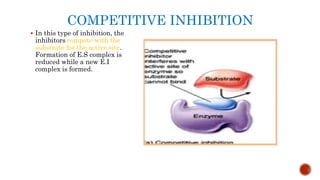
COMPETITIVE INHIBITION
 In this type of inhibition, the
inhibitors compete with the
substrate for the active site.
Formation of E.S complex is
reduced while a new E.I
complex is formed.
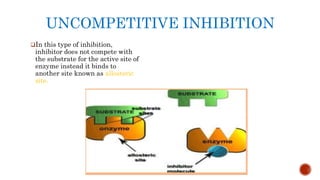
UNCOMPETITIVE INHIBITION
In this type of inhibition,
inhibitor does not compete with
the substrate for the active site of
enzyme instead it binds to
another site known as allosteric
site.
MIXED INHIBITION
In this type of inhibition both E.I and E.S.I complexes are formed.
Both complexes are catalytically inactive.
NON COMPETITIVE INHIBITION
It is a special case of inhibition.
In this inhibitor has the same affinity for either enzyme E or the E.S
complex.
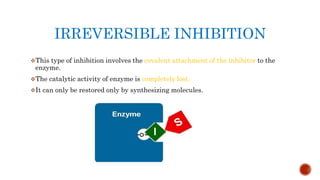
IRREVERSIBLE INHIBITION
This type of inhibition involves the covalent attachment of the inhibitor to the
enzyme.
The catalytic activity of enzyme is completely lost.
It can only be restored only by synthesizing molecules.
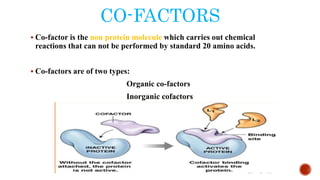
CO-FACTORS
 Co-factor is the non protein molecule which carries out chemical
reactions that can not be performed by standard 20 amino acids.
 Co-factors are of two types:
Organic co-factors
Inorganic cofactors
INORGANIC CO-FACTORS
These are the inorganic molecules required for the proper activity of enzymes.
Examples:
Enzyme carbonic anhydrase requires Zn ++ for its activity.
 Hexokinase has co-factor Mg++
ORGANIC CO-FACTORS
These are the organic molecules required for the proper activity of enzymes.
Example:
Glycogen phosphorylase requires the small organic molecule pyridoxal phosphate.
TYPES OF ORGANIC CO-
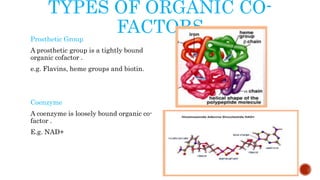
FACTORSProsthetic Group
A prosthetic group is a tightly bound
organic cofactor .
e.g. Flavins, heme groups and biotin.
Coenzyme
A coenzyme is loosely bound organic co-
factor .
E.g. NAD+
MECHANISM OF ENZYME
ACTION
The catalytic efficiency of enzymes is explained by two
perspectives:
 Thermodynamic changes
 Processes at the active site
THERMODYNAMIC CHANGES
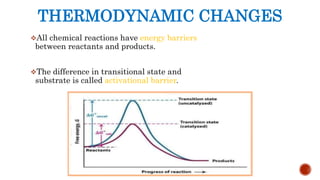
All chemical reactions have energy barriers
between reactants and products.
The difference in transitional state and
substrate is called activational barrier.
THERMODYNAMIC CHANGES
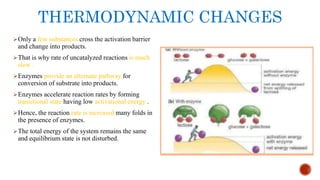
Only a few substances cross the activation barrier
and change into products.
That is why rate of uncatalyzed reactions is much
slow .
Enzymes provide an alternate pathway for
conversion of substrate into products.
Enzymes accelerate reaction rates by forming
transitional state having low activational energy .
Hence, the reaction rate is increased many folds in
the presence of enzymes.
The total energy of the system remains the same
and equilibrium state is not disturbed.
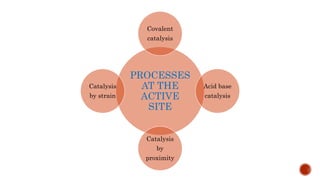
PROCESSES
AT THE
ACTIVE
SITE
Covalent
catalysis
Acid base
catalysis
Catalysis
by
proximity
Catalysis
by strain
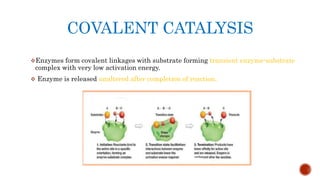
COVALENT CATALYSIS
Enzymes form covalent linkages with substrate forming transient enzyme-substrate
complex with very low activation energy.
 Enzyme is released unaltered after completion of reaction.
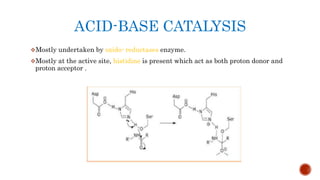
ACID-BASE CATALYSIS
Mostly undertaken by oxido- reductases enzyme.
Mostly at the active site, histidine is present which act as both proton donor and
proton acceptor .
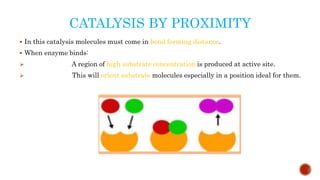
CATALYSIS BY PROXIMITY
 In this catalysis molecules must come in bond forming distance.
 When enzyme binds:
 A region of high substrate concentration is produced at active site.
 This will orient substrate molecules especially in a position ideal for them.
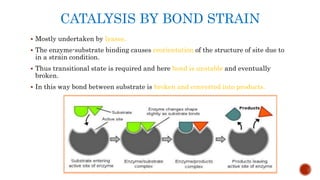
CATALYSIS BY BOND STRAIN
 Mostly undertaken by lyases.
 The enzyme-substrate binding causes reorientation of the structure of site due to
in a strain condition.
 Thus transitional state is required and here bond is unstable and eventually
broken.
 In this way bond between substrate is broken and converted into products.
APPLICATIONS OF ENZYMES IN THE
PHARMACEUTICAL INDUSTRY
Analytical Uses
Enzymes can be used to detect and measure amounts of glucose in blood.
Amount of glucose in blood and urine is an indicator for diagnosis of diabetes.
Industrial Uses
Penicillin G/V acylase and glucose isomerase are just two of the many enzymes
used in the pharmaceutical industry.
Penicillin acylase and glucose isomerase aid in the production of semi synthetic
penicillin and fructose syrup.
THERAPEUTIC
It can be administered individually or along with other
drugs and/or treatments.
Enzyme supplements for enzyme deficiencies.
Prolactazyme treats lactose intolerance.
Collagenase treats skin ulcer.
Asparaginase used to treat leukemia.
Streptokinase administered to patients immediately
after heart attacks.
Activase for breaking up clots and heart attacks.
TREATMENT OF CANCER
i. By inhibiting cancer cell growth, vascularization (blood supply) and metastasis
(spread).
ii. Enzymes are used to deliver and turn on cancer drugs only when in the
presence of cancer cells.
iii. Enzymes are used for treating side effects of cancer, such as hyperuricemia
ENZYME ASSAYS
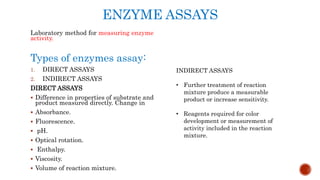
Laboratory method for measuring enzyme
activity.
Types of enzymes assay:
1. DIRECT ASSAYS
2. INDIRECT ASSAYS
DIRECT ASSAYS
 Difference in properties of substrate and
product measured directly. Change in
 Absorbance.
 Fluorescence.
 pH.
 Optical rotation.
 Enthalpy.
 Viscosity.
 Volume of reaction mixture.
INDIRECT ASSAYS
• Further treatment of reaction
mixture produce a measurable
product or increase sensitivity.
• Reagents required for color
development or measurement of
activity included in the reaction
mixture.
FIBRINOLYTIC DRUGS
Agents that activate plasminogen to form plasmin that degrades fibrin and so
break up thrombi is called fibrinolytic drugs.
FIBRINOLYTIC drugs are
1. Streptokinase
2. Tissue plasminogen activator (t-PA)
3. Urokinase
4. Stanozolon
5. phenformin
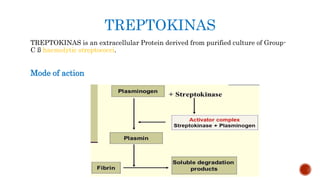
TREPTOKINAS
TREPTOKINAS is an extracellular Protein derived from purified culture of Group-
C ß haemolytic streptococci.
Mode of action
INDICATIONS
1. Acute Myocardial Infarction
2. Deep vein thrombosis
3. Pulmonary Embolism
4. Peripheral vascular disease
Adverse effects
1. Haemorrage
2. Hypotension
3. Allergic reaction
4. Cardiac arrhythmia
Thank
you

Enzyme in-therapy-1-1

  • 1.
    WELCOME TO OUR PRESENTATION Groupno: 01  Group members: Rana Ahmed (PHA-14001) Mahfujul Hasan (PHA-14002) Shahida Yeasmin (PHA-14005) Shamima Akter Sumi (PHA-14007) Ruma Akter (PHA-14009) Firuz Fatema Pria (PHA-14010) Ratna Sarker (PHA-14011)
  • 2.
  • 3.
    INTRODUCTION Enzymes are biologicalcatalysts that speed up the rate of the biochemical reaction. Most enzymes are three dimensional globular proteins (tertiary and quaternary structure). Some special RNA species also act as enzymes and are called Ribozymes e.g.hammerhead ribozyme.
  • 4.
    CHARACTERISTICS  Enzymes speedup the reaction by lowering the activation energy of the reaction.  Their presence does not affect the nature and properties of end product.  They are highly specific in their action that is each enzyme can catalyze one kind of substrate.  Small amount of enzymes can accelerate chemical reactions.  Enzymes are sensitive to change in pH, temperature and substrate concentration.
  • 5.
    ACTIVATION Activation is definedas the conversion of an inactive form of an enzyme to active form which processes the metabolic activity . TYPES OF ACTIVATION 1. Activation by co-factors. 2. Conversion of an enzyme precursor.
  • 6.
    ACTIVATION BY COFACTORS Many enzymes are activated by co-factors. Examples: DNA polymerase is a holo-enzyme that catalyzes the polymerization of de -oxyribonucleotide into a DNA strand. It uses Mg ++ ion for catalytic activity . CONVERSION OF AN ENZYME PRECURSOR Specific proteolysis is a common method of activating enzymes and other proteins in biological system. Example: The generation of pepsin from pepsinogen by HCl acid leads to the activation of other zymogens.
  • 7.
    INHIBITION  The preventionof an enzyme process as a result of interaction of inhibitors with the enzyme. INHIBITORS: Any substance that can diminish the velocity of an enzyme catalyzed reaction is called an inhibitor.
  • 8.
  • 9.
    REVERSIBLE INHIBITION It isan inhibition of enzyme activity in which the inhibiting molecular entity can associate and dissociate from the proteins binding site. TYPES OF REVERSIBLE INHIBITION There are four types: 1. Competitive inhibition. 2. Uncompetitive inhibition. 3. Mixed inhibition. 4. Non-competitive inhibition
  • 10.
    COMPETITIVE INHIBITION  Inthis type of inhibition, the inhibitors compete with the substrate for the active site. Formation of E.S complex is reduced while a new E.I complex is formed.
  • 11.
    UNCOMPETITIVE INHIBITION In thistype of inhibition, inhibitor does not compete with the substrate for the active site of enzyme instead it binds to another site known as allosteric site.
  • 12.
    MIXED INHIBITION In thistype of inhibition both E.I and E.S.I complexes are formed. Both complexes are catalytically inactive. NON COMPETITIVE INHIBITION It is a special case of inhibition. In this inhibitor has the same affinity for either enzyme E or the E.S complex.
  • 13.
    IRREVERSIBLE INHIBITION This typeof inhibition involves the covalent attachment of the inhibitor to the enzyme. The catalytic activity of enzyme is completely lost. It can only be restored only by synthesizing molecules.
  • 14.
    CO-FACTORS  Co-factor isthe non protein molecule which carries out chemical reactions that can not be performed by standard 20 amino acids.  Co-factors are of two types: Organic co-factors Inorganic cofactors
  • 15.
    INORGANIC CO-FACTORS These arethe inorganic molecules required for the proper activity of enzymes. Examples: Enzyme carbonic anhydrase requires Zn ++ for its activity.  Hexokinase has co-factor Mg++ ORGANIC CO-FACTORS These are the organic molecules required for the proper activity of enzymes. Example: Glycogen phosphorylase requires the small organic molecule pyridoxal phosphate.
  • 16.
    TYPES OF ORGANICCO- FACTORSProsthetic Group A prosthetic group is a tightly bound organic cofactor . e.g. Flavins, heme groups and biotin. Coenzyme A coenzyme is loosely bound organic co- factor . E.g. NAD+
  • 17.
    MECHANISM OF ENZYME ACTION Thecatalytic efficiency of enzymes is explained by two perspectives:  Thermodynamic changes  Processes at the active site
  • 18.
    THERMODYNAMIC CHANGES All chemicalreactions have energy barriers between reactants and products. The difference in transitional state and substrate is called activational barrier.
  • 19.
    THERMODYNAMIC CHANGES Only afew substances cross the activation barrier and change into products. That is why rate of uncatalyzed reactions is much slow . Enzymes provide an alternate pathway for conversion of substrate into products. Enzymes accelerate reaction rates by forming transitional state having low activational energy . Hence, the reaction rate is increased many folds in the presence of enzymes. The total energy of the system remains the same and equilibrium state is not disturbed.
  • 20.
  • 21.
    COVALENT CATALYSIS Enzymes formcovalent linkages with substrate forming transient enzyme-substrate complex with very low activation energy.  Enzyme is released unaltered after completion of reaction.
  • 22.
    ACID-BASE CATALYSIS Mostly undertakenby oxido- reductases enzyme. Mostly at the active site, histidine is present which act as both proton donor and proton acceptor .
  • 23.
    CATALYSIS BY PROXIMITY In this catalysis molecules must come in bond forming distance.  When enzyme binds:  A region of high substrate concentration is produced at active site.  This will orient substrate molecules especially in a position ideal for them.
  • 24.
    CATALYSIS BY BONDSTRAIN  Mostly undertaken by lyases.  The enzyme-substrate binding causes reorientation of the structure of site due to in a strain condition.  Thus transitional state is required and here bond is unstable and eventually broken.  In this way bond between substrate is broken and converted into products.
  • 25.
    APPLICATIONS OF ENZYMESIN THE PHARMACEUTICAL INDUSTRY Analytical Uses Enzymes can be used to detect and measure amounts of glucose in blood. Amount of glucose in blood and urine is an indicator for diagnosis of diabetes. Industrial Uses Penicillin G/V acylase and glucose isomerase are just two of the many enzymes used in the pharmaceutical industry. Penicillin acylase and glucose isomerase aid in the production of semi synthetic penicillin and fructose syrup.
  • 26.
    THERAPEUTIC It can beadministered individually or along with other drugs and/or treatments. Enzyme supplements for enzyme deficiencies. Prolactazyme treats lactose intolerance. Collagenase treats skin ulcer. Asparaginase used to treat leukemia. Streptokinase administered to patients immediately after heart attacks. Activase for breaking up clots and heart attacks.
  • 27.
    TREATMENT OF CANCER i.By inhibiting cancer cell growth, vascularization (blood supply) and metastasis (spread). ii. Enzymes are used to deliver and turn on cancer drugs only when in the presence of cancer cells. iii. Enzymes are used for treating side effects of cancer, such as hyperuricemia
  • 28.
    ENZYME ASSAYS Laboratory methodfor measuring enzyme activity. Types of enzymes assay: 1. DIRECT ASSAYS 2. INDIRECT ASSAYS DIRECT ASSAYS  Difference in properties of substrate and product measured directly. Change in  Absorbance.  Fluorescence.  pH.  Optical rotation.  Enthalpy.  Viscosity.  Volume of reaction mixture. INDIRECT ASSAYS • Further treatment of reaction mixture produce a measurable product or increase sensitivity. • Reagents required for color development or measurement of activity included in the reaction mixture.
  • 29.
    FIBRINOLYTIC DRUGS Agents thatactivate plasminogen to form plasmin that degrades fibrin and so break up thrombi is called fibrinolytic drugs. FIBRINOLYTIC drugs are 1. Streptokinase 2. Tissue plasminogen activator (t-PA) 3. Urokinase 4. Stanozolon 5. phenformin
  • 30.
    TREPTOKINAS TREPTOKINAS is anextracellular Protein derived from purified culture of Group- C ß haemolytic streptococci. Mode of action
  • 31.
    INDICATIONS 1. Acute MyocardialInfarction 2. Deep vein thrombosis 3. Pulmonary Embolism 4. Peripheral vascular disease Adverse effects 1. Haemorrage 2. Hypotension 3. Allergic reaction 4. Cardiac arrhythmia
  • 32.