Enzyme Engineering
And It’s Industrial
Application
By
PREMKUMAR SAKTHIVEL
MSC BIOCHEMISTRY
D24MBC00022
What is enzyme engineering
Enzymes are bio-catalyzers of protein origin which allow
great number of biological reactions. Engineering these
molecules for better beneficial features are commonly
known as Enzyme engineering
Improvement in the activity and usefulness of an existing
enzyme or creation of a new enzyme activity by making
suitable changes in its amino acid sequence is called
Enzyme Engineering
Enzyme
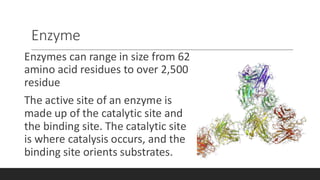
Enzymes can range in size from 62
amino acid residues to over 2,500
residue
The active site of an enzyme is
made up of the catalytic site and
the binding site. The catalytic site
is where catalysis occurs, and the
binding site orients substrates.
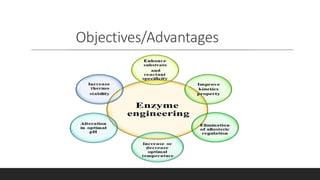
Objectives/Advantages
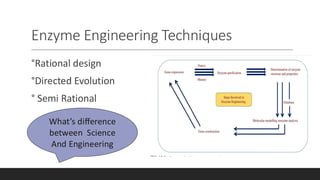
Enzyme Engineering Techniques
°Rational design
°Directed Evolution
° Semi Rational
What’s difference
between Science
And Engineering
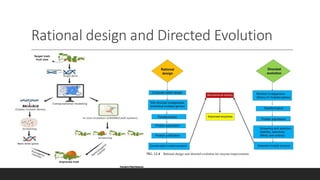
Rational design and Directed Evolution
Semi rational design
Directed evolution involves an extensive, time-consuming
screening and selection process.Rational design requires the
knowledge of the amino acid sequence of the particular
enzyme,along with the three-dimensional information. A
combination of both the strategies, that is,directed evolution
and rational design, leads to development of a novel
approach to over-come these drawbacks, and to improve the
applications of the enzyme
Industrial Applications
Enzyme engineering has improved industrial processes by enhancing enzyme
activity, specificity, and stability through directed evolution and computational
tools. Engineered enzymes increase production, reduce costs, and enhance
sustainability in industries like pharmaceuticals, biofuels, and fine chemicals.
Thermo-stability is crucial for industrial applications, and engineered enzymes
exhibit increased tolerance to temperature and organic solvents. High-
throughput screening efficiently identifies improved enzymes with enhanced
catalytic activity and specificity. Enzyme engineering strategies create enzymes
with novel catalytic functions, enabling non-natural reactions. Multi-enzyme
processes offer advantages like easy process control, high reaction rates, and
low toxic by-products.
Industrial applications
Directed evolution has led to significant improvements, such as a 10-fold
increase in production of enantiopure hexanediol using alcohol dehydrogenase,
and a 13-fold increase in production of intermediate compounds for atorvastatin
synthesis using glucose dehydrogenase. Additionally, lipase half-life was
increased 500-fold through directed evolution, and phenylalanine ammonia
lyase showed a 15-fold increase in catalytic activity.
Computational modeling continues to aid enzyme engineering and predict
enzyme behavior, while NMR experiments will help understand enzyme
flexibility and function. Multi-enzyme processes will become increasingly
important for industrial applications, offering a promising future for enzyme
engineering.
ENZYME ENGINEERING AND ITS INDUSTRIAL APPLICATIONS

ENZYME ENGINEERING AND ITS INDUSTRIAL APPLICATIONS

  • 1.
    Enzyme Engineering And It’sIndustrial Application By PREMKUMAR SAKTHIVEL MSC BIOCHEMISTRY D24MBC00022
  • 2.
    What is enzymeengineering Enzymes are bio-catalyzers of protein origin which allow great number of biological reactions. Engineering these molecules for better beneficial features are commonly known as Enzyme engineering Improvement in the activity and usefulness of an existing enzyme or creation of a new enzyme activity by making suitable changes in its amino acid sequence is called Enzyme Engineering
  • 3.
    Enzyme Enzymes can rangein size from 62 amino acid residues to over 2,500 residue The active site of an enzyme is made up of the catalytic site and the binding site. The catalytic site is where catalysis occurs, and the binding site orients substrates.
  • 4.
  • 5.
    Enzyme Engineering Techniques °Rationaldesign °Directed Evolution ° Semi Rational What’s difference between Science And Engineering
  • 6.
    Rational design andDirected Evolution
  • 7.
    Semi rational design Directedevolution involves an extensive, time-consuming screening and selection process.Rational design requires the knowledge of the amino acid sequence of the particular enzyme,along with the three-dimensional information. A combination of both the strategies, that is,directed evolution and rational design, leads to development of a novel approach to over-come these drawbacks, and to improve the applications of the enzyme
  • 8.
    Industrial Applications Enzyme engineeringhas improved industrial processes by enhancing enzyme activity, specificity, and stability through directed evolution and computational tools. Engineered enzymes increase production, reduce costs, and enhance sustainability in industries like pharmaceuticals, biofuels, and fine chemicals. Thermo-stability is crucial for industrial applications, and engineered enzymes exhibit increased tolerance to temperature and organic solvents. High- throughput screening efficiently identifies improved enzymes with enhanced catalytic activity and specificity. Enzyme engineering strategies create enzymes with novel catalytic functions, enabling non-natural reactions. Multi-enzyme processes offer advantages like easy process control, high reaction rates, and low toxic by-products.
  • 9.
    Industrial applications Directed evolutionhas led to significant improvements, such as a 10-fold increase in production of enantiopure hexanediol using alcohol dehydrogenase, and a 13-fold increase in production of intermediate compounds for atorvastatin synthesis using glucose dehydrogenase. Additionally, lipase half-life was increased 500-fold through directed evolution, and phenylalanine ammonia lyase showed a 15-fold increase in catalytic activity. Computational modeling continues to aid enzyme engineering and predict enzyme behavior, while NMR experiments will help understand enzyme flexibility and function. Multi-enzyme processes will become increasingly important for industrial applications, offering a promising future for enzyme engineering.