
Greening Your Products 
Orchideh Gharagozlou 
Niyousha Babrafkan 
Mohammad Farokhi 
Mohammad Ebrahim Zamani 
Ahmad Manzarnejad
Many innovative businesses have 
successfully introduced "green" 
products 
How do these business owners and 
product designers go about 
improving existing products or 
introducing new green products? 
What motivates them to do so?
While many of these products 
have saved money, they have 
also reduced impacts on 
human health and the 
environment by : 
 Using recycled or recyclable 
material (e.g., recycled 
paper products) 
 Reducing their energy usage 
(e.g., efficient washing 
machines that use less water 
and energy) 
 Eliminating the use of toxic 
chemicals during their 
manufacture
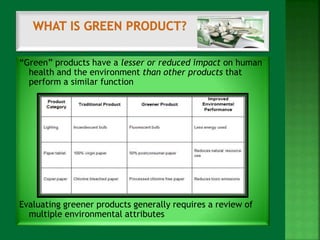
“Green” products have a lesser or reduced impact on human 
health and the environment than other products that 
perform a similar function 
Evaluating greener products generally requires a review of 
multiple environmental attributes
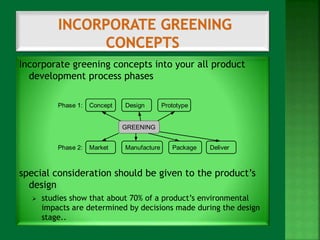
Incorporate greening concepts into your all product 
development process phases 
Concept Design Prototype 
GREENING 
Phase 2: Market Manufacture Package 
Deliver 
Phase 1: 
special consideration should be given to the product’s 
design 
 studies show that about 70% of a product’s environmental 
impacts are determined by decisions made during the design 
stage..
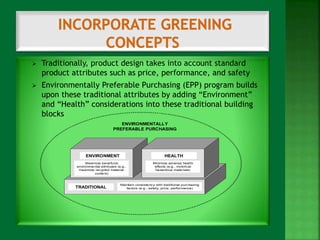
 Traditionally, product design takes into account standard 
product attributes such as price, performance, and safety 
 Environmentally Preferable Purchasing (EPP) program builds 
upon these traditional attributes by adding “Environment” 
and “Health” considerations into these traditional building 
blocks 
ENVIRONMENTALLY 
PREFERABLE PURCHASING 
ENVIRONMENT HEALTH 
TRADITIONAL 
Minimize adverse health 
effects (e.g., minimize 
hazardous materials) 
Maintain consistency with traditional purchasing 
factors (e.g., safety, price, performance) 
Maximize beneficial 
environmental attributes (e.g., 
maximize recycled material 
content)
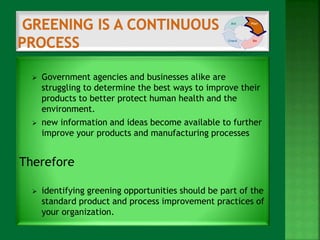
 Government agencies and businesses alike are 
struggling to determine the best ways to improve their 
products to better protect human health and the 
environment. 
 new information and ideas become available to further 
improve your products and manufacturing processes 
Therefore 
 identifying greening opportunities should be part of the 
standard product and process improvement practices of 
your organization.
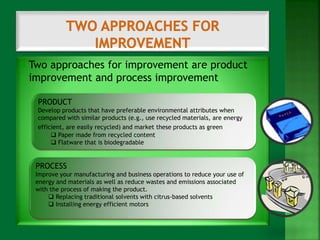
 Two approaches for improvement are product 
improvement and process improvement 
PRODUCT 
Develop products that have preferable environmental attributes when 
compared with similar products (e.g., use recycled materials, are energy 
efficient, are easily recycled) and market these products as green. 
 Paper made from recycled content 
 Flatware that is biodegradable 
PROCESS 
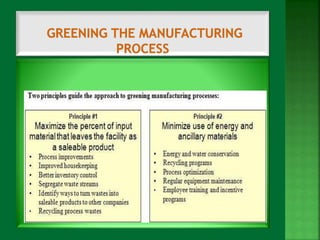
Improve your manufacturing and business operations to reduce your use of 
energy and materials as well as reduce wastes and emissions associated 
with the process of making the product. 
 Replacing traditional solvents with citrus-based solvents 
 Installing energy efficient motors
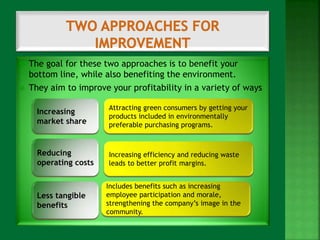
 The goal for these two approaches is to benefit your 
bottom line, while also benefiting the environment. 
 They aim to improve your profitability in a variety of ways 
Increasing 
market share 
Reducing 
operating costs 
Less tangible 
benefits 
Attracting green consumers by getting your 
products included in environmentally 
preferable purchasing programs. 
Increasing efficiency and reducing waste 
leads to better profit margins. 
Includes benefits such as increasing 
employee participation and morale, 
strengthening the company’s image in the 
community.
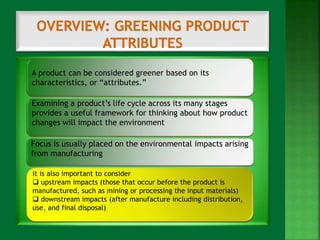
A product can be considered greener based on its 
characteristics, or “attributes.” 
Examining a product’s life cycle across its many stages 
provides a useful framework for thinking about how product 
changes will impact the environment 
Focus is usually placed on the environmental impacts arising 
from manufacturing 
it is also important to consider 
 upstream impacts (those that occur before the product is 
manufactured, such as mining or processing the input materials) 
 downstream impacts (after manufacture including distribution, 
use, and final disposal)
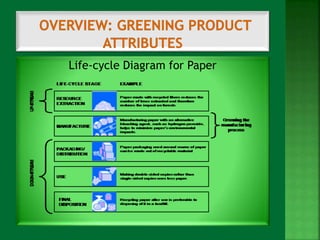
Life-cycle Diagram for Paper
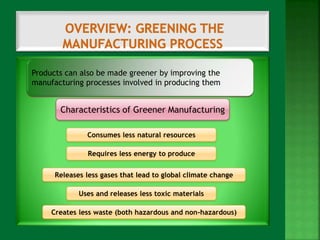
Products can also be made greener by improving the 
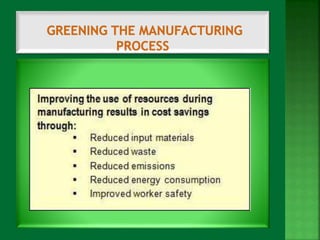
manufacturing processes involved in producing them 
Characteristics of Greener Manufacturing 
Consumes less natural resources 
Requires less energy to produce 
Releases less gases that lead to global climate change 
Uses and releases less toxic materials 
Creates less waste (both hazardous and non-hazardous)
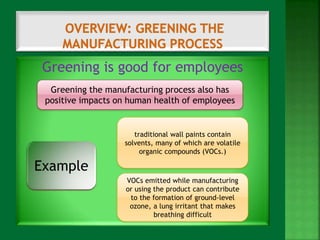
Greening is good for employees 
Greening the manufacturing process also has 
positive impacts on human health of employees 
Example 
traditional wall paints contain 
solvents, many of which are volatile 
organic compounds (VOCs.) 
VOCs emitted while manufacturing 
or using the product can contribute 
to the formation of ground-level 
ozone, a lung irritant that makes 
breathing difficult
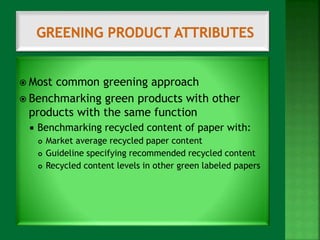
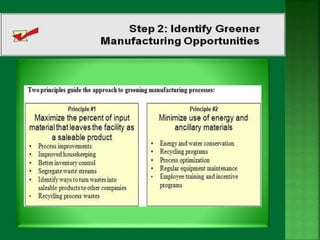
 Most common greening approach 
 Benchmarking green products with other 
products with the same function 
 Benchmarking recycled content of paper with: 
 Market average recycled paper content 
 Guideline specifying recommended recycled content 
 Recycled content levels in other green labeled papers
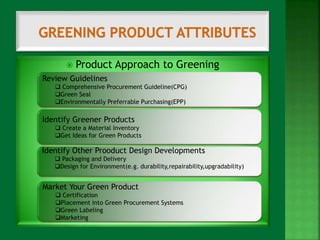
 Product Approach to Greening 
Review Guidelines 
 Comprehensive Procurement Guideline(CPG) 
Green Seal 
Environmentally Preferrable Purchasing(EPP) 
Identify Greener Products 
 Create a Material Inventory 
Get Ideas for Green Products 
Identify Other Prooduct Design Developments 
 Packaging and Delivery 
Design for Environment(e.g. durability,repairability,upgradability) 
Market Your Green Product 
 Certification 
Placement into Green Procurement Systems 
Green Labeling 
Marketing
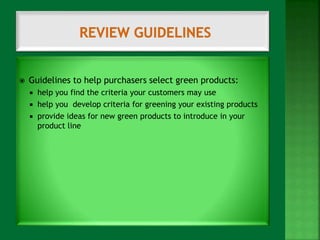
 Guidelines to help purchasers select green products: 
 help you find the criteria your customers may use 
 help you develop criteria for greening your existing products 
 provide ideas for new green products to introduce in your 
product line
 US Environmental Protection Agency 
 Signed into law in 1998 
 Initiatives Include environment in purchasing 
 Part of EPA’s effort 
 Use of materials recovered from solid waste 
 Buying recycled content products 

 Non-profit standard setting organization 
 Unbiased, third party 
 Awards “green seal of approval” 
 Products that cause less harm to the 
environment 
 Develops environmental standards for 
product categories 
 Carries out the actual certification of 
particular products from interested 
manufacturers
 US federal gov. spends more than $200 billion 
annually on goods and services. 
 EPP,a federal program encouraging and 
assisting Executive agencies in purchasing 
environmentally preferable products and 
services 
 empower federal consumers to make smart 
purchasing decisions that reflect 
environmental considerations
 Use information to 
 identify greener materials that can be 
substituted into your current products 
 identify new green products to add to your 
product offerings 
 Actions to take 
 Create a materials inventory 
 Get ideas for green products
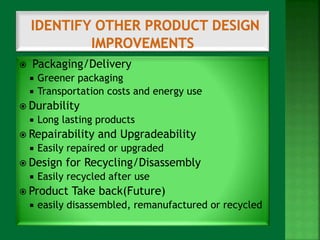
 Packaging/Delivery 
 Greener packaging 
 Transportation costs and energy use 
 Durability 
 Long lasting products 
 Repairability and Upgradeability 
 Easily repaired or upgraded 
 Design for Recycling/Disassembly 
 Easily recycled after use 
 Product Take back(Future) 
 easily disassembled, remanufactured or recycled
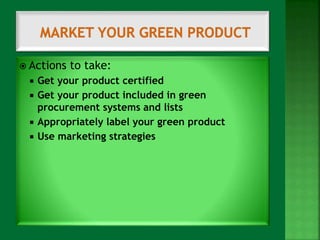
 Actions to take: 
 Get your product certified 
 Get your product included in green 
procurement systems and lists 
 Appropriately label your green product 
 Use marketing strategies
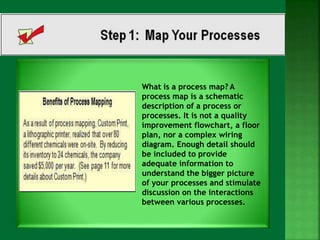
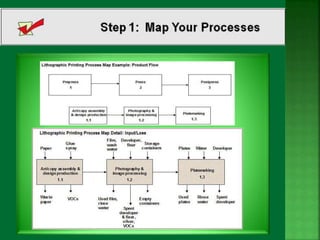
What is a process map? A 
process map is a schematic 
description of a process or 
processes. It is not a quality 
improvement flowchart, a floor 
plan, nor a complex wiring 
diagram. Enough detail should 
be included to provide 
adequate information to 
understand the bigger picture 
of your processes and stimulate 
discussion on the interactions 
between various processes.
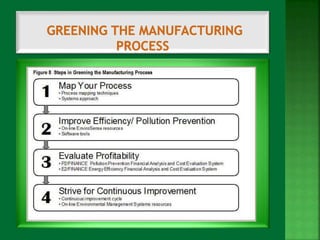
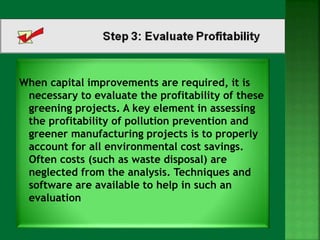
When capital improvements are required, it is 
necessary to evaluate the profitability of these 
greening projects. A key element in assessing 
the profitability of pollution prevention and 
greener manufacturing projects is to properly 
account for all environmental cost savings. 
Often costs (such as waste disposal) are 
neglected from the analysis. Techniques and 
software are available to help in such an 
evaluation
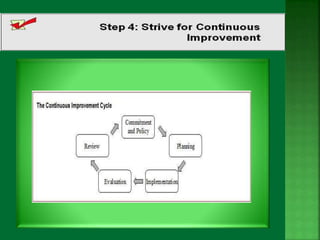
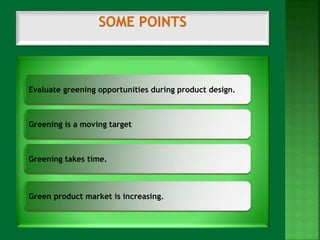
Evaluate greening opportunities during product design. 
Greening is a moving target 
Greening takes time. 
Green product market is increasing.
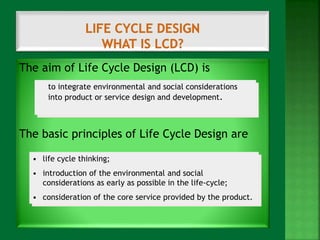
The aim of Life Cycle Design (LCD) is 
to integrate environmental and social considerations 
into product or service design and development. 
The basic principles of Life Cycle Design are 
• life cycle thinking; 
• introduction of the environmental and social 
considerations as early as possible in the life-cycle; 
• consideration of the core service provided by the product.
Life Cycle Management Navigator: 11_PR_LCD 36 
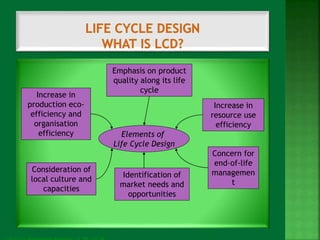
Emphasis on product 
quality along its life 
cycle 
Increase in 
resource use 
efficiency 
Increase in 
production eco-efficiency 
and 
organisation 
efficiency 
Consideration of 
local culture and 
capacities 
Concern for 
end-of-life 
managemen 
t 
Elements of 
Life Cycle Design 
Identification of 
market needs and 
opportunities
Where? 
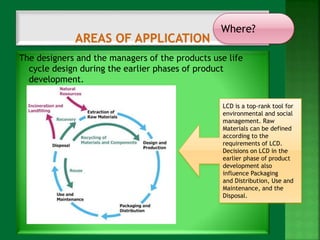
The designers and the managers of the products use life 
cycle design during the earlier phases of product 
development. 
LCD is a top-rank tool for 
environmental and social 
management. Raw 
Materials can be defined 
according to the 
requirements of LCD. 
Decisions on LCD in the 
earlier phase of product 
development also 
influence Packaging 
and Distribution, Use and 
Maintenance, and the 
Disposal.
Why? 
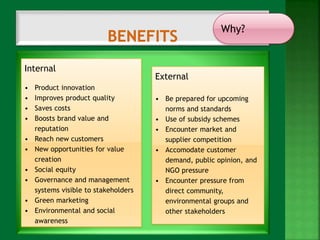
Internal 
• Product innovation 
• Improves product quality 
• Saves costs 
• Boosts brand value and 
reputation 
• Reach new customers 
• New opportunities for value 
creation 
• Social equity 
• Governance and management 
systems visible to stakeholders 
• Green marketing 
• Environmental and social 
awareness 
External 
• Be prepared for upcoming 
norms and standards 
• Use of subsidy schemes 
• Encounter market and 
supplier competition 
• Accomodate customer 
demand, public opinion, and 
NGO pressure 
• Encounter pressure from 
direct community, 
environmental groups and 
other stakeholders
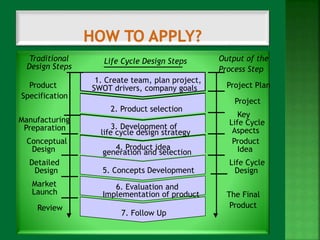
1. Create team, plan project, 
SWOT drivers, company goals 
2. Product selection 
3. Development of 
life cycle design strategy 
4. Product idea 
generation and selection 
5. Concepts Development 
6. Evaluation and 
Implementation of product 
7. Follow Up 
Product 
Specification 
Manufacturing 
Preparation 
Conceptual 
Design 
Detailed 
Design 
Market 
Launch 
Review 
Project Plan 
Project 
Key 
Life Cycle 
Aspects 
Product 
Idea 
Life Cycle 
Design 
The Final 
Product 
Traditional 
Design Steps 
Life Cycle Design Steps Output of the 
Process Step
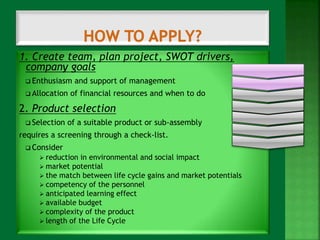
1. Create team, plan project, SWOT drivers, 
company goals 
 Enthusiasm and support of management 
 Allocation of financial resources and when to do 
2. Product selection 
 Selection of a suitable product or sub-assembly 
requires a screening through a check-list. 
 Consider 
 reduction in environmental and social impact 
 market potential 
 the match between life cycle gains and market potentials 
 competency of the personnel 
 anticipated learning effect 
 available budget 
 complexity of the product 
 length of the Life Cycle
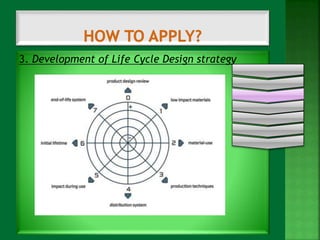
3. Development of Life Cycle Design strategy
4. Product idea generation and selection 
New concept development 
Selection of low impact materials 
Reduction of material usage 
Optimisation of production techniques 
Product structure level 
Reduction of impact during use 
Optimisation of the initial life time 
Optimisation of end-of-life system
5. Concepts development 
Filter the options through the criteria of 
technical and financial feasibility, market 
opportunities and expected environmental 
and social profit and the most favourable 
ones are selected. 
6. Evaluation and implementation 
of product 
7. Follow Up
Work on the parts of the product rather than the 
whole if you have products having short product 
development time! 
Concentrate on only one component or sub-assembly 
of the product when you have highly complex 
products and long-life span. 
There is no single methodology for “Life Cycle 
Design”! 
Key is to integrate the environmental and social 
impact consideration process into your usual design 
process. 
Use simple tools such as life-cycle mapping or 
matrixes! 
Develop an action plan!
BE GREEN !

Environmental new product development

  • 1.
    Greening Your Products Orchideh Gharagozlou Niyousha Babrafkan Mohammad Farokhi Mohammad Ebrahim Zamani Ahmad Manzarnejad
  • 2.
    Many innovative businesseshave successfully introduced "green" products How do these business owners and product designers go about improving existing products or introducing new green products? What motivates them to do so?
  • 3.
    While many ofthese products have saved money, they have also reduced impacts on human health and the environment by :  Using recycled or recyclable material (e.g., recycled paper products)  Reducing their energy usage (e.g., efficient washing machines that use less water and energy)  Eliminating the use of toxic chemicals during their manufacture
  • 4.
    “Green” products havea lesser or reduced impact on human health and the environment than other products that perform a similar function Evaluating greener products generally requires a review of multiple environmental attributes
  • 5.
    Incorporate greening conceptsinto your all product development process phases Concept Design Prototype GREENING Phase 2: Market Manufacture Package Deliver Phase 1: special consideration should be given to the product’s design  studies show that about 70% of a product’s environmental impacts are determined by decisions made during the design stage..
  • 6.
     Traditionally, productdesign takes into account standard product attributes such as price, performance, and safety  Environmentally Preferable Purchasing (EPP) program builds upon these traditional attributes by adding “Environment” and “Health” considerations into these traditional building blocks ENVIRONMENTALLY PREFERABLE PURCHASING ENVIRONMENT HEALTH TRADITIONAL Minimize adverse health effects (e.g., minimize hazardous materials) Maintain consistency with traditional purchasing factors (e.g., safety, price, performance) Maximize beneficial environmental attributes (e.g., maximize recycled material content)
  • 7.
     Government agenciesand businesses alike are struggling to determine the best ways to improve their products to better protect human health and the environment.  new information and ideas become available to further improve your products and manufacturing processes Therefore  identifying greening opportunities should be part of the standard product and process improvement practices of your organization.
  • 8.
     Two approachesfor improvement are product improvement and process improvement PRODUCT Develop products that have preferable environmental attributes when compared with similar products (e.g., use recycled materials, are energy efficient, are easily recycled) and market these products as green.  Paper made from recycled content  Flatware that is biodegradable PROCESS Improve your manufacturing and business operations to reduce your use of energy and materials as well as reduce wastes and emissions associated with the process of making the product.  Replacing traditional solvents with citrus-based solvents  Installing energy efficient motors
  • 9.
     The goalfor these two approaches is to benefit your bottom line, while also benefiting the environment.  They aim to improve your profitability in a variety of ways Increasing market share Reducing operating costs Less tangible benefits Attracting green consumers by getting your products included in environmentally preferable purchasing programs. Increasing efficiency and reducing waste leads to better profit margins. Includes benefits such as increasing employee participation and morale, strengthening the company’s image in the community.
  • 10.
    A product canbe considered greener based on its characteristics, or “attributes.” Examining a product’s life cycle across its many stages provides a useful framework for thinking about how product changes will impact the environment Focus is usually placed on the environmental impacts arising from manufacturing it is also important to consider  upstream impacts (those that occur before the product is manufactured, such as mining or processing the input materials)  downstream impacts (after manufacture including distribution, use, and final disposal)
  • 11.
  • 12.
    Products can alsobe made greener by improving the manufacturing processes involved in producing them Characteristics of Greener Manufacturing Consumes less natural resources Requires less energy to produce Releases less gases that lead to global climate change Uses and releases less toxic materials Creates less waste (both hazardous and non-hazardous)
  • 13.
    Greening is goodfor employees Greening the manufacturing process also has positive impacts on human health of employees Example traditional wall paints contain solvents, many of which are volatile organic compounds (VOCs.) VOCs emitted while manufacturing or using the product can contribute to the formation of ground-level ozone, a lung irritant that makes breathing difficult
  • 14.
     Most commongreening approach  Benchmarking green products with other products with the same function  Benchmarking recycled content of paper with:  Market average recycled paper content  Guideline specifying recommended recycled content  Recycled content levels in other green labeled papers
  • 15.
     Product Approachto Greening Review Guidelines  Comprehensive Procurement Guideline(CPG) Green Seal Environmentally Preferrable Purchasing(EPP) Identify Greener Products  Create a Material Inventory Get Ideas for Green Products Identify Other Prooduct Design Developments  Packaging and Delivery Design for Environment(e.g. durability,repairability,upgradability) Market Your Green Product  Certification Placement into Green Procurement Systems Green Labeling Marketing
  • 16.
     Guidelines tohelp purchasers select green products:  help you find the criteria your customers may use  help you develop criteria for greening your existing products  provide ideas for new green products to introduce in your product line
  • 17.
     US EnvironmentalProtection Agency  Signed into law in 1998  Initiatives Include environment in purchasing  Part of EPA’s effort  Use of materials recovered from solid waste  Buying recycled content products 
  • 18.
     Non-profit standardsetting organization  Unbiased, third party  Awards “green seal of approval”  Products that cause less harm to the environment  Develops environmental standards for product categories  Carries out the actual certification of particular products from interested manufacturers
  • 19.
     US federalgov. spends more than $200 billion annually on goods and services.  EPP,a federal program encouraging and assisting Executive agencies in purchasing environmentally preferable products and services  empower federal consumers to make smart purchasing decisions that reflect environmental considerations
  • 20.
     Use informationto  identify greener materials that can be substituted into your current products  identify new green products to add to your product offerings  Actions to take  Create a materials inventory  Get ideas for green products
  • 21.
     Packaging/Delivery Greener packaging  Transportation costs and energy use  Durability  Long lasting products  Repairability and Upgradeability  Easily repaired or upgraded  Design for Recycling/Disassembly  Easily recycled after use  Product Take back(Future)  easily disassembled, remanufactured or recycled
  • 22.
     Actions totake:  Get your product certified  Get your product included in green procurement systems and lists  Appropriately label your green product  Use marketing strategies
  • 26.
    What is aprocess map? A process map is a schematic description of a process or processes. It is not a quality improvement flowchart, a floor plan, nor a complex wiring diagram. Enough detail should be included to provide adequate information to understand the bigger picture of your processes and stimulate discussion on the interactions between various processes.
  • 30.
    When capital improvementsare required, it is necessary to evaluate the profitability of these greening projects. A key element in assessing the profitability of pollution prevention and greener manufacturing projects is to properly account for all environmental cost savings. Often costs (such as waste disposal) are neglected from the analysis. Techniques and software are available to help in such an evaluation
  • 34.
    Evaluate greening opportunitiesduring product design. Greening is a moving target Greening takes time. Green product market is increasing.
  • 35.
    The aim ofLife Cycle Design (LCD) is to integrate environmental and social considerations into product or service design and development. The basic principles of Life Cycle Design are • life cycle thinking; • introduction of the environmental and social considerations as early as possible in the life-cycle; • consideration of the core service provided by the product.
  • 36.
    Life Cycle ManagementNavigator: 11_PR_LCD 36 Emphasis on product quality along its life cycle Increase in resource use efficiency Increase in production eco-efficiency and organisation efficiency Consideration of local culture and capacities Concern for end-of-life managemen t Elements of Life Cycle Design Identification of market needs and opportunities
  • 37.
    Where? The designersand the managers of the products use life cycle design during the earlier phases of product development. LCD is a top-rank tool for environmental and social management. Raw Materials can be defined according to the requirements of LCD. Decisions on LCD in the earlier phase of product development also influence Packaging and Distribution, Use and Maintenance, and the Disposal.
  • 38.
    Why? Internal •Product innovation • Improves product quality • Saves costs • Boosts brand value and reputation • Reach new customers • New opportunities for value creation • Social equity • Governance and management systems visible to stakeholders • Green marketing • Environmental and social awareness External • Be prepared for upcoming norms and standards • Use of subsidy schemes • Encounter market and supplier competition • Accomodate customer demand, public opinion, and NGO pressure • Encounter pressure from direct community, environmental groups and other stakeholders
  • 39.
    1. Create team,plan project, SWOT drivers, company goals 2. Product selection 3. Development of life cycle design strategy 4. Product idea generation and selection 5. Concepts Development 6. Evaluation and Implementation of product 7. Follow Up Product Specification Manufacturing Preparation Conceptual Design Detailed Design Market Launch Review Project Plan Project Key Life Cycle Aspects Product Idea Life Cycle Design The Final Product Traditional Design Steps Life Cycle Design Steps Output of the Process Step
  • 40.
    1. Create team,plan project, SWOT drivers, company goals  Enthusiasm and support of management  Allocation of financial resources and when to do 2. Product selection  Selection of a suitable product or sub-assembly requires a screening through a check-list.  Consider  reduction in environmental and social impact  market potential  the match between life cycle gains and market potentials  competency of the personnel  anticipated learning effect  available budget  complexity of the product  length of the Life Cycle
  • 41.
    3. Development ofLife Cycle Design strategy
  • 42.
    4. Product ideageneration and selection New concept development Selection of low impact materials Reduction of material usage Optimisation of production techniques Product structure level Reduction of impact during use Optimisation of the initial life time Optimisation of end-of-life system
  • 43.
    5. Concepts development Filter the options through the criteria of technical and financial feasibility, market opportunities and expected environmental and social profit and the most favourable ones are selected. 6. Evaluation and implementation of product 7. Follow Up
  • 44.
    Work on theparts of the product rather than the whole if you have products having short product development time! Concentrate on only one component or sub-assembly of the product when you have highly complex products and long-life span. There is no single methodology for “Life Cycle Design”! Key is to integrate the environmental and social impact consideration process into your usual design process. Use simple tools such as life-cycle mapping or matrixes! Develop an action plan!
  • 45.